
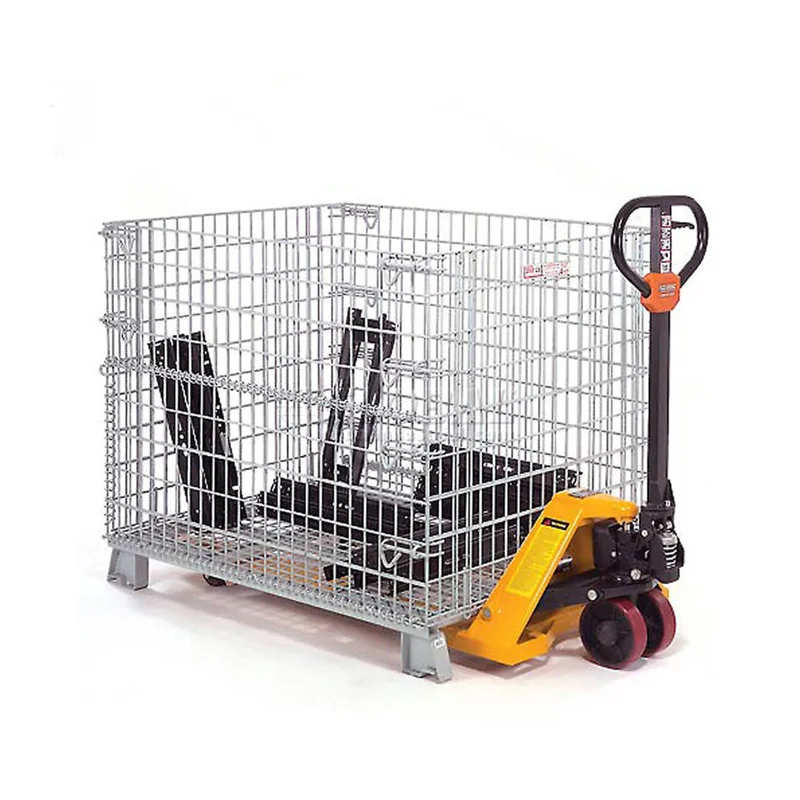
On a tight dock, the container is rarely the problem. The problem is the approach. If a loaded wire mesh container can only be entered from one face, the forklift has to swing around the end of the row, back out, and re-line up before the forks are anywhere near the base. Every extra manoeuvre costs time, and in a bay with a wall, a trailer or a second row behind you, the swing may not exist at all.
A four-way entry base removes that constraint. On a collapsible steel wire mesh container the entry is not a slot cut into the box — it is the clearance created by the base frame and the formed feet under the mesh body. That is what lets the forks or the pallet-jack wheels come in from whichever face is open. It is a handling-interface property, and like every interface it has to be confirmed against the drawing and the floor it will actually run on.
How the four-way entry is built into the base
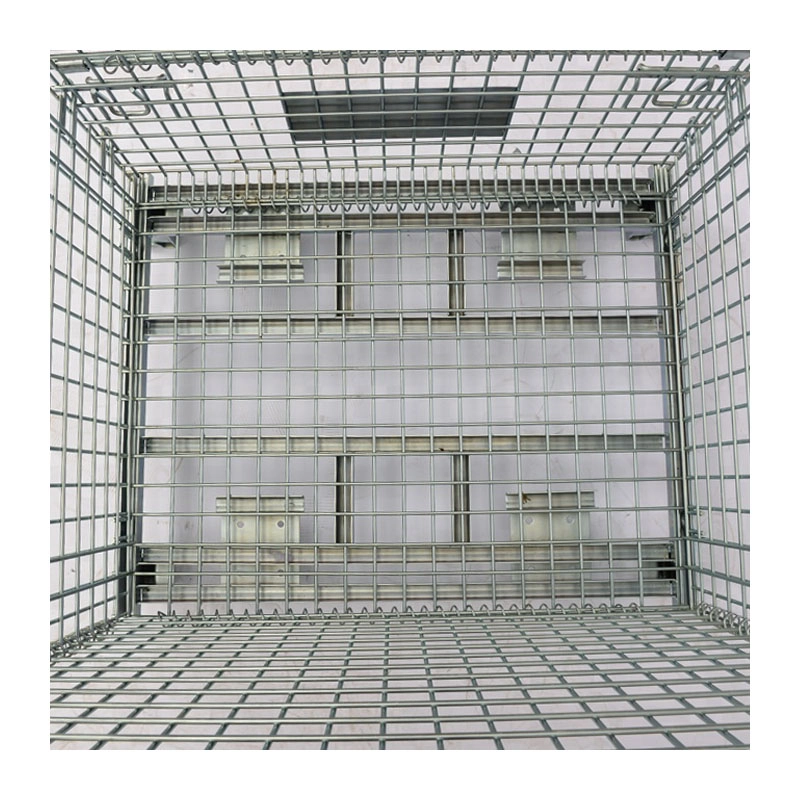
The mesh body of a Stbox container sits on a channel-steel base. Structural U-channel runs under the floor panel, and the formed feet at the corners lift the base clear of the ground. The gap between the underside of the base and the floor is continuous from front to back and from side to side, so there is no “front” and “back” pair of pockets — there are four open approaches to the same base.
Nothing in the container blocks those approaches. The half-drop gate, the fixed mesh panels and the hinges all start above the base line, so the gate side is just as enterable as the other three faces. The indexed image record for this product shows the bottom channel reinforcement and the formed stacking feet, and it records four-way pallet-jack entry on the base; on the dock, that is the difference between turning the truck and simply turning the forks.
What the base frame and the feet have to do for that to hold
Four-way entry is only as good as the base underneath it. Three requirements matter when you read a drawing or inspect a delivered unit. First, the channel reinforcement has to run through the base, not only around its edge: a fork inserted from an unexpected side lifts a mid-span area of the floor panel, and a base that is stiff only at the perimeter will bow there. Second, the underside has to be flat and free of protrusions along the whole entry path, because anything that hangs below the base becomes a stop for the fork tip or the load wheel.
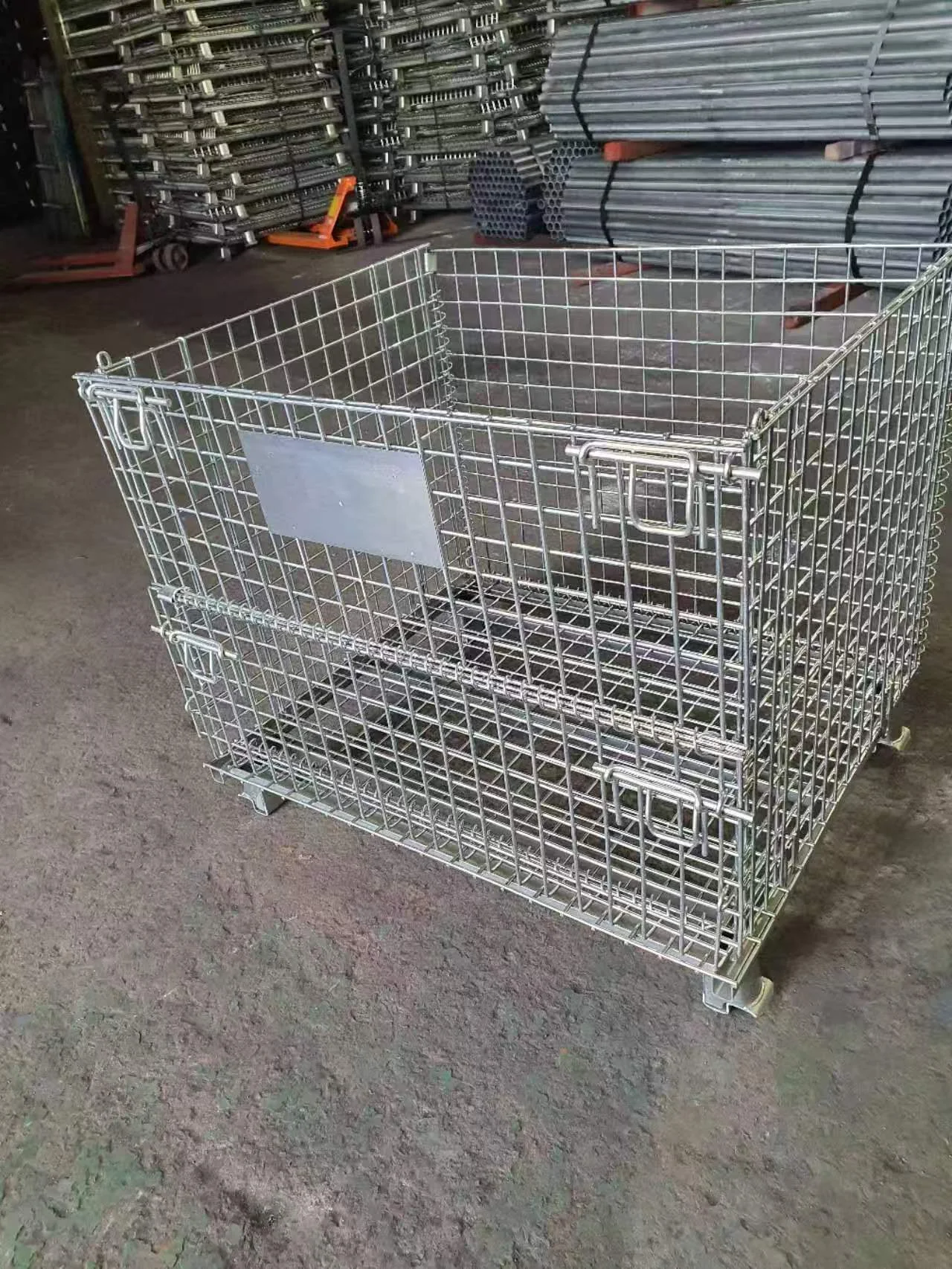
Third, the feet carry a double duty. They set the entry clearance, and they are also the stack locators that seat one container into the frame of the one below. A foot that is bent, cracked or missing changes both — it can close up the entry on that side and stop the stack from seating squarely. That is why the inspection before a shift covers the base, the mesh, the welds and the feet together, and why forks should be engaged smoothly and squarely at a steady speed rather than pushed in at an angle. Confirm the feet are fully seated before releasing a stack.
Can a pallet jack enter the same base?
Yes, where the base opening and the jack are matched. The indexed record for this container shows a manual hydraulic pallet truck lifting it, and the entry clearance is documented as four-way. A pallet jack is a lower, tighter interface than a forklift, so two checks matter before you plan a route around it: the lowered fork height of the specific jack must clear the base opening, and the load wheels must roll in without lifting the container as they enter.
Two limits are worth stating plainly. A pallet jack is a manual device — it suits short, flat, level moves inside a bay or along an aisle, not yard transfers or long gradients, where a forklift belongs. And the effort of starting a loaded container on a manual jack rises with the load, so the jack’s rated capacity has to be checked against the actual load, not assumed from the container’s own load record. Container load ratings and stacking limits are documented per project variant, and the four-way entry describes how the container is handled, not how much it may carry.
Floors and conditions where four-way entry should not be relied on
Four-way entry answers the question “which side can I come from”. It does not answer “is this floor suitable”. The base needs a continuous, hard, level surface to slide in over, and the following conditions break that assumption. Where they apply, no entry direction compensates — the fix is a different floor, a different handling point, or a different container.
- Uneven or broken concrete with lips, steps or spalled edges, where the fork tip or load wheel has nothing continuous to travel on.
- Soft or loose ground — gravel, dirt, sand or yard aggregate — where the base and the wheels settle instead of sitting level.
- Slopes, ramps and dock plates or levellers that are not sitting level under the container.
- Drainage grates, expansion joints, embedded rails and floor pockets wide enough for a wheel or a fork tip to drop into.
- Wet, oily or icy floors, where the traction the wheels need is simply not there.
Where this matters most in a plant
- Dense bay layouts where the truck cannot swing around the end of the row to reach a single fixed entry face.
- Loading and unloading a trailer or container, where the trailer wall decides which side the forks can come from.
- Parts storage and work-in-progress buffering on flat workshop floors, where a pallet jack has to reach the container from whichever side is currently open.
- Machining or assembly stations, where the load is presented to the pick side and the half-drop gate has to face the operator without re-spotting the container.
Questions buyers ask before ordering
Is four-way entry standard on every size of this container?
Treat it as a configuration point to confirm, not a blanket promise. The channel-steel base with formed feet and four-way pallet-jack entry is what the indexed record for this product shows, but the documented project records cover different footprints and different base details. Ask for the approved drawing of your size and check the entry clearance and the foot positions on it before the batch is built.
Do I need a special pallet jack?
No special type is required, but the jack has to match the base. Check the lowered fork height, the load-wheel diameter and the jack’s rated capacity against the base opening and against the real load. Then train the approach: enter squarely and smoothly, at a steady speed, without angling the forks into the base.
Can I use it on a sloped or rough dock apron?
No — a hard, level and continuous surface is the condition for the base to slide in cleanly. On a slope, loose aggregate or a broken apron, plan a flat transfer point instead and keep the container on the level floor. Survey the actual handling route before the order, because the floor decides as much as the base does.
If your bottleneck is dock turning space rather than floor quality, the entry side is the part you can specify. See the current Stbox wire mesh container configurations, gate options and finishes on the wire mesh container product page, and confirm the base entry clearance for your footprint on the drawing before you order.
Need a Custom Storage Solution?
Speak directly with our technical engineers. We offer free structural designs, heavy-duty catalog evaluations, and quick B2B price quotations.
Request a Quote Now →