
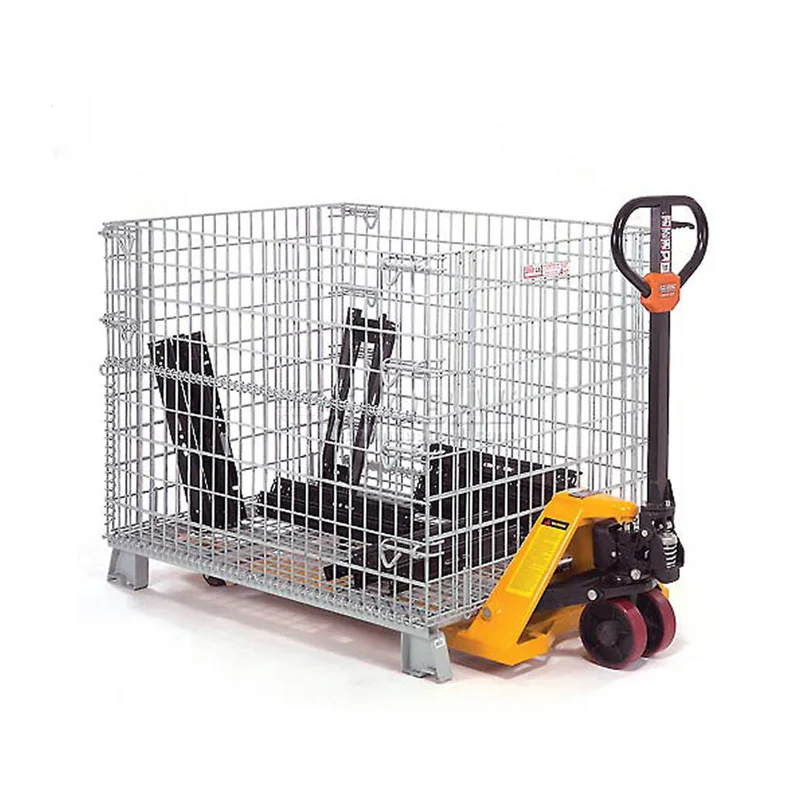
On a narrow dock, the container is rarely the problem. The problem is the approach. If a loaded wire mesh container only allows entry from one face, the forklift has to go around the end of the row, back up, and realign before the forks are near the base. Every extra maneuver costs time, and in a bay with a wall, a trailer, or a second row behind, the room to turn may not exist.
A four-way entry base eliminates that restriction. In a collapsible steel mesh container, the entry is not a slot cut into the box, but the clearance created by the base frame and the shaped feet under the mesh body. That is what allows the forks or pallet truck wheels to enter from any face that is clear. It is a property of the handling interface and, like any interface, must be confirmed by checking it against the drawing and against the floor on which it will actually be used.
How four-way entry is incorporated into the base
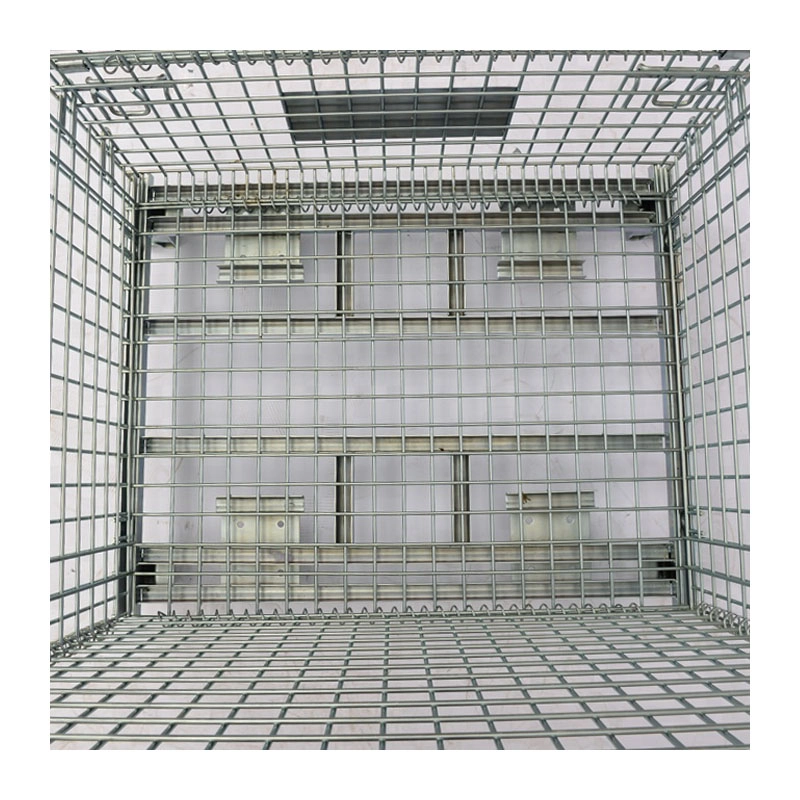
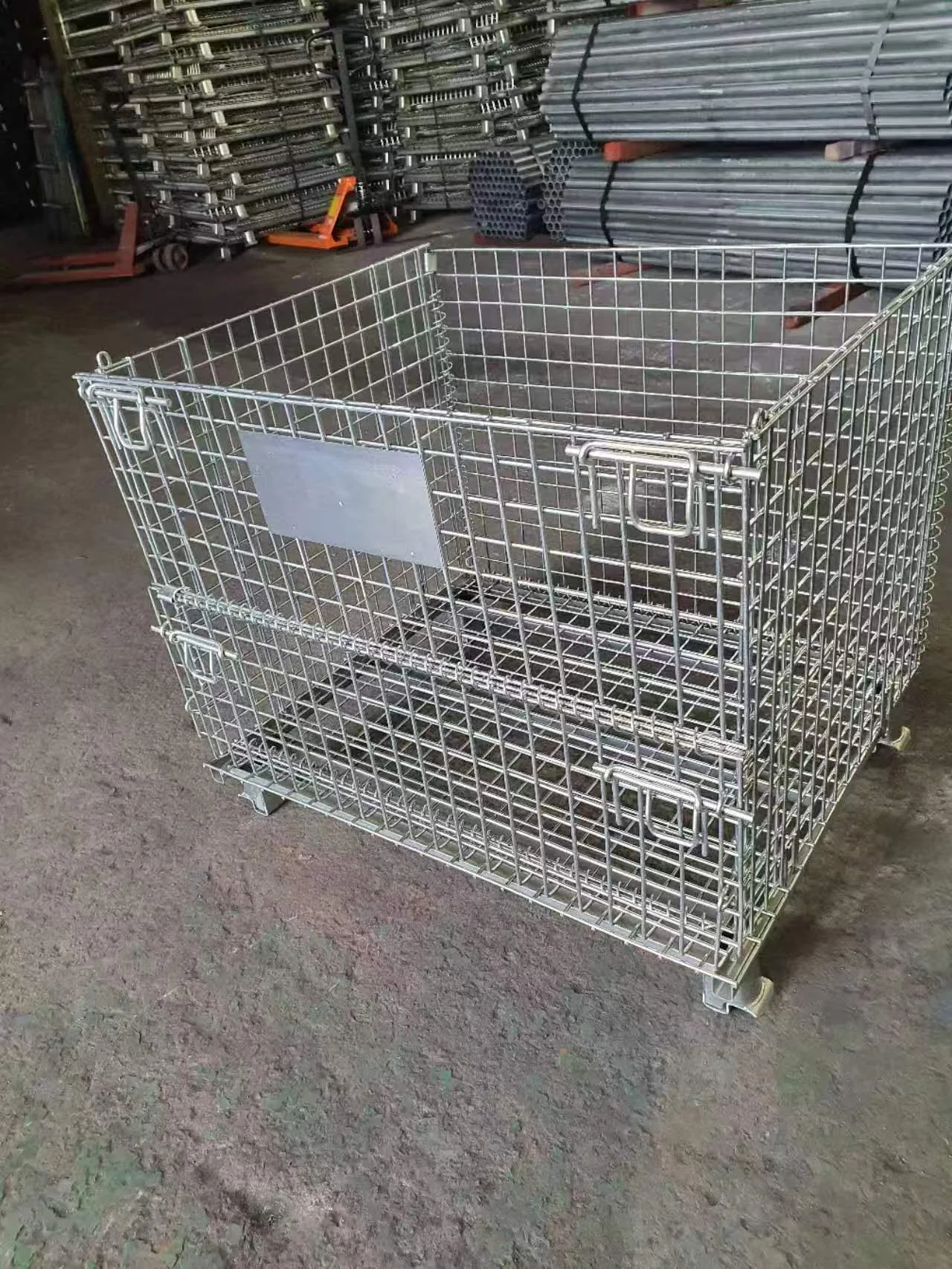
The mesh body of a Stbox container sits on a steel channel base. Beneath the bottom panel runs a structural U-channel, and the shaped corner feet raise the base off the floor. The gap between the bottom of the base and the floor is continuous front to back and side to side, so there is no pair of "front" and "rear" pockets: there are four open accesses to the same base.
Nothing in the container blocks those accesses. The half drop gate, the fixed mesh panels, and the hinges start above the base line, so the gate side is just as accessible as the other three faces. The indexed image record for this product shows the lower channel reinforcement and the shaped stacking feet, and documents four-side pallet truck entry at the base; on the dock, that is the difference between having to turn the truck and simply turning the forks.
What the base frame and feet must meet for this to hold true
Four-way entry is only as good as the base beneath it. There are three important requirements when reading a drawing or inspecting a delivered unit. First, the channel reinforcement must run across the base, not just around its edge: a fork inserted from an unexpected side lifts a middle area of the bottom panel, and a base that is only rigid at the perimeter will buckle there. Second, the underside must be flat and free of protrusions along the entire entry path, because anything hanging below the base becomes a stop for the fork tip or the load wheel.
Third, the feet serve a dual function. They define the entry clearance and are also the stacking locators that seat one container into the frame of the one below. A bent, cracked, or missing foot alters both functions: it can close entry on that side and prevent the stack from seating correctly. That is why the pre-shift inspection checks the base, mesh, welds, and feet together, and why forks must be inserted smoothly and aligned, at constant speed, rather than pushed in at an angle. Confirm that the feet are fully seated before releasing a stack.
Can a pallet truck enter the same base?
Yes, provided the base opening and the pallet truck are compatible. The indexed record for this container shows a manual hydraulic pallet truck lifting it, and the entry clearance is documented as four-way. A pallet truck is a lower and narrower interface than a forklift, so before planning a route with one, two checks are advisable: the fork height in the lowered position of the specific pallet truck must clear the base opening, and the load wheels must roll in without lifting the container on entry.
Two limits are worth mentioning clearly. A pallet truck is manual equipment: it suits short, flat, level moves within a bay or along an aisle, not yard transfers or long slopes, where a forklift is appropriate. In addition, the effort to start a loaded container with a manual pallet truck increases with the load, so the pallet truck's rated capacity must be checked against the actual load, and not assumed from the container's own load capacity. Container load capacities and stacking limits are documented per project variant, and four-way entry describes how the container is handled, not how much it can carry.
Floors and conditions where four-way entry should not be relied upon
Four-way entry answers the question "from which side can I access." It does not answer "is this floor suitable." The base needs a continuous, hard, level surface to slide on, and the following conditions break that assumption. Where they occur, no direction of entry compensates: the solution is a different floor, a different handling point, or a different container.
- Uneven or broken concrete with lips, steps, or chipped edges, where the fork tip or load wheel has no continuous surface to travel over.
- Soft or loose ground: gravel, dirt, sand, or yard aggregate, where the base and wheels sink instead of staying level.
- Slopes, ramps, and dock plates or levelers that are not level under the container.
- Drain grates, expansion joints, embedded rails, and floor gaps wide enough for a wheel or a fork tip to fall into.
- Wet, oily, or icy floors, where the traction the wheels need simply isn't there.
Where this matters most in a plant
- Dense bay layouts where the truck cannot swing around the end of the row to reach a single fixed entry face.
- Trailer or container loading and unloading, where the trailer wall decides which side the forks can enter from.
- Part storage and work-in-process buffers on flat shop floors, where a pallet truck has to reach the bin from whichever side is open at that moment.
- Machining or assembly stations, where the load is presented at the picking side and the drop gate must face the operator without repositioning the bin.
Questions buyers ask before ordering
Is four-way entry standard across all sizes of this container?
Treat it as a configuration point to confirm, not a blanket promise. The channel-steel base with formed feet and four-way pallet truck entry is what the indexed record for this product shows, but documented project records cover different footprints and different base details. Request the approved drawing for your size and check entry clearance and foot position on it before the batch is built.
Do I need a special pallet truck?
No special type is required, but the pallet truck must match the base. Check lowered fork height, load wheel diameter, and the truck's rated capacity against the base opening and against the actual load. Then train the approach: enter straight and square, at steady speed, without angling the forks into the base.
Can it be used on a sloped or uneven dock threshold?
No: una superficie dura, nivelada y continua es la condición para que la base se deslice limpiamente. En una pendiente, árido suelto o un umbral roto, planifique en su lugar un punto de transferencia plano y mantenga el contenedor en el suelo nivelado. Inspeccione la ruta real de manejo antes del pedido, porque el suelo decide tanto como la base.
Si su cuello de botella es el espacio de giro en el andén más que la calidad del suelo, el lado de entrada es la parte que puede especificar. Vea las configuraciones actuales, opciones de compuerta y acabados del contenedor de malla metálica Stbox en la página de producto del contenedor de malla metálica, y confirme la holgura de entrada de la base para su huella en el plano antes de hacer el pedido.
¿Necesita una Solución de Almacenamiento a Medida?
Hable directamente con nuestros ingenieros técnicos. Ofrecemos diseños estructurales gratuitos, evaluaciones de catálogos para cargas pesadas y cotizaciones de precios B2B rápidas.
Solicitar un Presupuesto Ahora →