
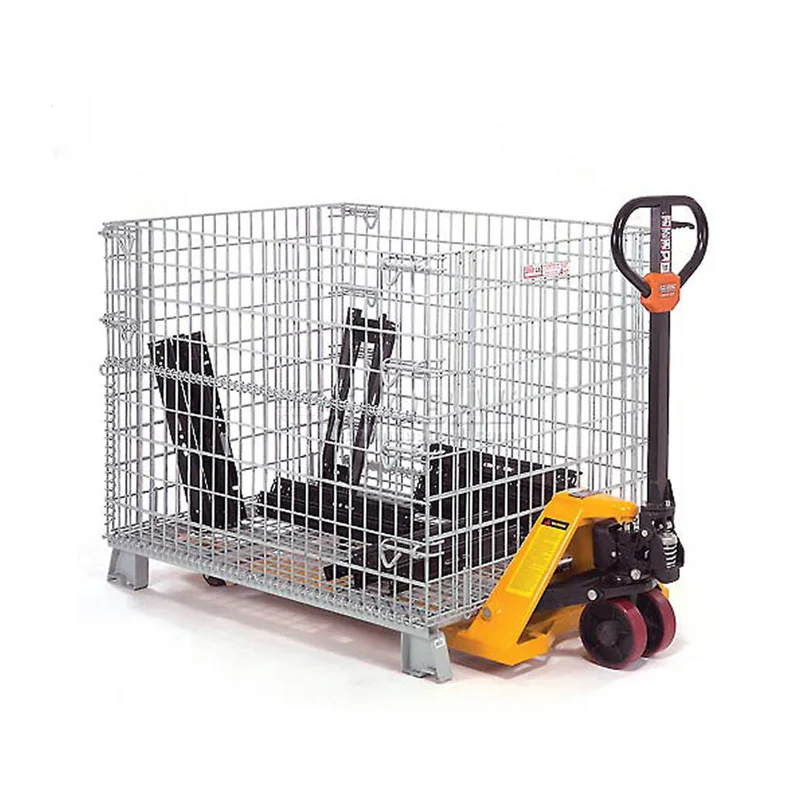
In a tight loading bay, the container is rarely the problem. The problem is the approach route. If a loaded wire mesh container can only be accessed from one side, the forklift must turn around the end of the row, reverse, and realign before the forks even come near the base. Every extra maneuver costs time, and in a bay with a wall, a trailer, or a second row behind you, that turning space may not exist at all.
Four-sided access at the base removes that limitation. In a collapsible steel wire mesh container, the access is not an opening cut into the bin — it is the clear space created by the base frame and the formed legs under the mesh body. This allows the forks or pallet wheels to enter from any open side. It is a property of the handling interface, and like any interface it must be confirmed against the drawing and the floor on which the container will actually be used.
How the four-sided access is built into the base
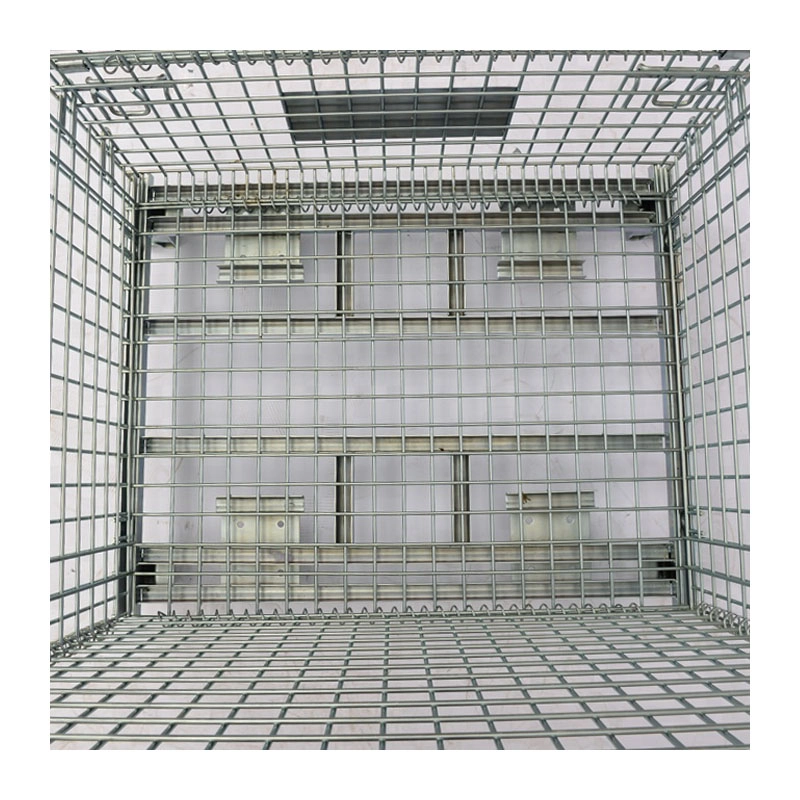
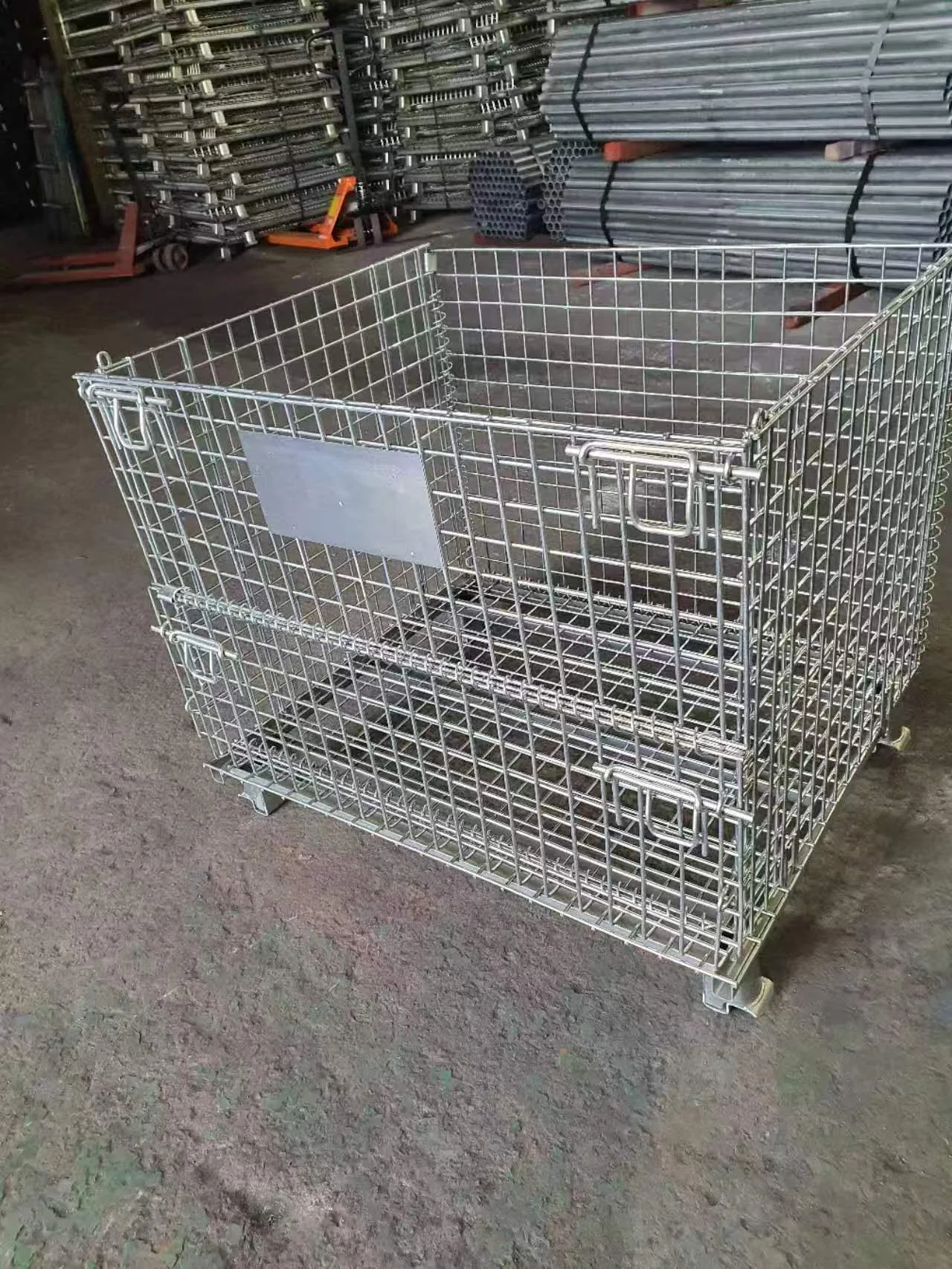
The mesh body of a Stbox container rests on a base of U-profile steel. Structural U-profile steel runs under the floor plate, and the formed legs at the corners lift the base clear of the ground. The space between the underside of the base and the floor runs from front to back and from left to right, so there is no "front" and "back" pair of recesses — there are four open approach directions to the same base.
Nothing in the blocks those approaches. The half-height gate, the fixed mesh panels, and the hinges all begin above the base line, so the gate side is just as accessible as the other three sides. The indexed imagery for this product shows the lower U-profile reinforcement and the formed stacking legs, and states four-sided pallet truck access at the base; on the loading bay, that is the difference between turning the truck and simply turning the forks.
What the base frame and legs must do to make that work
Four-sided access is only as good as the base beneath it. Three requirements matter when reading a drawing or inspecting a delivered unit. First, the U-profile reinforcement must run through the base, not only along the edge: a fork inserted from an unexpected side lifts a mid-span section of the floor plate, and a base that is stiff only at the perimeter will deflect there. Second, the underside must be flat and free of protrusions across the entire access path, because anything that protrudes below becomes a stop for the fork tip or the load wheel.
Third, the legs serve a dual function. They set the access height and are also the stacking positioners that let one container settle into the frame of the one below. A leg that is bent, cracked, or missing changes both functions — it can close off access on that side and prevent the stack from sitting square. This is why pre-service inspection covers the base, mesh, welds, and legs together, and why forks must be inserted level and straight, at a constant speed, rather than pushed in at an angle. Check that the legs are fully seated before releasing a stack.
Can a pallet truck enter the same base?
Yes, provided the base opening and the truck are matched. The indexed documentation for this container shows a manual hydraulic pallet truck lifting it, and the access height is documented as four-sided. A pallet truck is a lower, tighter interface than the base, so two checks matter before planning a route around it: the lowered fork height of the specific truck must clear the base opening, and the load wheels must roll in without lifting the container on entry.
Two limitations must be stated clearly. A pallet truck is a manual tool — it suits short, flat, level moves within a bay or along an aisle, not yard moves or long ramps, where a forklift belongs. And the effort to get a loaded container moving on a manual truck increases with the load, so the truck's capacity must be checked against the actual load, not assumed from the container's own load statement. Container loading and stacking limits are documented per project variant, and four-sided access describes how the container is handled, not how much it may carry.
Floors and conditions where four-sided access is not reliable
Four-sided access answers the question "which side can I come from." It does not answer "is this floor suitable." The base needs a continuous, hard, flat surface to slide over, and the following conditions break that assumption. Where they apply, no access direction compensates — the solution is a different floor, a different handling point, or a different container.
- Uneven or broken concrete with lips, steps, or crumbled edges, where the fork tip or load wheel has no continuous surface to roll over.
- Soft or loose ground — gravel, earth, sand, or site hardstanding — where the base and wheels sink rather than sit level.
- Slopes, ramps, and dock levelers or plates that do not sit level under the container.
- Drain grates, expansion joints, embedded rails, and floor pits wide enough for a wheel or a fork tip to drop into.
- Wet, oily, or icy floors, where the traction the wheels need is simply absent.
Where this matters most in a factory
- Dense magazijnindelingen waar de truck niet aan het einde van de rij kan omdraaien om één vaste invoerzijde te bereiken.
- Loading and unloading a trailer or container, where the trailer wall determines from which side the forks can come.
- Parts storage and work-in-progress buffering on flat workshop floors, where a pallet truck must be able to reach the container from any open side.
- Machining or assembly stations, where the load is presented to the pick side and the half-drop gate must face the operator without having to reposition the container.
Questions buyers ask before ordering
Is four-sided access standard on every size of this container?
Beschouw het als een te bevestigen configuratiepunt, niet als een algemene belofte. De basis van kanaalstaal met gevormde voeten en vierzijdige palletwagen-toegang is wat het geïndexeerde record voor dit product laat zien, maar de gedocumenteerde projectrecords beslaan verschillende afmetingen en verschillende basisdetails. Vraag om de goedgekeurde tekening van uw formaat en controleer de toegangsvrijheid en de voetposities erop voordat de batch wordt gebouwd.
Do I need a special pallet truck?
No special type is required, but the pallet truck must fit the base. Check the lowered fork height, the load wheel diameter and the pallet truck's load capacity against the base opening and against the actual load. Then train the approach: insert square and smoothly, at a constant speed, without inserting the forks into the base at an angle.
Can I use it on a sloped or rough loading dock?
No — a hard, flat and continuous surface is the precondition for clean insertion of the base. On a slope, loose granulate or a broken dock, plan a flat transfer point instead and keep the container on the flat floor. Inspect the actual transport route before ordering, because the floor determines just as much as the base.
If your bottleneck is the turning space on the loading dock rather than the floor quality, then the entry side is the part you can specify. View the current wire mesh container configurations, gate options and finishes from Stbox on the product page for wire mesh containers, en bevestig de basistoegangsvrijheid voor uw afmeting op de tekening voordat u bestelt.
Heeft u een op maat gemaakte opslagoplossing nodig?
Spreek rechtstreeks met onze technische ingenieurs. Wij bieden gratis constructieontwerpen, evaluaties van zwaar belaste catalogi en snelle B2B-prijsopgaven.
Vraag nu een offerte aan →