🏭 Steelpallet · Factory Direct · OEM Available

Erack Heavy Duty Mold Rack for Crane-Assisted Die Rack Storage
Erack

Explore Erack heavy duty mold rack and die rack storage for injection molding and stamping workshops. Compare three-post full-extension, two-post, pneumatic, and multi-level options, with clear crane, hardened-floor, anchoring, load, and quotation requirements.

100%
Steel Quality
Heavy
Duty Rating
Custom
Sizes Built
Erack Heavy Duty Mold Rack for Crane-Assisted Die Rack Storage

Store heavy molds in controlled, crane-accessible bays

Erack is a heavy-duty roll-out mold rack system for injection molds, stamping dies, mold bases, and tooling sets that need structured storage and controlled retrieval.

Erack converts floor stacking into layered die rack storage. Its bearing-assisted drawer guidance supports 100% horizontal extension so an overhead crane, chain hoist, or electric hoist can lift a mold vertically from an opened bay. The system is intended for industrial workshops with hardened floors, floor anchor bolts, and overhead lifting infrastructure. It is not a light-duty shelf, a general-purpose rack, or a crane-free storage product. Common search names include heavy duty mold rack, die rack storage, drawer mold rack, die roll out rack, mold storage rack, and three-post mold rack.

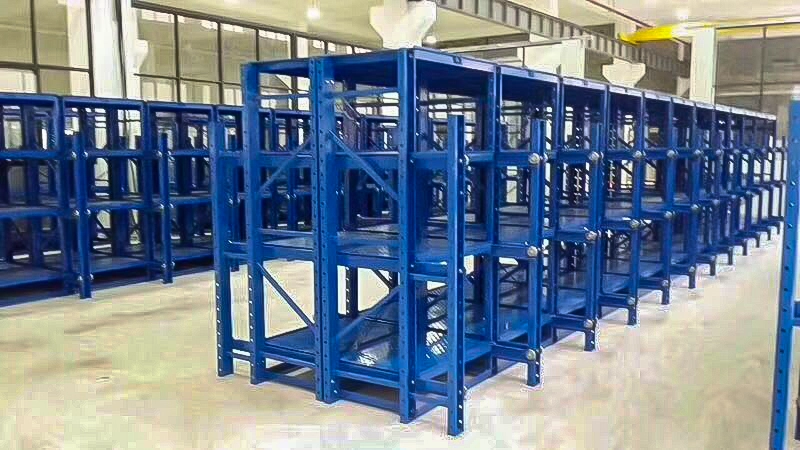
Row of blue drawer-type mold racks in workshop

  • 100% drawer extension creates a direct vertical lifting path for the overhead crane or hoist.
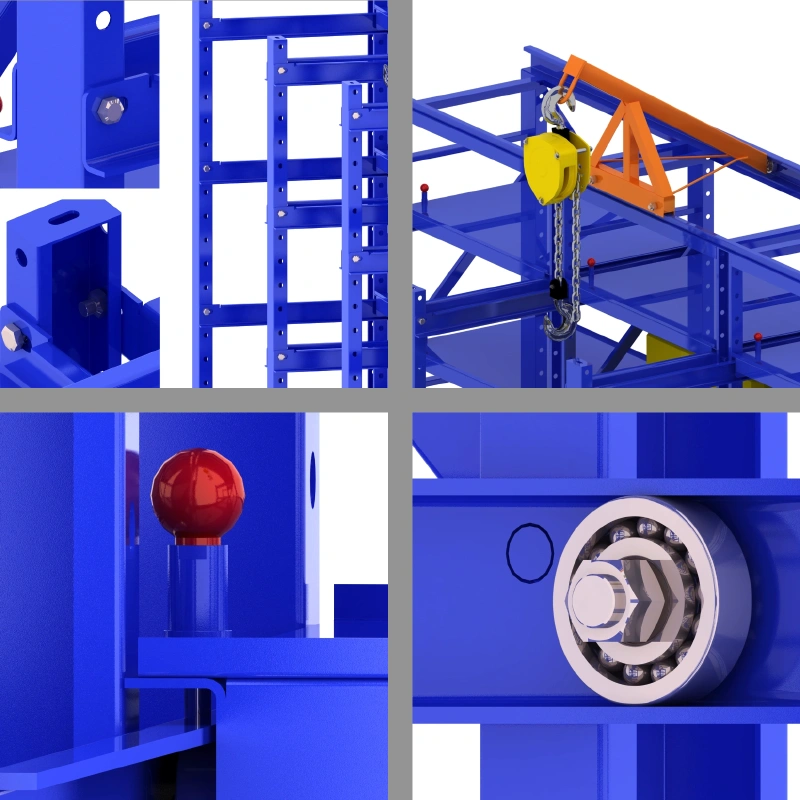
  • Safety pins, guide-rail limits, back bracing, and floor anchoring control drawer movement and center-of-gravity shift.
  • Typical planning range is 0.5–3 t per level, with project-specific confirmation required from mold weight, dimensions, layers, lifting method, and floor conditions.

Select the rack configuration around your tooling and site

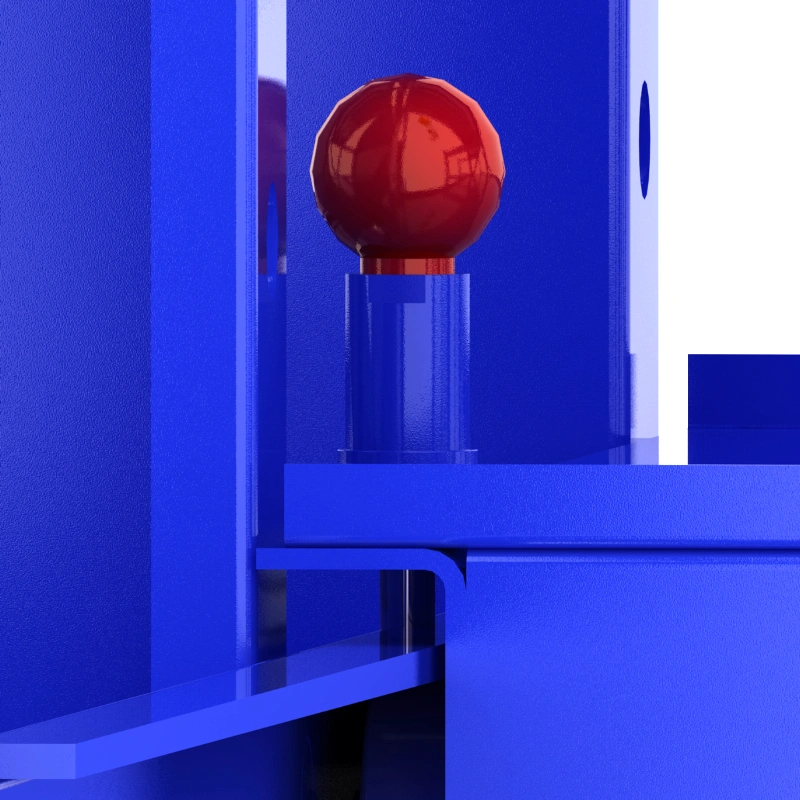
Mold rack top structure with manual hoist render

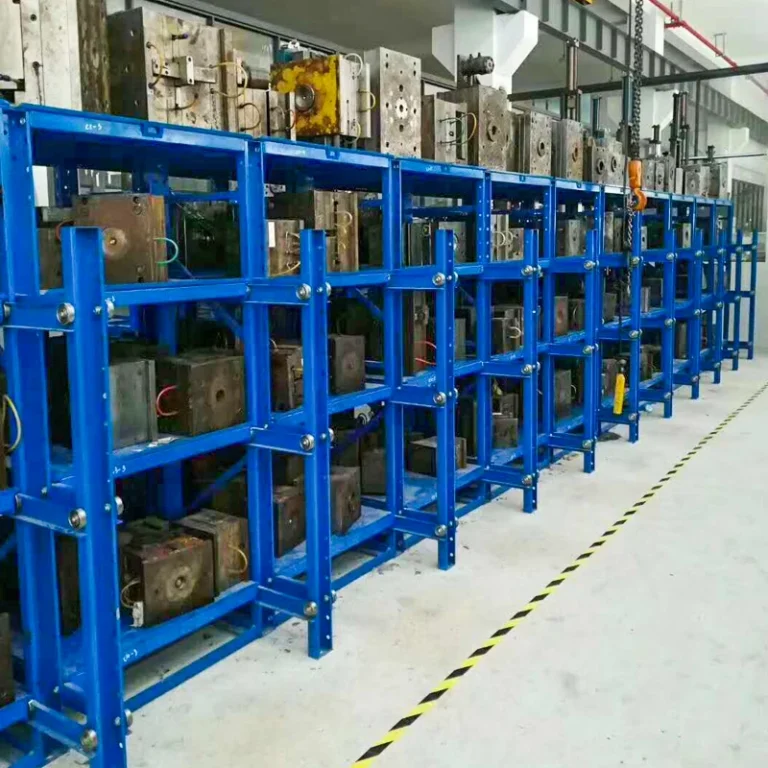
Three-post full-extension mold rack

Use this configuration when heavy molds require 100% drawer pull-out and the open drawer must remain supported during crane lifting. Install it on a hardened floor with anchor bolts and under suitable overhead lifting equipment.
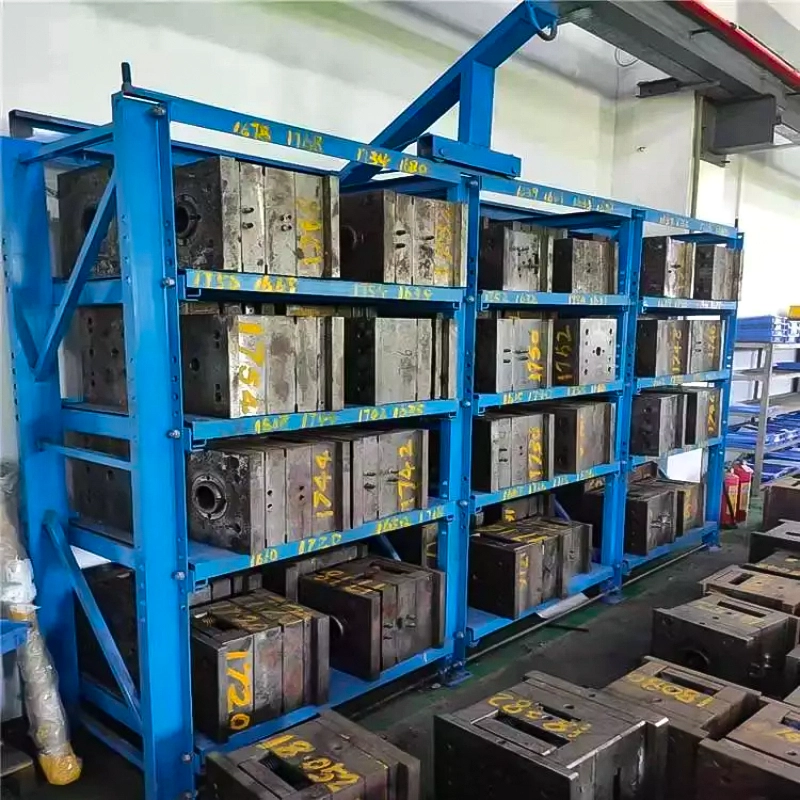
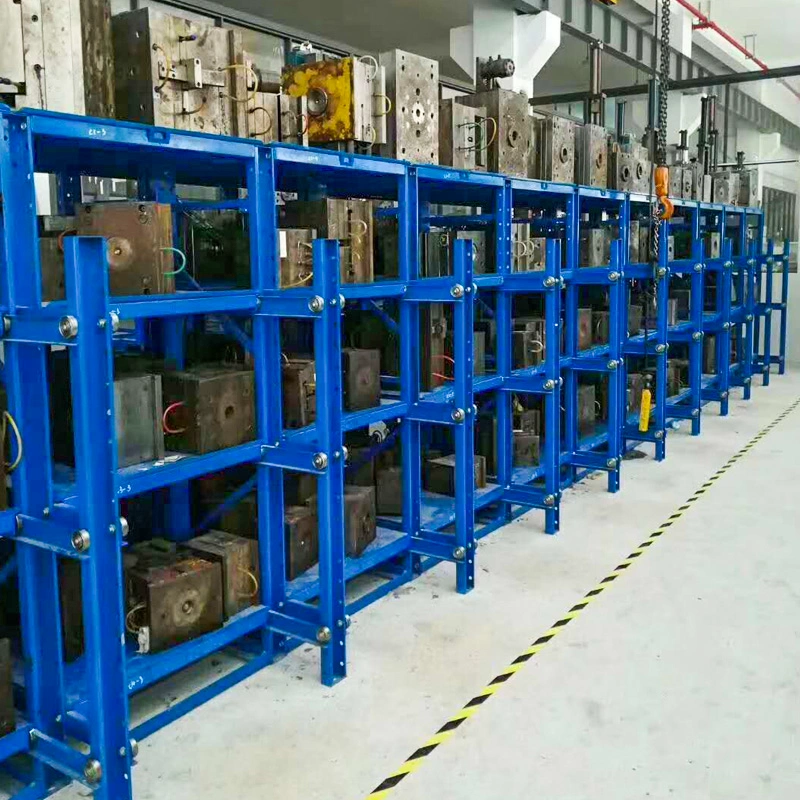
Blue mold rack fully loaded with injection molds

Two-post or semi-open configuration

Consider this option only after load, drawer extension, stability, and lifting path have been checked for the actual mold inventory. It is not an automatic substitute when full pull-out or high torque is required.

Close-up of mold rack safety locking pin

Pneumatic-assisted drawer system

Choose pneumatic assistance when frequent changeovers or EHS rules make manual pull force unsuitable. It still requires a correctly specified rack, safe operation, and compatible plant air supply.

Modern warehouse view of mold storage area

Project-sized multi-level rack

Plan 2–4 layers, drawer sizes typically from 850 × 850 mm to 1350 × 1250 mm, and 0.5–3 t per level. Final dimensions and capacity must match the tooling and crane clearance.

Why replace floor stacking or ordinary shelving?

Faster, more controlled retrieval

A dedicated bay keeps each mold identifiable and accessible. Pull one drawer fully forward, manage the safety pin as required, then use the overhead lifting device for a vertical pick instead of searching floor piles or moving surrounding loads.

Less aisle consumed by heavy-tool handling

A crane-accessible drawer changes the handling path from horizontal forklift maneuvering to a controlled vertical lift. The actual space and time effect depends on the existing layout and should be confirmed during site planning.

Designed around heavy-load stability

Full extension changes the load moment, so the system uses mechanical limits, safety pins, rear bracing, and floor anchoring. Do not pull multiple fully loaded drawers together or operate beyond the confirmed level load.

A better fit for SMED and EHS-led workshops

Injection molding plants, stamping plants, automotive component factories, mold maintenance shops, and tooling departments can use the system when frequent changeovers and controlled heavy-tool handling justify fixed infrastructure. Pneumatic assistance can reduce operator effort.

Clear decision boundary

Do not select Erack for soft or unverified floors, sites without an overhead crane or suitable hoist, purely light-duty storage, or applications above the confirmed load. A conventional light rack or floor solution may be more appropriate.

From mold inventory to an engineered rack proposal

  1. 1. Send the mold and site inputs

    Provide the largest mold length, width, height, and single-tool weight; required number of layers; preferred drawer sizes; overhead crane, chain-hoist, or electric-hoist details; available lifting clearance; and floor type, thickness, hardness, and anchoring conditions.

  2. 2. Check the handling boundary

    Confirm that the crane or hoist can reach the rack and that the hardened floor can accept the required anchor bolts. If there is no overhead lifting equipment or the floor is soft, stop and redesign the handling method before purchase.

  3. 3. Match the configuration

    Select three-post full extension, a reviewed two-post or semi-open arrangement, manual operation, or pneumatic assistance. Set layers, drawer dimensions, spacing, and the 0.5–3 t per-level planning range from the actual tooling list.

  4. 4. Review installation and quotation

    Review anchoring, rear bracing, guide-rail alignment, safety-pin operation, crane clearance, and the rule that only the permitted drawer is extended. Submit the data for the selection and site-adaptation quotation.

Erack questions buyers should answer before ordering

What is Erack, and what else is it called?

Erack is a heavy-duty roll-out mold rack system for layered storage and crane-assisted retrieval of dies and molds. Buyers may also search for heavy duty mold rack, die storage rack, die rack storage, drawer mold rack, die roll out rack, mold storage rack, mould rack storage, or three-post mold rack.

Who is Erack for, and who should not choose it?

It is for injection molding and stamping plants, automotive component factories, tooling departments, and heavy-manufacturing workshops with heavy molds, repeated changeovers, hardened floors, and overhead lifting equipment. Do not choose it for soft floors, sites without a crane or suitable hoist, purely light loads, or any application above the confirmed rating.

What configurations and sizes are available?

The planning range is typically 0.5–3 t per level, with 2–4 layers and drawer sizes from about 850 × 850 mm to 1350 × 1250 mm. Three-post full extension is the primary heavy-load option; two-post or semi-open arrangements require project review. Pneumatic assistance reduces manual pull effort but does not remove anchoring, safety-pin, capacity, or lifting requirements.

How does Erack compare with other storage methods?

Floor stacking has low initial structure cost but makes identification, access, and safe lifting difficult. Ordinary shelving is not automatically suitable for multi-ton drawers and extension torque. Automated storage adds controls and integration requirements. Erack is a fixed, mechanical, crane-compatible choice when direct access and heavy-tool handling are the priority.

What must I provide for a quotation?

Send the maximum mold length, width, height, and single weight; number of layers; expected drawer size; crane or hoist type and lifting clearance; floor type, thickness, hardness, and anchoring details; changeover frequency; and whether pneumatic assistance is required.

What are the boundaries, and how do I start?

Common failure conditions include soft-floor installation, no overhead lifting method, overloading, opening multiple loaded drawers together, bypassing safety pins, or poor guide-rail maintenance. Submit the complete data set for an Erack selection and site-adaptation proposal before quotation and installation.

Request Pricing Details


    Request Quote List

    Your quote request list is empty.

    Unlock Professional Blueprint Drawings

    Please provide your business contact information to retrieve original CAD/DWG drawings and engineering calculations.