
Warehouses that run a hand pallet truck and a forklift usually start from one reasonable assumption: if the steel pallet box can be picked by the forklift, an operator can also walk a pallet jack under it. That assumption is where projects stall. A collapsible steel stillage that lifts cleanly on tines can be impossible to enter with a pallet truck, because the jack does not reach into the load. It rolls on the floor underneath it and carries its own legs and wheels into the space below the box.
The two interfaces are separate questions. Forklift entry asks whether the tines suit the fork pockets, whether the pocket depth suits the tine length, and whether the truck can lift the load at that load centre. Pallet-jack entry asks whether there is a clear, floor-level path under the box for two forks, two outrigger legs and a wheel set, and whether the lift stroke and the turning envelope exist in your aisle. If the forklift side is still open, start with the fork length and clearance check. This article is about the machine that usually fails second.
A Pallet Truck Enters From the Floor, a Forklift Enters From a Pocket
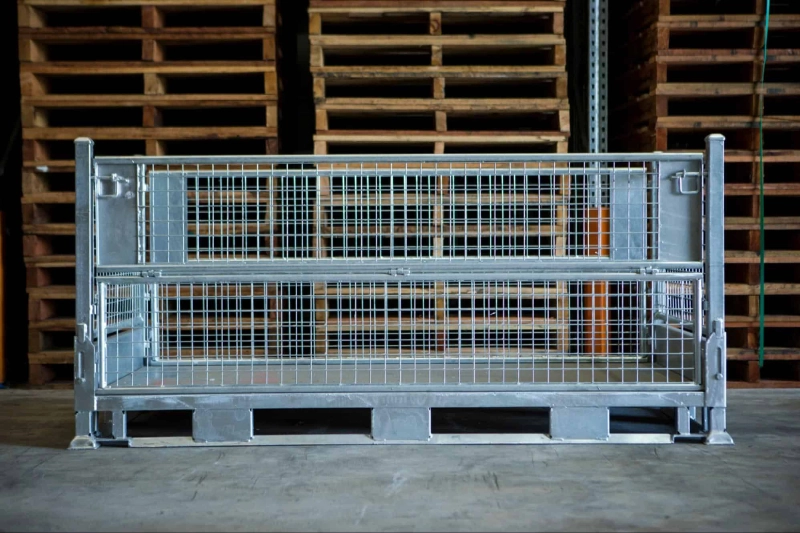
A forklift tine slides into a channel or under a base rail and lifts against the roof of that pocket. The pocket does not need to be generous, and the rest of the underside can be filled with cross members, gussets and stacking feet, because nothing has to travel under the base except the two tines. A manual pallet truck works the other way round. Its forks slide in from floor level, its steer wheels run inside the outrigger legs at the handle end, and its load rollers sit at the fork tips. Everything the truck is made of travels under or beside the box, at floor level, for the whole length of the move.
| Vraag | Forklift tine | Pallet truck fork |
|---|---|---|
| Path into the load | Into a fork pocket or base channel, from the side or the end | Under the base from the open face, with the chassis following the forks |
| What sets the entry height | Pocket roof height and tine thickness | The gap between the floor and the lowest steel on the base |
| What else has to pass | Two tines, nothing more | Outrigger legs, steer wheels, load rollers, handle linkage |
| Where the load is carried | On the pocket roof along the tine length | On two narrow fork strips, starting at the tip rollers |
| Common failure | Tines too long, too thick or spread too wide for the pockets | Legs, rollers or wheels meet stacking feet, caster plates or low cross members |
That is why a base designed only around tines can still refuse a jack in the first metre, even though the same box is the easiest pick in the aisle for a forklift.
The Three Interference Points: Fork Height, Outrigger Legs, Wheel Set
Fork height against the lowest point of the base. The figure that matters is not the deck height on a drawing. It is the lowest steel on the face the jack will enter from. Stacking feet, caster mounting plates, a gate hinge rod, bottom deck framing and corner gussets all hang below the deck line, and any one of them sets the real gap. Measure the lowest of them across the full entry face, then measure again with the box loaded: a base that bows under a concentrated load turns a marginal gap into a scrape, and the scrape is silent, because the operator sees the box moving and not the underside.
Outrigger legs beside the load. On a manual truck the steer wheels sit inside the outrigger legs at the handle end, so both legs travel at floor level outside the fork band. That band has to be free of the box, and free of everything standing around it: floor guides, pallet stacks, racking base plates, drain covers, door rails. A base that flanges down over that band blocks the approach even when the forks themselves would fit under the deck.
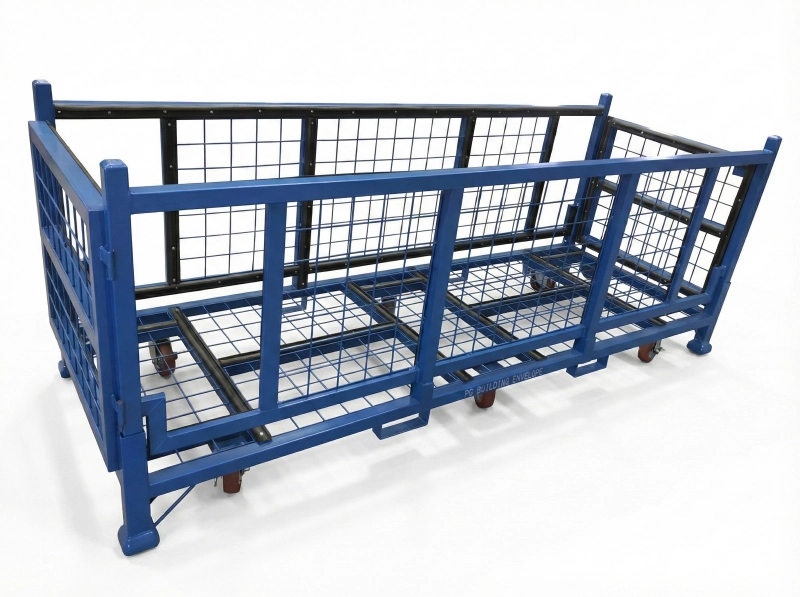
The box’s wheel set against the truck’s. Casters are the most common conflict. On a castered stillage the wheels are mounted at the base corners, which is exactly the floor the outrigger legs and load rollers need, and they are also the points that must carry the loaded box. A castered box is normally rolled or towed by hand; asking a pallet truck to lift it is a different base design, not a different technique. Even without casters, worn load rollers, grit, a crowned slab or standing water reduce the effective entry gap on the day of the move.

Long and double-bay bodies make all three points harder, because the approach face is longer, the base is more likely to carry intermediate supports, and the truck has to be squared before the forks are through.
Lift Stroke and Turning Space: Confirm Both Before the Drawing Is Released
Entry is only the first half of the move. The truck must then take the lowest point clear of the floor and keep it clear all the way, not just at the first pump. That means checking the route rather than the aisle where the test was made: expansion joints, dock levellers, thresholds, ramps, sloping aprons, embedded rails, and the drop at the far end when the forks are withdrawn with a load still on the deck. Two more figures belong in the same review — the truck’s rated capacity at the actual fork length and load centre, and whether it will raise this load through its full stroke instead of stalling halfway with the base still short of clearance.
Turning space is measured around the load, not around the box alone: the box diagonal, the truck length behind the load, the handle sweep, and the room to swing the pair through ninety degrees without touching racking uprights or an opposing stack. Long bodies multiply the diagonal quickly, so an extra-long body in a narrow aisle is usually the case that fails the review.
None of this is settled by a truck brochure or a product photo. It is settled by measuring your truck and your aisle, and by putting a sample box on that truck, on that floor.
Five Handling Routes, and What Each One Rules Out
Once the interference points are known, the design question becomes which route the box actually has to serve. Both forklift-pocket bases and castered bases exist as project builds, so the choice is made per project, not per catalogue line.
| Route | Fits when | Rules out |
|---|---|---|
| Forklift-pocket base only | Every move has a forklift, and the box is stacked in layers or placed in racking | Hand-truck access in aisles or line-side zones where only a pallet jack is available |
| Jack-enterable base | The measured fork height, outrigger band and load wheels clear the base, and floor plus lift stroke are confirmed on site | Protruding stacking feet or casters below the deck, and aisles too narrow for the turned load |
| Castered stillage | The box is rolled short distances by hand on flat, hard, clear floor, with caster load confirmed for that floor | Pallet-truck picking of the same box, and any route over joints, ramps or soft flooring |
| Crane or lifting-point handling | An overhead crane serves the bay and lifting points are part of the drawing | Sites with no crane in the aisle, and any move that has to be repeated by a truck |
| Rekcompatibele bodem | Fast-moving stock goes into beam racking and the base is built for beam support as well as stacking | Floor-level stacking, unless the same base also carries stacking feet |
A mixed base, with fork pockets for the forklift and short-range casters for hand moves, is a drawing conversation rather than an off-the-shelf option: the caster brackets land in the band the jack’s legs need, so both interfaces have to be resolved together and then confirmed on a sample.
When Forklift-Only Handling Is the Simpler Answer
Jack entry is worth engineering when the same box genuinely has to be moved by a person with a truck: line-side replenishment, an aisle closed to forklift traffic, a container door served by hand. Where none of those apply, adding jack entry only adds underside constraints:
- The load has to be stacked in three to five layers or placed in racking, so the forklift or crane remains the only machine that reaches it.
- The base is longer than the truck’s usable fork length, which is common on extra-long and double-bay bodies.
- The load path is already tight: two narrow fork strips are a different load case from a tine-supported pocket, and the base has to be designed for that rather than adapted afterwards.
- Stacking feet carry the box below and are part of the stack system, yet they occupy the same band the outriggers need, so the two features have to be traded openly.
- The floor, ramp or dock plate on the route makes a rolling lift unsafe whatever the drawing says.
The honest answer in those cases is a fork-pocket base with no jack claim. The expensive answer is to assume dual use and find out at the first loaded move.
What to Send for a Pallet Jack Fit Review
Jack entry cannot be approved from a truck catalogue page, and no universal compatibility statement applies to the Mybox range: recorded loads and handling figures in our files are project references, not a series rating. A review starts from your equipment and your floor:
- Truck make and model, plus the measured lowered fork height, fork length, fork width and fork spread.
- Outrigger outside width, how far the legs run ahead of the fork tips, and load wheel diameter.
- Box base drawing, or clear photos of the underside with the lowest point marked on the entry face.
- Loaded weight, load centre, and whether the load is uniform or concentrated.
- Aisle width, turning area, floor type, and every joint, ramp or dock plate on the route.
- Whether the box will also be stacked, racked or castered.
With those six items in hand, the base can be drawn with the entry, the lift stroke and the turning envelope all accounted for, and what remains is a sample trial on your own floor.
Pallet Jack Entry Questions Buyers Ask
Can the same Mybox be moved by a forklift and a pallet jack?
Only if the base is designed for both, and only after your truck and floor have been measured. Fork pockets and jack entry compete for the same space under the deck: what helps a tine — a raised pocket, a closed underside, protruding stacking feet — is usually what stops an outrigger leg or a load roller. Treat dual use as a drawing requirement to be confirmed, not as a property of the product family.
Our boxes have casters. Can we still use a pallet jack on them?
Normally the castered box is rolled, not picked. The caster plates and wheels sit at the base corners at floor level, which is exactly where the truck’s legs and load rollers have to pass, and those wheels also have to carry the loaded box on your floor. If a jack must pick it, the base needs a separate review.
The forks fit under the box with a couple of millimetres to spare. Is that a fit?
No. A gap that narrow closes under load deflection, floor joints, grit and roller wear, and the failure is silent: the truck keeps moving while the base scrapes or drags. Clearance has to be confirmed with the box loaded and across the whole route, not in the empty aisle where the first test happened.
How does this differ from the forklift fork-length check?
The forklift question is whether the tines suit the pockets and whether the truck handles the load at that load centre, which is covered in the fork length and clearance article. The pallet-truck question is whether a floor-rolling chassis can get under the base at all, and whether there is room to lift and turn once it is there.
Send Your Truck Dimensions and Box Base Drawing
If the same box has to serve a hand pallet truck and a forklift, send the truck’s measured fork height, fork length and outrigger band together with your base drawing and aisle width. We will review the entry, the lift stroke and the turning envelope against the Mybox collapsible steel stillage build you need, and tell you where a fork-pocket base or a castered box is the better answer. Jack entry stays unconfirmed until a sample has been tried on your floor.
Heeft u een op maat gemaakte opslagoplossing nodig?
Spreek rechtstreeks met onze technische ingenieurs. Wij bieden gratis constructieontwerpen, evaluaties van zwaar belaste catalogi en snelle B2B-prijsopgaven.
Vraag nu een offerte aan →