
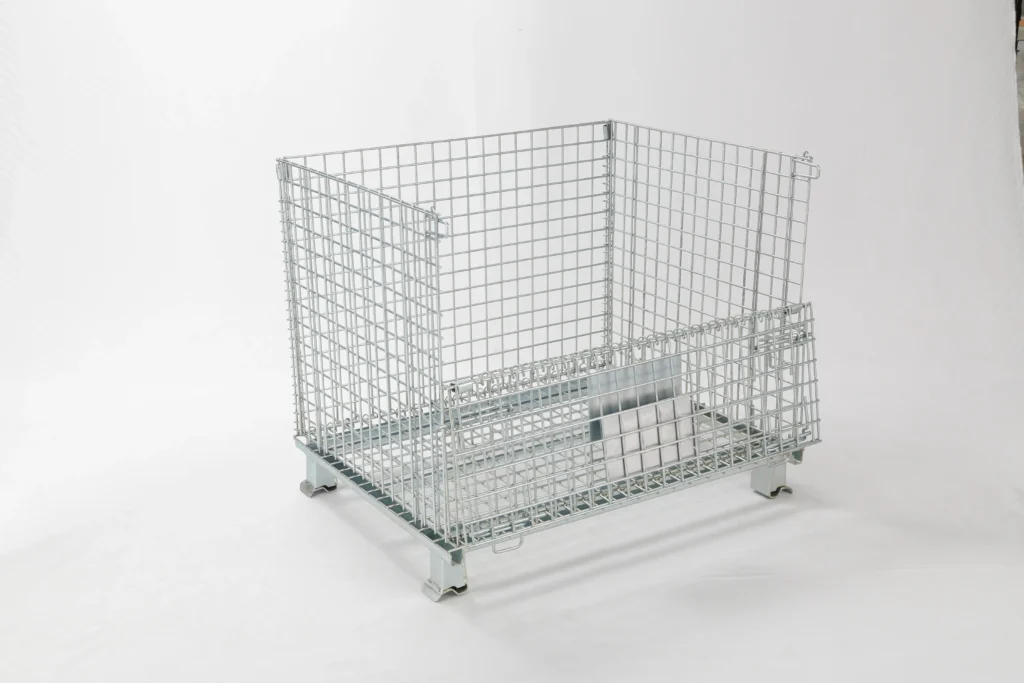
A buyer with a shipment date sends a short message: collapsible wire mesh container, about 1000 x 800, has to hold 1.4 t, please quote today. A price comes back within hours. A drawing follows, a sample panel is cut and welded, then the batch is welded, galvanized, folded and strapped. Weeks later the cages are uncrated at the plant and something is wrong: the load limit was written for a different stacking pattern, the gate opens on the side the pallet jack approaches from, or there is no liner and the small machined parts drop through the 50 x 50 mm mesh.
None of that is a manufacturing failure. It is the cost of a load that was never confirmed in writing before the drawing was released. In a custom cage order the cheapest hour is the one spent putting seven numbers on paper, and the most expensive document is a drawing approved against an assumption.
How a missing load line turns into sampling, manufacturing and freight rework
The chain starts with a category word instead of a specification. Cage, folding box, pallet cage and stillage are used interchangeably in daily purchasing language, so the first decision a supplier has to make is which product family is even being priced. That guess becomes a drawing: base reinforcement, wire diameter, stacking feet, gate side and finish are all fixed by it. The drawing then becomes a sample, and once mesh panels are cut and welded the sample looks authoritative, so nobody reopens the load question. The sample becomes a batch, with welding jigs, galvanizing loads, folding and strapping counts and a container loading plan all built on the same assumption. At the far end, the mismatch surfaces, and by then the cheap corrections are gone.
Each stage consumes the same delivery window the buyer was trying to protect. Rework does not move the order forward; it puts the same work behind a longer queue. That is why the sequence in this article is not paperwork for its own sake. It is the shortest route between an inquiry and a container that fits.
Seven items that must be in writing before a drawing exists
Our inquiry review runs on seven confirmations, and it is also the list a buyer can send before asking anyone for a price. Each item is on the list because leaving it open changes the product, not merely a number.
| Confirmation | Why an open answer changes the drawing |
|---|---|
| Load per cage, and how it is defined | The project files we hold record 1,400 kg per cage for one size and 1,000 kg per cage for others, and one project table uses the term dynamic load. Write the maximum normal load, whether it is evenly distributed or concentrated, and whether it is assessed static or in handling. |
| Expected number of uses | A single delivery and a recurring plant turnover are different purchases. Reuse cycles decide whether an economy mesh cage is the right family to quote at all. |
| Stacking condition, including the limit above the bottom cage | Tier count alone is not an answer. Recorded project figures include an upper-cage total of 2,000 kg, 1,200 kg and a recommendation of 500 kg per upper cage. Those describe three different structures. |
| Environment and finish | Cold galvanizing around 10 µm, electro-galvanized at 8 µm or more, and hot-dip around 40 µm appear as separate project records. None of them is the standard coating of the whole product. |
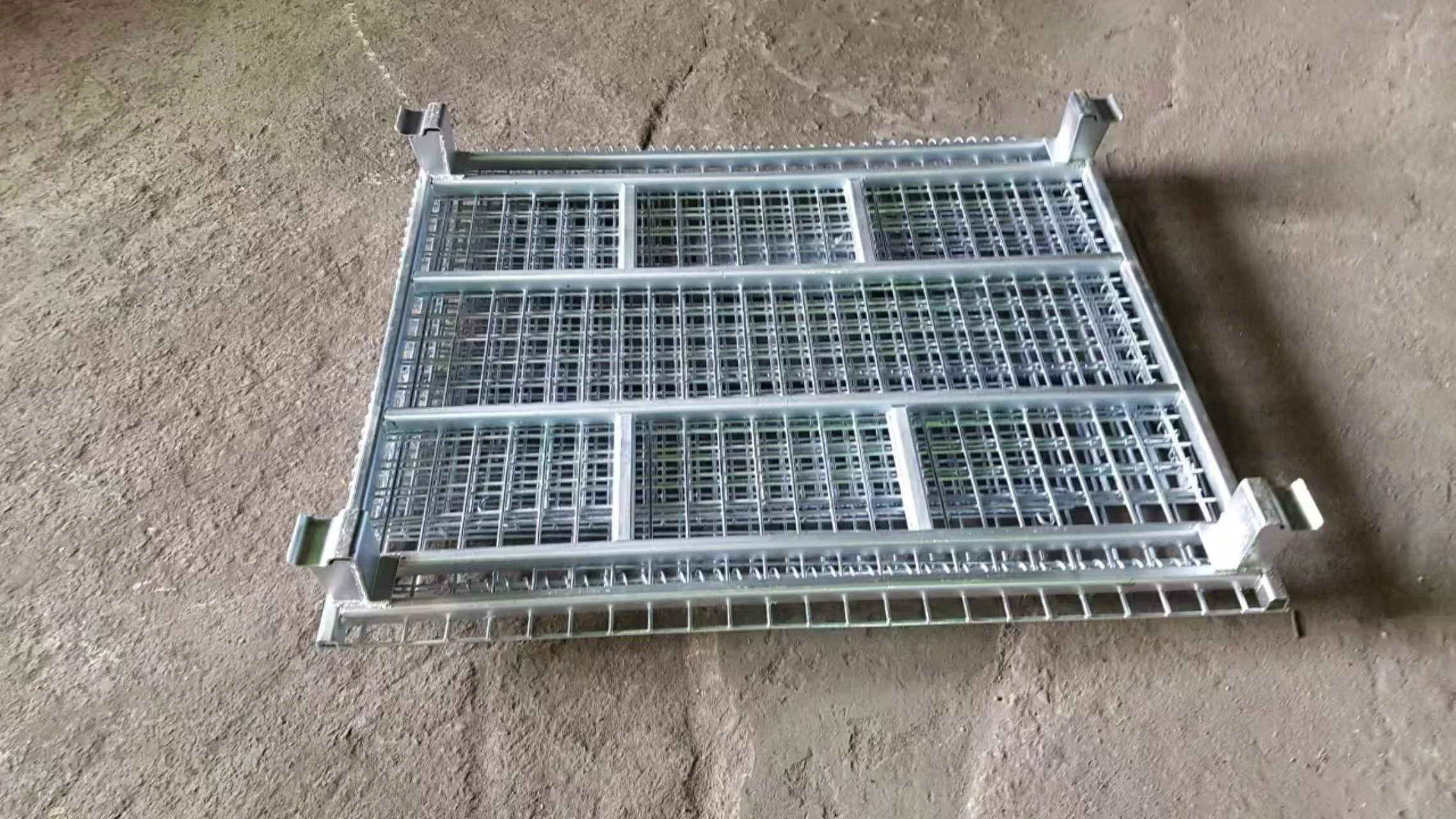
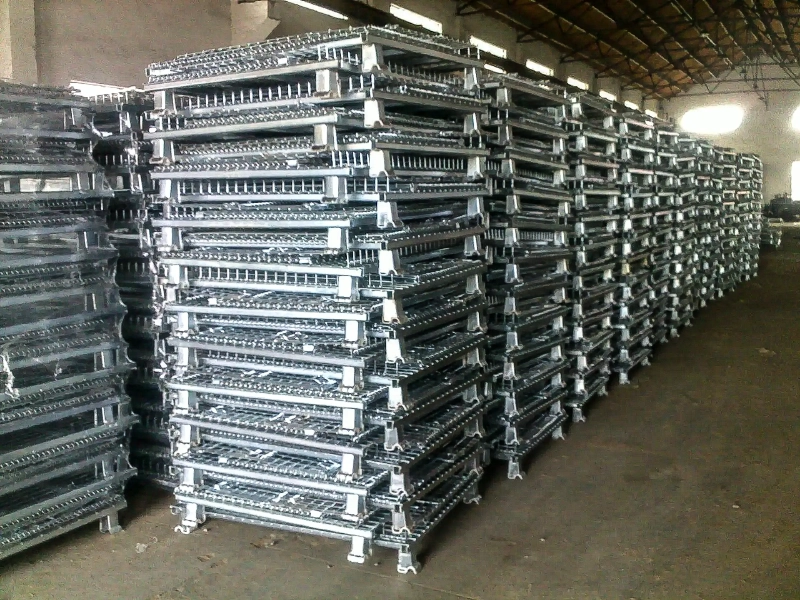
| Assembled dimensions and folded dimensions | Folded height, not assembled size, sets the container count. One project records a 190 mm folded height; other projects confirm folding without a recorded height. |
| A photograph of the item intended | Visual identity settles the family question faster than any product name, and it belongs in the quotation as well as the inquiry. |
| Destination and shipping method | It decides packing route and delivered cost per unit, and it is the input for film and strapping versus wooden crating. |
In this product family a photograph in the quotation is more useful than the product name in the description. A mesh cage, a square-tube folding box and a pallet cage can all be described as foldable storage, and only one of them matches what the plant floor actually needs.
Why three projects cannot share one drawing
Consolidation is tempting: we buy three sizes, give us one drawing and one price. In this product the three variants on file are three different containers that happen to look alike.
| Recorded variant | Per-cage load | Stacking record | Wire and mesh | Finish record | Tare and packing |
|---|---|---|---|---|---|
| 1000 x 800 x 840 mm | 1,400 kg per cage | Up to 4 tiers, upper-cage total 2,000 kg or less | Diameter 6 mm, 50 x 50 mm | Cold or hot galvanized, roughly 10 µm and 40 µm | 42 kg; about 250 pcs in a 20 ft and 638 pcs in a 40 ft high cube |
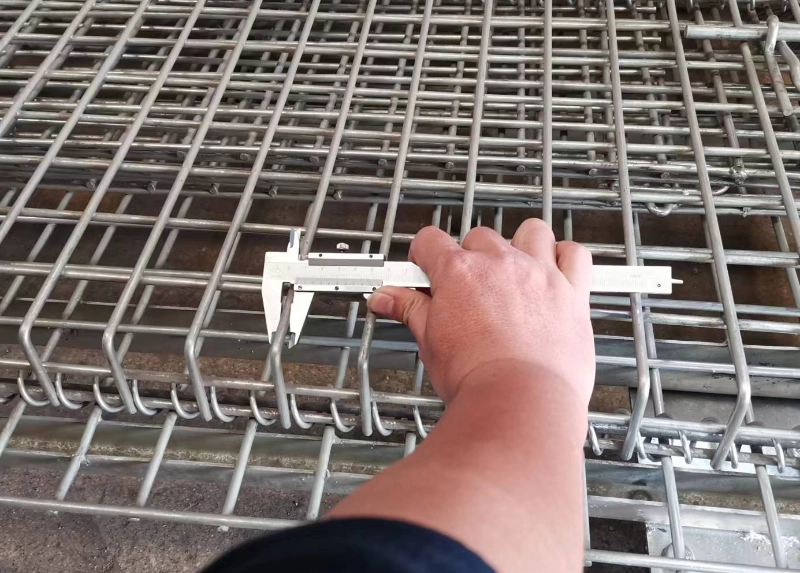
| 1050 x 1050 x 1000 mm | 1,000 kg per cage | Up to 4 tiers, upper-cage total 1,200 kg or less | Diameter 6.0 mm plus or minus 0.1 mm, 50 x 50 mm | Cold galvanized, roughly 10 µm | 53 kg; about 150 pcs in a 20 ft |
| 800 x 1200 x 890 mm | 1,000 kg recorded | Recommendation of 4 tiers or fewer, 500 kg or less in each upper cage | 5.8 mm, 50 x 50 mm | Electro-galvanized, 8 µm or more | 47 kg; folded height 190 mm, ten folded per stack at about 1240 x 1240 x 1600 mm |
The gap between the first two upper-cage limits is 800 kg. A merged drawing has to print one of those numbers, which leaves at least two sites operating outside their own design basis while they believe they hold an approved document. Wire diameter, tare weight, folded height and base reinforcement move with the same decision, and folded height is the input to the container plan, so a merged drawing also produces a merged and wrong freight estimate.
Gate orientation is equally local. One recorded request fixes the opening on the 800 mm side, which is a per-project requirement rather than a preference. A shared drawing turns that into a coin toss against the aisle the pallet jack actually uses. Load terminology does not survive merging either: one project table states dynamic load while others state load per cage, and folding two definitions into one line hides the difference instead of resolving it.
One project variant, one drawing, one confirmation sheet. Three sizes means three drawings, and the extra drafting effort is far smaller than one wrong batch.
The confirmation order that saves the most delivery time
The order matters as much as the list, because some answers unlock drafting and others only annotate it.
- Product identity first, meaning the photograph and the name the buyer uses internally. A wrong family wastes every later number.
- The load statement second, in one sentence with its definition. Load selects the structure and the stacking geometry.
- Reuse cycle third. It decides whether a mesh cage or a heavier frame is being priced.
- Handling interface fourth: forklift, pallet jack, entry directions and fork dimensions. This has to be settled before the base is drawn.
- Environment and finish fifth. This can run in parallel with drafting, because it changes the coating rather than the structure.
- Dimensions, folded height and packing sixth, so the container plan is built before freight is quoted.
- Gate details and accessories last: half-drop height, liner, lid and casters change weight and centre of gravity, so they are confirmed after the load line is fixed.
The release rule that follows from this order is simple. Drawing release waits for items one to three. Items four to six run while the drawing is being prepared. Item seven can arrive as a change note, but any change after release re-issues the drawing and re-checks the packing plan. Used this way, the slow operations such as mesh cutting, welding and galvanizing start only once the load is fixed, and nothing downstream has to be rebuilt.
What belongs on the quotation and on the purchase order
A quotation that can be compared with another quotation contains six lines: an image of the product being quoted, the confirmed load requirement, the expected reuse cycle, the intended stacking condition, the selected finish, and a short written confirmation of the buyer’s own terminology. A quotation that contains a price and a product name cannot be compared with anything.
The purchase order carries the rest. Dimension with tolerance, load definition with the per-level stack limit, wire diameter and mesh opening, finish with the accepted zinc thickness, gate orientation and half-drop height, accessory list with fixing method, packing method with the container plan, and the inspection points that will be signed off at loading.
What written confirmation does not buy
A written load is a design basis, not a certificate. None of the project files we hold include a load-test standard, fixture, duration, deformation limit or third-party certificate, and a photographed heavy-load stacking scene documents an operation rather than a certification.
Coating values are project records, not a service-life promise. Outdoor, humid or coastal duty needs the finish and the acceptance criteria selected for that duty, and the zinc figures above must not be reused as a corrosion guarantee across other sizes.
Stacking height is project-specific. The recorded recommendations differ in both tier count and upper-cage allowance, so a limit confirmed for one size cannot be extended to another. Delivery is confirmed only against a specific quantity, packing method and destination, which is why we do not state a lead time before those three are settled.
Where this sequence fits, and where it does not
Bring these seven items to the first inquiry when the order matches the following conditions:
- Repeatable plant supply of machined, cast or general industrial parts, with work-in-progress buffering and floor distribution by forklift or pallet jack.
- Export orders where folded height and container count decide the delivered cost per unit.
- Replacement of cages from another supplier whose feet deformed or whose panels bowed, since that symptom usually traces back to an unconfirmed stack limit.
- Mixed programmes with several sizes, ordered as separate drawings against separate confirmation sheets.
- Buyers who need a written record before an internal purchase approval, rather than a verbal understanding between engineers.
It does not apply in the same way when the request is:
- A storage structure rather than a movable container, since a cage stack limit is not the layer load of a rack beam.
- A sealed container, since small parts, dust and security call for liners or lids confirmed as accessories.
- A load above the recorded limit of the selected variant, which is a change of product family rather than a setting.
- One drawing reused across three sites with different sizes and different stack plans.
Buyer questions we answer most often
We only need a rough price to open a budget. Why not quote first and confirm later?
A rough price is legitimate when it is labelled as an assumption and re-quoted before any drawing is released. The failure mode is a rough price that quietly becomes the order, because then its assumptions become the drawing. Ask for the assumption list to be attached to the price.
Can three sizes share one drawing if the quantity per size is small?
No. The recorded variants differ in per-cage load, upper-cage stacking limit, wire diameter, finish and folded height. A merged drawing states one set of numbers and is therefore wrong for at least two of them, and small quantities make the rework proportionally more expensive rather than less.
Which single answer decides the most?
The load line: maximum normal load per cage plus the allowed total load above the bottom cage. It selects the structure and the stacking geometry before price has any meaning.
Can the finish be decided after the drawing is approved?
Finish selection can run in parallel with drafting but not after approval, because the accepted zinc thickness is part of what is inspected. On one recorded project the buyer asked for cold and hot galvanized pricing as two separate options, which works only when the finish is written down beside the load.
Send the seven items before the drawing request, mark any unknown figure as unknown rather than assuming it, and keep one confirmation sheet per size. An explicitly open item costs one email. An implicitly assumed one costs a batch. For the wider family comparison behind these numbers, see the mesh cage and square-tube folding box comparison, and for the reuse side of the same decision see reuse cycle counts and container economics.
Heeft u een op maat gemaakte opslagoplossing nodig?
Spreek rechtstreeks met onze technische ingenieurs. Wij bieden gratis constructieontwerpen, evaluaties van zwaar belaste catalogi en snelle B2B-prijsopgaven.
Vraag nu een offerte aan →