
How Does a Collapsible Steel Stillage Replace Fixed Wire Cages for Industrial Parts Storage?
See how the Mybox collapsible steel stillage replaces fixed wire cages for industrial parts storage. Review 1100 × 885 × 950 mm dimensions, 330 mm folded height, reference loads, stacking limits and empty-return benefits.
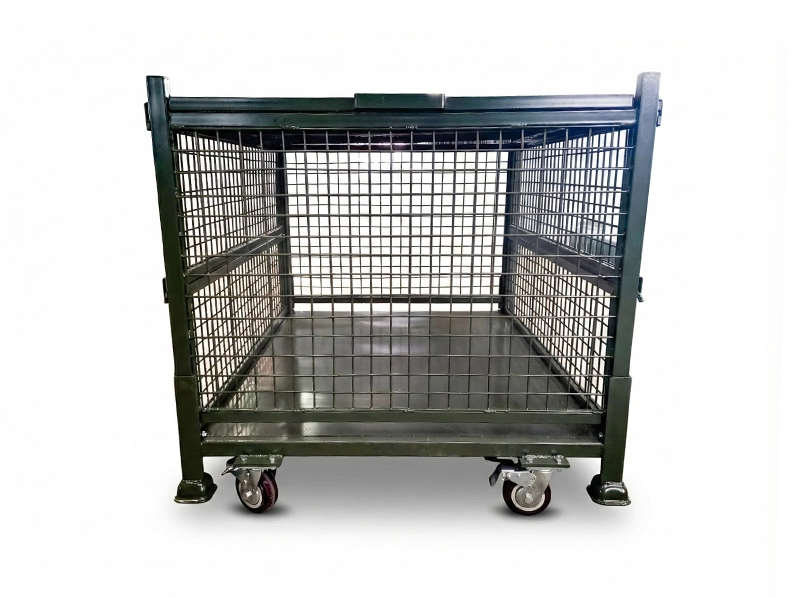
Replace fixed wire cages with a reusable steel frame
Mybox is a collapsible steel stillage for industrial parts storage, internal handling and empty-return logistics. The standard reference size is 1100 × 885 × 950 mm, with an approximate tare weight of 70 kg.
A fixed wire mesh container is usually built around panels. Mybox adds a Q235 carbon-steel 40 × 40 mm square-tube upright frame around 50 × 50 mm mesh made from Ø5 mm wire. That steel-tube frame gives the box a defined stacking interface, while the collapsible panels reduce the empty height to 1100 × 885 × 330 mm. The result is a reusable metal pallet box that can store parts in a stack, open from the working sides, and return empty without shipping the full assembled volume.
- Standard footprint: 1100 × 885 × 950 mm assembled; approximately 70 kg tare weight.
- Project parameter example: 4000 kg static load and 2000 kg dynamic load. These are reference values for the standard configuration, not a universal load guarantee.
- Empty-return height: 1100 × 885 × 330 mm when folded for return transport or compact storage.
- Parts access: four-side opening can be configured for picking; doors, gates, casters and lids must be confirmed against the operating method.
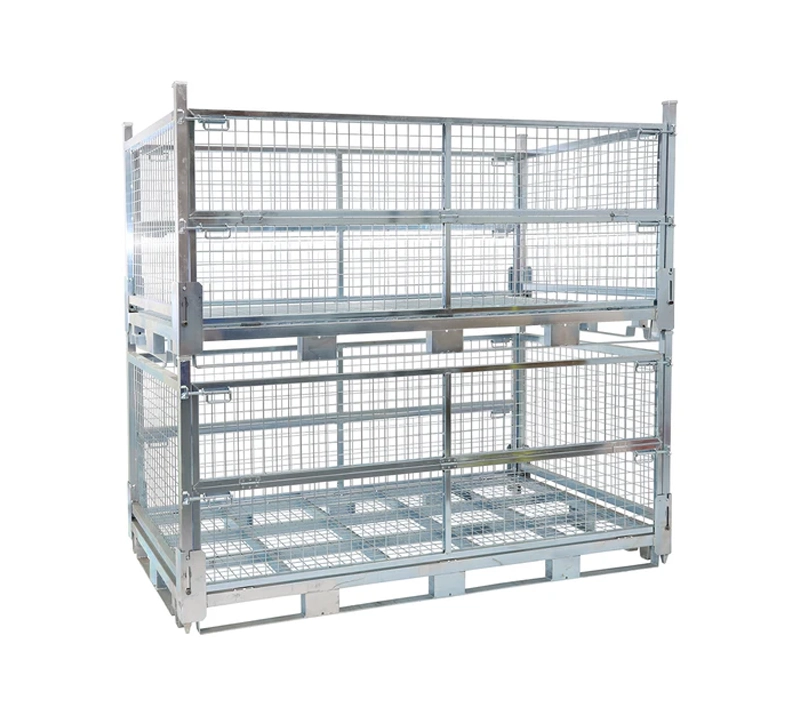
- Stacking boundary: a 3–5-level planning range may be considered for the standard concept, but the approved loaded height depends on load distribution, floor condition, handling, support and the final drawing.
Choose the stillage around the material flow
STANDARD STORAGE
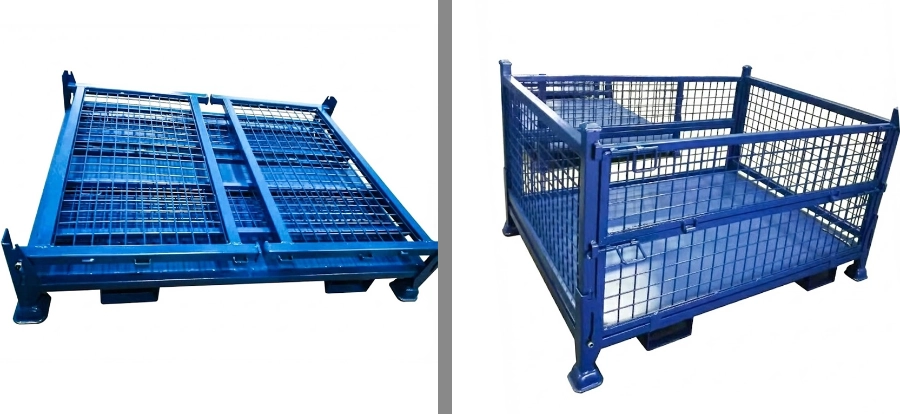
Floor-stacking parts stillage
Use the standard 1100 × 885 × 950 mm assembled box for repeatable storage of industrial parts that can be loaded by forklift or pallet jack and kept within a planned stack height.
50 × 50 mm mesh, Ø5 mm wire
Static/dynamic reference: 4000/2000 kg
EMPTY RETURN
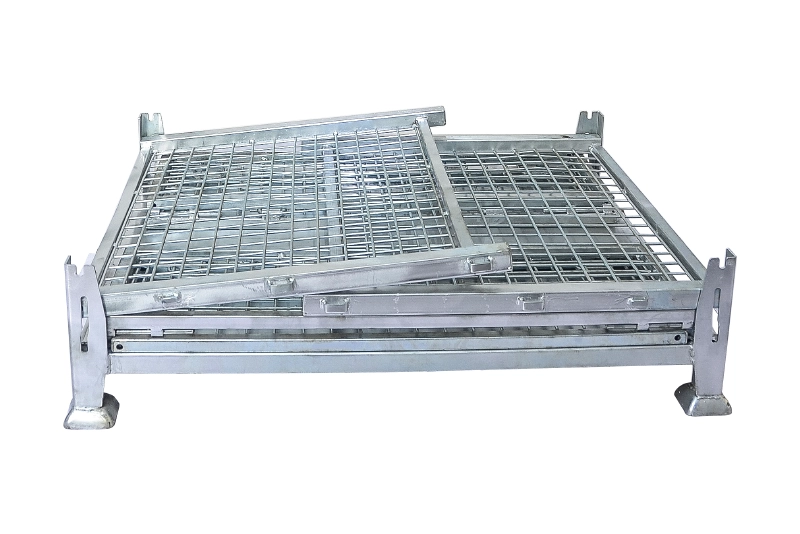
Collapsed return and buffer stock
Fold the empty cage to approximately 330 mm high before return transport or when the warehouse needs to hold spare containers. This addresses the empty-volume problem that a fixed cage cannot solve.
Reusable, non-disposable packaging format
Folded units are for empty storage or return

PICKING OR CUSTOM
Access-focused parts handling
For spare-parts rooms and line-side replenishment, discuss four-side opening, drop gates, braked casters, lids, surface finish or custom dimensions. The right combination depends on whether the box is picked in place, moved full, or stored on a rack.
Rack use requires compatibility review
Custom dimensions require a separate load check
A cage for storage, a frame for the whole handling cycle
More than a wire panel
The square-tube upright frame creates a defined load path and stacking interface around the mesh. It is the key structural difference from a basic rigid wire mesh container; the final allowable load still belongs to the approved configuration.
Less empty volume to return
When the parts have been delivered, the box can be folded from 950 mm working height to approximately 330 mm. More empty units can occupy the same return or buffer space than fixed cages, reducing wasted transport volume.
Stacking with a clear limit
Three to five levels may be a planning range for the standard concept, not an automatic approval for every load. Static and dynamic ratings must be read with the load center, stacking feet, floor flatness, movement method and layer count.
Access where parts are picked
Four-side opening and optional mobility can shorten the reach to small parts. If the job needs a lid, a caster base, a rack beam, overhead lifting or unusually heavy point loads, those conditions must be reviewed before the configuration is released.
Specify the box against the real load case
Describe the parts
Share part dimensions, weight per box, center of gravity, packaging, quantity per SKU and whether the parts need visual access or protection from loss.
Map the movement
Confirm forklift or pallet-jack entry, full-box moves, picking in place, return transport, rack storage and any need for braked casters or a lid.
Set the stack boundary
Review the intended layer count, loaded and empty conditions, floor, support points and dynamic handling. Do not convert the 4000 kg static reference into a blanket guarantee.
Release the right drawing
Confirm dimensions, doors, mesh, coating, accessories and the applicable load conditions before quotation and production. The standard box is a starting configuration, not a substitute for project review.
What to verify before replacing fixed wire cages
What is the fundamental difference between Mybox and a wire mesh container?
A basic wire mesh container is primarily a panel-and-mesh enclosure. Mybox combines 50 × 50 mm Ø5 mm mesh with a Q235 40 × 40 mm square-tube upright frame and a folding structure. The frame supports a more defined stacking and handling concept; it does not mean every Mybox configuration has the same allowable load.
Why does the collapsible structure matter for empty returns?
The assembled height is approximately 950 mm, while the folded reference height is approximately 330 mm. Empty boxes can therefore be consolidated for return transport or stored in a smaller buffer area. The saving comes from reducing empty volume, not from reducing the loaded box dimensions.
How many fully loaded boxes can be stacked?
The standard planning discussion may cover 3–5 levels, but the approved number must be tied to the actual load, load distribution, floor, stacking feet, box condition, handling and required safety margin. The 4000 kg static and 2000 kg dynamic figures are project reference parameters for the standard concept, not a universal four-ton guarantee.
Is Mybox suitable for every small-parts warehouse?
It is a strong fit when the warehouse needs reusable containment, vertical stacking, forklift or pallet-jack handling, four-side access, or empty-return efficiency. A fixed wire cage may remain more suitable for a simple low-cost enclosure. Mybox is not the right choice without further engineering review for unapproved overhead lifting, unstable point loads, uncontrolled outdoor exposure, or rack use that has not been checked.
Can it be customized with casters, doors, a lid or a different finish?
Those are configuration topics for the quotation: access doors or gates, braked casters, lids, dimensions and corrosion-protection finish can be selected when they match the workflow. Each change can affect tare weight, center of gravity, stacking and handling, so it should be shown on the final drawing rather than assumed from a standard photo.
What should be included in an inquiry?
Send the part type, maximum loaded weight, dimensions, desired quantity per box, forklift or pallet-jack method, full-box movement, target stack layers, rack or floor storage, empty-return route and required access. We can then confirm whether the standard collapsible steel stillage is appropriate or whether a custom configuration is needed.