
Rerack | Stackable Rack | Empty Return Logistics
For exporters, 3PL operators, and seasonal warehouses, nesting clearance is not a minor detail. In this design example, a 100 mm clearance keeps the forklift moving, protects the structure, and makes empty return volume materially smaller.
When a stackable rack is used as a returnable asset, the question is not just how much it can carry when full. The real cost appears when the rack comes back empty, waits in a temporary storage zone, or sits idle during a slow season. That is why nesting clearance matters: it determines whether empty structures slide smoothly or waste space and create handling friction.
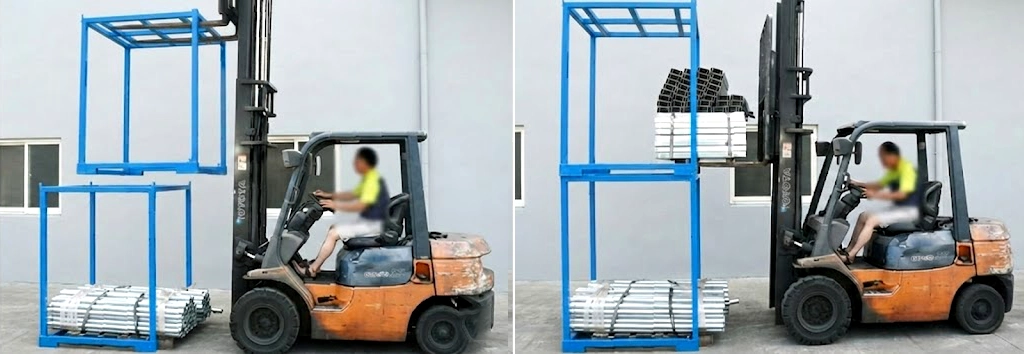
In this Rerack design example, the nesting clearance is set at 100 mm. This number is not presented here as a universal standard. It is a practical design value that balances two things at once: the forklift must enter and exit without jamming, and the empty rack must still nest tightly enough to reduce trailer volume and yard footprint.
What the 100 mm clearance is solving
The purpose of nesting clearance is simple: to make the empty structure stackable without turning the forklift approach into a precision job. If the clearance is too tight, the operator has to wrestle with the structure, scratch the coating, or re-enter at a different angle. If the clearance is too wide, the footprint grows and the whole point of nesting is lost.
A 100 mm design clearance gives the operator enough room to pick up, seat, and lower the structure while keeping the bundle of empty racks compact. For export loops and warehouse returns, that is the difference between a rack that behaves like a return asset and a rack that behaves like dead space.
Why fork thickness should define the clearance
The correct clearance is not chosen by guesswork. It must be matched to the actual fork thickness, fork heel geometry, and the real insertion angle used in the yard. A catalog number is not enough, because different forklifts and attachments behave differently when the operator starts loading under time pressure.
That is why the 100 mm value in this example should be read as a design specification, not a statement that every site should copy it unchanged. If your forklift forks are thicker, your turning tolerance is smaller, or your handling route is rougher, the nesting clearance must be re-checked against the actual equipment that will touch the structure.
What this means for return freight and seasonal buffering
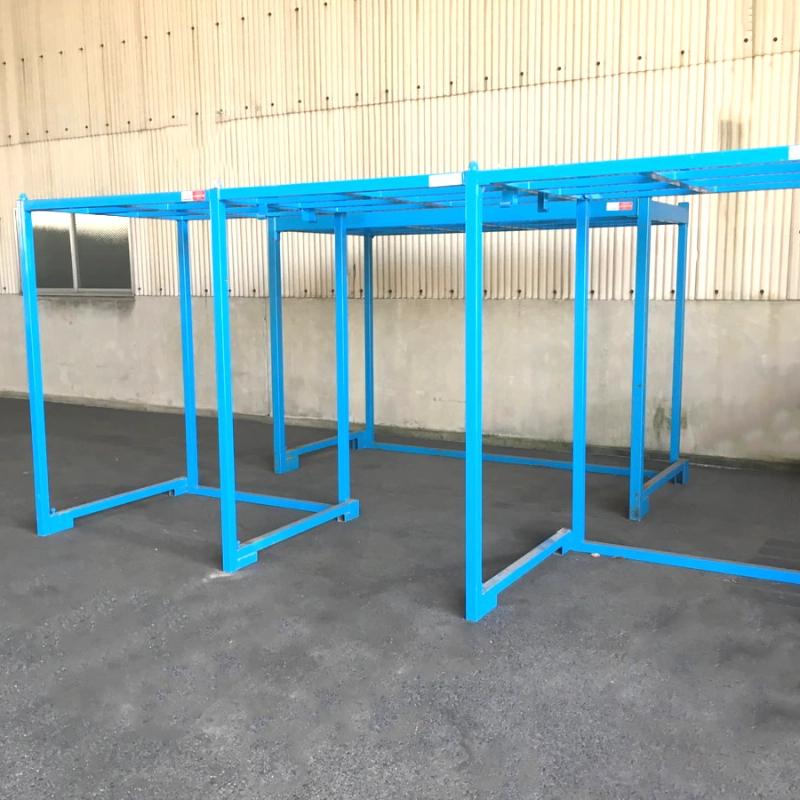
Once empty racks nest properly, the return leg shifts from a volume problem to a controllable logistics task. More nested units fit per trailer, so the cost of bringing empties back drops. In an export loop, this matters as much as outbound loading efficiency, because the empty return leg is part of the asset lifecycle.
Seasonal businesses feel the same effect inside the warehouse. During peak, compact empty racks can be parked in a corner temporary storage area without consuming entire pallet rack aisles. During off-season, the same pool of stackable racks can be kept as buffer capacity instead of becoming a storage burden.
Where this example fits and where it does not
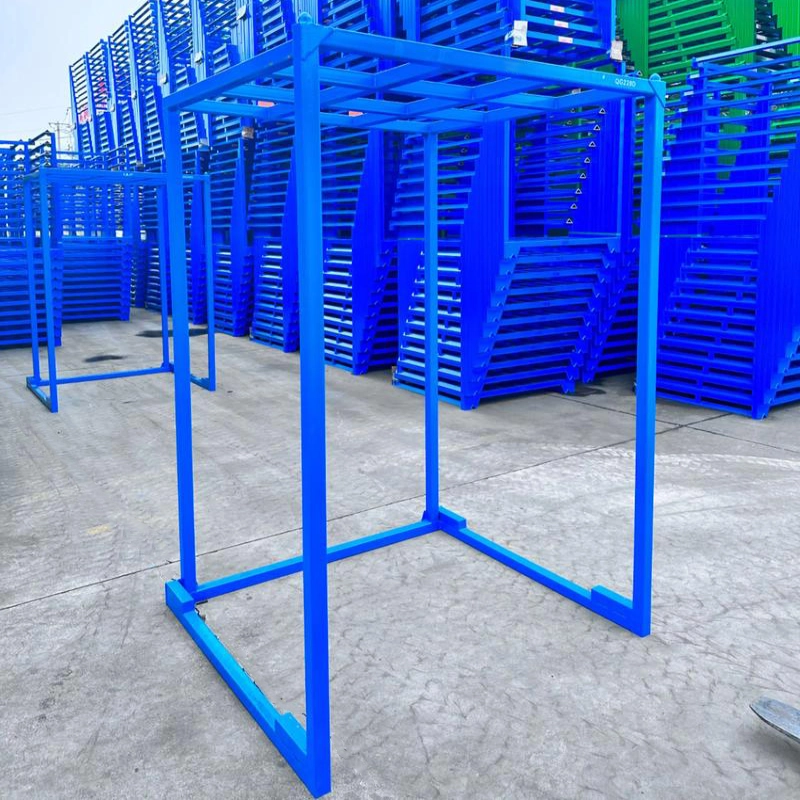
This example is a good fit when the operation relies on forklifts, returnable racks, and variable demand. It suits export trade, 3PL cross-dock pools, and seasonal overflow rooms where empty return volume and temporary storage density matter.
It is not the first choice when the site needs fixed, highly selective pallet access at all levels. In that case, standard pallet rack may be more practical. If the layout is fixed and aisle density is the main target, drive-in pallet rack may be the better alternative. If the load tolerates bottom compression and the handling route is simple, block stacking on the floor may still be acceptable, but it gives up the control and return efficiency that a stackable rack system provides.
For teams comparing stackable racks, post pallets, and other returnable storage assets, the decision should start with actual fork thickness, the return route, and how much space the empty structure can consume. That is the real logic behind the 100 mm example clearance.
FAQ
Is 100 mm always the correct nesting clearance?
No. In this article, it is a design example value. The final clearance must be confirmed against the actual forklift fork thickness, operator tolerance, and the handling route used in daily work.
When should I choose another system?
If your main priority is selective separation and fixed storage positions, a standard pallet rack may be better. If you want high aisle density in a fixed layout, drive-in pallet rack may be more suitable. Use this stackable rack approach when return volume, nesting efficiency, and forklift-based circulation are the main pain points.
Precisa de uma Solução de Armazenamento Personalizada?
Fale diretamente com nossos engenheiros técnicos. Oferecemos projetos estruturais gratuitos, avaliações de catálogos de alta capacidade e orçamentos rápidos para B2B.
Solicite um Orçamento Agora →