
A count that starts with a lid, a strap or a stack of taped boxes is a handling job before it is a counting job. The operator lifts, opens, reaches inside, moves parts aside, reads a label, closes the box and puts the load back — and the count itself may have taken seconds. When a factory counts the same containers every shift, or every week before dispatch, those openings become a permanent line of work that never shows up as a cost item.
Sebox approaches the problem from the container side: the family of foldable steel pallet boxes / stillages can be built with welded mesh faces instead of solid sheet, so that the load stays contained but stays visible. With a half-height front gate, the same container can also be opened at floor level while it is on the second or third level — which turns a full teardown and opening of the stack for counting into a visual pass plus a targeted spot check.
Why counting starts with what you can see through
Em uma contagem no armazém, o contêiner determina quanto da carga é legível a partir do corredor. Laterais de tela metálica proporcionam uma visão contínua do nível de preenchimento e das próprias peças em toda a altura da face. Uma caixa-palete de tela metálica portanto suporta uma contagem que lê a carga de fora: quantas camadas de peças, quão cheia está a caixa, se um lote foi esgotado, se a mesma peça está presente em duas caixas. Em contêineres com laterais de chapa ou fechados, o operador tem que interromper a visão para obter a mesma informação. Essa é toda a diferença entre inventário visual sem desembalar e uma rotina de abrir-toda-caixa — a informação existe em ambos os casos; apenas um deles requer uma etapa de manuseio para alcançá-la.
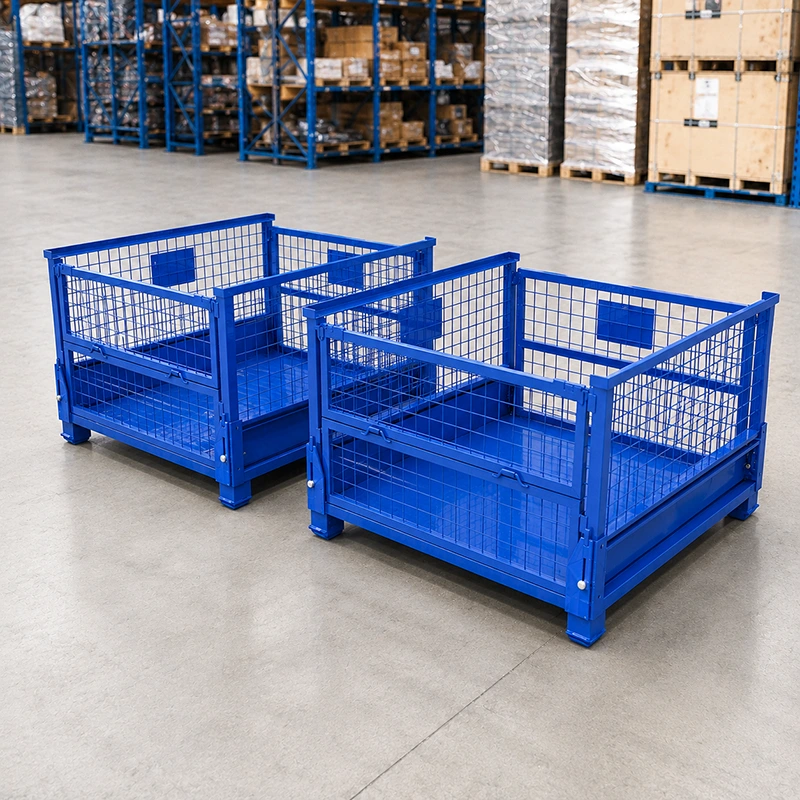
The image above is the configuration that makes this possible: two blue mesh foldable pallet cages with a rectangular steel frame, mesh on all four faces, a front gate and a reinforced base. Nothing on the mesh face is decorative. It is the viewing window, the containment and the ventilation in one part of the structure.
Where the hours go in an open-every-box count
Counting labor is rarely a single task. It is a chain of small tasks repeated per container, per level and per shift, and each link can fail separately. A typical open-and-count cycle includes:
- Reaching the container: moving a stack, pulling a unit from a rack position or calling a forklift to bring the lower level within reach.
- Opening the container: releasing straps or film, unlocking and lowering a gate, or lifting a lid that has been loaded since the last count.
- Reading the load: separating parts by hand to see what is underneath, which is where mixed batches and identical-looking machined parts cause repeated checks.
- Closing and restoring: relocking, repacking, regrouping the stack and returning the unit to its position without disturbing the next one.
- Recording and reconciling: noting the value and then investigating any discrepancy that the open-and-rummage method itself created.
Mesh eliminates or shortens several of these links in a single movement. The load is readable while the container is still stacked and still strapped; the gate does not need to be lowered for a fill-level or layer count; and because nothing needs to be repacked, the verification round that follows a disturbed count is often unnecessary. The saving is not a fixed number of minutes per box — it is the elimination of the opening and restoring steps from every pass where the count needs only confirmation rather than a piece-by-piece check. How much that is worth depends on how often you count, how deep your stacks are and how many containers sit per SKU.
Mesh panels versus solid steel sheet in a counting round
Both face types are available in the same welded steel frame, and both are legitimate. They answer different counting questions, so the choice should be made face by face rather than as a decision for the whole box.
| Counting question | Mesh face | Solid steel sheet face |
| Fill level and layer count from the aisle | Readable without opening; the operator can see how many layers are stacked in the box | Not readable; requires opening the door, removing the lid or a reliable label |
| Presence or absence of a specific batch | Visible if the batch is against the mesh; part geometry and stacking decide how much of the interior is exposed | Hidden until the container is opened |
| Counting while the container stays stacked | Supported on the visible faces; no unstacking for a visual check | Requires access to the gate, so the unit must be reachable |
| Small parts, chips, dust and oil residue | Confined only if the mesh opening is smaller than the smallest part of the load | Best confinement for fines, coolant residue and very small components |
| Typical counting method it supports | Visual check plus targeted spot check at the door | Label counting, weight counting, or open and count with a fixed access position |
| When to specify | Repeated counts, mixed batches, high number of containers per shift, parts large enough not to pass through the mesh | Fine or sharp components, sealed transport loads, or loads where counting is done by label and not by sight |
The honest limit is in the fourth row. Mesh gives visibility only when the opening is smaller than the smallest item in the load, and the mesh opening is one of the values that needs to be frozen in the approved drawing of the SKU you order — it is not a valid number for the whole series. A mixed-face construction is the usual compromise: mesh on the aisle-facing side and the front gate, sheet on the faces where small parts or residue need to stay inside.
Spot checks with half-height doors on the second and third levels
A visibilidade por si só não encerra uma contagem. Alguém, em algum momento, precisa confirmar a contagem de peças de um lote, e esse é o momento em que uma porta normal obriga a desempilhar. Uma porta frontal de meia-altura abre ao nível do fundo do recipiente, de modo que uma unidade apoiada no segundo ou terceiro nível se torna uma face de coleta alcançável sem precisar ser retirada. Dois fechos laterais liberam a porta, ela desce até a base, e o operador conta a fileira frontal de peças diretamente, ou retira a peça que precisa ser verificada e a recoloca.
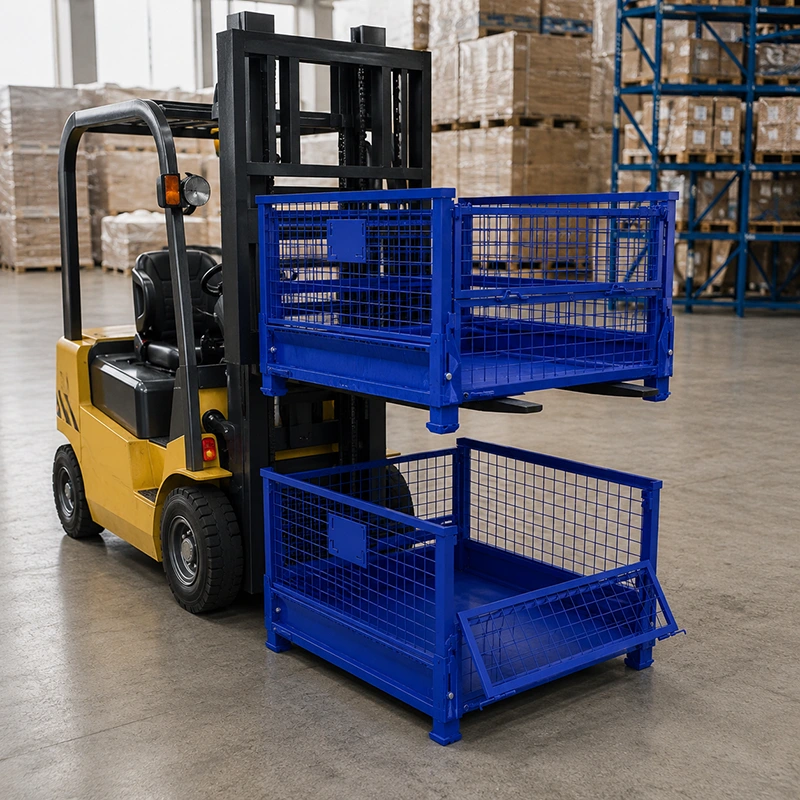
The photo shows the two conditions on which the method depends. One cage is being lifted by the forklift while another stands open on the floor with its front door folded down — the same base, the same hinge line, whether the unit is in the air or in a stack. For a spot check, the sequence is: read the screen face for the batch position, lower the half-door at the level containing it, count the accessible front row, close and lock again. The rest of the stack is left untouched, so the count does not create a second handling job to reorganize the warehouse.
Counting on the line instead of counting in stock
The biggest reduction in counting work usually comes from counting less often in a separate location. When parts move from machining to assembly in the same visible container, the line check and the stock check can be the same event, because the container carries its own inventory evidence. A wire container next to a CNC machine shows the operator what remains without a trip to stock and without opening a box, and the same container is the unit that is counted when it is finally moved.
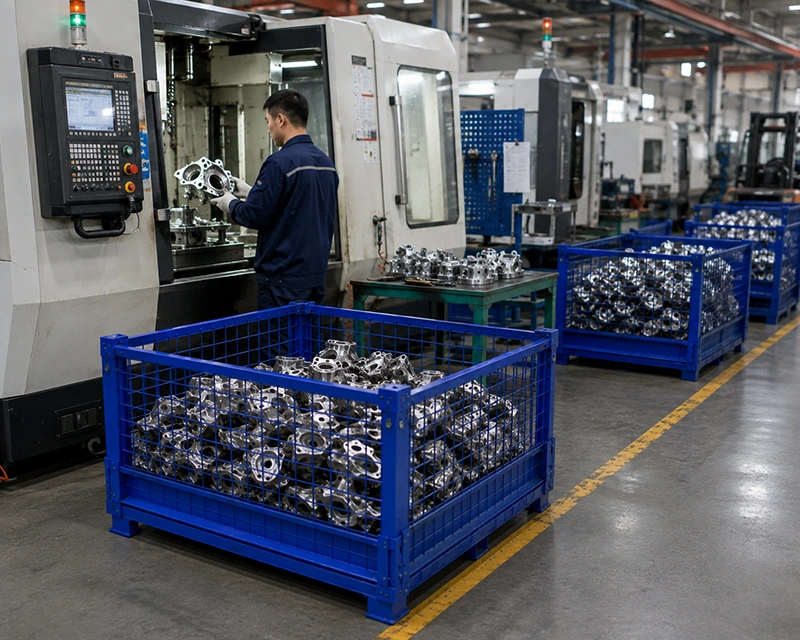
Here a worker examines machined parts next to loaded blue wire containers. The parts are silver and sit close together, exactly the case where the screen face does useful work: the fill level reads instantly and the batch identity reads from the label position, while the physical count of a specific row still goes through the door. Visual inventory reduces the number of full counts; it does not replace a piece-by-piece count when a piece-by-piece count is what the customer requires.
What a visual count does not solve
Buyers who have already tried wire containers know where the method stops. Being clear about this from the start is cheaper than finding out during an audit.
- Parts stacked away from the screen, or that block the face, are visible in outline but cannot be counted as individual parts.
- Very small components can only be contained by a screen opening sized below the smallest part; if this is not feasible, the face must be sheet or the load must have an internal lining agreed with the supplier.
- Sealed, wrapped or lidded loads provide a label count, not a visual count, until the load is opened.
- Small high-value parts usually need a weigh count or a piece read regardless of panel type; the screen speeds up the preliminary check, not the reconciliation.
- Stack layer count and load capacity are variant-specific. The documented Sebox variants support uniform loads of 1000 kg, 1300 kg and 1500 kg, with different base dimensions and weights, and a recommended stack of three to four layers appears in only one variant. Confirm both against your SKU and your floor before designing a counting route around a stack height.
Specifying a Sebox for count-friendly access
If visual inventory is a requirement rather than a preference, these are the points to fix in the drawing and the enquiry, in the order that most affects counting:
- Which faces are screen and which are sheet — specify side by side, including the base and the gate.
- Screen opening relative to the smallest part in the load, so that visibility does not become a spill risk.
- Gate type and height at arrival: half-door at floor level to reach a stacked layer, or a full gate where the whole face has to open.
- Gate hardware: base hinges, latch arrangement and the number of latches, because a spot check is only quick if the gate opens and closes properly.
- Feet or castors for the stacker and the stacking arrangement, because the counting route depends on which layers stay in place.
- Panel and frame finish, plus any label or marking position that the count record refers to.
- Payload capacity and stacking limits for the exact SKU, confirmed by the approved drawing and not by a catalogue line.
Two conditions argue against this approach on its own. If the load must be sealed against moisture, fine particles or theft, a sheet or a closed configuration is the right answer and the count will be done by label. If the parts are smaller than any viable opening, a mesh face will let them through or will need a lining that defeats visibility — in that case the container must remain solid and the count must be planned on the basis of weight or reading.
Two questions buyers ask before switching
Can we count a stacked container without dismantling it?
For the visible faces, yes: the mesh shows the fill level and the layer count from the aisle, and the arrival half-door gives access to a spot check of the front row at the layer where it sits. What it cannot do is count parts that are packed behind other parts or below the front row without opening further. A full part-level count of every item in a deep load remains a handling task; the advantage is that most checks never need one.
Does the mesh mean we lose protection compared with a solid container?
No — containment comes from a welded steel frame, posts and a reinforced base, with the mesh acting as the retention face. What changes is what the face does to small parts and debris, and that is why the opening and face mapping have to be specified. Both mesh and sheet constructions sit on the same pallet-style base with forklift entry, so handling and stacking do not change with the panel choice; only the counting method changes.
Next step: match the container to your count frequency
The container that suits a monthly inventory is not necessarily the container that suits a count every shift. What decides it is how often you count, how many containers per SKU are in the stack, how deep the stack can go, and how small the components are. Send us those four facts together with your part sizes and the current load per container, and we will map the mesh and sheet faces, the gate position and the stacking layout against the counting route you actually use — and tell you where a solid face is the better answer.