
A count that starts with a lid, a strap, or a stack of taped boxes is an operation before it is a count. The operator lifts, opens, reaches in, moves parts aside, reads a label, closes the box, and puts the load back — and the count itself may have taken seconds. When a factory counts the same bins every shift, or every week before shipping, those openings become a fixed labor line that never appears as a cost item in the budget.
Sebox approaches the problem from the container side: its family of collapsible steel pallet boxes / stillages can be built with welded mesh walls instead of solid panels, so the load stays enclosed but visible. With a half-drop front gate, the same container can also be opened at floor level while sitting on the second or third tier — turning a full unstack-and-open count into a visual check plus a targeted spot check.
Why counting starts with what you can see through it
In a warehouse count, the container determines how much of the load is readable from the aisle. Mesh walls give continuous visibility of the fill level and of the parts themselves across the full height of the side face. A mesh pallet stack box therefore supports a count that reads the load from outside: how many layers of parts, how full the box is, whether a batch has shrunk, whether the same part is present in two boxes. With solid-wall boxes or closed bins, the operator must interrupt visibility to get the same information. That is the whole difference between visual inventory without unpacking and a routine in which every box is opened — the information exists in both cases; only one of them requires a handling step to get to it.
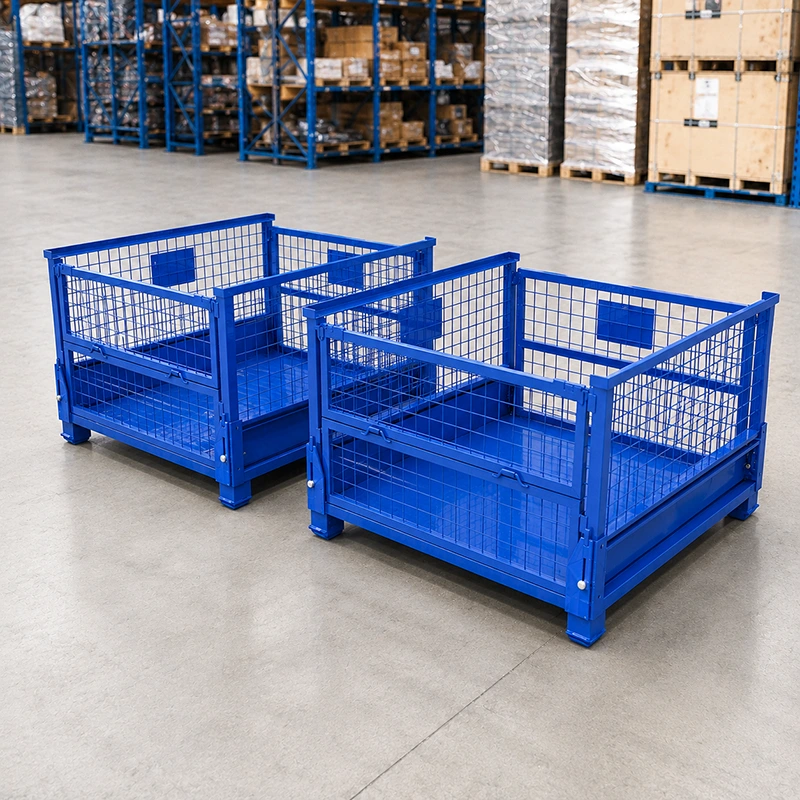
De afbeelding hierboven is de configuratie die dit mogelijk maakt: twee blauwe opvouwbare palletboxen met gaaswanden en een rechthoekig stalen frame, gaas op de vier zijvlakken, een voorhek en een verzilverde bodem. Niets aan de gaaswand is decoratief. Het is het kijkvenster, de insluiting en de ventilatie in één onderdeel van de constructie.
Waar de uren naartoe gaan bij een tel-bij-open-elke-box ronde
Telwerk is zelden één taak. Het is een keten van kleine taken die per container, per laag en per ploeg wordt herhaald, en elke schakel kan afzonderlijk falen. Een typische open-en-tel ronde omvat:
- De container bereiken: een stapel verplaatsen, een eenheid uit een rekvak trekken, of een heftruck vragen om de onderste laag binnen bereik te brengen.
- De container openen: banden of wikkel losmaken, een hek ontgrendelen en neerlaten, of een deksel optillen dat sinds de laatste telling is beladen.
- De lading aflezen: onderdelen met de hand uit elkaar halen om te zien wat eronder zit, waar gemengde partijen en identiek uitziende bewerkte onderdelen tot hertellingen leiden.
- Sluiten en herstellen: opnieuw vergrendelen, opnieuw wikkelen, de stapel opnieuw opbouwen, en de eenheid terug op zijn plaats zetten zonder de volgende te verstoren.
- Registreren en afstemmen: het cijfer noteren, en vervolgens eventuele afwijkingen onderzoeken die de open-en-rommel methode zelf heeft veroorzaakt.
Gaas verwijdert of verkort meerdere van deze schakels in één beweging. De lading is afleesbaar terwijl de container nog gestapeld en nog gestrapt is; het hek hoeft niet te worden neergeklapt voor een vulniveau- of lagentelling; en omdat niets opnieuw hoeft te worden ingepakt, is de hertelronde die volgt op een verstoorde telling vaak overbodig. De besparing is geen vast aantal minuten per box — het is de eliminatie van de open- en herstelstappen uit elke ronde waar de telling alleen bevestiging nodig heeft in plaats van een stuksniveau-verificatie. Hoeveel dat waard is, hangt af van hoe vaak u telt, hoe diep uw stapels zijn, en hoeveel containers er per SKU staan.
Gaaspanelen versus massieve staalplaat in een telronde
Beide wandtypes zijn beschikbaar op hetzelfde gelaste stalen frame, en beide zijn legitiem. Ze beantwoorden verschillende telvragen, dus de keuze moet per wand worden gemaakt in plaats van als beslissing voor de hele bak.
| Telfrage | Gaaswand | Massieve staalplaatwand |
| Vulniveau en aantal lagen vanaf het gangpad | Afleesbaar zonder te openen; de operator kan zien hoeveel lagen er in de kist zijn gestapeld | Niet afleesbaar; vereist het openen van de deur, het verwijderen van het deksel of een label dat wordt vertrouwd |
| Aanwezigheid of afwezigheid van een specifieke batch | Zichtbaar als de batch tegen het gaas ligt; onderdeelgeometrie en stapeling bepalen hoeveel van de binnenkant zichtbaar is | Verborgen totdat de container wordt geopend |
| Tellen terwijl de container gestapeld blijft | Ondersteund voor de zichtbare wanden; geen destapeling voor een visuele controle | Vereist toegang tot de deur, dus de eenheid moet bereikbaar zijn |
| Kleine onderdelen, spanen, stof en olieresten | Alleen ingesloten als de gaasopening kleiner is dan het kleinste onderdeel in de lading | Beter insluiten van fijn materiaal, koelmiddelresten en zeer kleine componenten |
| Typische telmethode die het ondersteunt | Visuele controle plus gerichte steekproef via de deur | Labelgebaseerde telling, weegtelling of openen-en-tellen op een vaste toegangreeksplek |
| Wanneer dit te specificeren | Herhaaldelijke tellingen, gemengde batches, hoge containerhoeveelheden per ploeg, onderdelen groot genoeg om niet door het gaas te vallen | Fijne of scherpe componenten, afgesloten transportladingen of ladingen waar de telling wordt bepaald door een label in plaats van door zicht |
De eerlijke beperking zit in de vierde rij. Gaas geeft alleen zichtbaarheid wanneer de opening kleiner is dan het kleinste item in de lading, en de gaasopening is een van de waarden die vastgelegd moet worden op de goedgekeurde tekening voor de SKU die u bestelt — het is geen seriebreed getal. Een gemengde-wand uitvoering is het gebruikelijke compromis: gaas aan de gangpad-zijde en de voordeur, plaat op de wanden waar kleine onderdelen of resten binnenin moeten blijven.
Half-neerklapbare deur steekproeven op de tweede en derde laag
Zichtbaarheid alleen rondt een telling niet af. Iemand moet uiteindelijk een stuktelling voor één batch bevestigen, en dat is het moment waarop een gewone deur een destapeling afdwingt. Een half-neerklapbare voordeur opent op containervliegenderniveau, zodat een eenheid die op de tweede of derde laag staat een bereikbare pickervoorzijde wordt zonder te worden afgenomen. Twee zijgrendels ontgrendelen de deur, hij klapt neer naar de basis, en de operator telt de voorste rij onderdelen direct, of haalt het onderdeel eruit dat geverifieerd moet worden en plaatst het terug.
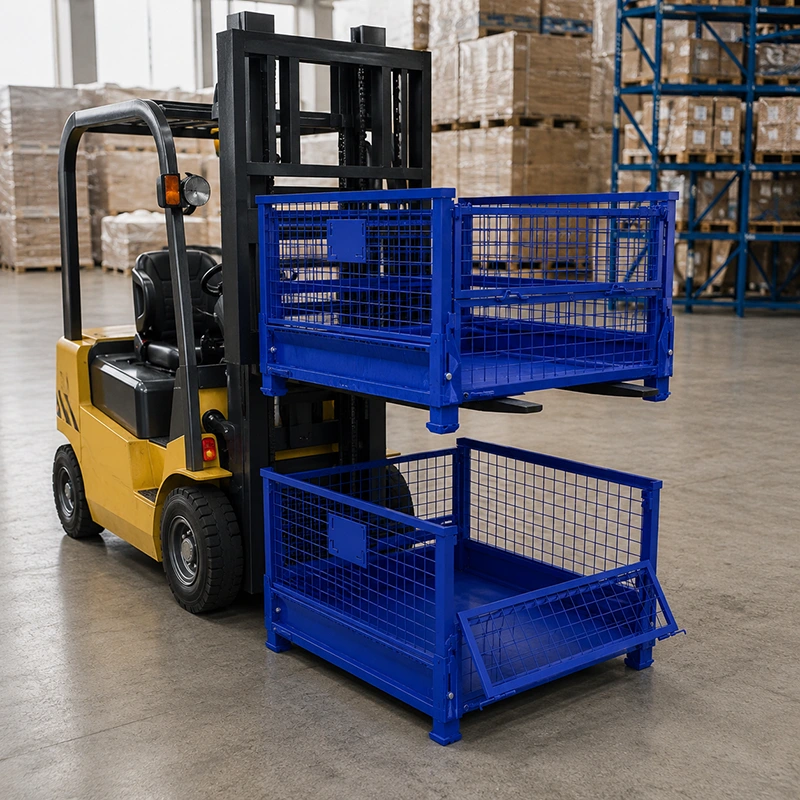
The photo shows the two conditions on which the method relies. One cage is lifted by a forklift while another stands open on the floor with the front drop-down door folded down — the same base, the same hinge line, whether the unit is in the air or in a stack. For a sample, the sequence is: read the mesh wall for the batch position, fold down the half door onto the layer containing it, count the accessible front row, close and lock again. The rest of the stack remains untouched, so the count does not create a second handling task to put the warehouse back as it was.
Counting at the line instead of counting in the warehouse
The largest reduction in counting work usually comes from counting less often at a separate location. When parts go from machining to assembly in the same visible container, the line-side check and the warehouse check can be the same event, because the container carries its own inventory evidence. A mesh rack next to a CNC machine shows the operator what is left without a trip to the warehouse and without opening a crate, and the same container is the unit that is counted when it is eventually moved.
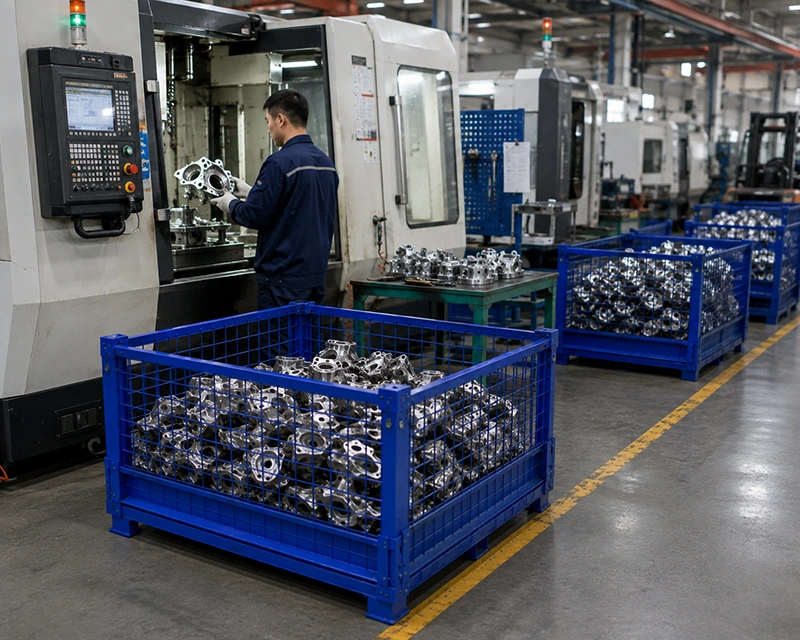
Here a worker inspects machined parts next to loaded blue steel mesh rack bins. The parts are silver and densely packed, exactly the case in which the mesh wall does useful work: the fill level is directly readable and the batch identity is readable from the label position, while the physical count of a specific row still goes through the door. Visual inventory reduces the number of full counts; it does not replace piece-by-piece counting when piece-by-piece counting is what the customer requires.
What a visual count does not decide
Buyers who have already tried mesh containers know where the method stops. Being clear about it in advance is cheaper than discovering it during an audit.
- Components stacked away from the mesh or blocking the view are visible as a silhouette but cannot be counted as separate pieces.
- Very small components can only be contained by a mesh opening smaller than the smallest part; if that is not practical, the front must be a sheet or the load must have an inner liner agreed with the supplier.
- Sealed, packaged or lidded loads give a count based on the label, not a visual count, until the load is opened.
- Small high-value parts usually need a weigh or piece-by-piece scan regardless of panel type; mesh shortens the preliminary check, not the reconciliation.
- The number of stack layers and the load capacity are variant-dependent. Documented Sebox variants have uniform loads of 1000 kg, 1300 kg and 1500 kg with different footprints and weights, and a recommended stack of three to four layers is listed on only one variant. Check both against your SKU and your shop floor before designing a count route around a stack height.
Specifying a Sebox for count-friendly access
If visual inventory is a requirement rather than a preference, these are the points to record on the drawing and in the request, in the order that most affects counting:
- Which walls are mesh and which are sheet — specify them side by side, including the base and the gate.
- Mesh opening relative to the smallest part in the load, so visibility does not become a spill risk.
- Front gate type and height: half-drop at floor level for reach into a stacked layer, or a full gate where the whole wall must open.
- Gate hardware: basic hinges, latch arrangement and number of latches, because a sample is only fast if the gate opens and closes cleanly.
- Forklift legs or pockets and the stacking arrangement, because the count route depends on which layers stay in place.
- Paneel- en frameafwerking, plus eventuele etiket- of markeringspositie waarop de telregistratie betrekking heeft.
- Werkbelasting en stapelbeperkingen voor de exacte SKU, bevestigd tegen de goedgekeurde tekening in plaats van een catalogusregel.
Twee omstandigheden pleiten op zichzelf tegen deze aanpak. Als de lading moet worden afgesloten tegen vocht, fijne deeltjes of diefstal, dan is plaat of een gesloten configuratie het juiste antwoord en zal de telling etiketgestuurd zijn. Als de onderdelen kleiner zijn dan elke praktische opening, laat een gaaswand ze ofwel door of heeft een voering nodig die het zicht tenietdoet — in dat geval moet de container massief blijven en moet de telling worden gepland rond gewicht of scannen.
Twee vragen die kopers stellen voordat ze overstappen
Kunnen we een gestapelde container tellen zonder deze af te bouwen?
For the visible walls, yes: the mesh gives fill level and layer count from the aisle, and the half-drop front gate gives access for a spot check of the front row at the layer you are standing at. What you cannot do is count pieces that are packed behind other parts or under the front row without opening further. A full piece-by-piece count of every item in a deep load remains a handling task; the gain is that most passes never need one.
Does mesh mean we lose protection compared with a solid bin?
No — containment comes from a welded steel frame, uprights and a reinforced base, with the mesh acting as a retaining wall. What changes is what the wall does with small parts and offcuts, which is why opening and wall assignment need to be specified. Both mesh and sheet versions sit on the same pallet-style base with forklift access, so handling and stacking do not change with the panel choice; only the counting method does.
Next step: match the container to your count frequency
The container that suits a monthly stocktake is not necessarily the container that suits a count every shift. What decides it is how often you count, how many containers per SKU sit in the stack, how deep the stack is allowed to grow, and how small the components are. Send us those four facts together with your part sizes and current load per container, and we will set the mesh and sheet walls, gate position and stack arrangement against the counting route you actually run — and tell you where a solid wall is the better answer.
Heeft u een op maat gemaakte opslagoplossing nodig?
Spreek rechtstreeks met onze technische ingenieurs. Wij bieden gratis constructieontwerpen, evaluaties van zwaar belaste catalogi en snelle B2B-prijsopgaven.
Vraag nu een offerte aan →