
A count that starts with a lid, a strap or a stack of taped cartons is a handling job before it is a counting job. The operator lifts, opens, reaches in, moves parts aside, reads a label, closes the box and puts the load back — and the count itself may have taken seconds. When a plant counts the same bins every shift, or every week before dispatch, those openings become a standing labour line that never shows up as a line item.
Sebox approaches the problem from the container side: the collapsible steel pallet box / stillage family can be built with welded wire mesh faces instead of solid plate, so the load stays contained but stays visible. With a half-drop front gate, the same container can also be opened at floor level while it sits on the second or third tier — which turns a full destack-and-open count into a sight pass plus a targeted spot check.
Why counting starts with what you can see through
In a warehouse count, the container decides how much of the load is legible from the aisle. Wire mesh sides give a continuous view of the fill level and of the parts themselves across the full height of the face. A mesh pallet stacking box therefore supports a count that reads the load from outside: how many layers of parts, how full the box is, whether a batch has been depleted, whether the same part is present in two boxes. On plate-sided or closed bins the operator has to interrupt the view to get the same information. That is the whole difference between visual inventory without unpacking and an open-every-box routine — the information exists in both cases; only one of them requires a handling step to reach it.
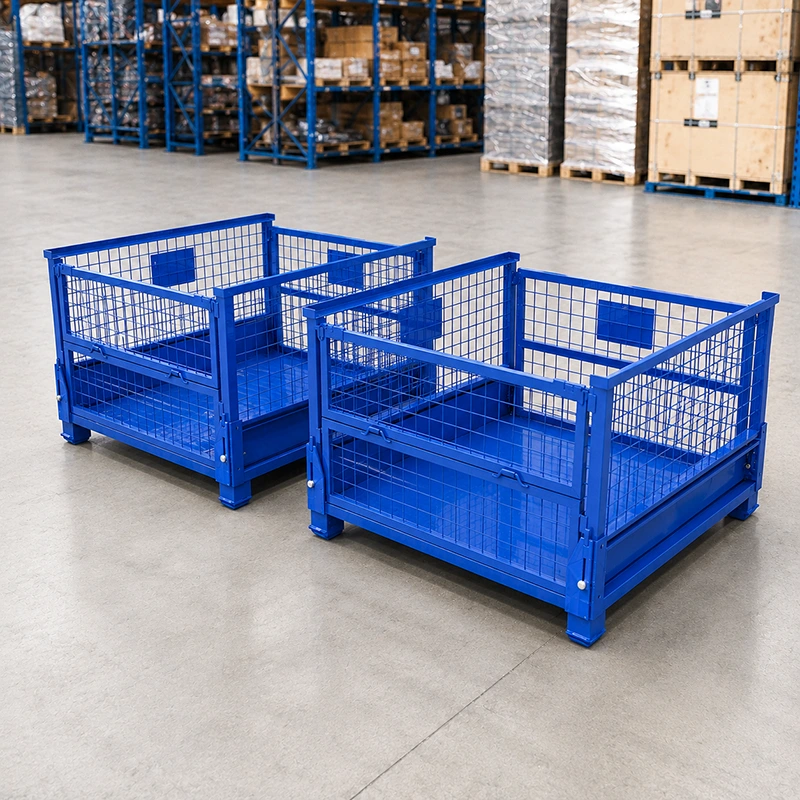
The image above is the configuration that makes this work: two blue collapsible wire mesh pallet cages with a rectangular steel frame, mesh on the four faces, a front gate and a reinforced base. Nothing about the mesh face is decorative. It is the viewing window, the containment and the ventilation in one part of the structure.
Where the hours go in an open-every-box count
Counting labour is rarely one task. It is a chain of small tasks repeated per container, per tier and per shift, and each link can fail separately. A typical open-and-count round includes:
- Reaching the container: moving a stack, pulling a unit out of a rack bay, or asking for a forklift to bring the bottom tier into reach.
- Opening the container: releasing straps or wrap, unlatching and dropping a gate, or lifting a lid that has been loaded since the last count.
- Reading the load: separating parts by hand to see what is underneath, which is where mixed batches and identical-looking machined parts cause re-checks.
- Closing and restoring: relatching, re-wrapping, restarting the stack, and returning the unit to its position without disturbing the next one.
- Recording and reconciling: writing the figure, then investigating any variance that the open-and-rummage method itself created.
Wire mesh removes or shortens several of these links in one move. The load is readable while the container is still stacked and still strapped; the gate does not need to be dropped for a fill-level or layer count; and because nothing has to be repacked, the re-check round that follows a disturbed count is often unnecessary. The saving is not a fixed number of minutes per box — it is the elimination of the opening and restoration steps from every pass where the count only needs confirmation rather than a piece-level verification. How much that is worth depends on how often you count, how deep your stacks are, and how many containers sit per SKU.
Mesh panels versus solid steel plate in a count round
Both face types are available on the same welded steel frame, and both are legitimate. They answer different count questions, so the choice should be made face by face rather than as a whole-bin decision.
| Count question | Wire mesh face | Solid steel plate face |
| Fill level and layer count from the aisle | Readable without opening; the operator can see how many layers are stacked in the box | Not readable; requires gate opening, lid removal or a label that is trusted |
| Presence or absence of a specific batch | Visible if the batch is against the mesh; part geometry and stacking decide how much of the interior is exposed | Hidden until the container is opened |
| Count while the container stays stacked | Supported for the visible faces; no destack for a sight pass | Requires access to the gate, so the unit must be reachable |
| Small parts, swarf, dust and oil residue | Contained only if the mesh aperture is smaller than the smallest part in the load | Better containment for fines, coolant residue and very small components |
| Typical count method it supports | Visual pass plus targeted gate spot check | Label-based count, weigh count, or open-and-count with a fixed access position |
| When to specify it | Repeat counts, mixed batches, high container counts per shift, parts large enough not to pass through the mesh | Fine or sharp components, sealed transport loads, or loads where the count is driven by a label rather than by sight |
The honest limit sits in the fourth row. Mesh gives visibility only when the aperture is smaller than the smallest item in the load, and mesh aperture is one of the values that has to be frozen on the approved drawing for the SKU you order — it is not a series-wide number. A mixed-face build is the usual compromise: mesh on the aisle-facing side and the front gate, plate on the faces where small parts or residue have to stay inside.
Half-drop gate spot checks on the second and third tier
Visibility alone does not finish a count. Somebody eventually has to confirm a piece count for one batch, and that is the moment a normal gate forces a destack. A half-drop front gate opens at container floor level, so a unit sitting on the second or third tier becomes a reachable pick face without being taken down. Two side latches release the gate, it drops to the base, and the operator counts the front row of parts directly, or takes out the piece that has to be verified and puts it back.
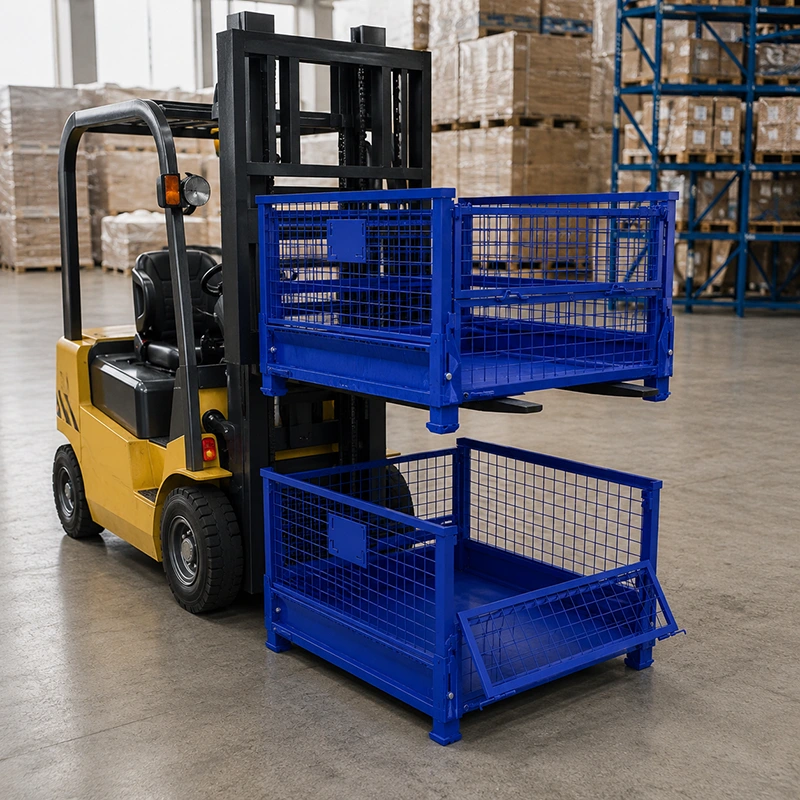
The photo shows the two conditions the method depends on. One cage is being lifted by forklift while another stands open on the floor with its front drop gate folded down — the same base, the same hinge line, whether the unit is in the air or in a stack. For a spot check, the sequence is: read the mesh face for the batch position, drop the half gate on the tier that holds it, count the accessible front row, close and relatch. The rest of the stack is untouched, so the count does not create a second handling job to put the warehouse back the way it was.
Counting at the line instead of counting in the stores
The largest reduction in counting work usually comes from counting less often in a separate location. When parts move from machining to assembly in the same visible container, the line-side check and the stores check can be the same event, because the container carries its own inventory evidence. A mesh stillage beside a CNC machine shows the operator what is left without a trip to the stores and without opening a box, and the same container is the unit that gets counted when it is finally moved.
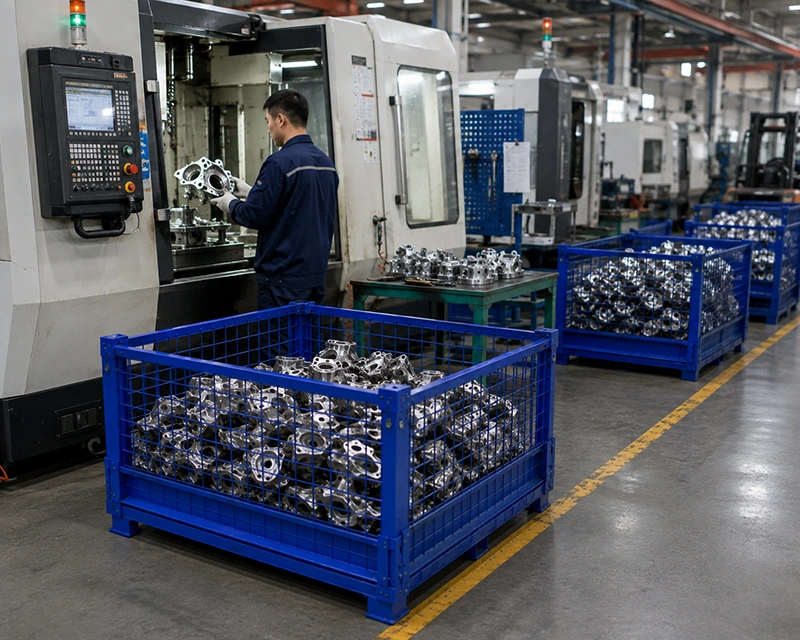
Here a worker inspects machined parts beside loaded blue wire mesh stillage bins. The parts are silver and closely packed, which is exactly the case where the mesh face does useful work: the fill level reads instantly and the batch identity reads from the label position, while the physical count of a specific row still goes through the gate. Visual inventory reduces the number of full counts; it does not replace a piece-level count when a piece-level count is what the customer requires.
What a visual count does not settle
Buyers who have already tried mesh containers know where the method stops. Being clear about it up front is cheaper than discovering it during an audit.
- Parts stacked away from the mesh, or blocking the face, are visible in outline but not countable as individual pieces.
- Very small components can only be contained by a mesh aperture sized below the smallest part; if that is not practical, the face should be plate or the load should have an inner liner agreed with the supplier.
- Sealed, wrapped or lid-covered loads give a label count, not a visual count, until the load is opened.
- High-value small parts usually need a weigh count or a piece-level scan regardless of panel type; mesh shortens the preliminary check, not the reconciliation.
- Stacking layer count and load rating are variant-specific. Documented Sebox variants carry uniform loads of 1000 kg, 1300 kg and 1500 kg with different footprints and weights, and a recommended stack of three to four layers appears on one variant only. Confirm both against your SKU and your floor before designing a count route around a stack height.
Specifying a Sebox for count-friendly access
If visual inventory is a requirement rather than a preference, these are the points to fix on the drawing and in the enquiry, in the order that affects counting most:
- Which faces are mesh and which are plate — specify side by side, including the base and the gate.
- Mesh aperture relative to the smallest part in the load, so visibility does not become a spill risk.
- Front gate type and height: half-drop at floor level for reach into a stacked tier, or a full gate where the whole face has to open.
- Gate hardware: base hinges, latch arrangement and the number of latches, since a spot check is only fast if the gate opens and closes cleanly.
- Forklift feet or pockets and the stacking arrangement, because the count route depends on which tiers stay put.
- Panel and frame finish, plus any label or marking position that the count record refers to.
- Working load and stacking limits for the exact SKU, confirmed against the approved drawing rather than a catalogue line.
Two conditions argue against this approach on their own. If the load has to be sealed against moisture, fines or theft, plate or a closed configuration is the right answer and the count will be label-driven. If the parts are smaller than any practical aperture, a mesh face will either let them through or need a liner that defeats the visibility — in that case the container should stay solid and the count should be planned around weight or scanning.
Two questions buyers ask before switching
Can we count a stacked container without taking it down?
For the visible faces, yes: the mesh gives fill level and layer count from the aisle, and the half-drop front gate gives access to a front-row spot check on the tier you are standing at. What you cannot do is count pieces that are packed behind other parts or below the front row without opening further. A full piece-level count of every item in a deep load is still a handling task; the gain is that most passes never need one.
Does mesh mean we lose protection compared with a solid bin?
No — the containment comes from a welded steel frame, posts and a reinforced base, with the mesh acting as the retaining face. What changes is what the face does to small parts and residue, which is why aperture and face mapping have to be specified. Both mesh and plate builds sit on the same pallet-style base with forklift entry, so handling and stacking do not change with the panel choice; only the count method does.
Next step: match the container to your count frequency
The container that suits a monthly stocktake is not necessarily the container that suits a count every shift. What decides it is how often you count, how many containers per SKU sit in the stack, how deep the stack is allowed to grow, and how small the components are. Send us those four facts together with your part sizes and current load per container, and we will map the mesh and plate faces, gate position and stacking arrangement against the count route you actually run — and tell you where a solid face is the better answer.
Need a Custom Storage Solution?
Speak directly with our technical engineers. We offer free structural designs, heavy-duty catalog evaluations, and quick B2B price quotations.
Request a Quote Now →