
Rerack Inverted Stack Rack vs Demountable Post Pallet
Compare an inverted stack rack with a demountable post pallet for custom pallet stillage projects. See the trade-off between welded stability, lower cost and empty nesting versus removable posts, base reuse and robotic palletizing.
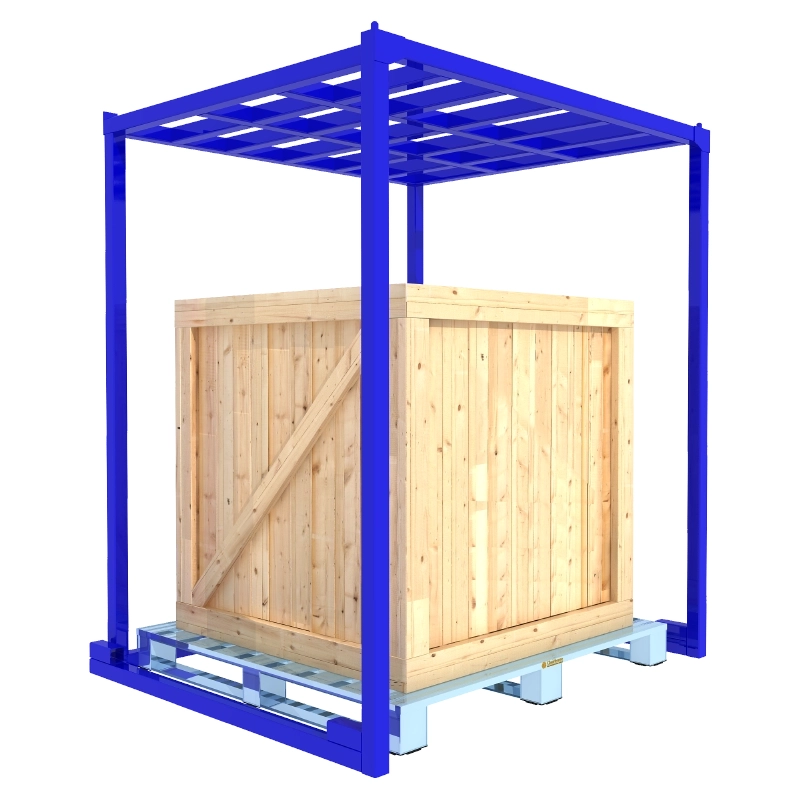
Inverted Stack Rack or
Demountable Post Pallet?
Choose the inverted stack rack when stability, lower project cost and empty-rack nesting come first. Choose the demountable post pallet when you need a removable base that can also support robotic palletizing.
Both options are custom steel stack rack / pallet stillage solutions for palletized loads. The right choice depends on how often the structure must be changed, whether the base will be reused as a palletizing platform, the load height, and how empty units will return or be stored.
| Decision point | Inverted stack rack | Demountable post pallet |
|---|---|---|
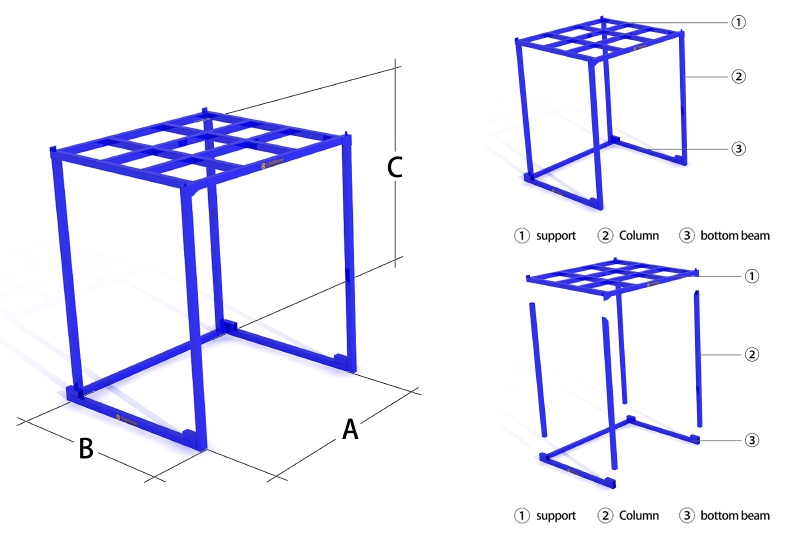
| Frame | Fixed welded frame | Separate base, removable posts and hanging tie bars |
| Stability direction | More direct structural rigidity | High-load/high-height layouts need two post plates plus tie-bar reinforcement |
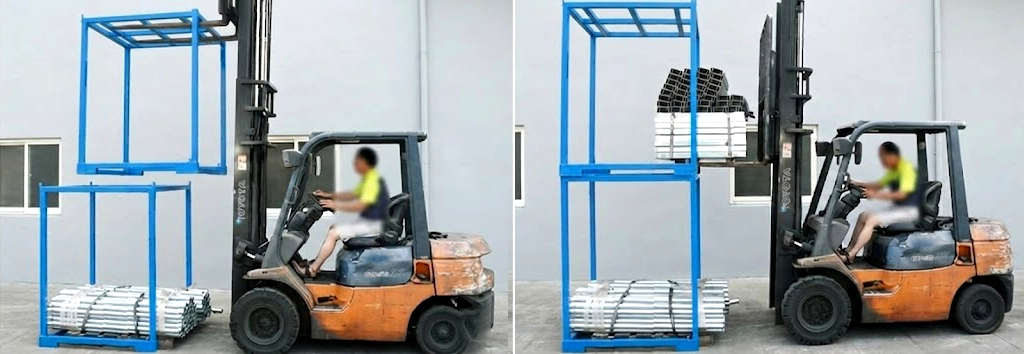
| Empty handling | Can nest when empty | Posts and bars can be removed for compact return and storage |
| Extra use | Dedicated stacking and transport frame | Base can be used as a mechanical-hand/robotic palletizing bottom support |
| Project sample weight | 61 kg | 75 kg |
- Use existing 1100 × 1100 mm plastic pallets as a starting point for layout confirmation.
- For a project sample, boxed wet wipes at 600 kg per pallet were planned for three storage levels; this is not a universal rated capacity.
- All dimensions, tare weight and load requirements are confirmed against the pallet, cargo height, forklift and stacking layout before production.
Match the Stillage to the Work Pattern
STABLE + COST-FOCUSED
Inverted Stack Rack
The fixed welded frame is the straightforward route for repeated stacking and forklift handling. It gives the project a rigid load path, costs less than the more configurable alternative in the sample comparison, and nests when empty.
Empty-rack nesting
Project sample: 61 kg
FLEXIBLE + REUSABLE BASE
Demountable Post Pallet
The base, posts and hanging tie bars separate. Remove the posts when the unit must return as a compact base or be reused as a bottom support for a mechanical hand or robotic palletizing process.
Two post plates plus tie bars for tall loads
Project sample: 75 kg
CHECK THE HANDLING CYCLE
Need a Side-by-Side Quote?
When your operation mixes fixed stacking, empty return and robotic palletizing, request both structures against the same pallet and cargo data. The comparison should include height, post reinforcement, nesting sequence and forklift entry.
Custom load review
Custom surface treatment
Which Route Fits Your Operation?
Choose inverted for fixed, repeatable stacking
Select the welded inverted frame when the pallet footprint and stacking pattern are stable, the rack will stay assembled, and direct rigidity matters more than disassembly.
Choose demountable for base reuse
Select the post-pallet route when the base must do more than carry a stack: it can be separated and used as a bottom support for a mechanical hand or robotic palletizing workflow.
Reinforce tall demountable loads
For higher cargo, a four-single-post arrangement can be prone to movement. The project approach uses two post plates connected with hanging tie bars; the exact reinforcement is confirmed from the cargo height and handling forces.
Do not choose from tare weight alone
The 61 kg inverted and 75 kg demountable figures are project samples, not standard values. Structure, dimensions, attachments and finish change tare weight, so compare the complete use cycle instead.
Turn Your Preference into a Buildable Specification
Share the pallet and cargo
Provide pallet size, cargo footprint, total cargo-plus-pallet height, single-pallet weight and the number of storage levels.
Choose the operating route
Tell us whether the priority is a fixed welded inverted stack rack, a removable-post base, or a side-by-side quotation for both.
Verify handling and stability
We check forklift entry, post layout, tie-bar reinforcement for tall loads, pallet support points and empty nesting or disassembly sequence.
Confirm finish and return plan
Confirm indoor, cold-store or moisture exposure, surface treatment, packaging and the container or flat-bed loading plan before release.
Questions Before You Choose a Stack Rack System
Is the inverted stack rack a standard size?
No. Rerack is project-customized around the pallet footprint, cargo height, forklift entry, stacking level and nesting clearance. Published project dimensions and weights should not be treated as a single standard SKU.
Why is the demountable option heavier in the sample?
The referenced project sample is 75 kg for the demountable option versus 61 kg for the inverted option. The figures reflect those structures only; tare weight changes with dimensions, reinforcement, attachments and finish.
Can a demountable post pallet carry a high load?
It can be designed for the project, but a taller load needs a stability review. The referenced approach uses two post plates and tie bars rather than four unsupported single posts. Final geometry and any additional reinforcement must be confirmed before manufacture.
When is nesting more important than disassembly?
Choose the inverted welded frame when assembled empty units need to nest quickly for warehouse recovery or return transport. Choose demountable posts when reducing the base footprint or reusing the base as a robotic palletizing bottom support is the stronger priority.
Can the 600 kg, three-level example be applied to every Rerack?
No. The 600 kg per pallet, 1100 × 1100 mm plastic pallet, boxed wet-wipe load and three-level plan are project reference conditions from one inquiry. They are not a universal rated capacity. Request a project review for your load.
What should I send for a comparison quote?
Send pallet size, cargo weight and height, intended stack level, handling equipment, empty-return method, environment and whether robotic palletizing is required. We can then compare both structures on the same basis.
B2B Racking Structural Engineering Calculator
Input your structural guidelines below. Our math system calculates material deflection, stress bounds, and recommends optimal profiles.
Click Compute to calculate stress factors and display structural drawing recommendations.