
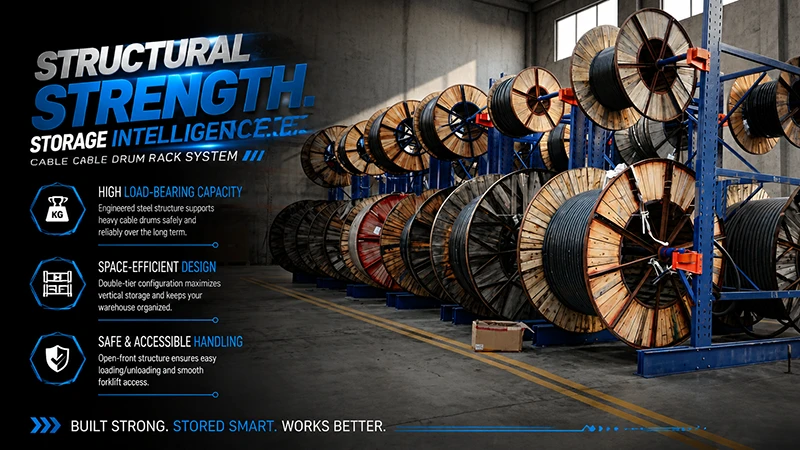
Two different machines are offered under the same three words. One is a storage rack that gives each drum a fixed location and lets a forklift place it there and take it out. The other is an A-frame unwinding stand that holds a single reel at working height so cable can be pulled off continuously. Buyers who treat them as the same purchase end up with a storage structure that cannot feed a line, or with an unwinding stand with no place to store the other thirty reels.
The decision is a process decision, not a price decision. If the problem on your floor is footprint, mixed reel diameters and drums moved twice, you are buying storage — Carack is a modular steel cable drum rack with adjustable reel supports and optional roller-bearing supports. If the problem is feeding a machine, you are buying unwinding hardware. This comparison describes what each device actually does, where the boundary between them really runs, and how you can check which one your location needs first.
What each device actually solves
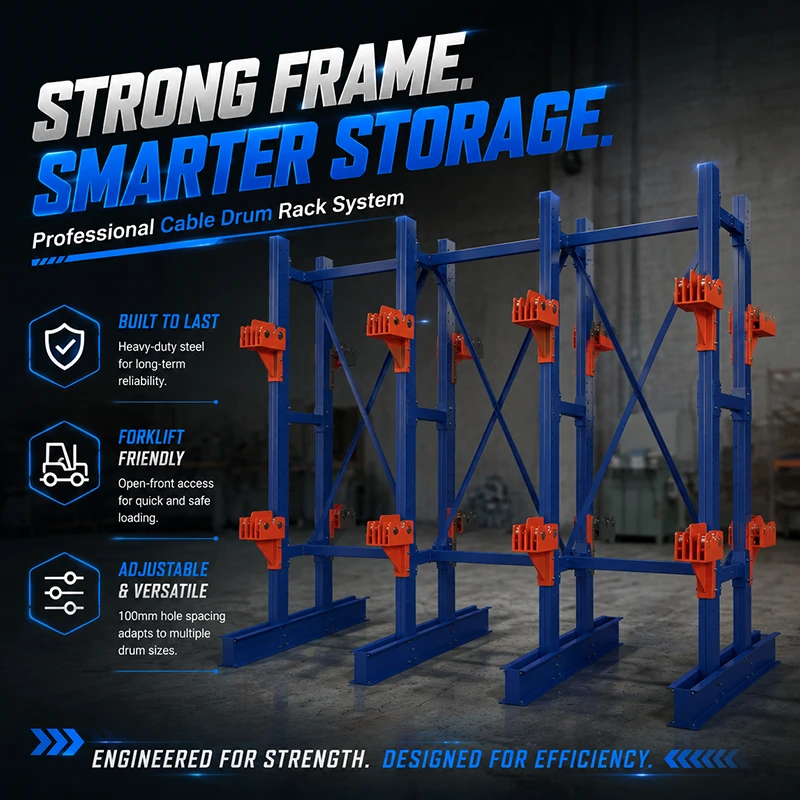
A cable reel storage rack is an inventory structure. It is intended to keep many reels off the floor in fixed bays, separate them by diameter, weight, cable type or production status, and keep each reel liftable by forklift. Carack is built as a rigid steel frame of main frames and auxiliary frames, with reel support brackets at selected levels. The auxiliary frames are not free-standing units; they lean on the main frame, and that is why the number of bays is a layout decision rather than a standard number off the shelf.
An A-frame unwinding stand is a process device. It holds one reel — sometimes two — at the point where the cable is pulled off, at a working height and orientation that suits the run. It is sized to the job in front of it, not to the size of the reel population behind it.
| Beslispunt | Cable reel storage rack | A-frame unwinding stand |
|---|---|---|
| Primary task | Keep many reels off the floor in fixed positions | Hold one reel where cable is unwound |
| Number of reels it is sized for | The stored inventory; one fixed layout alone delivered 12 positions for Ø800 mm reels plus 48 positions for ø500 mm and Ø600 mm reels in one row | Usually one reel, at the machine or the cutting and measuring section |
| How the reel moves | All the way in and out with the forklift | Reel is placed once, then the cable runs off it |
| What determines the sizing | Reel diameters and weights, aisle width, forklift approach, level splitting | Working height, unwinding direction, run distance |
| Constructie | Bolted main and auxiliary uprights with support brackets at selected levels | A-shaped frame with a spindle or shaft |
| Take part of a reel off | Only possible where roller-bearing supports are specified for that position | The normal operating mode |
| Not designed for | Powered unwinding, tension control, automatic measuring or cutting | Holding a mixed reel inventory |
When a cable drum storage rack is the right answer
Choose storage when the problem is the reel population, not the feed. Mixed diameters are the clearest signal: on one fixed project the customer's reel list ran from about 500 kg to 3,000 kg per reel, with diameters from Ø737 mm to 2,007 mm and reel widths from 610 mm to 1,118 mm. One universal level height would have wasted the rack, so the design was split into two groups — a two-tier group with four positions per frame unit and a single-tier group with two positions per frame unit, both about 3,002 mm high. The special upright profile carries mounting holes at 100 mm spacing, which makes such a split adjustable at installation rather than fixed at the drawing stage.
Aisle width is the second signal. On another fixed layout the rack measured 9,630 × 1,200 × 3,150 mm, with the bottom level sized for Ø800 mm reels and the upper levels for Ø500 mm and Ø600 mm reels. In an area of 10 × 4.3 m, two rows would have left only about 1,550 mm of aisle, so the proposal used one row per area. A storage rack is only usable if the truck can still get to it, so the aisle check belongs to the rack decision, not to a later site meeting.
Storage is also the answer when the reel has to leave the rack and be placed on a mobile trolley. That is a handling question, not a rotation question: it depends on confirmed fork clearance and support geometry for the specific reel and truck. One fixed customer conversation confirmed that removing a reel from the rack and transferring it was a current concern — it did not confirm that a final design had solved the clearance problem, so this must be verified per configuration rather than assumed.
When an A-frame unwinding stand is the right answer
Choose an unwinding stand when one reel has to feed something continuously. The stand stands next to the machine, the coating line or the cutting and measuring station, and its whole purpose is to let the cable run off the drum with low friction in the direction the process needs. It is positioned for the run.
It is not inventory. A stand does not separate reels by diameter or cable type, does not give the yard a callable location for thirty drums, and does not shorten the forklift ride to the far end of the hall. If the requirement on your floor is continuous unwinding into a machine, a storage rack by itself will not deliver that — that is a different device category and must be offered as such. Likewise, if reels are stacked on the floor because they have no positions, an unwinding stand will not fix the footprint.
Om expliciet te zijn over de grens: Carack is een vaste, modulaire stalen opslagstructuur. Het is geen geautomatiseerde kabelcarrousel, geen kabelopwikkelmachine en geen aangedreven afwikkeleenheid.
Waar de grens vervaagt: Rotatie binnen het rek
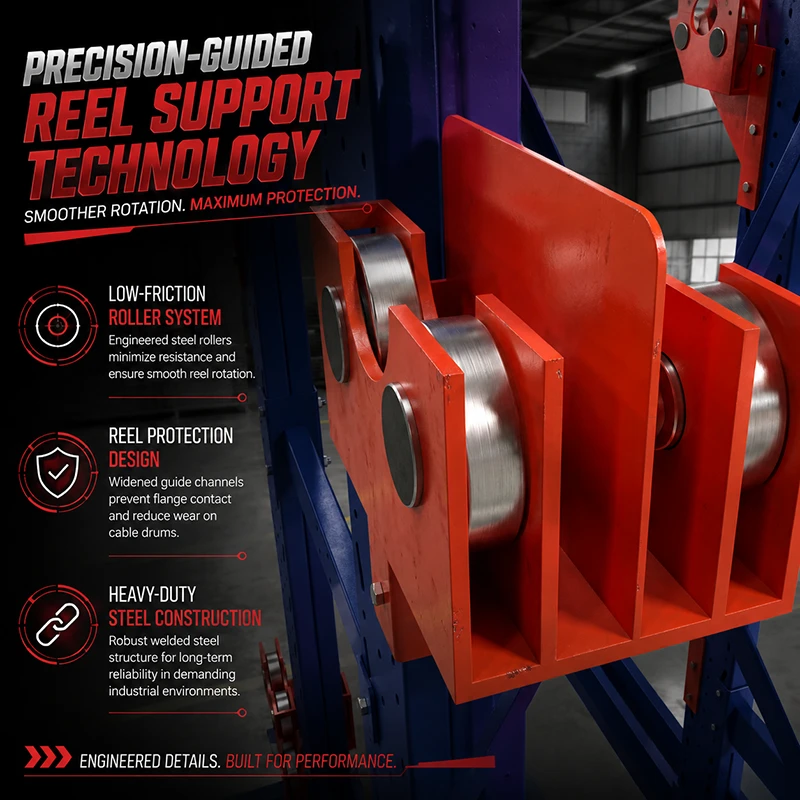
Carack kan worden gespecificeerd met rollager haspelsteunen. Waar die steunen zijn gespecificeerd, kan een haspel in zijn positie roteren en kan kabel worden afgetrokken zonder de hele trommel neer te halen. Die optie is de reden waarom de twee productcategorieën door elkaar worden gehaald, en het is de moeite waard om de beperkingen duidelijk te stellen.
De rotatieondersteuning is er voor gedeeltelijke afname, niet voor continue productieafwikkeling. Er is geen aandrijving, geen spanningsregeling, geen accumulatie en geen meet- of snijfunctie in het rek, en of de geometrie geschikt is voor uw haspel, uw vrachtwagen en uw gangpad moet worden bevestigd in de offerte of de tekening voor die configuratie. Bij een geregistreerd buitenproject werd de rollagerondersteuning gespecificeerd samen met thermisch verzinken, wat laat zien hoe de twee beslissingen — afnamemethode en afwerking — samen worden genomen in plaats van afzonderlijk.
Snelle beslissingschecklist
- Tel de haspels die vandaag geen positie hebben. Veel haspels en gemengde diameters wijzen eerst op een opslagrek.
- Vraag of de haspel in zijn geheel wordt opgehaald en verplaatst. Gehele trommelafhandeling met heftruck wijst op een opslagrek.
- Vraag of één haspel continu een proces moet voeden. Continu afrollen bij een machine wijst op een afwikkelstandaard.
- Vraag of een deel van een haspel eraf moet zonder de trommel te laten zakken. Gedeeltelijke afname wijst op een opslagrek met rollagersteunen, positie per positie bevestigd.
- Meet het gangpad en de heftruckbenadering voordat de lay-out wordt getekend — een plan met twee rijen in een gebied van 10 × 4,3 m liet slechts ongeveer 1.550 mm gangpad over op een geregistreerd project.
- Check the finish against the location. Hot-dip galvanizing was requested on a registered outdoor storage project; the field needs an approved corrosion protection specification.
Veelgestelde vragen
Can a cable reel storage rack replace an A-frame dereeling stand?
No. A storage rack gives each drum a defined location and keeps it retrievable; an A-frame stand exists to let cable run off a reel continuously. Where a work roller is specified with roller bearing supports, a reel can rotate in place for partial take-off, but that is not the same job as feeding a line. In most plants the two are used together — the rack stores, the stand dereels.
Which should I buy first?
Look at which problem costs you the most today. If reels are on the floor, taking up workspace and being moved twice, buy the storage side first: it solves locations, diameter separation and forklift access. If a tank needs to feed a machine and cable is being dragged across the floor from a drum, buy the dereeling device. If both are true, follow the rack first, because a dereeling stand still needs a reel brought to it.
What can't the rack do that a dereeling machine can?
Carack is a fixed, modular steel storage structure with optional roller bearing supports. It has no drive, no tension control, no accumulation and no metering or cutting function, and it is not an automated cable carousel or take-up machine. If your specification calls for powered or tension-controlled pay-off, that is a different machine category and should be quoted separately.
Decide with your own reel list
Start with the process, not the hardware. If your reels need positions, adjustable supports, and a forklift approach that works in the aisle you actually have, then the storage side of this equation is your project. If a reel must feed a line, that is the pay-off side. Send the reel diameters, reel weights, aisle width, and the handling equipment you use, and the level split, support positions, and finish can be dimensioned around them instead of guessed.
Heeft u een op maat gemaakte opslagoplossing nodig?
Spreek rechtstreeks met onze technische ingenieurs. Wij bieden gratis constructieontwerpen, evaluaties van zwaar belaste catalogi en snelle B2B-prijsopgaven.
Vraag nu een offerte aan →