
How Sebox changes the empty-return equation in internal circulation loops
In an internal circulation loop, the container is not a passive box. It decides how much space you lose when it returns empty, how fast operators can stage the next batch, and whether the loop feels neat or congested. That is why a collapsible cage pallet is often compared with a non-collapsible cage: the load task may be similar, but the return footprint is not.
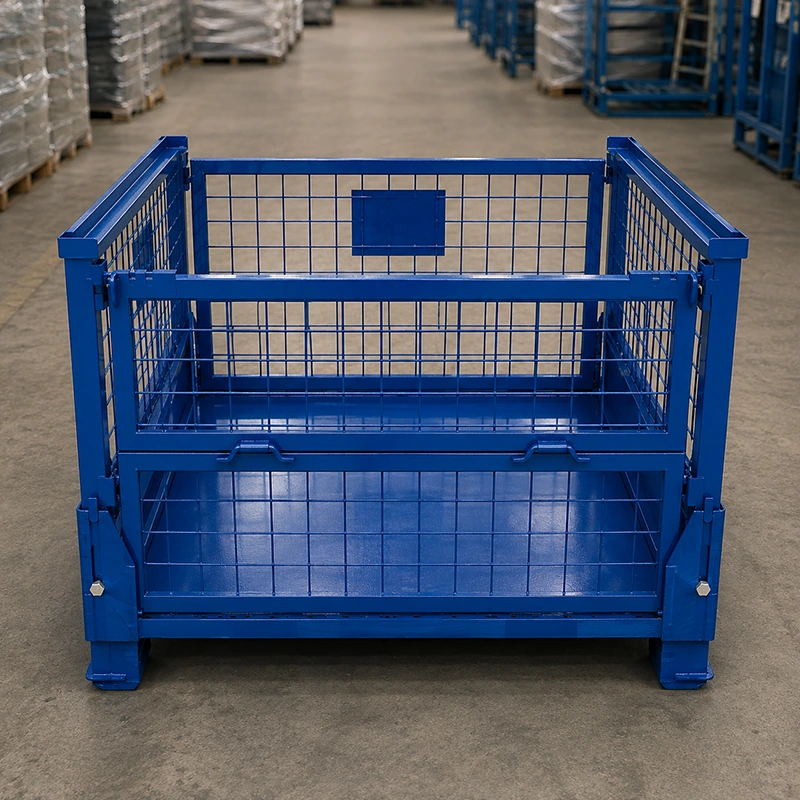
For Sebox, the core difference is simple. When erected, it behaves like a metal pallet box or collapsible stillage for heavy parts containment; when folded, the empty unit drops to a much slimmer profile. If your warehouse or shuttle route runs on repeat, that difference starts showing up in floor space, loading density, and handling rhythm.
Return volume: the folded unit changes the empty-trip equation
A fixed cage returns at almost the same height every time. That means the empty-trip cube stays close to the working cube, so every return leg consumes more rack space, dock space, and truck space than it needs to. Sebox, by contrast, folds down to 1000 × 800 × 335 mm in the documented standard configuration, versus 1000 × 800 × 840 mm erected. In practical terms, that is a large reduction in idle height before you even start stacking the empty units.
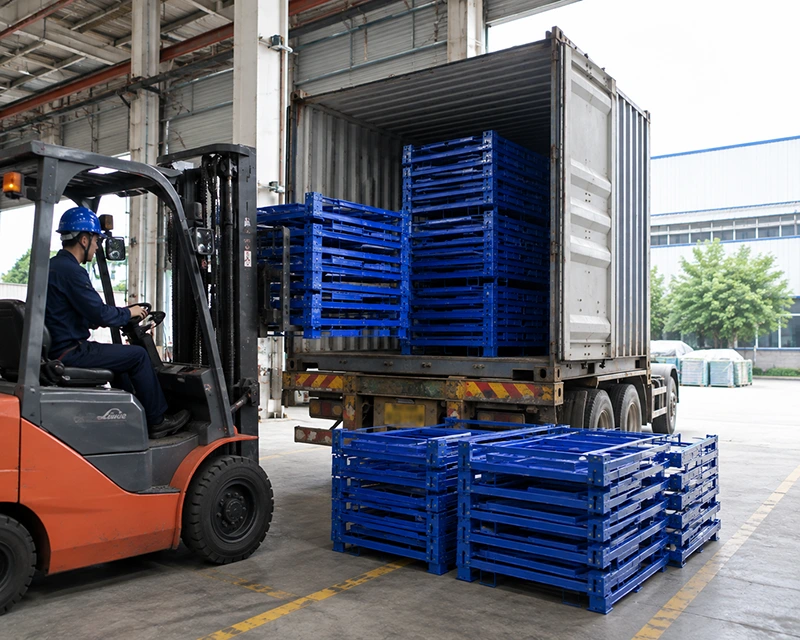
This is why the folded state matters more than the nominal load rating when the loop is dense. If the empty boxes are staged for the next shift, sent back from a downstream plant, or loaded into a return container, the folded cube can reduce the amount of air you are shipping. In project terms, the space saving is often discussed as a range rather than a promise, because it depends on stacking pattern, return packaging, and whether you can nest or stack the folded units safely. In many real loops, the folded box can mean roughly 60% to 80% less occupied space than the erected state.
How cycle frequency changes total owning cost
Total owning cost is not only about purchase price. In an internal circulation system, it is also driven by how many times the container moves, how often it returns empty, and how much handling time each cycle consumes. A low-frequency loop may tolerate a fixed cage because the empty return leg is rare. But once the loop runs every day, or once the same box shuttles between production, storage, and outbound logistics, the return cube becomes a recurring cost driver.
That is where the foldable structure earns its place. With Sebox, the operator can collapse the box after unloading, reduce staging congestion, and move a larger number of empty units in the same return slot. If the loop is long, the savings compound: less floor area at the destination, fewer trucks or smaller containers devoted to empty returns, and less manual reshuffling in the dock area. None of that needs a heroic assumption; it only needs frequency. The more often the box completes the cycle, the more the empty-return volume begins to influence the real cost of ownership.
The same logic also explains why the product is not a universal answer. If the unit spends most of its life full, rarely moves empty, or stays within one local area, the folding benefit shrinks. In that case, a fixed cage can remain the simpler choice because it removes the extra fold/unfold step and avoids changing operator habits.
When a non-collapsible cage is still enough
There are real situations where a fixed cage is good enough. If you use the bin as a stationary buffer, if the goods are not returned upstream, or if the loop is short and the number of empty moves is low, the extra mechanism of a collapsible stillage may not be the main value. Some plants prefer the simplest possible container when they are mostly storing parts inside one building and do not need to reclaim floor space from empty units.
But once the business problem shifts from “can it hold the parts?” to “how much does the empty box cost me every week?”, the comparison changes. Sebox is built for that second problem. The welded steel structure, forklift pockets, half-drop front gate, and stackable form are meant for repeat handling, not just static storage. If your operation has frequent empty returns, limited staging space, or containerized outbound logistics, the foldable design usually has the edge.
Where Sebox fits in practice
Use a collapsible cage pallet when you need a reusable unit for heavy parts containment, visual inventory, and reverse logistics. It is a strong fit for automotive parts, machining workshops, warehouse bulk storage, closed-loop distribution, and overseas container shipping. The benefit is strongest when the box moves often and returns empty often.
- High-frequency internal circulation with empty backhaul pressure
- Production-to-warehouse or warehouse-to-warehouse transfers
- Floor space constraints at the receiving dock or staging area
- Projects that need a foldable metal pallet box but still want open visibility
Want the detailed comparison and product fit guidance?
Need a Custom Storage Solution?
Speak directly with our technical engineers. We offer free structural designs, heavy-duty catalog evaluations, and quick B2B price quotations.
Request a Quote Now →