
The outbound leg gets all the attention: how many metal pallet boxes fill the container, what each one weighs loaded, how the forklift picks it at the far end. The return leg is where closed-loop plans usually break, because that is the leg you pay for with nothing inside the box. If the empty container volume is never planned, the loop quietly costs the same as a one-way shipment.
For the Sebox collapsible cage pallet on the 1000 × 800 mm footprint, the folded profile is about 1000 × 800 × 335 mm against roughly 840 mm erected. That single folded figure — not the load rating and not the mesh pattern — is what a return plan is built from. This article turns it into a container count, a stack column height and a cost comparison that will survive a budget review with your finance team.
First Decide Which Empty-Leg Option You Are Actually Buying
Three different return strategies get sold as if they were the same thing. A fixed steel bin returns at full height, so every empty trip costs the same cube as the loaded trip. A fold-flat body, such as this collapsible pallet box, returns as a flat pack at the 335 mm pitch. A knock-down body — bolted panels and posts dismantled, or posts pulled out of the base — returns as a bundle of panels plus a base plate, which is flatter again per piece but costs more handling time on both legs.
The Sebox documentation describes both fold-flat bodies and bolted detachable assembly for transport, so the purchase order has to name which one you are quoting. The plan below assumes a fold-flat body in the 1000 × 800 × 335 mm folded configuration. If your supplier quotes a detachable-post variant, the column height and the container count change, and so does the labour line.
What drives the choice is not the catalogue page. It is how many return cycles the loop runs per year, who pays the return freight, and whether the same container can be re-planned instead of running on a fixed schedule. Under roughly two cycles a year, folding rarely earns its hinge and latch hardware; at weekly or fortnightly cycling, the empty-leg cube becomes the largest single number in the logistics budget.
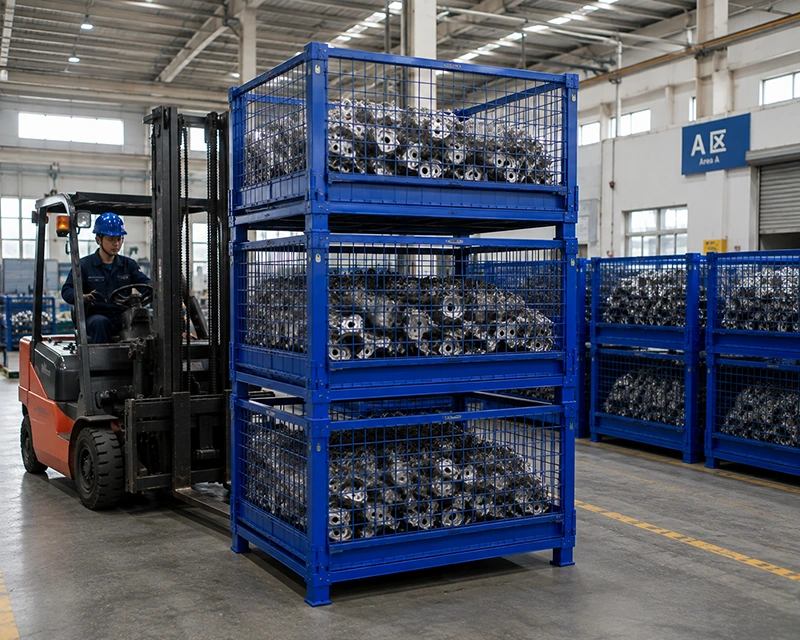
Converting 1000 × 800 × 335 mm Folded Boxes Into a Container Count
The calculation is simple geometry, but the assumptions have to be stated or the number is worthless in a negotiation. Work it in five steps and keep the assumptions next to the result.
- Step 1 — plan area. One folded box occupies 1.00 × 0.80 = 0.80 m² of container floor.
- Step 2 — columns across the width. A container gives roughly 2,350 mm of internal width. Two columns of 1,000 mm take 2,000 mm and fit; the remaining ~350 mm carries nothing, because it is narrower than the 800 mm footprint.
- Step 3 — rows along the length. Roughly 5,900 mm of internal length gives 7 rows at 800 mm per row on a 20GP; roughly 12,000 mm gives 15 rows on a 40ft high cube.
- Step 4 — columns per floor layer. 2 columns × 7 rows = 14 columns in a 20GP; 2 × 15 = 30 columns in a 40HQ.
- Step 5 — tiers. One folded column runs to about 2,150 mm, the height discussed in the next section. Against roughly 2,390 mm of internal height on a 20GP that is one tier, not two, and the door opening matters as much as the internal height.
Multiply step 4 by the units per column and you get the first-pass count: about 98 folded boxes in a 20GP and about 210 in a 40HQ, before packing loss, dunnage and any mixed load. Plan with 90 to 98 for a 20GP until your forwarder has checked the loading sequence, and treat every one of these figures as an estimate on the approved packing plan rather than a booking promise.
One rule matters more than the arithmetic: do not move counts between variants. Our own source files record loading examples of 56 units in a 20GP for one larger footprint and 70 units for another, and those numbers belong to those footprints only. The 1000 × 800 × 335 mm folded box is calculated on its own dimensions, and a count copied from a different variant is how buyers end up short at the container door.
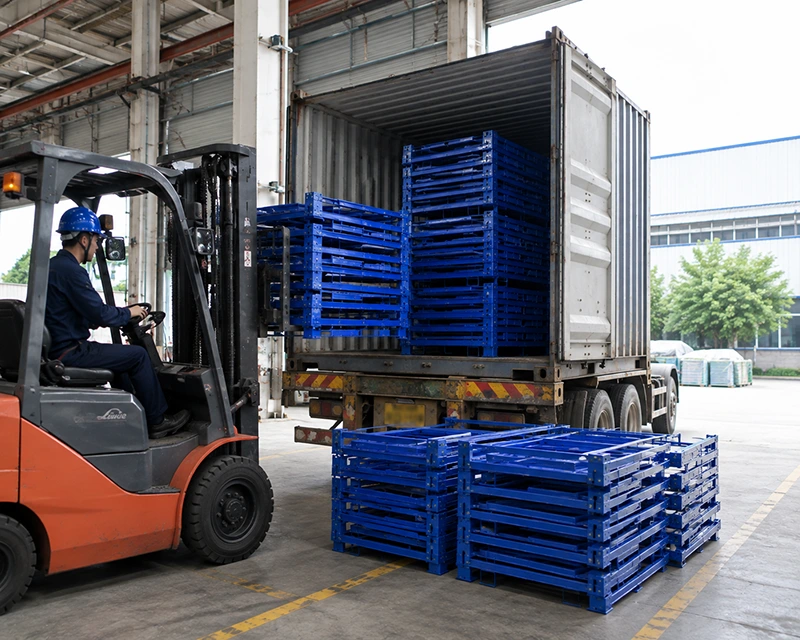
Seven Folded Boxes as One Column of About 1000 × 800 × 2150 mm
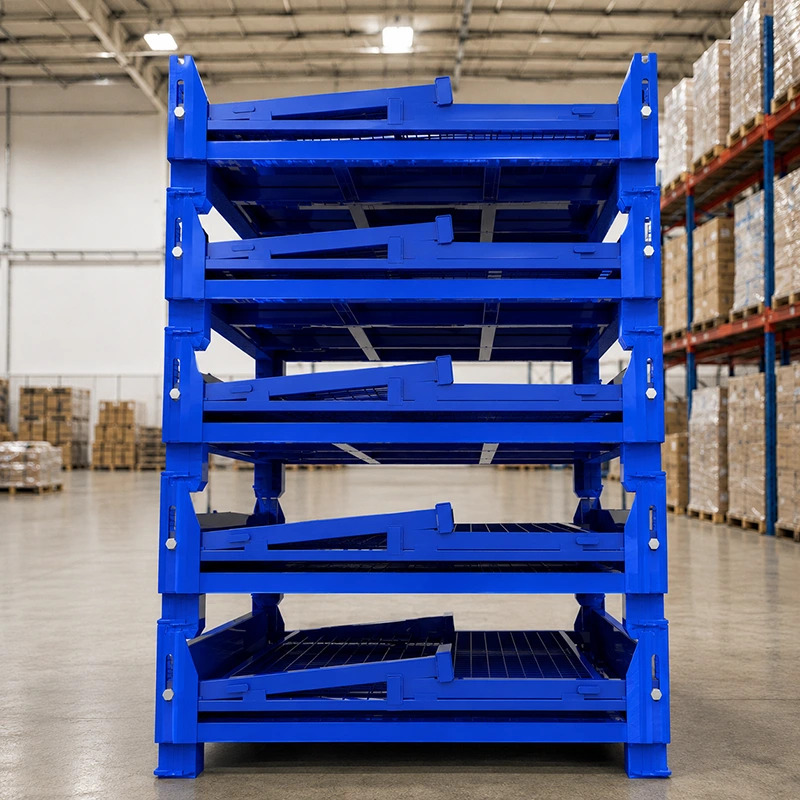
The practical planning unit is not a single flat pack; it is a banded column. A seven-unit column is about 1000 × 800 × 2150 mm, which is the figure used in the container calculation above. It is worth checking the arithmetic behind it, because it tells you where the risk sits: seven units at 335 mm each add to 2,345 mm, not 2,150 mm. The shorter figure only holds if the folded frames nest into each other by about 30 mm at each interface and the banding pulls the column down.
That 195 mm difference is not a detail. If nesting is confirmed on the approved drawing, a 2,150 mm column passes a 20GP door opening of roughly 2,280 mm and sits comfortably inside the 2,390 mm internal height. If nesting is not confirmed, the column runs at 2,345 mm, which barely clears internal height and will not walk through the door upright. In that case the honest options are six units per column (about 2,010 mm) or laying the column flat and losing the tier benefit entirely.
Stability of the folded column comes from three habits rather than from the box itself. Every unit goes into the column in the same fold orientation so the frame edges, not the mesh, carry the load down through the stacks. Two steel straps per column with corner protectors keep the interfaces closed during road transit; a single strap lets the top units rotate. Column heights stay equal across the container so the load is level, and the columns are braced against the container walls or dunnage instead of being left free to walk.
Do not confuse this with a stacked-load rating. The 3 to 4 recommended layers for this variant apply to erected, loaded boxes, and the fold pattern under an empty box is a different structure. A folded column height of about 2,150 mm is a packing figure, and the crush limit of the folded frame should be confirmed before anyone stacks anything on top of it.
The Return-Cost Arithmetic to Take to Finance
Return savings are usually quoted as a percentage, which hides the assumptions. Rebuild the number in four lines and each assumption becomes visible.
- Line 1 — effective folded pitch. Column height ÷ units per column: 2,150 mm ÷ 7 ≈ 307 mm per box, or 335 mm per box if nesting is not confirmed.
- Line 2 — return volume per box. 1.00 × 0.80 × 0.307 ≈ 0.25 m³ folded, against about 0.67 m³ for the same box erected at 840 mm.
- Line 3 — return ratio. 307 mm ÷ 840 mm ≈ 0.37, so the empty box takes roughly 60 to 63 percent less cube than the erected body. Our own source files mention a 60 to 80 percent band for the family; that band spans different box heights, and at 840 mm erected the geometry cannot reach 80 percent, which would need a pitch of about 170 mm. Use the calculated number for this variant, not the top of the range.
- Line 4 — trips and unit cost. Total folded cube ÷ usable cube per container gives the trips; trips × freight per trip, plus handling and strapping, divided by the units in the loop, gives return cost per unit. Compare that with the fixed-bin baseline and subtract the added fold-and-strap labour hours.
Two effects decide whether the percentage reaches the budget. Weight does not shrink: this variant is about 57 kg per unit, so a 20GP of folded boxes is volume-limited at roughly 5 to 6 tonnes and payload is not the constraint — confirm that with your forwarder for your route. And cube only converts into money when the return leg is the binding constraint. If a truck or container already runs under-filled on a fixed weekly schedule, folding frees space without removing a trip, and the saving appears only when the volume crosses the next container threshold.
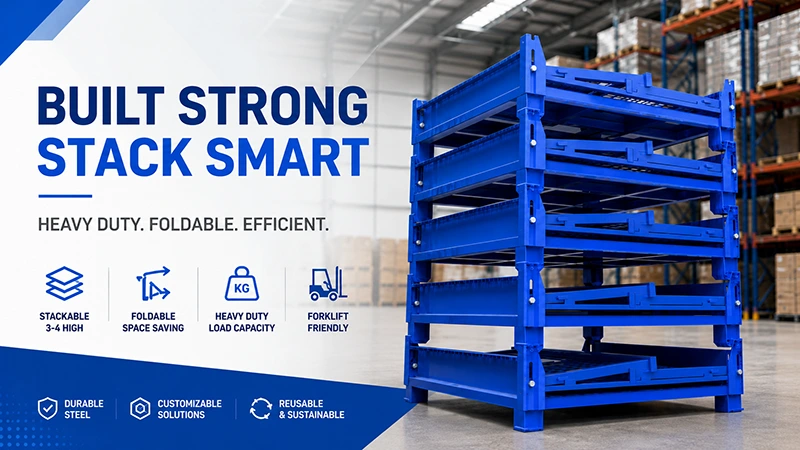
Where a Folded Return Plan Is the Wrong Answer
- Low cycle counts. Below roughly two return cycles a year, the hinge and latch hardware and the extra fold time cost more than the cube you recover.
- A return leg that is not the constraint. If the empty leg already runs on a fixed schedule with spare space, the volume reduction improves tidiness, not cost.
- Fines, swarf and oil. Mesh bodies let small particles and coolant through; solid-panel bodies contain them but add weight and hinge points. Either way the column height has to be recalculated for the panel set you choose.
- Height-limited routes. A 2,150 mm column plus dunnage leaves little margin under a 20GP internal height, and the door opening — not the internal height — is what stops the taller straight-multiplied column.
- Automated loading cells. Where a robot or a dedicated gripper loads the container, a rigid body throughout the cycle is often required and the fold step moves to a manual station.
- Mixed fleets. Folded columns and fixed bins cannot share one container count. Calculate each type separately and add the container totals.
What We Need to Produce Your Return Load Estimate
We can build the column layout, the container count and the folded-to-erected ratio for your loop, but it has to be computed on your box, not copied from another variant. Send the box variant and load per unit, the number of units in the closed loop, return cycles per year, the lane and carrier, the container type you can actually book, the panel and gate configuration, and how much labour you have for folding and strapping. If the return leg can be re-planned rather than run on its existing schedule, say so — that single answer changes the result more than any other input.
Return Logistics Questions Buyers Ask
How many folded 1000 × 800 × 335 mm boxes fit in a 20GP?
On this folded footprint the geometry gives 14 columns per floor layer at seven boxes per column, about 98 boxes, so plan with 90 to 98 until the loading sequence and dunnage are confirmed. The count is specific to the 1000 × 800 × 335 mm folded configuration and is not transferable to the larger variants in the family.
Can seven folded boxes really be stacked into one column?
Yes as a planning unit of about 1000 × 800 × 2150 mm, provided the frame nesting that delivers the 2,150 mm height is confirmed on the approved drawing. Each column needs two straps with corner protectors, a consistent fold orientation and equal height alongside its neighbours. Without confirmed nesting, plan six boxes at about 2,010 mm or the 2,345 mm straight stack.
How do I calculate the saving on the empty return leg?
Divide column height by units per column to get the folded pitch, multiply it by the 1000 × 800 mm footprint to get return cube per box, and compare that with the erected volume at 840 mm. For this variant the ratio is about 0.37, roughly 60 to 63 percent less cube. Then convert cube into trips at your container utilisable volume, multiply by freight and handling per trip, and subtract the added fold-and-strap labour.
Need a Custom Storage Solution?
Speak directly with our technical engineers. We offer free structural designs, heavy-duty catalog evaluations, and quick B2B price quotations.
Request a Quote Now →