
The box has been ordered and the forklift in your aisle is the forklift that has to move it. That is the point where the questions stop being general: do the tines reach far enough into the base, does the channel mouth clear the tine thickness with the box sitting on the floor, do the tines land under the fork channels rather than between them, and is the truck still rated for that mass with the load sitting that far forward.
For a long collapsible steel stillage, none of those answers come from the box’s own length and load figures. They come from matching four tine dimensions against four base dimensions, and from treating the forklift capacity plate as a review of its own. This article works through that comparison on the 16263 scheme, and states plainly which lines in that scheme are still open.
What the 16263 scheme records, and what it still leaves open
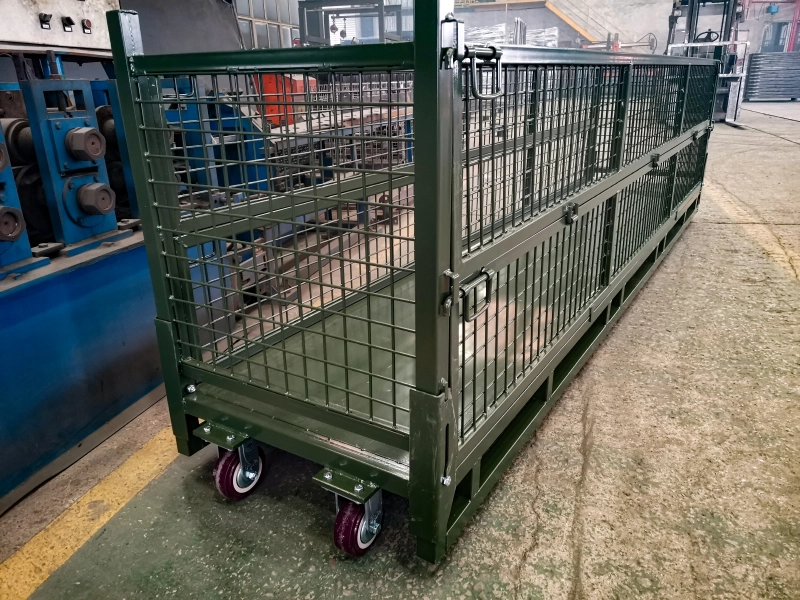
The brief behind opportunity 16263 asked for an internal length of 3200 mm, an external width of 1150 mm, a total height not exceeding 915 mm, and a base that carries wheels and forklift channels. The technical scheme answers with an outside size of 3340 x 1150 x 915 mm, an inside size of 3200 x 970 x 590 mm, a tare of about 185 kg, a load of 1000 kg, three stacking layers and 42 units per 40HQ.
The base is welded as one piece, and the scheme reserves dual-direction forklift channels with the stated aim of keeping the centre of gravity balanced while the truck moves. The folding gates sit on the two sides of the 1150 mm width direction and are held by gate pins, able to open half or full; the gate drawing in that record is a principle illustration, not the final structure of this design.
Three lines in the same record are still open: whether the four sides and the base are mesh or steel plate, whether electrostatic powder coating is acceptable, and whether 1000 mm of forklift channel spacing suits the buyer’s truck. That last line is the reason the fork check belongs before a drawing is released rather than after the boxes arrive.

Check the tines first: length, thickness and spread
Measure the truck, not the catalogue. Three tine dimensions decide whether a 3340 mm long base can be picked cleanly, and each one fails in a different way.
| Truck dimension | Where to compare it on the box | What goes wrong when it does not fit |
|---|---|---|
| Tine length, heel to tip | The base dimension along the entry axis, and how deep the reserved channel runs into the base | Short tines leave part of the load in front of them, so the box is carried as a cantilever instead of being supported under its mass |
| Tine thickness and tine width | The clear height and clear width of the channel mouth, measured at the mouth itself | A tine that will not enter at the mouth will not enter further in, and forcing it damages the base edge and the finish |
| Tine spread, centre to centre and inner gap | The position of the reserved channels across the base | Tines landing between channels put the load on the underside sheet or the mesh instead of the channel structure drawn to carry it |
Two further checks belong in the same pass. Take the clear entry height at the channel mouth with the box standing on the floor, and take it again after a caster set is fitted: on this scheme the wheels are supplied unbolted and installed on site for shipping volume, so the base band changes between delivery and service. Then check that the carriage, backrest and mast clear a body 915 mm tall when the load is pulled back against the carriage.
Measure the set you actually have. A worn heel, an added backrest extension or a rented replacement truck can each change the numbers you are comparing against, and the channel spacing you confirm should be confirmed against that measured set.
Which faces may be entered: two, not four
The 16263 record reserves dual-direction forklift channels. Two-way entry is not four-way entry. A dual-direction base is drawn for approach from the two opposing faces of one axis; the other two faces were not drawn as entry faces, and nothing in this record supports presenting them to a truck.
Which axis carries the channels still has to be read off the approved drawing. The record states that dual-direction channels were reserved, not which pair of faces they sit on, and that is a separate line to confirm alongside the proposed 1000 mm channel spacing.
The gates complicate the same layout in a useful way. They sit on both sides of the 1150 mm width direction, so the face a truck enters and the face a picker opens are two separate decisions. A box parked with its entry face toward the aisle may be showing its gates to a wall; a box parked gates-out may be blocking its own fork channels. Record both faces, then set the floor layout around them.
Rated capacity and load centre are two separate reviews
A forklift capacity plate states a capacity at a stated load centre. Move the mass further forward and the usable capacity falls, because the tipping moment rises. A 3340 mm long box with the load sitting toward the far end is not the same lift as a 1200 mm pallet carrying the same mass, even on the same truck and even with the same number on the plate.
That is why the two figures are different in kind. The 1000 kg in the 16263 record is the load the box is designed to carry. The capacity available on your truck at the actual load centre, after any tine extension, attachment or lift-height derating, is the truck manufacturer’s figure and governs the lift. We do not substitute for that review, and a box load figure must never be read as permission to lift it.
Height belongs in the same review. With three layers recorded on this scheme, a truck picking a two-high stack is handling a higher centre of gravity than one picking a single box, and any derating for lift height applies to the whole stack rather than to one box in it.
The three cases the same truck has to meet
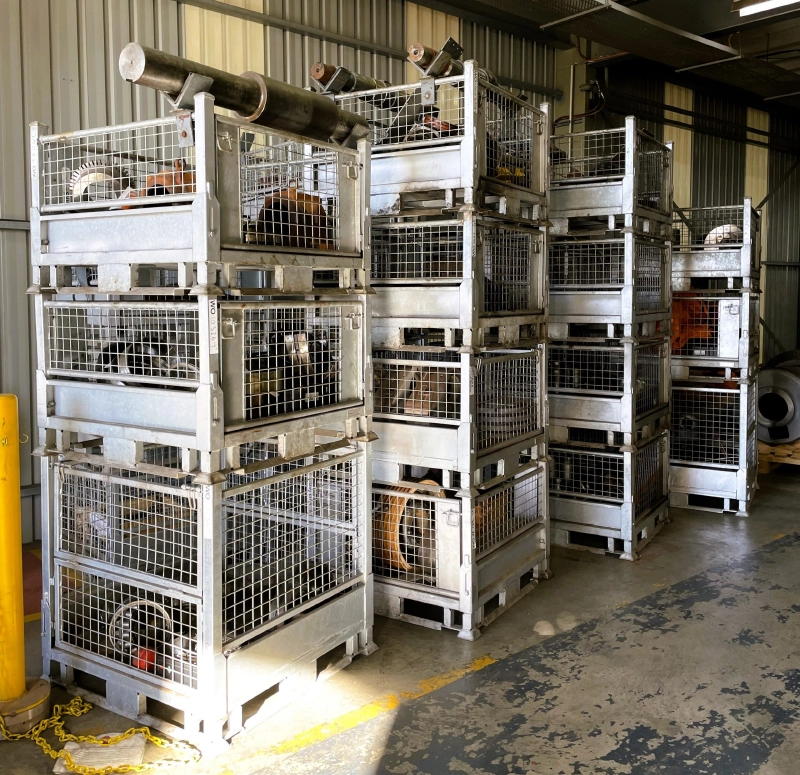
An empty box, a loaded box and a folded stack present different numbers to the same forklift, and the entry check has to be run for whichever case actually occurs in your building.
Empty. At a tare of about 185 kg the capacity question is rarely the constraint, but the geometry still is: this is the case where the box sits lowest on the floor and where the channel mouth is measured. It is also the case in which a box shifted alone is most likely to be picked on tines that reach too little of the base.
Loaded. Close and pin the gates before the lift, so the load cannot spread toward an open face while the box is in the air, and check the loaded centre of gravity along the 3340 mm length rather than assuming it sits in the middle. A load biased to one end is also a parking decision, not only a lifting one.
Folded. With the panels folded down the truck sees essentially the base, so the channel geometry is unchanged, but the folded stack height and the number of bases in one lift are site variables that have to be confirmed against your own stack and aisle.

What to send us for an interface evaluation
- Tine length from heel to tip, tine thickness and tine width, and the centre-to-centre and inner-gap spread of the truck you will use
- Clear entry height measured at the channel mouth, once with the box on the floor and once with the caster set fitted
- The capacity plate value, the lift height you expect, and whether a stack will be picked rather than a single box
- The entry direction you intend to use, and whether any aisle genuinely needs a four-way base
- The loaded centre of gravity: where the mass sits along the 3340 mm length, and how high it reaches
- Which face gates will be opened at, if picking happens while the box is parked in its storage position
With those six lines on one page, the fork interface can be checked against the base drawing before release, and the open channel-spacing line can be closed with a measurement instead of an assumption.
Where this check decides the order
- A plant standardising on one extra-long steel stillage across several departments that all use different trucks
- An existing forklift fleet that will not be replaced when the new boxes arrive
- Loaded transport where the box has to be picked from a trailer deck as well as from the warehouse floor
- Aisle layouts where the gates must face the picker and the fork channels must still face the truck
Frequently asked questions
Our truck is 1150 mm wide and the box is 3340 mm long. Will it pick the box up?
The truck’s width is not the deciding number. What decides it is whether the tines reach far enough into the reserved channel to carry the mass rather than cantilever it, whether the channel mouth clears the tine thickness, and whether the capacity plate still covers the load at that centre. Measure the tines and read them against the drawing; the box length alone answers none of the three.
Is a dual-direction base the same as a four-way base?
No. Dual-direction means entry from the two opposing faces of one axis, which is what the 16263 record reserves. Four-way entry is a different base and has not been quoted on this scheme; if your aisle layout needs it, ask for it in writing so it is drawn, priced and checked rather than assumed.
The record says 1000 kg. Does that mean our truck can lift 1000 kg of box?
Those are two separate reviews. The 1000 kg is the load the box is designed to carry in the 16263 scheme. The capacity available to your truck at the real load centre, at your lift height and with your attachments, comes from the truck manufacturer’s capacity plate. Satisfying the first says nothing about the second.
Is the 1000 mm channel spacing fixed?
No. The 16263 record lists it as a point to confirm with the buyer, alongside whether the sides and base are mesh or plate and whether powder coating is acceptable. Measure your tine spread first, then confirm the spacing against it on the drawing.
Next step
Send your tine dimensions, the entry direction you intend to use and the loaded centre of gravity, and we will assess the fork interface against the base drawing before it is released. The wider Mybox range, including the extra-long and double-bay builds shown above, is described on the collapsible steel stillage product page. If the load itself has not been fixed yet, the related reading on confirming the load before a drawing or sample is released sets out the order that check should follow.
Need a Custom Storage Solution?
Speak directly with our technical engineers. We offer free structural designs, heavy-duty catalog evaluations, and quick B2B price quotations.
Request a Quote Now →