
How to Fit More Motorcycles Into One Showroom or Garage Bay
If your floor is full but the bikes are still coming, the problem is rarely inventory alone. It is usually layout. A steel motorcycle pallet system like Mtrack turns each loose motorcycle into a fork-handled logistics unit, so the same floor can hold more bikes without turning the room into a dead-end maze.
The key idea is simple: stop treating every motorcycle as a free-standing object that needs open floor around it. With the right pallet geometry, a bike sits on one defined position, can be moved by forklift, and can be stacked or stored in a controlled way when the project calls for it. That is why dealers, clubs, and private collectors often look at motorcycle pallet rack storage only after the floor starts to feel cramped.
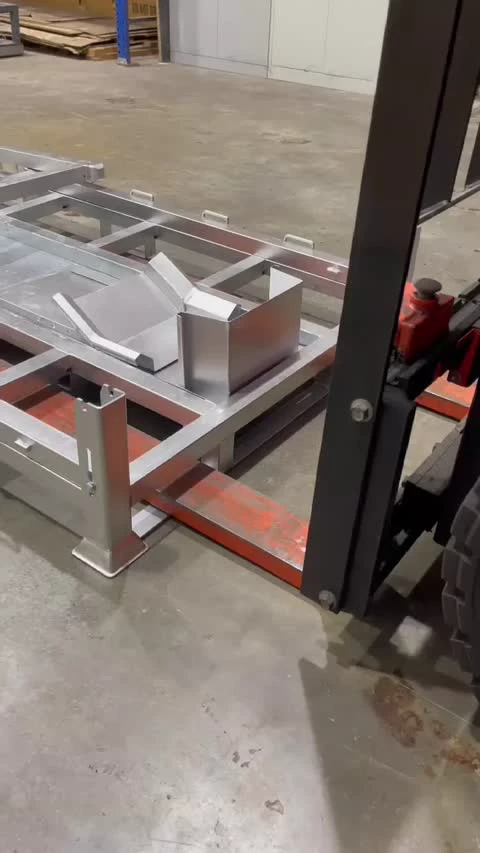
Mtrack is not a generic warehouse pallet and it is not an enclosed crate. It is a steel base frame designed around motorcycle loading, wheel location, strap restraint, and fork access. Final size, load, and stacking behavior still depend on the motorcycle envelope, handling direction, storage policy, trailer or container limits, and how the bikes will be retrieved later.
1. Turn floor space into lanes, not random parking
In a showroom or garage, wasted space usually appears in the gaps between bikes, at the wall, and at the end of each row. Once a motorcycle is parked on a pallet with a fixed footprint, the room becomes easier to grid out. The bike no longer floats on the floor. It occupies one defined slot, and the remaining space can be planned for access, rotation, display, or staging.
This is where the pallet approach saves more than a few square meters. It also reduces the friction of moving a motorcycle in and out of storage. Forklift access makes the unit part of the logistics chain instead of a one-off parking problem. Reference project sizes, weights, and fork openings vary, but the design principle stays the same: the pallet should match the motorcycle and the route, not the other way around.
2. Fit starts with motorcycle geometry, not guesswork
Not every model behaves the same. A cruiser, a sportbike, and a touring machine may all fit very differently because of wheelbase, overall width, handlebar span, and total height. That is why Mtrack is specified by project review, not by a single universal claim. The right setup may use wheel grooves, ramps, front-wheel locating or clamping, U-shaped strap hooks, and fork openings that match the handling plan.
If the fleet mixes models, the question is not just whether a bike fits on the base. It is whether the bike can be loaded, restrained, stacked, and retrieved without forcing the operator into awkward moves. In practice, that means checking the motorcycle envelope, the route width, the rack depth, and the available lifting direction before the pallet is finalized. If those inputs are clear, the storage plan becomes much easier to scale.
That is also where the difference between a real motorcycle pallet and an improvised flat pallet becomes obvious. A flat pallet can carry weight, but it does not automatically solve wheel location, front-wheel restraint, or repeated handling. Mtrack is built for the motorcycle first, then the storage environment.
3. Why it is different from a fixed rack
A fixed rack keeps bikes in one permanent position. That can work when the same layout never changes, but it also locks you into one storage logic. Mtrack is different. It can be moved by forklift, adapted to the handling direction, and configured for fold-down or removable posts when empty-return volume matters. In a storage room, that flexibility matters as much as raw capacity.
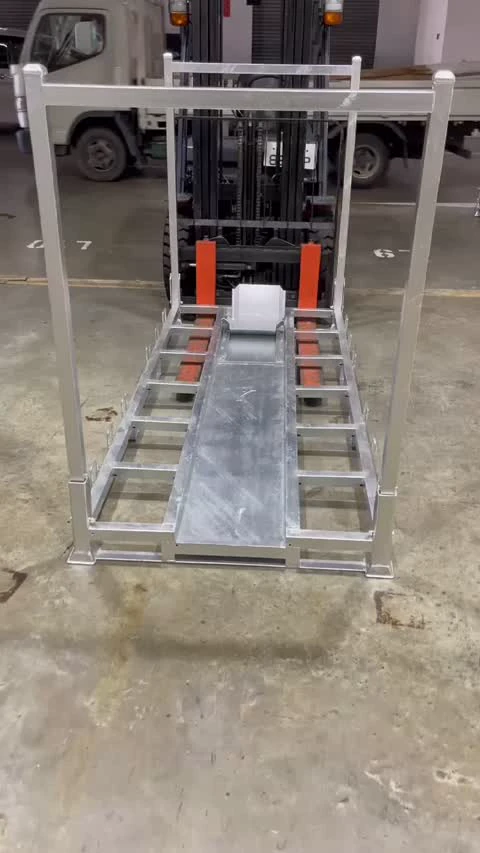
Fixed racks may look simple, but they can waste room during reconfiguration, create awkward retrieval paths, and leave you with dead space when the fleet changes. A pallet-based system gives you more control over floor use, trailer loading, empty storage, and return transport. Reference working loads in project files include 250, 350, and 500 kg per pallet, but those figures are always subject to design review rather than a universal promise.
There is one more practical point: Mtrack is not meant to erase normal restraint requirements. The motorcycle still needs to be secured correctly. The value is that the pallet gives you a repeatable framework for doing it, instead of asking the operator to improvise every time.
Where Mtrack fits best
- Dealer and distributor transfers where forklift handling is faster than manual parking.
- Club, racing, and event storage where bikes must be staged, moved, and loaded repeatedly.
- Private collector storage where floor space is tight and retrieval order matters.
- Mixed storage programs where stacking policy, empty-return size, and bay layout need to stay flexible.
FAQ
Can one Mtrack design fit every motorcycle?
No. Fit depends on the motorcycle envelope and the handling plan. Wheelbase, width, height, fork direction, and restraint method all matter. Mtrack is configurable, but the final layout still needs project review.
Is it suitable for outdoor storage?
Only for covered or short-term transfer use when the support plan matches the site. Prolonged rain is not advised because water can remain inside tubes and lead to internal rust over time.
Need a Custom Storage Solution?
Speak directly with our technical engineers. We offer free structural designs, heavy-duty catalog evaluations, and quick B2B price quotations.
Request a Quote Now →