
Most line-side empty container problems start with the return leg, not the delivery leg. Loaded boxes arrive on a schedule. Empty ones leave whenever somebody has time, so they accumulate beside the station, in the aisle, or in a temporary zone that keeps growing until a supervisor marks it with tape. The usual answer is a rack reserved for empties or a fenced staging area — floor space bought for a container that carries nothing.
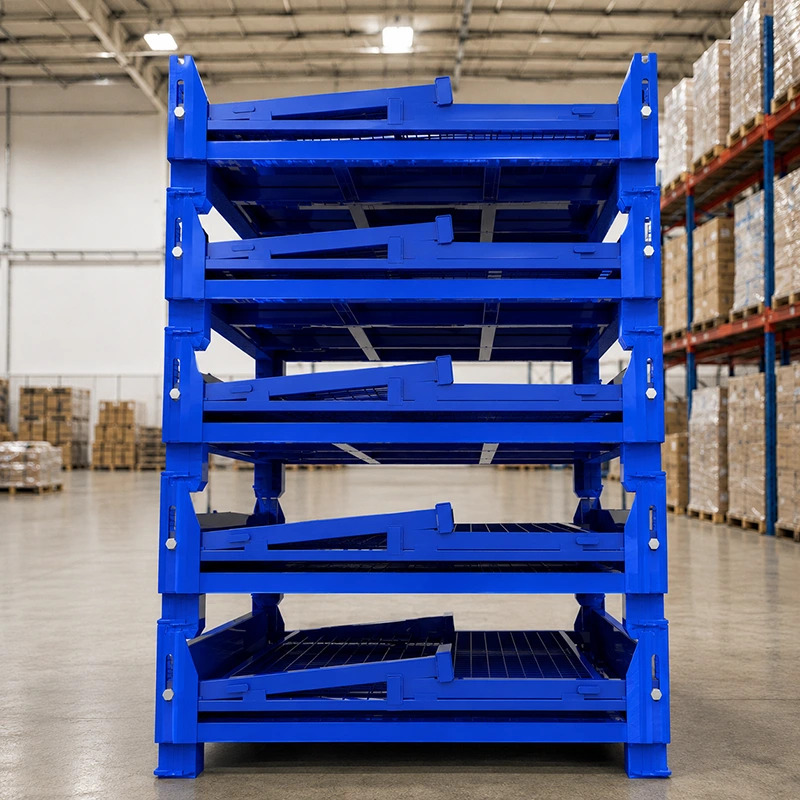
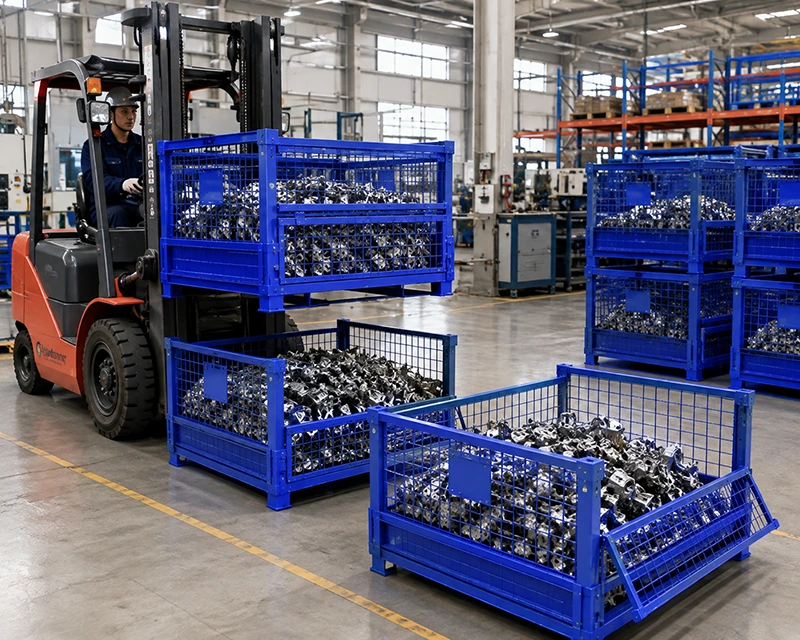
A collapsible cage pallet changes that arithmetic because the same unit serves both states. Loaded, a Sebox metal pallet box is a rigid contained unit that goes to the line by forklift. Empty, the side gates fold down and the same unit becomes a flat stackable block. One packaging system covers the loaded leg and the empty leg, which is what makes it possible to park empties inside the footprint the line already reserves instead of next to it. What follows is where that works, where it is conditional, and where a rack or a dedicated area remains the correct answer.
Getting Folding Boxes Into an Existing Line-Side Layout
The entry point is a position, not a new zone. Pick the spot where a loaded pallet already lands at the station and treat it as a two-state position: loaded unit in, folded unit out, at the same stop. Because a folded Sebox keeps its pallet footprint — Variant C stays at 1000×800 mm, Variant A at 1220×1015 mm — it occupies floor that the line has already conceded to pallet traffic. What changes is the height envelope: the folded profile is stated as 335 mm for both of those schemes, against a working height of 840 mm and 950 mm respectively.
Two decisions have to be taken before the position means anything. First, who folds the unit — the operator who empties it or the handler who collects it — because a unit that nobody owns stays open and eats the same floor as before. Second, whether empties leave in the same handling movement that brings the next loaded unit, which is what turns a growing pile into a closed loop of fixed size. A half-drop front gate supports the first decision: parts come out at working height without lifting over the side or dismantling the stack. None of this removes the need for a marked position and a housekeeping rule; it changes what that position has to be sized for.
Casters or No Casters: Which Transfer Mode Each One Suits
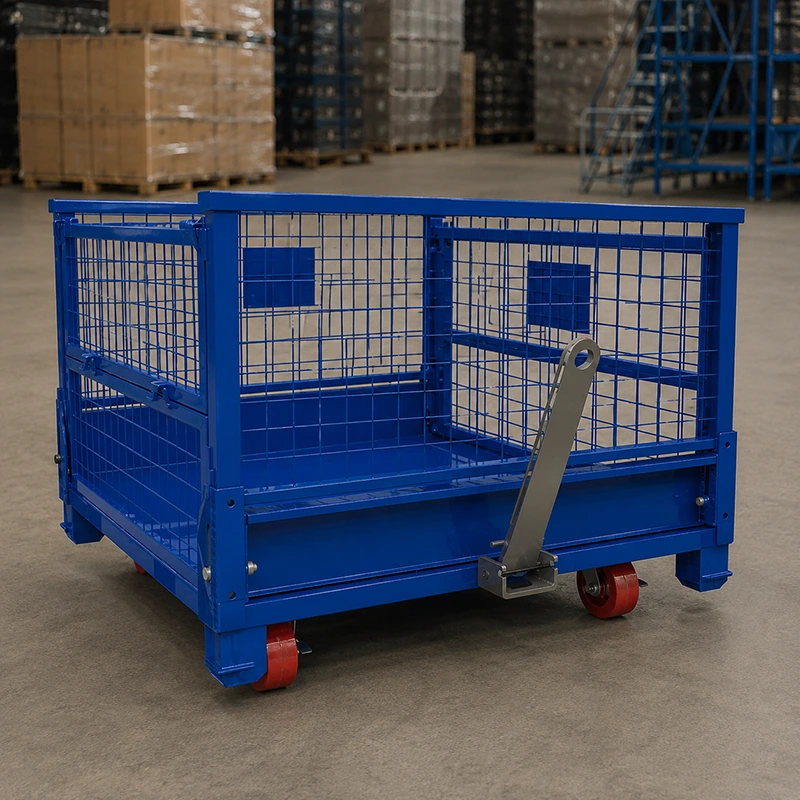
Sebox is built either with pallet-style feet and forklift pockets or with an optional caster set, and the choice decides how empties are moved far more than how loads are moved. Without casters, the unit is a palletized article: it is picked by forklift or pallet jack, and a folded block of several units is handled as one liftable stack. That suits routes where a truck already passes the station and where the empty block can be collected on the same trip as the next delivery.
With casters, the unit is pushed by hand or towed — a tow arm appears on pictured configurations — which suits short, level transfers between two fixed stations where taking forklift time is impractical. The trade-offs are real and belong in the layout: casters add standing height to every unit in a stack, wheel condition and floor joints decide how much load one person can push, and a folded block of several units should not be treated as a pushable trolley. Mixed fleets are common: casters on the line-side units that shuttle between stations, plain forklift-base units for the ones that travel in stacks.
How Stacking Height Is Confirmed On Site
Stacking is where published figures get misused. Two different numbers are involved: the load a single unit is designed to carry and the limit on what may be placed above it. The Sebox schemes differ on the first — around 1000 kg on Variant C with a 3 to 4 layer recommendation, about 1300 kg on Variant A and 1500 kg on Variant B — and one technical source quotes a 5 m maximum stacking height while another works in layers. Those statements are not interchangeable, and none of them can be lifted into a plant layout without a site confirmation.
Four checks settle the height in practice. Floor point loading under the base feet, which is not the same thing as a distributed floor capacity. What the upper units actually are: a folded unit weighs a fraction of a loaded one, so a folded block and a loaded stack do not share a limit. The lift height and free-lift of the truck that has to place and retrieve the top unit at that position. And access — a stacked unit still needs room for a person to open a half-drop gate at the lowest level, so aisle clearance limits stack height as much as structure does.
Folded height is the one figure that can be quoted with confidence per scheme: 335 mm per unit on Variant C and Variant A, with the folded block reverting to the same footprint as the loaded box. How many folded units may go into one block is a separate question and must be fixed against the specific build and the handling method, not inferred from the folded height.
When a Rack or a Dedicated Area Is Still the Right Answer
Folding solves volume, not governance. Cases that still need structure or reserved floor include: empty peaks that swing with shift pattern or season beyond what the marked position can hold; site rules that cap stack height at shoulder level or restrict floor point loads in that bay; units that must stay dry, under cover, or separated by part family for damage inspection between loops; folded blocks that exceed what the available truck or attachment can lift in one movement; and any position where a folded block would obstruct a pedestrian route or an escape path. Where a plant’s own standard requires rack-supported storage for containers, that standard stands — a foldable box does not override it.
A workable compromise is often a small marked floor position for the everyday empty count plus one scheduled collection per shift, with the rack or staging area kept only for the peak. That keeps the dedicated space sized for a peak event rather than for average daily accumulation.
- Assembly and sub-assembly stations where loaded units arrive by forklift and empty units must leave the same stop
- CNC and machining cells where one palletized unit absorbs the WIP buffer and the empty return leg
- Two-station loops where a castered or towed unit replaces a forklift trip between machining and assembly
- Closed-loop logistics and return freight, where folded units travel as a stacked block instead of open containers
Questions Buyers Ask Before Changing a Line-Side Layout
Can a folded box replace the empty-container rack completely?
Sometimes, not by default. It removes the need for a rack reserved only for empties when the folded block fits inside a footprint the line already keeps for pallets, and when the empty count is stable enough to sit in a marked position. Folding reduces height and return volume; it does not reduce floor footprint, so a position is still required. If the empty peak is unpredictable or the site sets stack limits, part of the reserve stays.
How many empty units fit in one folded stack?
Folded height alone does not answer that. A 335 mm folded profile per unit is a single-unit figure from Variant C and Variant A; the number of units per block depends on the upper-load limit of the build, the base and floor condition, and how the block is lifted and set down. Confirm it against the specific scheme before the position is dimensioned.
Do casters make sense at line side?
For short, level routes between two fixed stations, where manual push or a tow arm removes a forklift trip — yes. For anything that ends in a folded stack, or where floor joints and ramps make pushing heavy, the plain forklift-base version is the more predictable choice.
Requesting a Line-Side Parking Layout
To turn this into a usable layout, send the line-side area drawing or its dimensions, the peak number of empty boxes counted at shift change, and how empties leave the station today. From those three inputs we return a parking proposal stating the folded footprint and block height, the handling mode it assumes, and the point at which the position stops being sufficient and reserve space has to be added.
Need a Custom Storage Solution?
Speak directly with our technical engineers. We offer free structural designs, heavy-duty catalog evaluations, and quick B2B price quotations.
Request a Quote Now →