
A high-turnover warehouse does not lose the count because the counter is slow. It loses it because every box has to be opened before anyone knows whether it is worth opening: gate unlatched, load face disturbed, box re-closed, stack re-checked, forklift held in the aisle. Where parts arrive on an open pallet or in a fully closed steel bin, the person at the counting station has no information until the containment is opened.
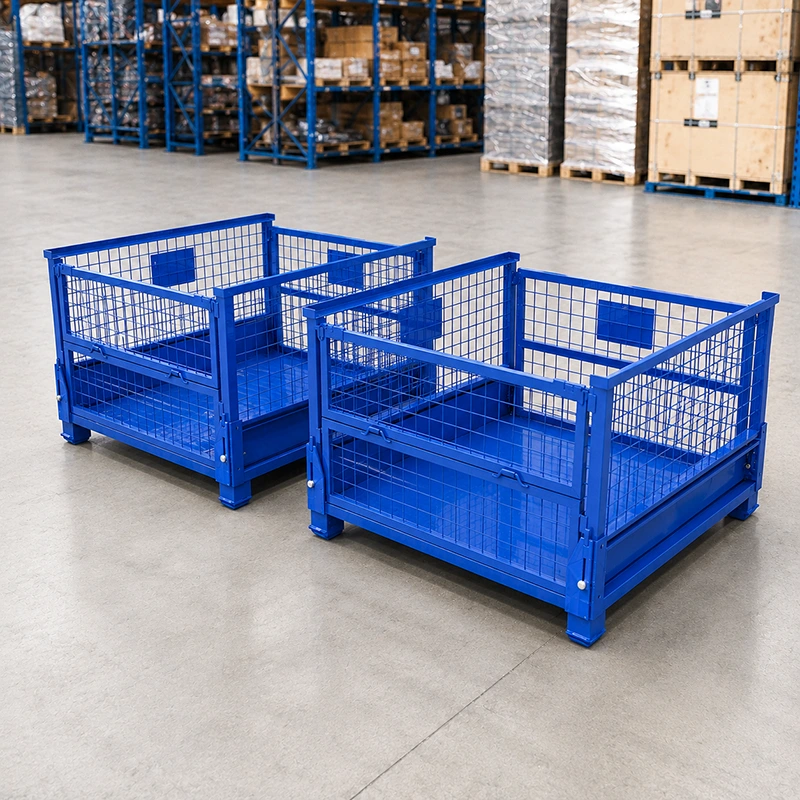
A Sebox collapsible steel pallet box can be built with welded wire mesh panels on the sides and gates instead of solid sheet steel. That changes what the counting station can do from the aisle, and it changes which boxes get opened at all. What follows is deliberately narrow: an open grid lets a checker read a box before touching it. It does not count parts, and it does not replace a physical count where a number has to be signed off.
Why an open steel grid reduces the number of boxes opened
The useful distinction is between reading a box and counting a box. Reading means establishing fill level, part type and obvious condition through the mesh while the unit is still closed, stacked and latched. Counting means establishing a quantity that will be recorded. A mesh-sided metal pallet box supports the first and leaves the second where it belongs.
In practice the reduction in opening comes from triage. A checker walking a block of stacked stillages can separate units that are visibly near empty, visibly overfilled, visibly mixed with a different part number, or visibly leaning and distorted from units that show a normal load face and can be released on a documented spot-check. Only the flagged units are opened. On a line that checks the same block every shift, the difference is not a faster count of each box; it is fewer boxes entering the count at all.
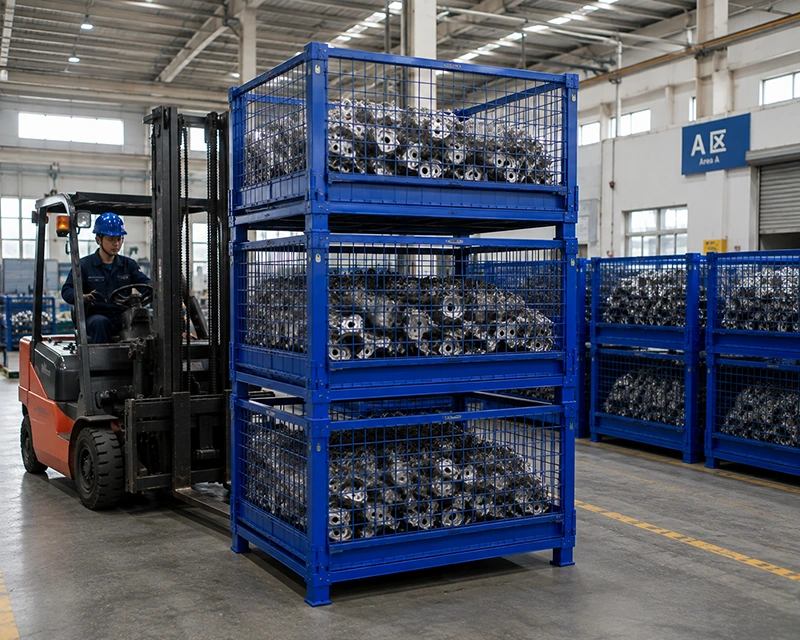
The stack position matters as much as the panel type. Mesh on the sides and front gate keeps a lower unit readable when loaded units sit above it, which is the case where a closed steel bin gives nothing away. Where a customer needs the load readable at three levels, that is a structural request, not a counting-tool request: the mesh, post spacing and gate arrangement are confirmed per build.
Mesh panels against solid steel panels: the difference at the counting station
Both enclosure types are documented on the same product family, and they answer opposite questions. A wire mesh enclosure answers what is in the box. A solid sheet enclosure answers what stays in the box.
- Mesh panels: the load face is visible from the aisle, so fill level and part type can be read without opening. The same aperture that provides the sightline is an escape path for small parts.
- Solid steel panels: no sightline through the wall, so inspection means unlatching the gate or lifting the unit. The panel closes the aperture, which is why small fasteners, washers and oily turned parts are usually specified with sheet on the faces that leak.
- Mixed builds: sheet on the base skirt or lower faces and mesh above is the common compromise, keeping small parts contained at the bottom while the bulk of the load stays readable.
Two recorded builds show how far apart the two answers sit. One build is specified with roughly 5 mm wire mesh and 1.5 mm hot-rolled plate, the other with a 1 mm steel base plate. Mesh aperture, plate grade and base structure are confirmed against the drawing for the specific SKU, not taken from this article, and the current files do not publish an aperture figure. The selection rule is simple: if the smallest part in the box is smaller than the aperture, or if parts are oily and will migrate, mesh on that face is the wrong choice regardless of how useful the sightline looks at the counting station.
Inspection order through a half-drop front gate
A half-drop front gate is the reason a stacked box can be checked without dismantling the stack. The order below keeps the check short and keeps the gate from becoming a handling hazard.
- Read first, from the aisle. Fill level, part type, latch condition and any side bulge are checked through the mesh before any gate is touched. Most of the triage decision is made here.
- Confirm the stack before unlatching. The unit below must be sitting level, the locating faces engaged, and the gap to the next stack clear of forklift traffic. A gate opened on a badly seated unit is a load-containment problem, not a counting problem.
- Open the gate at the level you can actually reach. The half-drop gate hinges down and stays attached to the frame, so the panel is supported while the load face is exposed.
- Take the sample from the front face only. The open gate gives access to the face of the load, which is what a spot-check needs; it is not an invitation to reach into the body of the stack.
- Close and latch before the unit moves or before leaving the position. An unlatched gate changes what the box contains during handling and blocks the unit above.
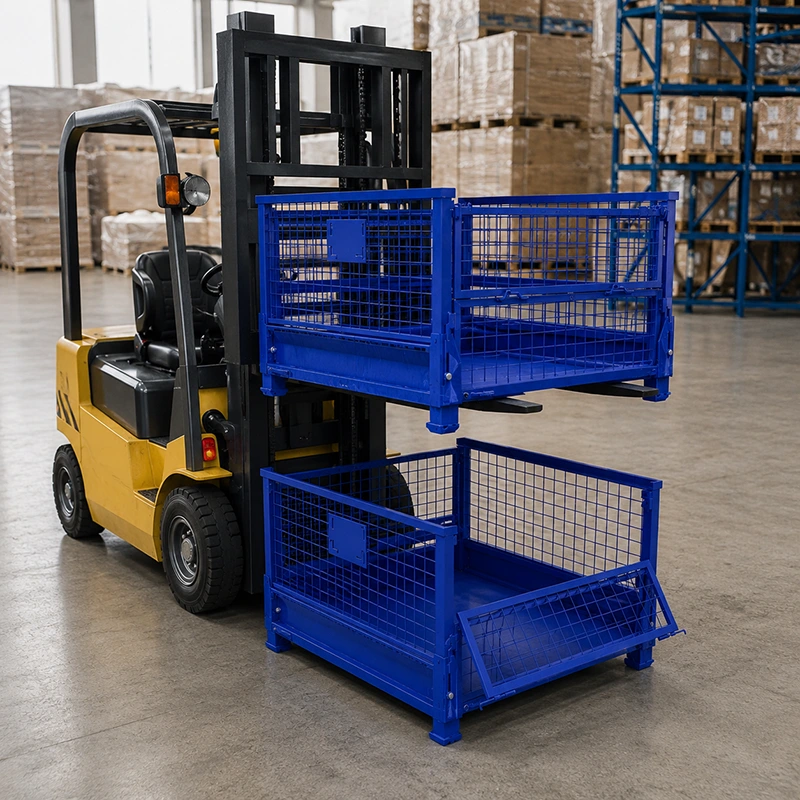
Gate arrangement is a build decision, not a default. Front gate, half-drop front gate, side gates and an auxiliary gate all appear in the product documentation, and which of them lets you reach bottom-level goods in a stack depends on the stack height and the aisle side the operator works from. That is settled before the drawing is released.
When the box still has to be opened or weighed
A sightline is not a count. These cases stay on the open-and-count or weigh path, and no mesh configuration changes that:
- Any quantity that closes a transaction: shipment release, delivery note, invoice, scrap value or customer acceptance. A recorded number needs a physical count, which means the gate open and, in a stack, usually the upper unit off.
- Mixed part numbers inside one unit. The grid shows that parts are present; it does not show how many of each, or whether two similar part numbers were loaded into the same box.
- Load verification against the rated load. Design loads recorded across the family are 1000 kg, 1300 kg and 1500 kg on three different builds, and a visual check says nothing about mass. Where the load has to be proven, the unit is weighed or verified against the loading record; the plate on one build cannot be used to clear another.
- Any out-of-pattern signal: a side panel bowing, a gate that will not latch, a stack that leans, oil pooling on the base. These stop the unit for unloading and inspection rather than a spot-check.
- Incoming or quality-hold inspection: dimensional checks, damage assessment or part-level identification that needs the load face out of the container.
Keeping the two activities separate is what makes the mesh useful. A team that treats the grid as a count will release quantities it never verified; a team that treats every box as closed will keep opening boxes it did not need to open.
Where a mesh-sided box is the wrong selection
The mesh build is not a universal answer, and it should not be presented as one. It is a poor fit when the smallest part is below the aperture, when parts are oily and small enough to migrate through the side, when the load has to be protected from dust, spray or weather, when sharp heavy scrap will strike the mesh directly, or when the buyer needs a documented standard or certification for the container. The word Gitterbox is a European search descriptor for this container type; the current product files do not evidence formal compliance with a named standard, so it is not written here as a compliance claim.
It is also not a substitute for a count system. Nothing in the mesh panel identifies a part number, records a quantity or triggers a reorder. Any labelling, barcode or colour-coding scheme has to be added and confirmed as part of the order.
What to send us before the panel type is fixed
Send the inspection frequency — how often the same box is checked per shift or per day, and whether the check happens with the unit stacked — together with the part form: smallest and largest dimension, weight per loaded box, dry or oily, and how many part numbers share one box. Add the number of stack levels and whether a gate must open while stacked. With those five answers we can say whether the box should be mesh, sheet or a mix, and whether a half-drop front gate earns its place on the build.
No opening-rate, labour-hour or counting-time figure is quoted for your site here; the current product files do not carry measured results, and a number invented for this page would be worthless in a procurement review.
Does a mesh box mean I no longer have to count?
No. The mesh lets you see fill level and part type without opening, which reduces how often a box is opened for a look. Every recorded quantity still needs a physical count.
Can one box have mesh on the sides and steel sheet on the base?
Yes, mixed enclosure is a documented configuration. Which faces become sheet depends on the smallest part dimension and on whether parts are oily, and it is confirmed on the drawing for the specific build.
Need a Custom Storage Solution?
Speak directly with our technical engineers. We offer free structural designs, heavy-duty catalog evaluations, and quick B2B price quotations.
Request a Quote Now →