
Braked Mybox for mobile picking workflows
When a Mybox is fitted with swivel casters and brakes, the box can move like a cart and stop like a fixed stillage. That sounds simple, but it solves a real floor problem: operators often need to bring small-batch goods to the line, park the container in a picking lane, then lock it in place so the team can work without hunting for a forklift every time.
For teams searching for a pallet cage with wheels or a mobile picking trolley, the question is not whether wheels are convenient. The real question is whether the workflow needs a container that can be moved by hand or by a dolly, then held steady while picking, counting, or kitting happens. This is where the braked caster option matters most.
What the wheels and brakes actually solve
A wheeled Mybox reduces short-distance handling. Instead of waiting for a truck or relying on a forklift aisle, one operator can reposition the container for line-side replenishment, supermarket restocking, or kit assembly. The brake is the difference between “easy to move” and “safe to leave in place.” Once the unit reaches the work point, the brake keeps the box from rolling while items are picked from the front or the side.
The casters are still an option, not a default. That matters because not every site wants a moving base. If the box will stay in one bay, be stacked in a fixed lane, or be lifted by forklift more often than it is rolled, a fixed foot style can be the cleaner choice. Mobility is useful only when the route between receiving, staging, and dispatch is short and repeatable.
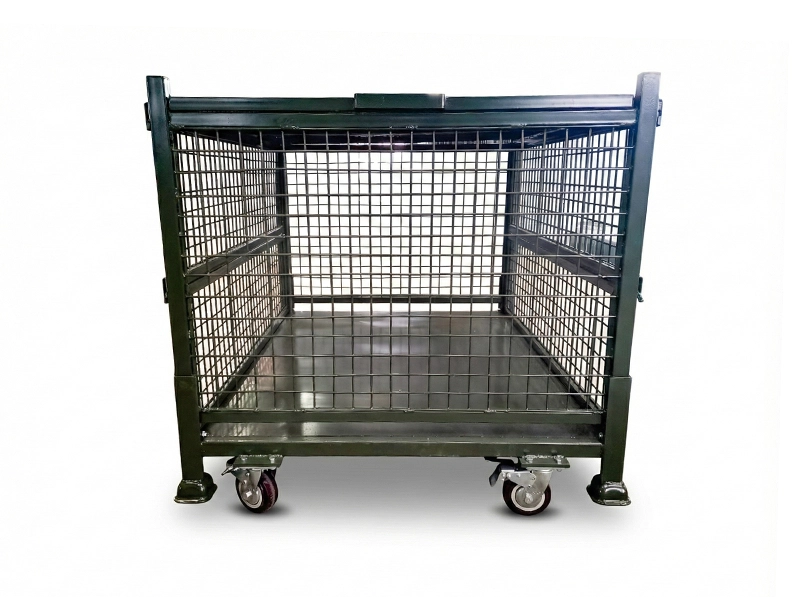
Which picking flows fit a mobile Mybox
Mobile Mybox units are best in small-batch, high-frequency flows. Common examples include line-side replenishment, kitting for assembly, warehouse storage for small parts, and order-picking zones where operators push containers from one bay to the next. In these settings, the box becomes a rolling storage crate instead of a dead-end storage point.
They also work well when the team needs to separate product families without building a full rack lane for each family. A mobile stillage can be staged near the source, rolled to the destination, then parked with the brake engaged. For some warehouses, that is faster and simpler than moving every load with a forklift.
Do not treat the wheel option as a universal upgrade. It is most useful when the floor is flat enough for controlled movement, the route is short, and the load is distributed evenly inside the cage. If the payload is top-heavy, unevenly stacked, or frequently moved across rough ground, mobility may create more risk than value.
How to choose between a wheeled and a fixed-base Mybox
Choose the wheeled version when the unit must travel inside the warehouse, stop at the point of use, and return quickly to the next cycle. Choose the fixed version when the container is meant to live in one position, support denser static stacking, or work mainly as a storage cage rather than a mobile picking tool.
Fixed-base units are often better for heavier, more stable storage routines because they keep the center of gravity lower and remove caster maintenance from the workflow. Wheeled units are better when labor savings come from movement, not from stationary storage. In short: if the box moves every day, wheels pay back. If the box mostly waits, fixed feet are usually the smarter spec.
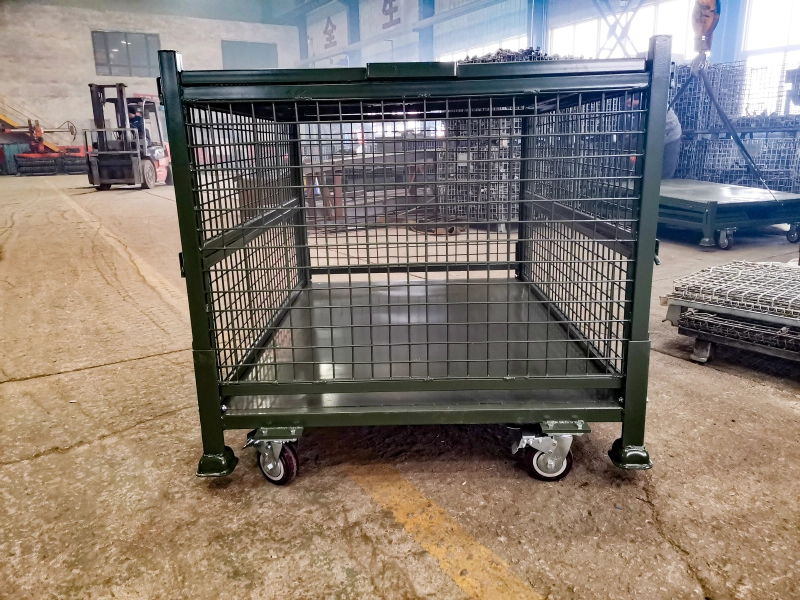
Before moving a loaded Mybox, check these four things
- Floor condition: smooth, level ground gives the brake and caster much better control.
- Load balance: keep heavy items spread evenly so the container does not twist while turning.
- Route length: the shorter the route, the more practical the mobile option becomes.
- Parking habit: always lock the brake before picking, packing, or handing over the load.
FAQ
Is the caster version stronger than the fixed version?
No. The wheel option changes the handling method, not the basic fact that the box still needs proper loading discipline. Strength comes from the frame, weld quality, and correct use; mobility comes from the caster set. If your workflow does not need movement, a fixed base can be the more stable choice.
What is the best use case for a braked Mybox?
Use it when a team needs a mobile picking station, a rolling parts bin, or a small-batch transfer container that can move without a forklift. If you are deciding between PDP-04 and PDP-02, compare the mobile route against the fixed-storage route: one is built for movement, the other for staying put. See PDP-04 and See PDP-02, then use the unified CTA to request the right layout for your line.
Need a Custom Storage Solution?
Speak directly with our technical engineers. We offer free structural designs, heavy-duty catalog evaluations, and quick B2B price quotations.
Request a Quote Now →