

When a buyer searches “stillage vs wire mesh container,” the real question is usually not whether either product can hold parts. It is whether the container will stay aligned and manageable as the stack gets higher, the load becomes heavier, and forklifts or pallet jacks keep moving units in and out. A conventional wire mesh container can be a sensible choice for light, low-level storage. High-stack storage needs a closer look at the load path, stacking interfaces and operating conditions.
Mybox combines wire mesh panels with steel tube uprights and a defined stacking structure. That does not make every application automatically safe or make a 5 m stack universal. It gives the project a more deliberate frame for checking vertical loads, alignment and handling. The product technical basis references a 4,000 kg static load, a 2,000 kg dynamic load and stacking up to 5 m; the applicable rating must still be confirmed for the selected configuration, load pattern and site conditions.
Why the frame changes the high-stack comparison
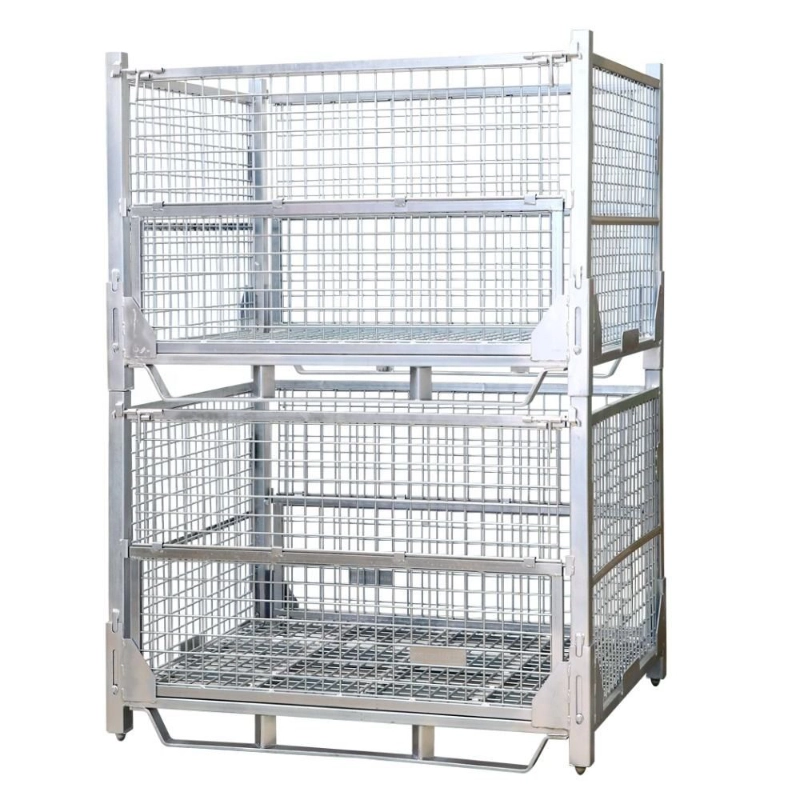
A pure wire mesh container mainly relies on formed mesh panels, perimeter members and corner contact points. It may work well where loads are light, stacks are low and the floor is level. As height increases, small issues such as uneven floor contact, a displaced container, panel deflection or a load placed off-centre can affect the whole stack. These are operating risks to assess, not reasons to dismiss the format.
Steel tube uprights create a clearer load path
Mybox uses steel tube uprights as the cage’s vertical backbone, together with mesh panels, stacking feet and folding door components. The uprights help define where vertical forces are carried from one unit to the next, while the stacking feet help keep the contact geometry repeatable. For a high-bay plan, this makes it easier to review stack alignment, load distribution and clearance rather than relying only on the apparent stiffness of a mesh wall. Stable stacking still depends on an intact container, correct engagement, an evenly distributed load and a flat base.
What the 5 m and 4,000/2,000 load figures actually mean
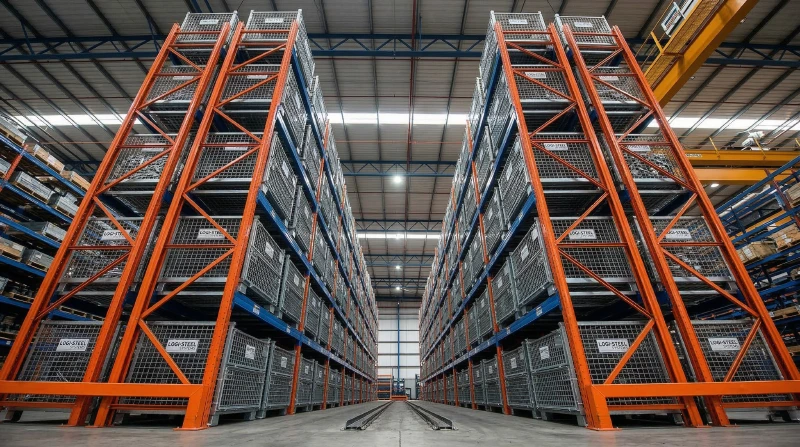
The 5 m figure should be read as a product reference under stated conditions—not as permission to build any five-metre stack. Static load describes a stationary load case; the technical basis lists 4,000 kg static and 2,000 kg dynamic. The lower dynamic figure matters when units are being moved or subjected to handling forces. The number of units, the weight in each unit, the centre of gravity, the stacking interface, floor flatness and forklift practice all affect the decision. Do not multiply a single-container rating by the number of boxes and treat the result as an approved stack height. Ask for a configuration check when loads are dense, uneven, long or handled frequently.
When a conventional wire mesh container may be enough
- Choose a standard wire mesh container when the stack is low, the contents are relatively light and evenly distributed, and the unit is used mainly for floor-level storage.
- It can suit operations with a level floor, controlled forklift handling and no requirement for a 5 m high-bay stack or long-term vertical storage.
- It may be the economical option when standard dimensions are acceptable and the team does not need a defined steel-tube frame, custom length or repeated high-level access.
- Choose Mybox when the plan combines higher stacking, heavier or irregular parts, frequent whole-box handling, four-side access, folding return logistics or a requirement to review a steel-tube load path. Confirm the final stack and load limits for the project.
Buyer questions before selecting a stackable stillage cage
Can Mybox be stacked to 5 m?
The current product reference gives 5 m as a stacking-height guideline. It is conditional on the actual load, container configuration, correct stacking engagement and a sufficiently flat base. Treat it as a design-review input, not a blanket operating limit; request confirmation for the proposed stack.
Is a pallet cage always safer than a wire mesh container?
No. Suitability depends on load, height, floor condition, handling method and inspection. A conventional wire mesh container can be appropriate for lower, lighter and controlled storage. Mybox is the better fit when the project needs steel tube uprights, defined stacking interfaces and a more structured review for high-stack or repeated handling conditions.
Need a Custom Storage Solution?
Speak directly with our technical engineers. We offer free structural designs, heavy-duty catalog evaluations, and quick B2B price quotations.
Request a Quote Now →