
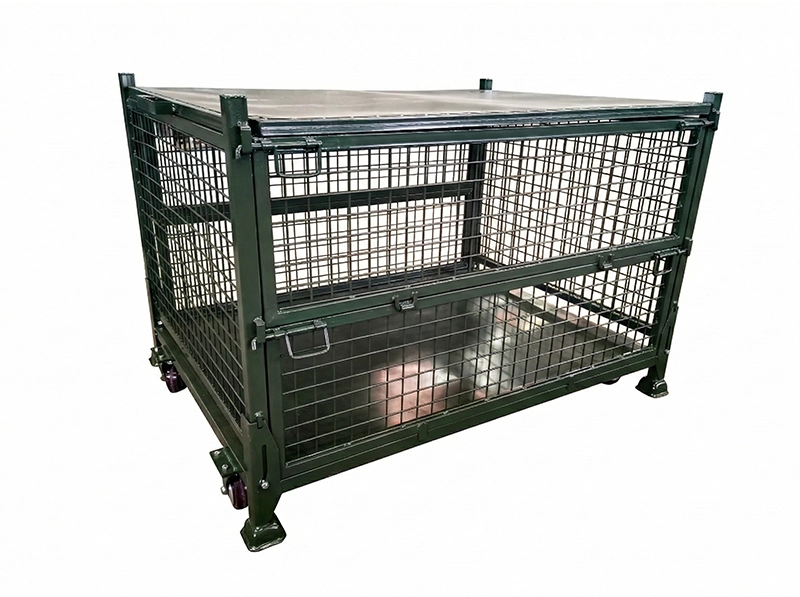
When operators repeatedly walk around a fixed gate, reach over a high wall, or move a loaded box short distances between storage and a picking point, the access hardware becomes part of the handling method. A half-drop gate can bring the working opening closer to the operator, while casters can remove some short-distance repositioning. Neither feature should be selected from a product photo alone.
For a Mybox steel pallet box, start with the picking action, then check the floor, braking, load state and stacking method. A box that rolls well for local picking is not automatically suitable for loaded stacking, forklift handling or every warehouse floor. Treat mobility and safe stacking as two separate design decisions.
Choose the half-drop gate around the picking motion
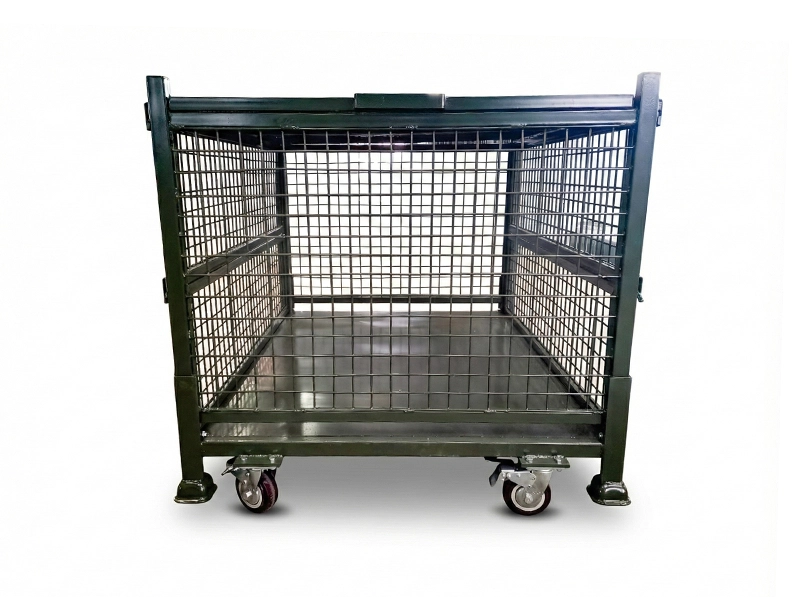
A half-drop gate reduces the front barrier at the access side, so an operator can reach smaller parts closer to waist level instead of bending deeply into a full-height box or walking around to a fixed opening. It is most useful when the same face is accessed repeatedly and the load can be arranged so the picking zone remains reachable. Gate height, hinge or latch arrangement, opening clearance and the position of the goods must be reviewed together. A loaded gate should only be opened when the project design, load restraint and operator procedure allow it; do not assume that every half-drop gate is safe to open under every load or stacking condition.
Separate caster mobility from loaded stacking
Casters make sense when a box is moved short distances on a smooth, level warehouse floor for line-side supply, kitting or local order picking. Select the wheel material and diameter for the actual floor, joints, thresholds, debris and turning space, and specify a brake so the box can be held at the picking position. A caster solution needs a confirmed load state, route and pushing method; it should not be treated as suitable for ramps, uneven outdoor ground or long-distance towing without a separate review. For boxes that will be stacked with cargo, moved by forklift or placed in a rack, fixed stacking feet and the corresponding base interface may be the better starting point. Casters and stacking feet can appear in one configuration, but their interaction, clearance and allowed loaded condition must be confirmed on the project drawing.
Use folding for the empty return, not as a substitute for the design review
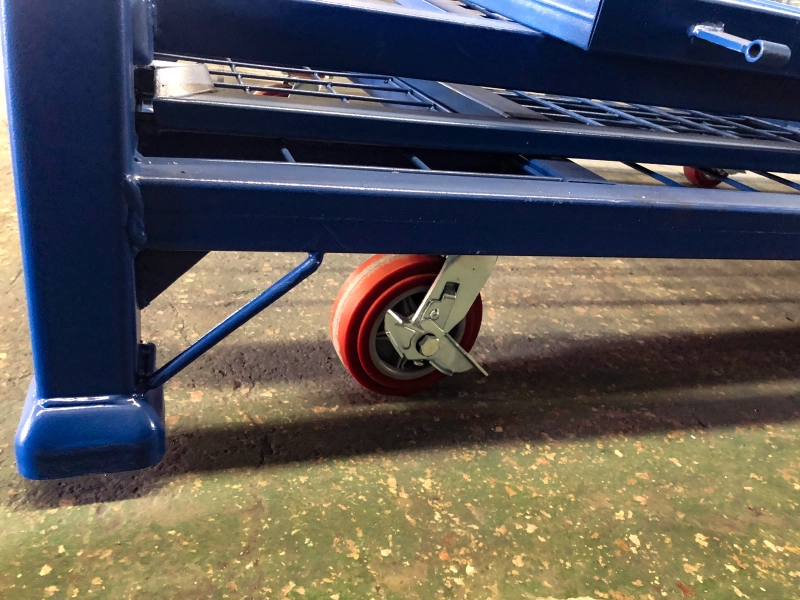
Once the goods have been delivered, a collapsible steel pallet box can be folded for return transport and empty storage. The product brief records folded heights around 330–370 mm for different schemes and indicates that some projects save about 60%–80% of empty storage or transport volume; the actual result changes with box dimensions, lid, caster arrangement and packing method. This is where folding can reduce return freight and floor-space cost. Before ordering, confirm whether wheels are removed, retained or folded with the box, and whether the folded stack can be handled safely. The caster detail shown here is evidence of a brake-caster option, not a universal load or floor rating.
Where this combination can help
- Line-side picking of small or mixed industrial parts where the access face stays in one position.
- Short warehouse transfers between a storage location, kitting area and production point on a smooth, level floor.
- Forklift or pallet-jack movement of loaded boxes when the base, fork access and stacking condition are designed for that handling method.
- Return logistics where empty boxes are folded after delivery to reduce storage and transport volume.
Questions to settle before quotation
Can a half-drop gate be opened when the steel pallet box is full or stacked?
Only if the specific gate, load arrangement, clearances and stacking condition are designed and approved for that operation. Ask for the allowed loaded and stacked states rather than assuming the gate can be opened in every position.
What information should we provide for a caster or fixed-foot Mybox design?
Provide the cargo length, width and height; single-box weight and load distribution; picking height and access face; floor type, joints and thresholds; pushing distance and turning route; forklift or pallet-jack details; whether the box moves loaded; planned stacking layers; and indoor, outdoor or surface-treatment conditions. These inputs allow the gate, caster, brake, base and fixed stacking-foot combination to be reviewed together.
Need a Custom Storage Solution?
Speak directly with our technical engineers. We offer free structural designs, heavy-duty catalog evaluations, and quick B2B price quotations.
Request a Quote Now →