
If you want to lower empty-box handling cost without moving conveyors, racks, or transfer points, the first lever is usually the container, not the line. That is why a collapsible Sebox is often a practical starting point for workshop supervisors who need savings fast but cannot afford a layout project.
In a plant that already uses forklifts, pallet jacks, or a fixed staging bay, Sebox lets you keep the existing handling route and simply replace rigid bins or carton-based returns with a foldable steel pallet box. When the box comes back empty, it folds down and carries far less dead volume. The line stays where it is; the return loop becomes easier to manage.
Keep the line, change the container
The appeal of Sebox is not a promise of zero modification. It is a controlled swap. If the current process already accepts palletized handling, a foldable steel pallet stillage can fit into the same loading point, the same dock lane, and the same return path. That is exactly where the indexed Sebox stock photos are useful: the hero image shows a solid-panel foldable steel pallet stillage with forklift pockets and a 1000kg-class load mark, which is the kind of structure you want when the container has to be reused many times instead of thrown away after one trip.
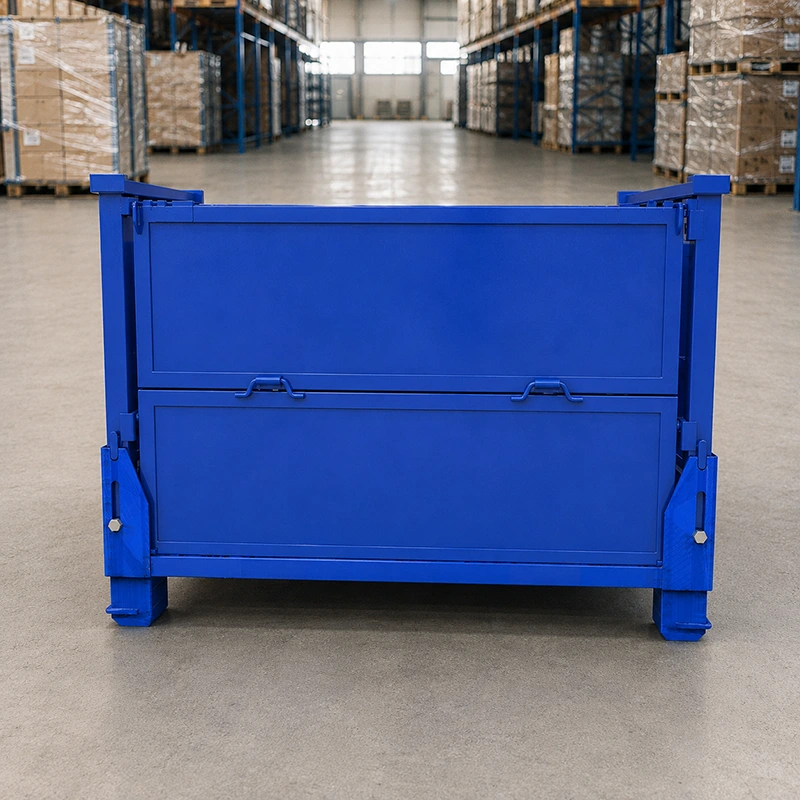
Three container choices usually exist. You can keep rigid steel bins or cartons, which is the least disruptive option but leaves the return leg bulky. You can move to plastic pallet boxes, which can reduce weight but may be less tolerant of heavy parts and rough circulation. Or you can switch to Sebox, which is most useful when the loop already depends on mechanical handling and you want the same box footprint in use, then a much smaller footprint when the box comes back empty.
Where the savings actually come from
The first saving is reverse logistics volume. A collapsible steel pallet box typically gives you a much smaller return package than a rigid container, so fewer empty units occupy trailers, containers, or dock space. The second saving is floor space. Empty boxes stop blocking the staging zone, which matters when supervisors are trying to clear the lane between receiving, assembly, and outbound loading. The third saving is labor. Folding, stacking, and returning empties is faster than re-taping cartons or re-bundling mixed packaging after every cycle.
For heavy parts, another gain matters just as much: containment. A reusable steel box is better suited to repeated forklift transfer than a paper carton or a one-way tote. If the parts are greasy, sharp-edged, or dense, a solid-panel Sebox can reduce scatter and protect the load during the trip back to the supplier, the warehouse, or the next workshop. If your process needs visibility for counts, a mesh-style variant can be the better choice, but the core logic is the same: replace disposable handling with a reusable, stackable transport stillage.
For planning, think in simple terms. If your return route is full of empties, the box swap can cut the pain point immediately. If your line only moves light, hand-carried cartons and has no palletized handoff point, Sebox is not the first move. In that case, you would spend more time adding handling steps than you would save.
Pilot timing and the equipment you already need
In a straightforward rollout, a pilot can often start in one to two weeks. The schedule is usually simple: confirm the box size and stack height, check fork-entry clearance, validate the return route, and run a small batch before switching the full loop. If the path already uses forklifts or pallet jacks, you normally do not need a new conveyor, a new line position, or a special loading machine. An overhead crane can stay in the process if it is already part of your plant, but Sebox itself does not require a new lifting system.
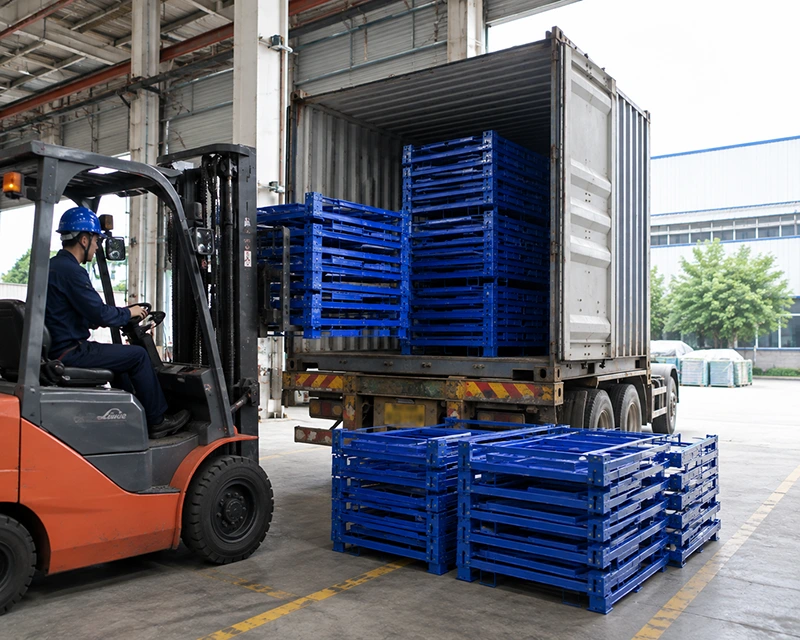
If the box size, stack rule, or dock route needs adjustment, allow a longer pilot window, usually three to four weeks. That extra time is not wasted; it is the period where you confirm that the new container fits the real workflow instead of the theoretical one. Once the pilot is stable, the switch can be phased by line, by product family, or by return route.
Where Sebox fits best — and where it does not
- Reusable part loops that already use forklifts or pallet jacks for movement.
- Plants that pay too much for empty return volume and need a foldable return format.
- Staging zones that are crowded by empties and need a smaller folded footprint.
- Operations replacing cartons or rigid bins with a reusable steel container for repeated circulation.
Common questions from workshop supervisors
What savings should I expect first?
The first savings usually appear in empty return volume, staging-space recovery, and fewer manual touchpoints. In practice, the folded return form can reduce the space occupied by an empty container to about one third or one quarter of the deployed volume, depending on the exact model and how the return route is packed. That is why the biggest win is often seen in backhaul and dock congestion before it shows up anywhere else.
What do I need before a pilot starts?
You only need the basics: a fixed box footprint, a known return route, and palletized handling already in the process. If the line has no fork access and relies only on hand carrying, Sebox is usually not the right first step. If those basics are in place, the next move is a small switch plan: one container size, one loop, one pilot batch, then a phased rollout if the numbers hold up. That is the cleanest way to improve empty-box handling without reworking the line.
Need a Custom Storage Solution?
Speak directly with our technical engineers. We offer free structural designs, heavy-duty catalog evaluations, and quick B2B price quotations.
Request a Quote Now →