
A counting station that has to open every container before it can say anything about the contents is not really a counting station; it is an unpacking operation with a clipboard attached. In a high-turnover warehouse, or on a line where the count has to be finished inside a changeover window, the cost is not just the minutes at the box. It is the resealing, the re-strapping, the second handling move and the risk that the batch goes back into the stack in a different order than it came out.
A Sebox mesh-sided metal pallet box changes that sequence without changing the count itself. The wire mesh enclosure lets a checker read fill level, part family and obvious damage from the aisle, so only the boxes whose visible state disagrees with the record get opened. On a stackable transport stillage the half-drop front gate extends the same logic to a box that cannot be lifted off the stack for inspection. What that does and does not buy you is worth stating precisely.
What the Open Steel Grid Lets a Checker Read From the Aisle
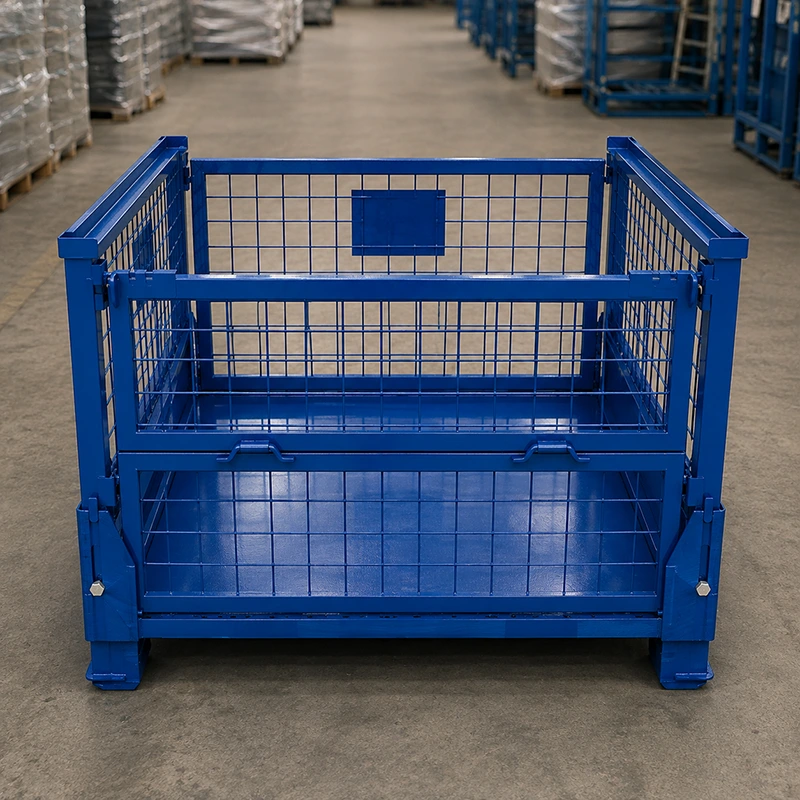
Three things are legible through a wire mesh container side: roughly how full the box is, what family of part is inside, and whether the visible layer has shifted, spilled over the top rail or taken a hit in transit. On a plant where boxes carry one part number and a label at eye height, those three readings usually confirm that the box matches its paperwork. The checker walks the bay, reads the stack, and moves on.
This is why the mesh version reduces the number of openings rather than replacing the count. Fewer boxes enter the counting queue, because the cheap question — is this the box I think it is, is it about as full as I expected, does anything look wrong — is answered without breaking the container open. The boxes that do enter the queue still go through the full procedure, with the lid or gate open and the parts in hand. The saving is in how many boxes reach that point, and it scales with how often the same stack is walked.
It also depends on the stack being readable. If labels are only visible from one side, if the mesh face is turned into the aisle at random, or if fill level is meaningless because the box holds a single large casting, the aisle read gives you much less and the opening count barely moves.
Mesh Panels Against Steel-Sheet Panels at the Counting Station
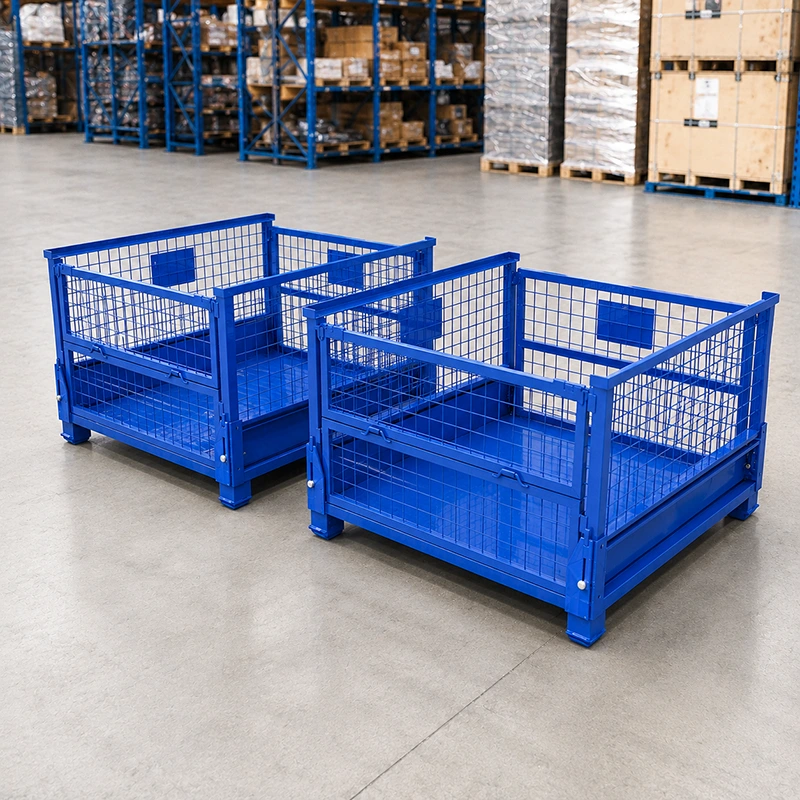
Not every load should be visible. Fasteners, washers, oily turned parts and anything smaller than the aperture will pass through a mesh face, and an oily part that escapes the containment defeats the purpose of a collapsible cage pallet in the first place. The two panel types are not a quality ladder; they are a trade between what the counter can see and what the box can hold.
| Face type | Readable from the aisle | Small-part containment | Where it fits |
|---|---|---|---|
| Welded wire mesh | Fill level, part family, visible displacement or damage | Parts must be larger than the aperture | Mixed-size metal parts, WIP buffers, stacks that are counted often |
| Solid steel sheet | Nothing inside; the label and the record carry the box | Retains small, oily, wet or sharp parts | Small components, contamination-sensitive loads |
| Sheet with a mesh face | Only the mesh face is readable | Determined by which faces are sheeted | A depth check on one face with the rest closed off |
Most plants do not pick one answer for the whole site. A machining line with medium castings can run a fully mesh mesh pallet stacking box and count by eye, while the deburring cell next door needs a sheeted base and a sheeted back face so that swarf and small parts stay inside. The Sebox files support mesh or steel-panel selection on the sides and the base, together with separate front, side and auxiliary gates, but the exact face combination has to be fixed on a confirmed drawing. A photograph of one configuration is not a specification for the next one.
The Half-Drop Gate Spot-Check Order
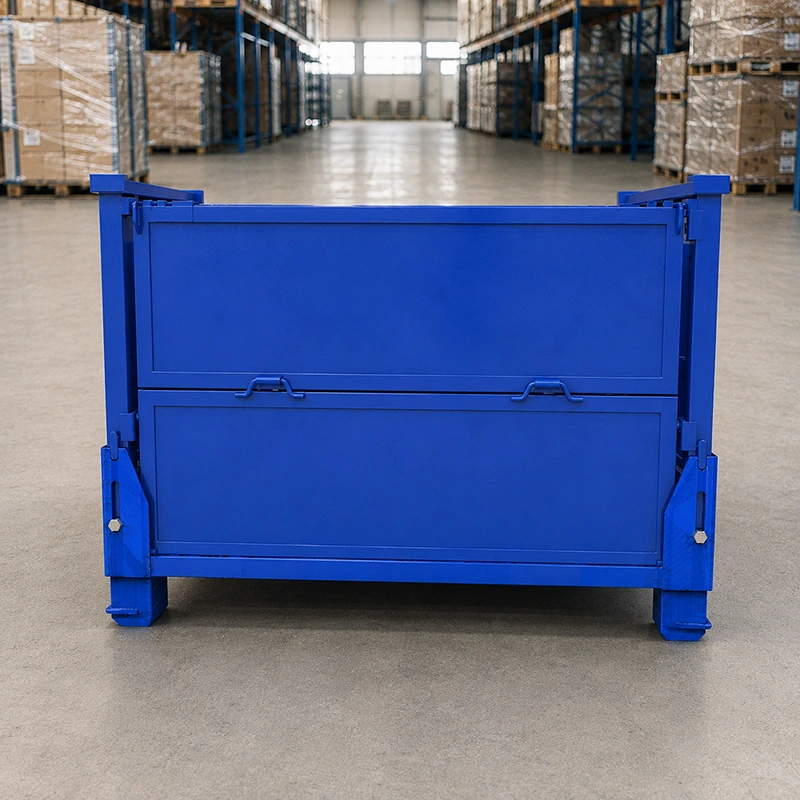
Access while stacked is the second half of the argument. A half-drop front gate opens the lower part of the front face and leaves the upper half, top rail and the rest of the mesh in place. That matters in a high-density stack: the box is not taken out of the row, the upper load path is untouched, and the parts behind the upper half still have a barrier in front of them. The sequence below keeps the check short and keeps the box contained.
- Read the stack from the aisle first and compare each box with its record. Most boxes should be closed out here, without anyone touching a latch.
- Open the half-drop gate only on the box whose visible state disagrees with the record — wrong part family, unexpected fill level, shifted load, visible damage.
- With the box still in the stack, release the lower half of the front gate. Keep hands clear of the gate edge; the upper half stays latched as the containment barrier.
- Check the exposed layer: part type against the label, single part number or mixed, obvious damage, and whether the fill height is plausible for the stated quantity.
- Take a sample only if the pieces at the front are genuinely reachable. Digging into the centre of the box is unloading, not inspection, and it changes the count you were trying to protect.
- Re-latch the half gate before the box is moved, re-stacked or handed to a forklift. A gate left open under a stacked box is the one outcome this procedure must never produce.
Two site conditions decide whether the gate is actually usable at the bottom of a stack: the gate opening width, and the free space between the box front and the next bay or rack upright. Both have to be checked against the real aisle, not assumed from a dimension list.
When the Box Still Has to Be Opened, Unloaded or Weighed
The visual check is a filter, not a metering instrument. A full box with a mesh side tells you the box is full. It cannot tell you whether there are 240 pieces or 245, and it cannot tell you what sits behind the front layer. These are the cases where the box comes out, opens fully or goes on a scale:
- An exact figure is owed to someone: a shipping document, an invoice line, a line-side consumption count, or a customer count claim.
- The box holds more than one part number and the split is not visible from the readable face.
- The load or the assembled stack is going to be used near a stated limit. Recorded figures such as a 1000 kg design load on one Scheme C build of 1000 by 800 by 840 mm, or 1300 kg and 1500 kg on the other documented builds, belong to those builds only; they are not transferable, and the only sound route is a check against the actual build on an actual scale.
- The question is about the middle of the load, or about parts that have settled into the base area.
- Damage, corrosion or oil leakage is suspected but cannot be seen through the grid.
- A quality hold or a claim is open, where the point is a documented, defensible record rather than a quick read.
Treating the mesh check as an automatic count is the most common way this idea gets oversold inside a plant. It is a way to spend less time unpacking boxes that did not need unpacking. It is not a scanner.
Where the Visual Check Pays Back First
- High-turnover warehouses where the same three-high stack is walked every shift and the count is repeated rather than performed once.
- CNC and machining workshops where part numbers change often and a quick family check at the buffer prevents the wrong batch reaching the next station.
- Automotive line-side flows with a fixed changeover or line-stop window, where opening every container will not fit inside the available time.
- Returnable and closed-loop fleets where the same units are checked in and out repeatedly and each return leg adds another counting point.
Buyer Questions on Mesh and Gate Configuration
Does a mesh container remove the need to count?
No. It reduces the number of boxes that have to be opened before a count can be trusted. The exact quantity still comes from opening the box that matters, from the paperwork, or from a scale, depending on what the figure is used for.
Can one build mix a mesh face with sheeted faces?
The files support mesh or steel-panel selection on sides and base, with front, side and auxiliary gate options. Which faces become sheet, which become mesh, and which gate type suits your stack height all have to be confirmed on a drawing rather than inferred from a stock photograph.
Send us the counting frequency for the stack and the form of your parts — smallest dimension, single part number or mixed, oily or dry, approximate piece weight and intended payload per box. With that in hand we can tell you which faces should be mesh, whether a half-drop front gate or a full side gate suits the way your stacks are built, and what still has to be confirmed against your actual aisle and lift equipment before a drawing is released.
Need a Custom Storage Solution?
Speak directly with our technical engineers. We offer free structural designs, heavy-duty catalog evaluations, and quick B2B price quotations.
Request a Quote Now →