
Plant WHS & Safety Audit
A steel plant moves long pipes and tubes by the hundredweight every shift, and the fastest way to fail a WHS audit is to let a forklift muscle a 6-metre bar through a pedestrian aisle. A roll-out cantilever rack takes the forklift out of the aisle entirely: each pipe size sits on its own 100%-extension arm, lifted and placed by the overhead crane, so the only person in the walkway never has to touch the load.
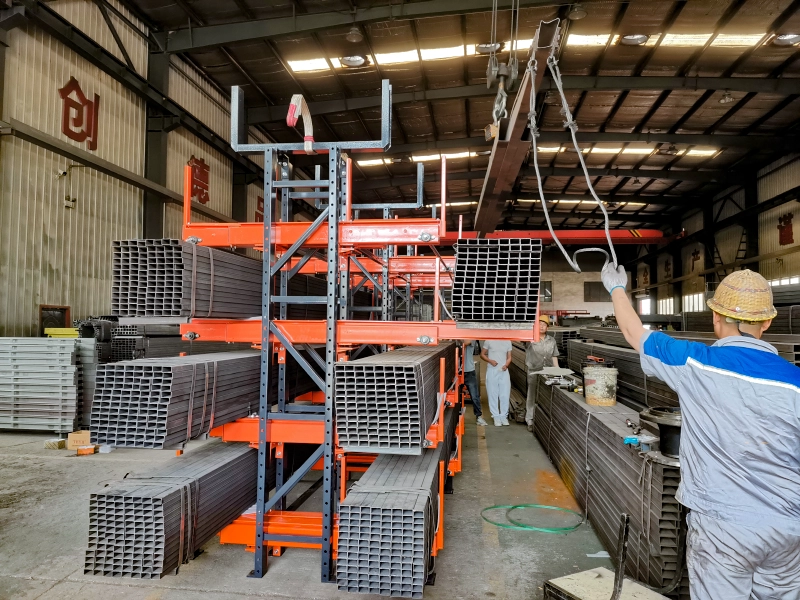
| Product | Telescopic / Roll-Out Cantilever Rack (Terack) |
|---|---|
| Load per arm level | Up to 1500 kg for heavy pipes and tubes |
| Reach | 100% full-extension pull-out arms to a crane pick point |
| Operation | Single-operator manual crank; overhead crane lifts the load |
| Aisle safety | No forklift in the storage aisle; people segregated from moving loads |
| Structure | Q235 carbon steel uprights, roller-guided arms |
The audit question no plant manager wants to answer
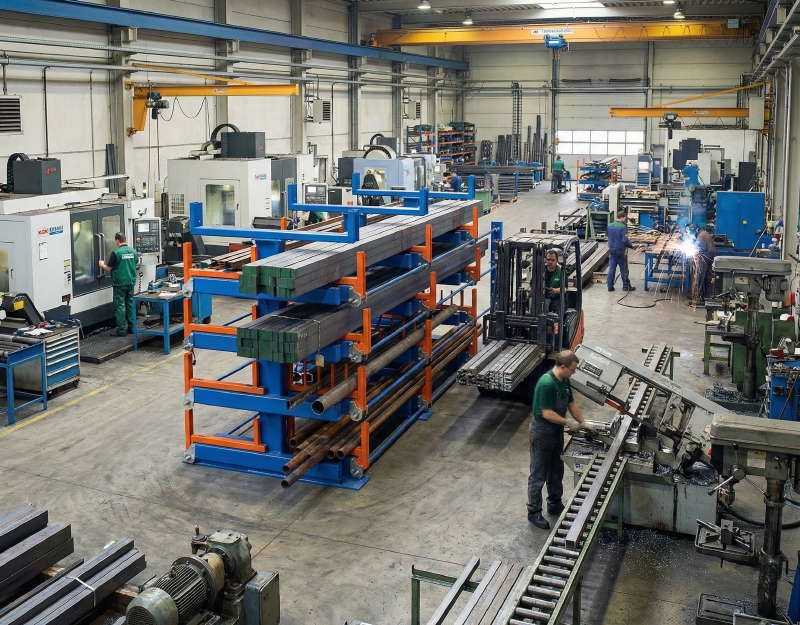
For a WHS manager at a steel manufacturing group, the audit question is simple and uncomfortable: how do long pipes move from receiving to the line? Too often the answer is a forklift carrying a 6- or 12-metre bar through a shared aisle, with a banksman walking backwards and a crane team waiting on the far side. That is precisely the pedestrian-and-lifting-gear cross-traffic a safety auditor writes up first. A long steel pipe carried on forks bows, slips and whips; a dropped 1500 kg bar does not allow a second chance. Before the plant even reaches the formal audit, every manual pipe move is a recorded exposure, and a forklift in the aisle is the single highest-risk item on the WHS manager’s list.
The finding is on the movement, not the rack
The audit does not fail on the rack, it fails on the movement. When long pipes are stored loose on the floor or on static racks, the only way to pick them is a forklift in the aisle or a two-person manual carry, both of which keep a lifting load in a pedestrian zone for the entire pick. For a plant manager under a strict safety audit, that is an open finding: unguarded crush risk, no segregation between people and moving loads, and no engineered control on how the bar is extracted. Bolting more signs to the floor does not close the finding. The workshop needs a storage method where the long load is never carried through a walkway by a truck, and where the hazardous task is designed out rather than warned against.
A roll-out cantilever rack removes the forklift from the aisle
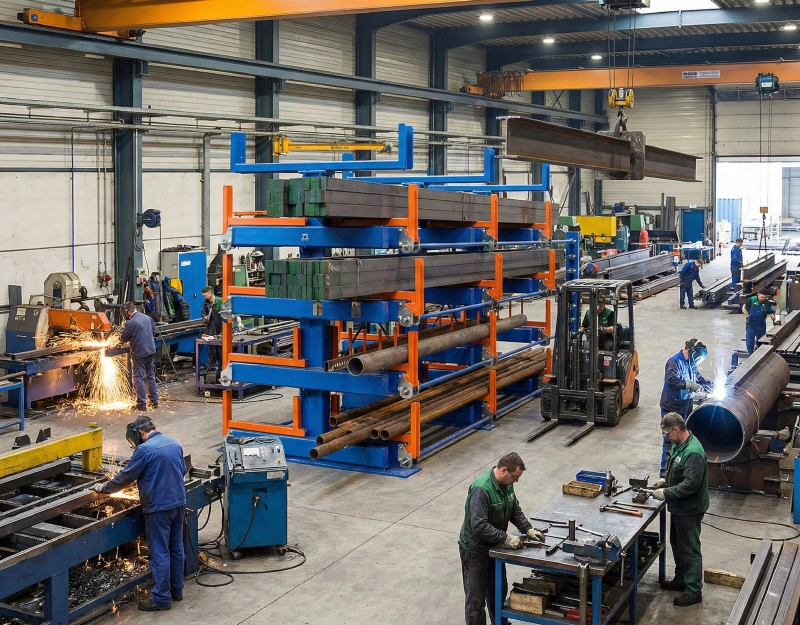
A roll-out (telescopic) cantilever rack is engineered so the forklift never enters the aisle. Each pipe size sits on its own 100%-extension arm; a single operator turns a rack-and-pinion crank and the loaded arm rolls out on bearings to a crane pick point. The overhead crane, already the safe, engineered way to move long steel, does the lift while the worker stands clear. That removes the pedestrian-and-lifting-gear cross-traffic that drives audit findings, and it turns long-pipe handling from a manual carry into a controlled, crane-only movement. For a WHS manager, that is the control the auditor is looking for: the hazardous task is eliminated, not just signposted, and every pick is repeatable and documented.
The safety case is built into the structure
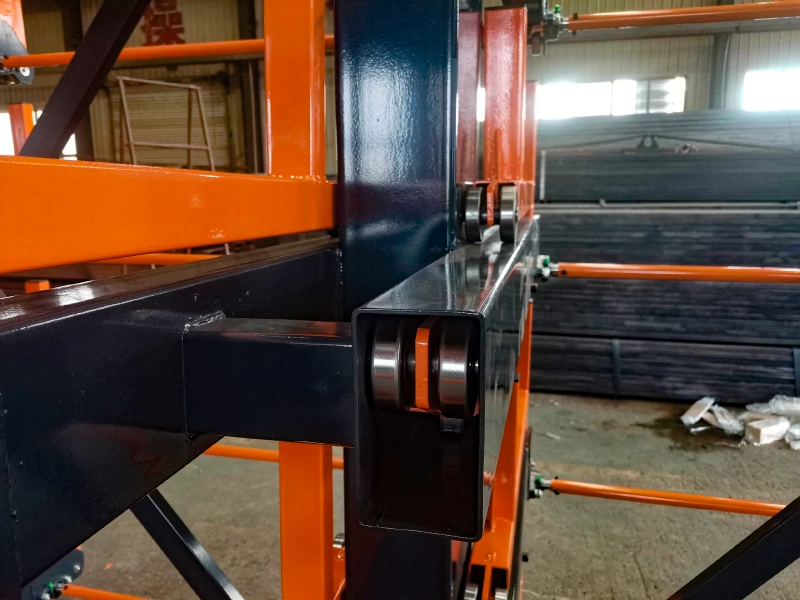
The compliance argument is in the steel. Terack roll-out cantilever racks use Q235 carbon steel uprights with roller-guided arms rated to 1500 kg per arm level, so a 6- or 12-metre pipe rests straight and supported instead of leaned and bowed. Arms are perforated and re-spaced without fabrication, so every diameter, seamless, ERW, galvanized, square or round, gets its own labelled, segregated bay. Because the load is retrieved by crank and crane, there is no forklift impact, no manual drag and no dropped-bar exposure in the aisle. The rated, fixed-capacity arms are the engineered control: each pipe is stored within a documented safe-working load, which is exactly what a safety audit wants to see on paper and on the floor.
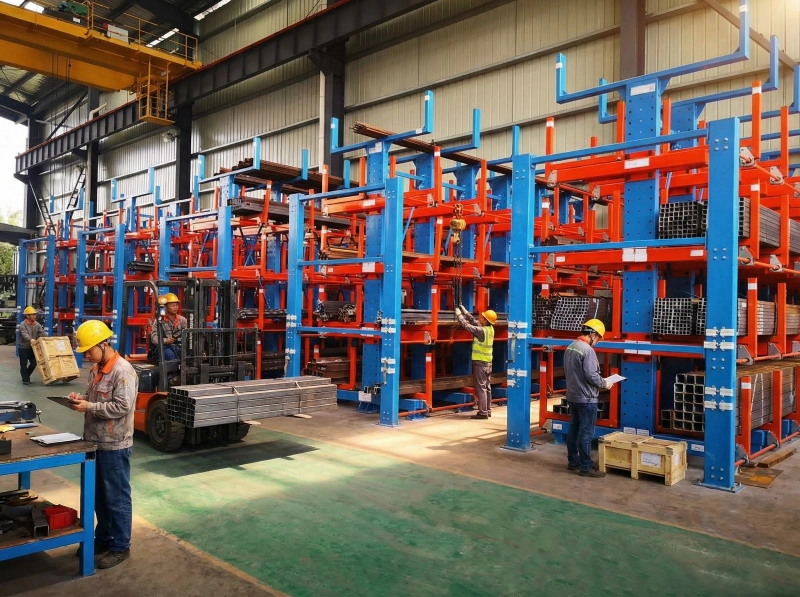
- Crane-only handling of long pipes and tubes, with the forklift removed from the storage aisle
- Segregated, labelled bays per diameter and grade to satisfy WHS audit documentation
Get the Terack Plant-Safety Racking Layout Sheet
Need a Custom Storage Solution?
Speak directly with our technical engineers. We offer free structural designs, heavy-duty catalog evaluations, and quick B2B price quotations.
Request a Quote Now →