
Die beladene Etappe eines Motorrad-Versandprogramms wird vom Motorrad bestimmt. Die leere Etappe wird vom Träger bestimmt. Deshalb können zwei Exporteure, die dasselbe Motorradmodell versenden, mit unterschiedlicher Ausrüstung beide richtig liegen: einer schickt die Träger jeden Monat zurück, der andere sieht den Träger nie wieder.
Dieser Leitfaden trennt die drei Konfigurationen, die wir auf dem Mtrack Stahlgrundrahmen bauen — dauerhaft befestigte Aufrechte, klappbare oder einsteckbare Aufrechte und eine Hybridvariante, die auf einer Seite klappt und auf der anderen abnehmbar ist — und zeigt, welches Rückkehrmuster zu welcher passt. Es gibt keinen universellen Sieger. Die entscheidenden Eingangsgrößen sind Rundreisen pro Jahr, wer die Rückfracht bezahlt und wie das Motorrad an jedem Ende verpackt wird.
Was ein klappbarer Motorradträger tatsächlich verändert
Klappbar heißt nicht, dass der gesamte Träger wie ein Karton zusammenfällt. Bei einem klappbaren Mtrack bleiben Grundrahmen, Radpositionierung und Gurtpunkte wie sie sind; die vertikalen Elemente sind die Teile, die sich bewegen. In dokumentierten Projekten tauchen zwei Mechanismen auf: Aufrechte, die aus den Grundsockeln herausgezogen werden (Einsteckpfosten), und Aufrechte, die nach innen klappen und flach auf der Plattform liegen. Beide existieren aus demselben Grund — der leere Träger darf nicht mehr die volle Höhe eines Motorrads einnehmen.
Das praktische Ergebnis ist, dass die Rückladung aus Grundrahmen plus gebündelten Pfosten besteht statt aus fertigen Trägern. In einem dokumentierten Projekt mit Einsteckpfosten wurden zwölf leere Träger zu einer einzigen Säule mit etwa 2.490 mm gebündelt. Diese Zahl gehört zu diesem Projekt und diesem Pfostendesign; sie ist keine Katalog-Stapelzahl. Was übertragbar ist, ist die Methode: Messen Sie Ihren eigenen leeren Stapel und multiplizieren Sie ihn dann mit der Anzahl der Rückfahrten, die Sie tatsächlich durchführen.
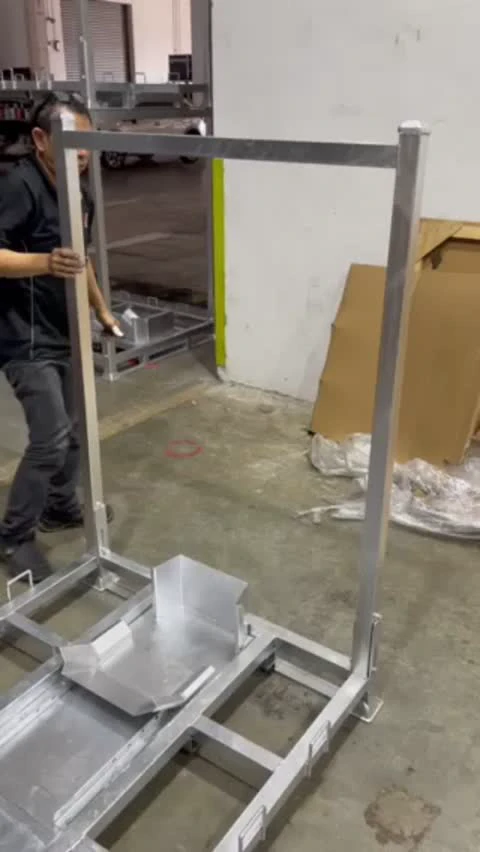
Folding also has its price, and that price is paid in handling, not in steel. Someone has to pull pins or swing uprights on every unit and every cycle. With four uprights per carrier and thirty carriers per shipment, that is repetitive manual work that needs a station, a routine, and an inspection step. If uprights, pins, or hinge points are damaged or lost, the next loaded stack is unsafe — so check the fit of the feet, pins, bolts, and hinge welds on every return before the carrier goes back into service.
What a fixed motorcycle carrier gives you instead
A fixed carrier is exactly what the name says: the uprights do not move. There is no pin to pull, no hinge to keep free of grit, no separate bundle of uprights to count and store, and no folding motion to train. Structurally, it is the simpler of the two — fewer interfaces, fewer parts that can go missing, one less step at the loading station, and one less thing to inspect after a rough sea leg.
That simplicity matters when the carrier does not come back. On a one-way export, where the carrier ships with the motorcycle and stays with the dealer or new owner, an empty-return feature and handling labor are cost the program never uses. In that case, a fixed carrier or the wooden crate the shipment would otherwise be packed in is the honest comparison. A crate is bought and disposed of per shipment; a fixed steel pallet is bought once and has yet to earn its price through repeated use or through resale value at the destination.
A fixed beam is also the simpler answer when the beam never leaves the building at all — dealer storage, a racing team's own vehicle fleet, or a collection on a fixed standing area. There, the return strap is a path across the floor, not a sea freight line, and folding fittings do not solve a problem.
The hybrid: fold one side, remove the other
Between the two extremes lies a configuration documented for an export project: one side of the beam folds, the other side is removable. The folding side retains a reference edge on the base frame so that the empty unit can still be positioned and stacked predictably; the removable side makes it possible to transport the posts as a separate bundle. This project used a load capacity of 250 kg per beam, which is a design result and not a series nominal load.
This arrangement is suitable for a program in which most trips are one-way, but some of the beams actually return — a dealer network that delivers motorcycles and occasionally sends beams back, or a mixed fleet in which some routes are one-way and others are not. It requires more design effort than any single solution, so it only pays off if the return pattern is actually mixed.
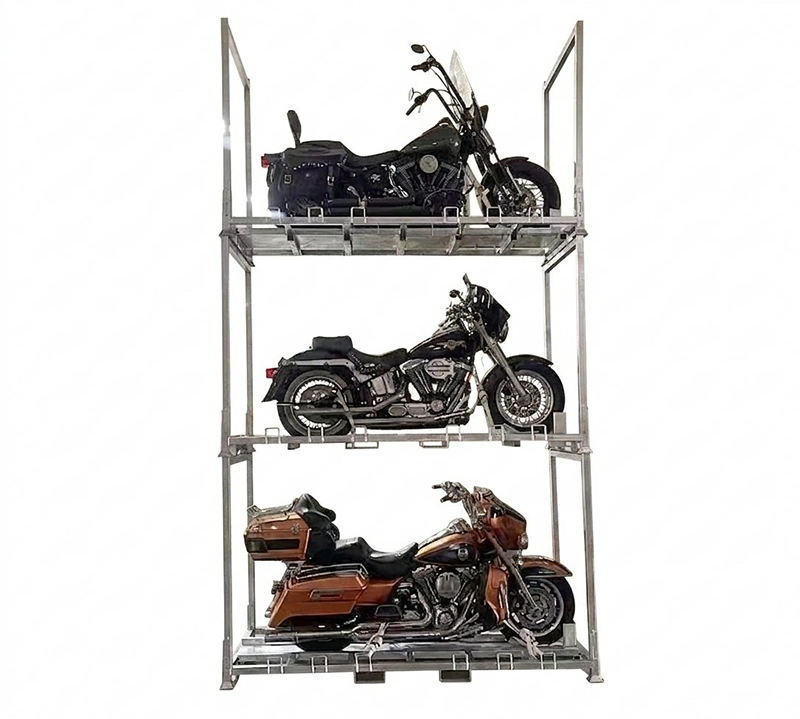
Regardless of which of the three variants you choose, the loaded journey looks the same: steel base frame, wheel groove or chock position, front wheel positioning and clamping options, U-shaped strap hooks and forklift entry, configured for two- or four-way handling. Documented project load capacities are 250, 350 or 500 kg per pallet after design review, reference dead weights are 70–108 kg, and the stacking notes were documented with four layers under a total stack height of about 6 m, while other projects specify three layers. None of these is a standard value — they are inputs that you confirm before drawing creation.
Choose based on return frequency, not product preference
The first question to answer is not "folding or fixed," but "how often does this rack come back." Everything else follows from that number.
- One-way, no return. Fixed posts or a wooden crate if the load is suitable for wood. Empty returns have no hardware that pays for itself.
- Return once or twice a year, mixed routes. The hybrid is worth a test — folding on the side that forms the reference, removable on the side that allows tight bundling of the posts.
- Return several times a year on fixed routes. Folding or plug-in posts begin to pay off because the empty volume is a regular freight lane, not a one-off.
- Permanent cycle — plant to dealer and back, week after week. Folding or plug-in posts, plus a defined empty-stacking routine and a trained handling station at both ends.
- Never transported — storage only in the plant or showroom. Fixed posts; the return route is internal and folding increases handling effort without freight gain.
Then check the packaging method, because it determines how much of the savings is retained. A foldable rack that is transported back in a crate brings no advantage. A rack whose posts are bundled but whose base frames are loose and unstacked has recovered only part of the volume. The container quantities in documented projects range from 28 to 56 sets in a 20-ft container and 72 to 140 sets in a 40-ft high-cube – this range is precisely the effect of dimensions, post type, wheel mounts, packaging, and loading direction, so the final quantity must come from the approved packaging plan, not from a brochure specification.
The surface treatment follows the same logic. Cold galvanizing around 10 μm and powder coating appear as project options; a technical note advises against hot-dip galvanizing for the structure in question because the heat can deform it. Prolonged rain is not recommended for these wheels because water can collect in hollow tubes – folding posts create open ends that should be checked at any outdoor staging area.
Questions buyers ask before finalizing the design
Does folding make the rack weaker?
Not fundamentally. The load path is determined by the base frame, the post cross-section, and the connection details, and the payload is specified on the approved drawing for your project. What changes is the number of interfaces that must be inspected in every cycle – and that inspection is not optional.
Can I use fixed and folding racks in the same program?
Yes, and that is common once the routes are separated. Racks on the circulation route are folded; racks on the one-way routes remain fixed. Both use the same wheel positioning and strap logic, so the loading teams do not have to learn two systems.
How do I quantify the savings before ordering?
Measure the empty stack height of the configuration you are considering, count the return trips per year, and compare these with the volume that the same number of fixed racks would occupy. Calculate with your own numbers – anything else is an estimate about your freight contract, not about your rack.
Where you can read on next
If your routes mix one-way and return traffic, start on the configuration page for the Mtrack foldable motorcycle shipping rack and read the empty return calculation in the Guide for flat-folding returnsWenn Ihr eigentliches Problem eher die Containerdichte als das Rückfuhrvolumen ist, ist der Guide for nesting and 40-ft loading the more suitable reference. Send us your motorcycle dimensions, the piece weight, the fork direction, the stacking layers, and your return pattern, and we will tell you before any drawing is created which of the three configurations fits.
Benötigen Sie eine individuelle Lagerlösung?
Sprechen Sie direkt mit unseren technischen Ingenieuren. Wir bieten kostenlose Strukturplanungen, Bewertungen von Hochlast-Katalogen und schnelle B2B-Preisangebote.
Jetzt Angebot anfordern →