
A motorcycle does not stand on a pallet by itself because it is heavy. It stands because the front wheel cannot turn or slide sideways, the rear wheel cannot swing out, and the unit can be lifted with forks without the motorcycle tipping onto its side stand. Loose on a platform, a 200 kg motorcycle will tip over within the first meter of a forklift turn. Fixed at three points, it behaves like cargo.
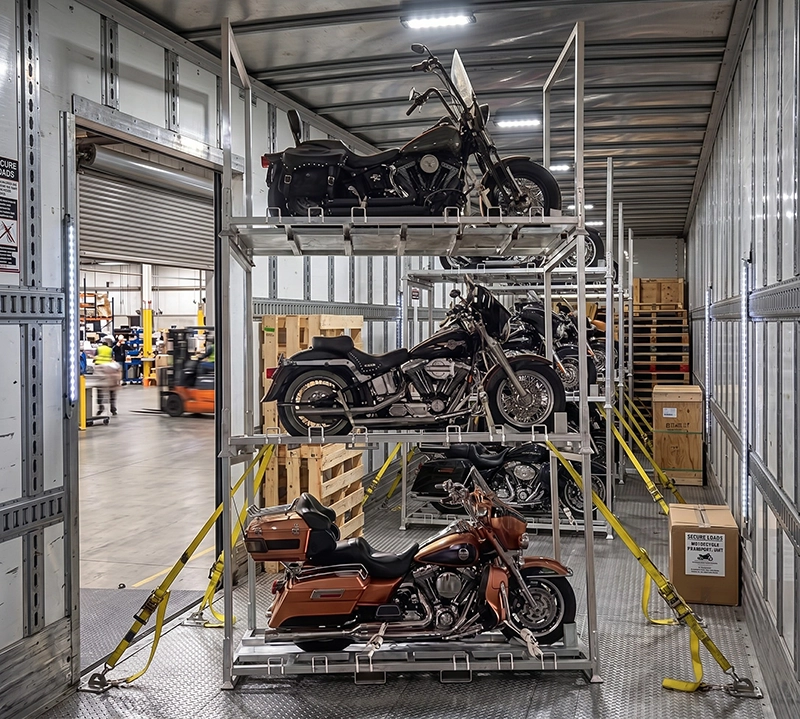
This is how the three fastening elements of an Mtrack motorcycle shipping pallet work together: a handwheel front wheel clamp, U-shaped strap hooks on both sides, and a ramp for sliding the motorcycle into position. Each element addresses a different failure mode, and each has its limit, which is determined by your motorcycle, not by a catalog.
Why a motorcycle falls over on a pallet
Three things move a parked motorcycle. The steering turns because a front wheel without any fixation follows the slightest lateral force and the motorcycle then falls in the direction the wheel was pointing. The rear wheel drifts because a tire loaded by its own weight on smooth steel has very little resistance to lateral sliding. And the suspension unloads because lifting the pallet with forks creates a brief vertical shock that compresses and releases both sides at different rates.
None of these are solved by a flat platform. A flat load bed gives a motorcycle a floor, not a position. The fixation must hold the angle of the front wheel, pull the chassis into a specific wheel position, and enclose the base so that the loaded unit can be moved as one forklift-handleable package for a motorcycle rack layout or container transport.

Element one: the handwheel front wheel clamp
The clamp closes the front tire from both sides of the wheel trough. A handwheel moves the clamping jaw in and out so that the same device is tightened before transport to set the tire and released afterward to roll the motorcycle out. This single operator control is important in fleet operations: no tools, no loose bolts that can get lost, and no discussion about how tight "tight" is.
What the clamp actually provides is the steering lock. With the front wheel fixed, the motorcycle can no longer rotate about its steering axis – and this is the mechanism behind most "it just fell over" incidents during transport. It also keeps the wheel centered in the trough, which makes the strap geometry predictable in the next step.
Two limits belong here. A handwheel clamp closes on the tire, not on the rim, and its usable range is an engineering value: front wheel diameter, tire width, and fender clearance are confirmed before the clamping jaw is tightened. If a motorcycle falls outside this range, the answer is a different clamping jaw or a different holder, not more torque on the handwheel.
Element two: U-shaped strap hooks on both sides
The hooks are U-shaped so that a hook or strap end sits at a defined point instead of being wrapped around any pipe or sharp edge. They are mounted on both sides of the pallet, and that is exactly the point of this symmetry: pulling down and forward from two sides presses the motorcycle into the wheel position, while a one-sided anchor pulls diagonally and brings the rear out of line.
The strap specification is a calculation, not a habit. The load capacity of the strap and the rated load of the hook are determined against the weight of the motorcycle and the actual pull directions and then entered into the drawing. A project with 250 kg per pallet and a project with 500 kg per pallet do not receive the same strap hardware, and both do not receive the same clamp setting.
Element three: the ramp is a loading path, not a fixation
A loaded touring motorcycle cannot be lifted onto a pallet by hand, and riding it up a loose ramp is the moment when paint and bodywork get damaged. The ramp provides a controlled slide-in line aligned with the wheel trough so that the motorcycle is already straight and the front wheel enters the clamp instead of being steered into it.
Separate the roles. Once the motorcycle is in position, the ramp has done its job; it is the clamp and the two-sided straps that hold the motorcycle transport pallet. Teams that treat the ramp as part of the fastening method or omit the clamp because the straps "feel tight" are the ones that have found a motorcycle crooked after lifting.
What side rails and wheel trough do – and what they do not
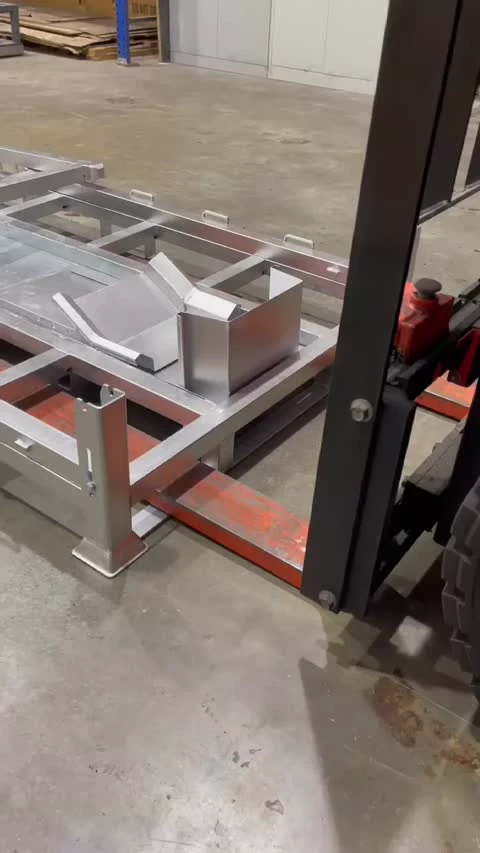
The wheel trough is a positioning feature: it provides the front tire with a guide groove so that the position of the motorcycle is repeatable from load to load – and this is exactly what allows a single drawing to serve an entire fleet. The side rails and the perimeter frame provide lateral limitation at floor level and protect the unit during forklift handling and stacking.
What they do not replace are the straps. A rail prevents the tire foot from slipping beyond the frame edge; it does not prevent a motorcycle from tipping outward over the rail. Therefore the securing package is specified as a combination, and therefore a bare, flat motorcycle metal pallet with side rail and without clamping is not the same product as a clamped Mtrack unit.
Load capacity, clamping force, and strap load capacity are project values
Documented Mtrack projects were designed with 250 kg, 350 kg and 500 kg per rack, with motorcycles approximately 2,270 to 2,410 mm in length, 850 to 1,000 mm in width and approximately 1,200 to 1,315 mm in height. These are project references, not a series load table. What you receive is recorded in the approved drawing after design release.
| Input confirmed by you | What this determines |
|---|---|
| Motorcycle weight and loaded center of gravity | Load capacity per rack, profile cross-sections of the frame, clamp retaining arrangement |
| Front wheel diameter and tire width | Clamping range of the clamping jaws and handwheel stroke |
| Rear wheel width and exhaust clearance | Slot width, hook positions, strap angle |
| Strap hardware provided by you | Hook shape and rated anchor points; strap load capacity is matched to the motorcycle weight |
| Fork entry direction and fork opening | Position of the base channel; documented openings include 175 x 75, 188 x 89 and 200 x 69 mm |
| Stacking plan or container height | Post type, number of tiers and total stack height, at max. 6 m with four tiers in a documented setup |
Nothing in this table can be derived from the photo. A photo proves that the configuration exists; the drawing proves that it fits your motorcycle.
When the three-component method is not the right answer
Be clear about the exclusions, because they determine whether you should order at all. If a motorcycle's front wheel is outside the confirmed clamping range or the tire is too wide for the jaw, this fixture will not be released for the lift. If a motorcycle is equipped with accessories that block the two-sided strap routing, the anchor positions must be re-planned instead of forced through. If it is not a motorcycle – irregular cargo, engines or a bulky fabricated assembly – the clamp and slot geometry is pointless, and a different platform configuration is the honest recommendation.
Es gibt auch eine Handhabungsbedingung, die kein Rahmendesign beseitigt: einen Bediener, der hebt, bevor die Klemme sitzt und beide Gurte gespannt sind. Die Hardware macht die Verriegelung möglich; die Prüfung vor dem Heben macht sie wirksam.
Where this configuration is used
- Factory shipping and dealer network transport, in which each motorcycle leaves the factory on its own fork-handleable unit.
- Container loading of motorcycles, with the clamp and strap points fixed so that the same crew repeats the same procedure.
- Dealer warehouses and distribution centers where motorcycle stack storage runs with mixed models of different heights.
- Racing, touring, event and collector transport, where paint damage to the rim or fairing is expensive.
Questions buyers ask about a tip-safe motorcycle pallet
Does the motorcycle roll or tip while the loaded pallet is being lifted?
If the front wheel is clamped and both sides are tensioned into the U-shaped hooks, the motorcycle is held at the wheel and pulled into a fixed position – exactly the condition for which the frame is designed. However, a sequence remains: clamp seated, straps tensioned, forks fully in the channels, then lift evenly. A unit lifted with the clamp open is not a secured unit – regardless of what the drawing says.
Can you guarantee that the motorcycle will not shift on any model?
No, and any supplier who says yes without your wheel dimensions is guessing. Clamping force, jaw range and strap specification are determined based on your motorcycle weight, front wheel size and strap angle. Within the confirmed envelope, we design for a fixed position; outside of it, we specify a different clamp or holder, or we tell you that the configuration is not suitable.
Will the clamp damage the wheel or the rim?
The jaw is specified to close on the front tire, and the contact surfaces are a drawing detail, not an on-site adjustment. Tell us wheel and tire sizes as well as any coatings that must be protected, and this will become part of the drawing review. Do not add pads or spacers to change the clamping grip after delivery.
How many tiers can be stacked once the motorcycles are loaded?
The number of tiers depends on the design and the vehicles, not on a general rule. A technical design recommends a total stack height of 6 m or less with four tiers; other projects were specified with three tiers or with two levels for transport. The number applicable to your space or container is determined once rack height and post type are fixed.
Send us the motorcycle, not the model number
The fastest way to a securing plan that withstands a real lift is: send us the motorcycle – brand, model year, front wheel diameter and tire width, rear wheel width, fueled weight as well as a photo of the motorcycle from the front and from the side. With this, we can tell you whether the clamping range of the handwheel clamp covers your wheel, where the U-hooks should sit and what strap load capacity your motorcycle requires. For the actual hardware, see the Configuration of the front wheel clamp motorcycle carrierZur Frage, wie die Tragfähigkeit pro Projekt festgelegt wird, lesen Sie reinforced motorcycle pallet racking for multi-level loading, and what happens with the carriers on the return trip in empty running can be found under flat-folding motorcycle carrier for cost-effective empty-run shipping.
Benötigen Sie eine individuelle Lagerlösung?
Sprechen Sie direkt mit unseren technischen Ingenieuren. Wir bieten kostenlose Strukturplanungen, Bewertungen von Hochlast-Katalogen und schnelle B2B-Preisangebote.
Jetzt Angebot anfordern →