
The loaded side of a motorcycle shipping program is determined by the motorcycle. The empty side is determined by the rack. That is why two exporters shipping the same motorcycle model can both be right with different hardware: one sends racks back every month, the other never sees the rack again.
This guide separates the three configurations we build on Mtrack's steel base frame — permanently fixed uprights, folding or plug-in uprights, and a hybrid that folds on one side and dismantles on the other — and shows which return pattern fits each configuration. There is no universal winner here. The deciding factors are the number of return trips per year, who pays the return freight, and how the motorcycle is packed at each end.
What a folding motorcycle rack actually changes
Folding does not mean the whole rack collapses like a box. On a folding Mtrack, the base frame, wheel position and tie-down points stay as they are; the vertical sections are the parts that move. Two mechanisms appear in documented projects: uprights that pull out of the base feet (plug-in posts), and uprights that fold inward and lie along the deck. Both exist for the same reason — the empty rack should no longer take up the full height of a motorcycle.
The practical result is that the return shipment consists of base frames plus bundled posts instead of finished racks. In one documented project with plug-in uprights, twelve empty racks were bundled into one column of approximately 2,490 mm. That figure belongs to that project and that post design; it is not a catalog stacking figure. What is transferable is the method: measure your own empty stack, and multiply it by the number of return trips you actually make.
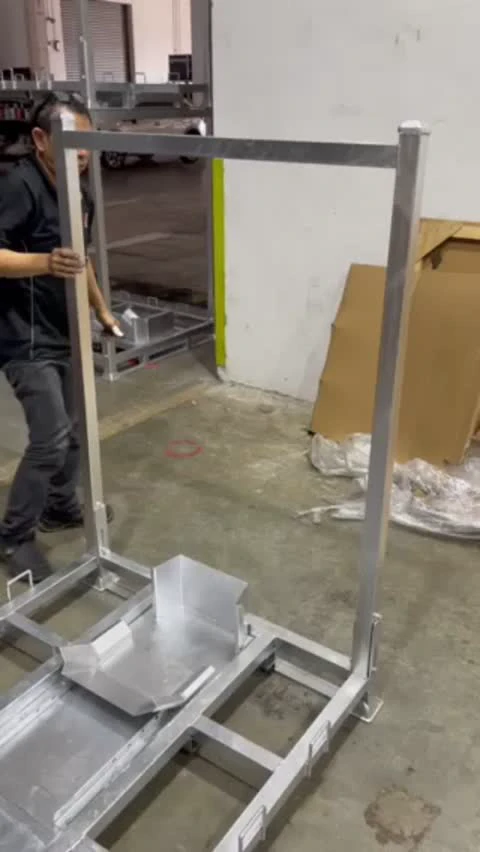
Folding also has a price, and it is paid in handling rather than in steel. Someone has to pull pins or swing posts at every unit, every cycle. With four posts per rack and thirty racks per shipment, that is a recurring manual job that requires a station, a routine and an inspection step. If posts, pins or hinge points are damaged or lost, the next loaded stack is unsafe — so check the fit of the feet, pins, bolts and hinge welds on every return before the rack is put back into service.
What a fixed motorcycle rack gives you instead
A fixed rack is exactly what the name says: the uprights do not move. There is no pin to pull, no hinge to keep free of dirt, no separate bundle of posts to count and store, and no folding mechanism that requires training. Structurally it is the simplest of the two — fewer connections, fewer parts that can be lost, one step less at the loading station and one thing less to inspect after a rough sea voyage.
That simplicity matters when the rack does not come back. For a one-way export where the rack travels with the motorcycle and stays with the dealer or the new owner, an empty-return function adds cost and handling work that the program never uses. In that case, a fixed rack, or the wooden crate in which the shipment would otherwise be packed, is the fair comparison. A crate is bought per shipment and thrown away; a fixed steel rack is bought once and must still earn its price through repeated use or through residual value at the destination.
A fixed rack is also the simpler answer when the rack does not leave the building at all — dealer storage, a race team's own transport fleet, or a collection on a fixed surface. There, the return is a walk across the floor, not an ocean freight line, and folding hardware solves nothing.
The hybrid: fold one side, dismantle the other
Between the two extremes is a configuration documented in a project for an export scheme: one side of the rack is foldable, the other side is demountable. The foldable side retains a reference edge on the base frame, so the empty unit still positions and stacks predictably; the removable side lets the posts travel as a separate bundle. That project used a workload of 250 kg per rack, which is one design result and not a series classification.
This setup suits a program where most trips are one-way, but some of the racks actually come back — a dealer network that sends out engines and occasionally returns racks, or a mixed fleet where some routes are one-way and others are not. It costs more design attention than any individual solution, so it only pays off when the return pattern is truly mixed.
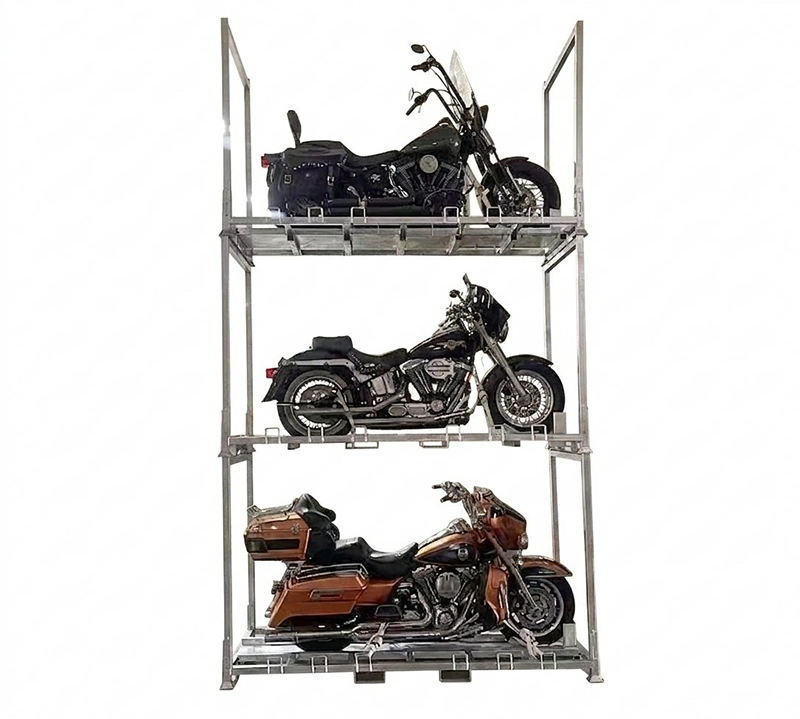
Welke van de drie u ook kiest, de beladen rit ziet er hetzelfde uit: stalen basisframe, wielgroef of blokkering, voorwielpositionering en klemmogelijkheden, U-vormige sjorhaken, en vorkheftrucktoegang geconfigureerd voor tweeweg- of vierweg-handling. Gedocumenteerde werkbelastingen van projecten liggen op 250, 350 of 500 kg per pallet na ontwerpbeoordeling, referentie-eigengewichten liggen op 70–108 kg, en stapelingsrichtlijnen zijn gedocumenteerd als vier lagen onder een totale stapelhoogte van ongeveer 6 m, waarbij andere projecten drie lagen specificeren. Geen van deze is een standaardwaarde — het zijn inputs die u bevestigt voordat een tekening wordt uitgegeven.
Choose on return frequency, not on product preference
The first question to be answered is not "foldable or fixed" but "how many times does this rack come back". Everything else follows from that number.
- One-way, never returns. Fixed uprights, or a wooden crate if the load is suitable for wood. With empty-return hardware, there is nothing to recover.
- Returns once or twice a year, mixed routes. The hybrid is worth investigating — foldable on the side that serves as reference, removable on the side with which the uprights can be bundled tightly.
- Returns several times a year on scheduled routes. Foldable or plug-in uprights are starting to become profitable, because the empty volume is a recurring freight line instead of a one-time one.
- Continuous loop — factory to dealer and back, week after week. Foldable or plug-in uprights, plus a fixed empty-stacking routine and a trained loading station at both ends.
- Never travels — only storage in the factory or showroom. Fixed uprights; the return leg is internal and folding adds extra handling without a freight advantage.
Then check the packaging method, because that determines how much of the saving you actually retain. A rack that is foldable but is sent back in a crate has gained nothing. A rack whose uprights are bundled but whose base frames are loose and unstacked has recovered only part of the volume. Container counts in registered projects range from 28 to 56 sets in a 20 ft and 72 to 140 sets in a 40 ft high cube — that spread is precisely the effect of dimensions, upright type, wheel blocks, packaging and loading direction, so the final count must come from the approved packaging plan, not from a slogan from a brochure.
The finish follows the same logic. Cold galvanizing around 10 μm and powder coating occur as project options; one technical note advises against hot-dip galvanizing for the described construction because the heat can deform it. Prolonged rain is discouraged for these racks, because water can remain standing in hollow tubes — foldable uprights add open ends that deserve attention at any outdoor storage location.
Frequently asked questions before buyers finalize the design
Does folding make the rack weaker?
Not in itself. The force path is determined by the base frame, the upright section and the connection detail, and the working load is fixed on the approved drawing for your project. What changes is the number of connections that must be inspected in each cycle — and that inspection is not optional.
Can I use fixed and foldable racks in the same program?
Yes, and that is common once the routes are separated. Racks on the loop route are folded up; racks on the one-way routes remain fixed. Both use the same wheel positioning and tensioning logic, so loading crews do not have to learn two systems.
How do I estimate the saving before I order?
Measure the empty stacking height of the configuration you are considering, count the number of return trips per year and compare that with the volume the same number of fixed racks would occupy. Do it with your own figures — everything else is a guess about your freight contract, not about your rack.
What you can do now
If your routes mix both one-way and return traffic, start on the configuration page for the Mtrack foldable motorcycle shipping rack and read the empty-return calculation in the manual for flat-foldable return shippingAls uw probleem eigenlijk containerdichtheid is in plaats van retourvolume, dan is de manual for nesting and 40 ft loading the better reference. Send us your motorcycle envelope dimensions, unit weight, fork direction, stacking layers and return pattern, and we will tell you which of the three fits before a drawing is issued.
Heeft u een op maat gemaakte opslagoplossing nodig?
Spreek rechtstreeks met onze technische ingenieurs. Wij bieden gratis constructieontwerpen, evaluaties van zwaar belaste catalogi en snelle B2B-prijsopgaven.
Vraag nu een offerte aan →