
Nestbarer Motorrad-Versandgestell für hochdichte 40-ft-Containerbeladung
Verschachtelbares Motorrad-Versandgestell für hochdichte Containerbeladung: 8 hoch × 10 Stapel ≈ 80 Gestelle in einem 40-ft-High-Cube, 7 hoch × 4 Stapel ≈ 28 in einem 20-ft, Steckpfosten und eine gefaltete Leer-Rücklieferung. Die Anzahlen sind Schemawerte, die anhand Ihrer Zeichnung bestätigt werden.
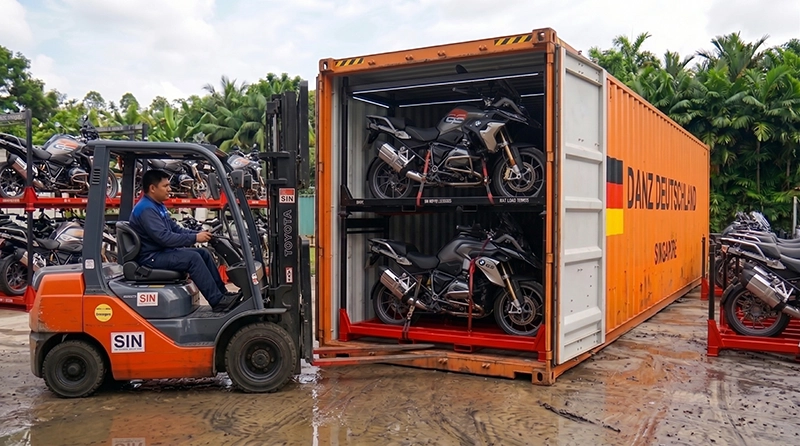
Eine Box, Dutzende Gestelle – und ein leeres Gestell, das auf dem Rückweg nicht im Weg ist
Wenn Sie Seefracht für Motorräder kalkulieren, ist die Zahl, die das Angebot bestimmt, nicht der Gestellpreis. Es ist die Frage, wie viele Motorrad-Versandpaletten in einen Container passen und wie viel Volumen die leeren Gestelle auf dem Rückweg verbrauchen.
Mtrack ist eine Motorrad-Stahlpalette, die um diese beiden Zahlen herum gebaut ist. Die Pfosten sind steckbar, sodass ein beladenes Gestell auf dem darunter liegenden Gestell stapelt, wobei die Füße auf den unteren Pfosten sitzen, und ein leeres Gestell verliert seine Pfosten oder klappt zusammen, anstatt als Gestell in voller Höhe zu versenden. Für eine Gestellkontur wurden Beladungsschemata mit 8 Gestellen pro Stapel über 10 Stapel in einem 40-ft-High-Cube und 7 Gestellen pro Stapel über 4 Stapel in einem 20-ft-Container erfasst. Dies sind Schemawerte aus benannten Projekten, keine Katalogbewertung: Die Anzahl variiert je nach Gestellkontur, Pfostentyp, Radhalterung, Verpackungsmethode und Beladungsrichtung, sodass die endgültige Zahl anhand Ihrer genehmigten Zeichnung festgelegt wird.
- Stahl-auf-Stahl-Verschachtelung. Die Füße des oberen Gestells landen auf den Steckpfosten des darunter liegenden Gestells, sodass jede Schicht vom Rahmen getragen wird und nicht vom darunter befindlichen Motorrad.
- Richtlinie zur Stapelhöhe. Ein technisches Update fordert eine Gesamtstapelhöhe von 6 m oder weniger und empfiehlt bei dieser Gestellhöhe vier Schichten. Höhere oder schwerere Motorräder reduzieren die praktische Schichtanzahl.
- 40-ft-High-Cube-Schema. 8 hoch × 10 Stapel ≈ 80 Gestelle. Das frühere Schema für dasselbe Gestell verzeichnete 90.
- 20-ft-Schema. 7 hoch × 4 Stapel ≈ 28 Gestelle. Das frühere Schema verzeichnete 32.
- Leere Rücklieferung. Steck- oder klappbare Pfosten verwandeln die Rückladung in Basen plus gebündelte Pfosten statt in volles Gestellvolumen.
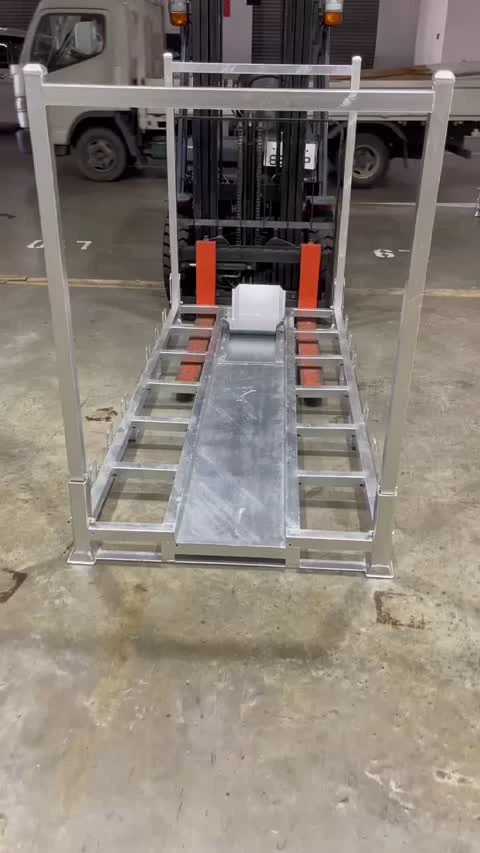
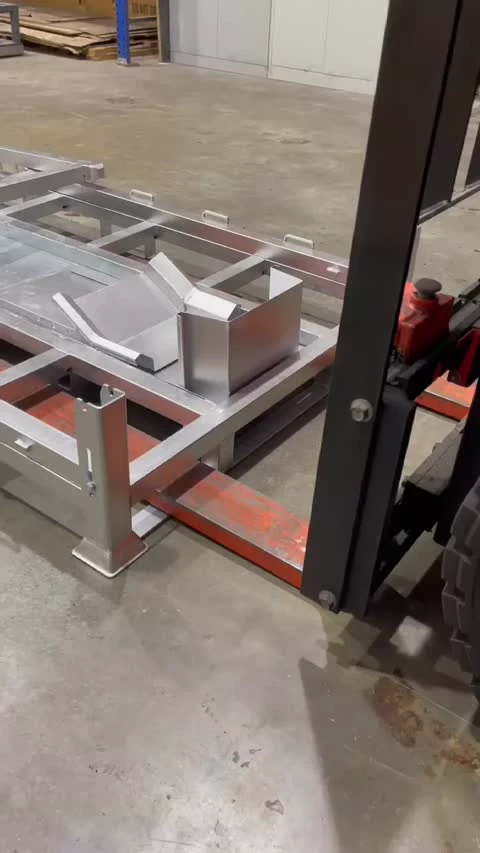
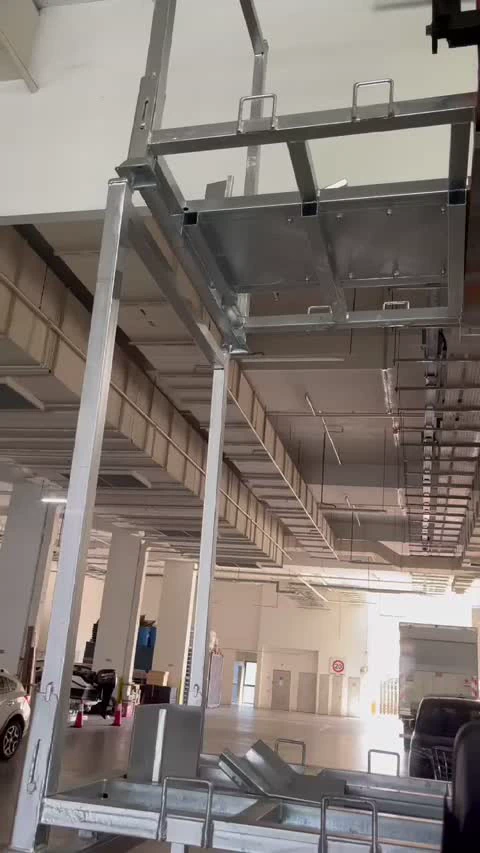
How the rack quantities actually look in practice
40 ft High Cube
8 high × 10 stacks ≈ 80 racks
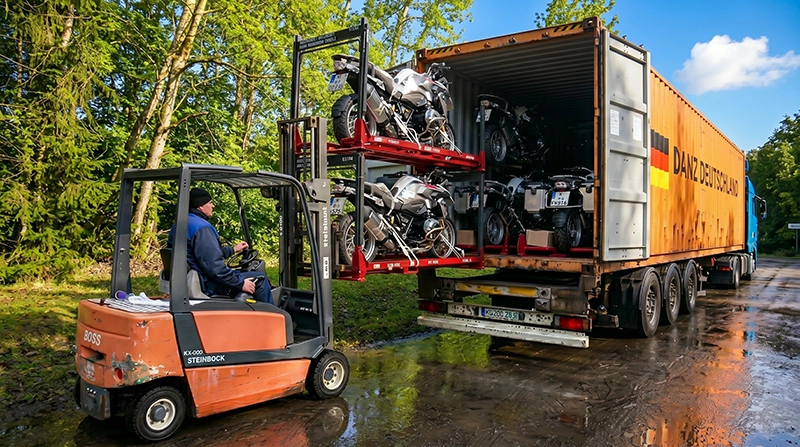
The 40-ft high cube is where the nesting structure pays off: a single stack of 8 racks, repeated 10 times across the floor area. It is the loading scheme value recorded for a rack profile, and the count is confirmed against the drawing, not quoted from a table.
- Single stack: 8 racks
- Stacks across the container: 10
- Scheme total: ≈ 80 racks (earlier scheme 90)
- Road-Glide project, base bundle 2580×1100×2500 mm: 72 racks
- Collector project, 2320×1050×1400 mm rack: 88 racks
 20-ft container
7 high × 4 stacks ≈ 28 racks
A 20-ft box accommodates the same rack with a lower stack and fewer stacks across the floor area. The plan always pays off when you split a season between 20-ft and 40-ft shipments, since freight costs per rack do not change linearly with container size.
- Single stack: 7 racks
- Stacks across the container: 4
- Scheme total: ≈ 28 racks (earlier scheme 32)
- Collector project, 2320×1050×1400 mm rack: 35 racks
 Leere Rückführung
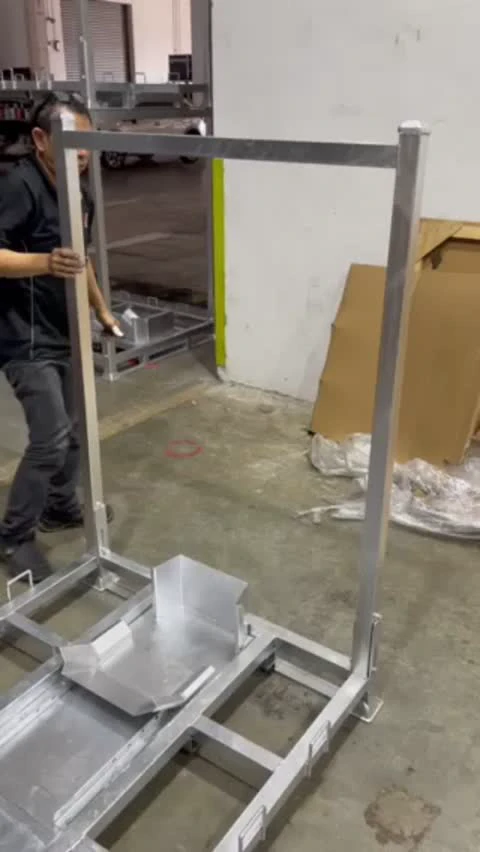
Plug-in posts removed, bases bundled
The posts are separated from the base, so the return is planned as a base bundle plus bundled posts. In one project, the bases were packed at 12 per bundle at 2580×1100×2500 mm, with 3 racks per bundle at 2580×1100×900 mm for posts and frames.
- Posts: plug-in or collapsible, bolted after assembly
- Empty handling: base bundle plus bundled posts
- Project bundle reference: 12 bases at 2580×1100×2500 mm
- Project bundle reference: 3 racks at 2580×1100×900 mm
Four factors that influence the container count
Rack outer dimensions
Documented rack outer dimensions range from 2320×1050×1400 mm to 2550×1050×1316 mm plus a 650 mm wide variant. A wider or taller rack reduces the number of stacks across the floor area before anything else is decided.
Wheel trough and securing
Adjustable wheel troughs are optional and their position can affect the stack above them. One customer asked for adjustable wheel troughs instead of a fixed position at the base. Whether the wheel troughs change the loading height must be checked against the loading plan, not assumed.
Loaded or empty
A rack transported with a motorcycle in it is calculated at rack height plus stack pitch; an empty rack with its posts removed is calculated as a base. The two plans result in very different freight costs per unit, and both should be calculated before placing an order.
Packaging method
Stretch film and strapping cause no packaging costs but leave the coating exposed to contact damage between units. Wood packaging costs more and takes up volume, calculated by area with a project reference of about CNY 90 per square meter, and it changes the bundle dimensions.
From annual volume to confirmed rack quantity
Send volume and port
Annual and per-shipment rack quantity required, destination port, and the largest and smallest motorcycle dimensions you ship: length, width, height and weight per unit.
We create the loading plan
Rack outer dimensions, post type, wheel trough or pure strap securing, packaging method and loading direction are combined into 20-ft and 40-ft high-cube scenarios.
Quantity fixed on drawing
The rack quantity, the number of stack levels and the maximum stack height are shown on the approved drawing. Nothing is quoted from a standing table of container quantities.
Production and return plan
Die Produktion folgt der freigegebenen Zeichnung, und die Leerlaufkonfiguration – Pfosten herausgenommen oder geklappt – wird dokumentiert, damit der Rücktransport auf Basis des tatsächlichen Volumens gebucht wird.
FAQ zur Containerbeladung
Sind 80 Gestelle in einem 40-ft-High-Cube eine garantierte Zahl?
Nein. Es handelt sich um einen Beladeplanwert für ein Gestellaußenmaß: 8 Gestelle pro Stapel über 10 Stapel. Für dasselbe Gestell wurden früher auch 90 dokumentiert, ein Road Glide-Projekt verzeichnete 72 mit Basisbündeln von 2580×1100×2500 mm, und ein Sammlerprojekt verzeichnete 88. Maßgeblich ist die Zahl, die für Ihr Gestell, Ihre Radmulden und Ihre Verpackung gezeichnet und unterschrieben wird.
Kann ich vier Lagen stapeln und unter 6 m bleiben?
Eine technische Aktualisierung verlangt eine Gesamtstapelhöhe von maximal 6 m, und bei der in diesem Dokument angegebenen Gestellhöhe werden vier Lagen empfohlen. Dabei handelt es sich um eine Stapelempfehlung aus einem einzelnen Projekt, nicht um eine serie-weitliche Grenze: Die Lagenanzahl muss anhand Ihrer Gestellstruktur, der Motorradhöhe sowie des Bodens oder der Transportgeräte geprüft werden.
Verändern Radkeile die Anzahl der passenden Gestelle?
Sie können es. Sind die in einigen Projekten verstellbar montiert, was das darüber gestapelte Gestell beeinträchtigen kann. Dies ist ein offener Punkt, den wir anhand des Verladeplans und der endgültigen Zeichnung bestätigen, anstatt eine feste Anzahl zuzusichern.
Wie kommen die leeren Gestelle zurück?
Die Pfosten sind steckbar und können abgenommen oder heruntergeklappt werden, sodass die Rückladung aus Sockeln plus gebündelten Pfosten besteht. Ein dokumentiertes Projekt verpackte 12 Sockel pro Bündel mit 2580×1100×2500 mm und 3 Gestelle pro Bündel mit 2580×1100×900 mm. Die Bündelgrößen werden für Ihren Gestellumriss und Ihre Verpackungswahl neu zugeschnitten.
Wie hoch ist die Tragfähigkeit eines Gestells?
There is no one-size-fits-all series load capacity. Project designs have been released at 250 kg, 350 kg, and 500 kg per rack. A technical review documents an allowable stress of 220 MPa with a maximum of 181 MPa at the U-shaped wheel plate under 500 kg loading, and 203 MPa when the middle beams remained unchanged. These are design values, not a certification. Send us your heaviest motorcycle and we will dimension the rack for it.
Can a pallet truck pick up the rack at ground level?
In one project, the structure was raised by about 1 inch to leave approximately 3.75 inches of clearance for a standard pallet truck, with two additional lifting channels in thicker material. Fork openings and center spacings vary by project—documented values include 175×75 mm, 188×89 mm, and 200×69 mm—so the entry geometry is confirmed based on your handling equipment.