
The loaded leg of a motorcycle shipping program is dictated by the bike. The empty leg is dictated by the rack. That is why two exporters moving the same motorcycle model can both be right with different hardware: one sends racks back every month, the other never sees the rack again.
This guide separates the three configurations we build on the Mtrack steel base frame — permanently fixed uprights, folding or plug-in uprights, and a hybrid that folds on one side and detaches on the other — and shows which return pattern each one fits. There is no universal winner here. The deciding inputs are round trips per year, who pays the return freight, and how the motorcycle is packed at each end.
What a foldable motorcycle rack actually changes
Folding does not mean the whole rack collapses like a carton. On a folding Mtrack, the base frame, wheel location and strap points stay as they are; the vertical members are the parts that move. Two mechanisms appear in recorded projects: uprights that pull out of the base sockets (plug-in posts), and uprights that hinge inward and lie down along the deck. Both exist for the same reason — the empty rack must stop occupying a full motorcycle’s height.
The practical result is that the return load becomes bases plus bundled posts instead of finished racks. In one recorded project using plug-in uprights, twelve empty racks were bundled into a single column at roughly 2,490 mm. That figure belongs to that project and that post design; it is not a catalogue stacking number. What transfers is the method: measure your own empty stack, then multiply it by the number of return trips you actually run.
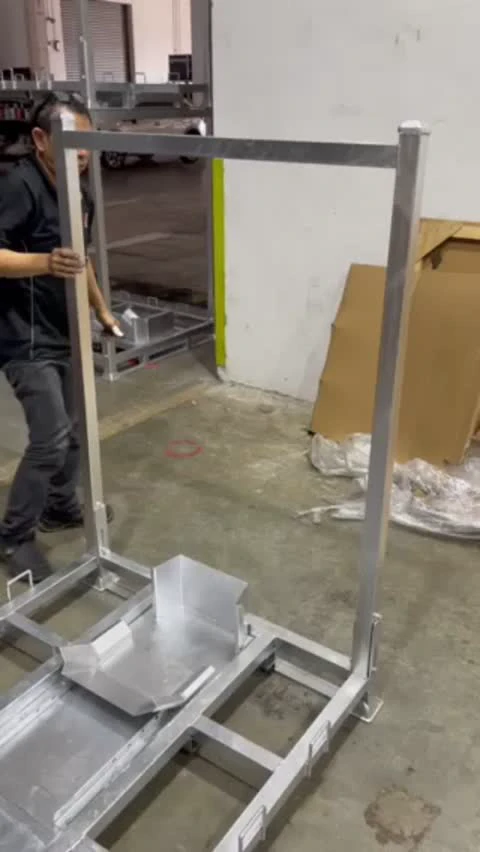
Folding has a cost too, and it is paid in handling rather than in steel. Someone has to pull pins or swing posts on every unit, every cycle. At four posts per rack and thirty racks per shipment, that is a repetitive manual job that needs a station, a routine and an inspection step. If posts, pins or hinge points are damaged or lost, the next loaded stack is unsafe — so check feet seating, pins, bolts and hinge welds on every return before the rack goes back into service.
What a fixed motorcycle rack buys you instead
A fixed rack is exactly what the name says: the uprights do not move. There is no pin to pull, no hinge to keep free of grit, no separate post bundle to count and store, and no folding action to train. Structurally it is the simpler of the two — fewer interfaces, fewer parts to lose, one less step at the loading station and one less thing to inspect after a rough sea leg.
That simplicity matters when the rack is not coming back. For a one-way export where the rack ships with the motorcycle and stays with the dealer or the new owner, an empty-return feature adds cost and handling work that the program never uses. In that case a fixed rack, or the wooden crate the shipment would otherwise be packed in, is the honest comparison. A crate is bought per shipment and discarded; a fixed steel rack is bought once and must still earn its price through repeated use or through resale value at the destination.
A fixed rack is also the simpler answer when the rack never leaves the building at all — dealer storage, a racing team’s own transport fleet, or a collection kept on a fixed footprint. There the return leg is a walk across the floor, not an ocean freight line, and folding hardware solves nothing.
The hybrid: fold one side, detach the other
Between the two extremes sits a configuration recorded on a project for an export scheme: one side of the rack folds, the other side is detachable. The folding side keeps a reference edge on the base, so the empty unit still locates and stacks predictably; the removable side lets the posts travel as a separate bundle. That project used a 250 kg per-rack working load, which is one design outcome and not a series rating.
This arrangement suits a program where most trips are one-way but a portion of racks genuinely returns — a dealer network that sends bikes out and occasionally sends racks back, or a mixed fleet where some lanes are one-way and some are not. It costs more design attention than either single solution, so it only pays when the return pattern really is mixed.
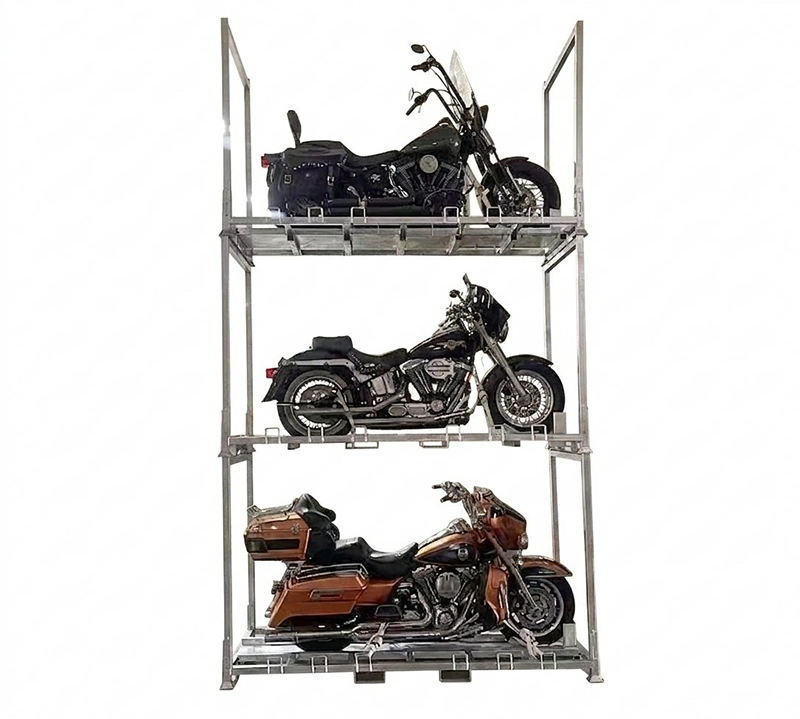
Whichever of the three you pick, the loaded trip looks the same: steel base frame, wheel groove or chock position, front-wheel locating and clamping options, U-shaped strap hooks, and forklift entry configured for two-way or four-way handling. Recorded project working loads run at 250, 350 or 500 kg per pallet after design review, reference tare weights sit at 70–108 kg, and stacking guidance has been recorded as four layers under a total stack height of about 6 m, with other projects specifying three layers. None of these is a default — they are inputs you confirm before a drawing is issued.
Choose by return frequency, not by product preference
The question to answer first is not “foldable or fixed” but “how many times does this rack come back”. Everything else follows from that number.
- One-way, never returns. Fixed uprights, or a wooden crate if the load suits wood. Empty-return hardware has nothing to recover.
- Returns once or twice a year, mixed lanes. The hybrid is worth examining — folding on the side that sets the reference, detachable on the side that lets posts bundle tight.
- Returns several times a year on scheduled lanes. Folding or plug-in uprights start to pay, because the empty volume is a recurring freight line rather than a one-off.
- Continuous loop — factory to dealer and back, week after week. Folding or plug-in uprights, plus a defined empty-stack routine and a trained handling station on both ends.
- Never travels — in-plant or showroom storage only. Fixed uprights; the return leg is internal and folding adds handling work for no freight gain.
Then check the packing method, because it decides how much of the saving you keep. A rack that folds but is shipped back inside a crate has gained nothing. A rack whose posts are bundled but whose base frames are loose and unstacked has recovered only part of the volume. Container counts in recorded projects range from 28 to 56 sets in a 20 ft and 72 to 140 sets in a 40 ft high cube — that spread is exactly the effect of dimensions, post type, wheel chocks, packing and loading direction, so the final count has to come from the approved packing plan, not from a brochure line.
Finish follows the same logic. Cold galvanizing around 10 μm and powder coating appear as project options; one technical note advises against hot-dip galvanizing for the referenced structure because the heat may distort it. Prolonged rain is not recommended for these racks, since water can sit inside hollow tubes — folding posts add open ends that deserve a look on any outdoor staging area.
Questions buyers ask before freezing the design
Does folding make the rack weaker?
Not by itself. The load path is set by the base frame, the post section and the connection detail, and the working load is frozen on the approved drawing for your project. What changes is the number of interfaces that must be inspected every cycle — and that inspection is not optional.
Can I run fixed and foldable racks in the same program?
Yes, and it is common once lanes are separated. Racks on the loop lane fold; racks on the one-way lanes stay fixed. Both use the same wheel location and strap logic, so loading crews do not have to learn two systems.
How do I size the saving before I order?
Measure the empty stack height of the configuration you are considering, count the return trips per year, and compare that with the volume the same number of fixed racks would take. Do it with your own numbers — anything else is a guess about your freight contract rather than your rack.
Where to go next
If your lanes mix one-way and return traffic, start from the configuration page for the Mtrack foldable motorcycle shipping rack and read the empty-return arithmetic in the flat-folding return shipping guide. If your problem is really container density rather than return volume, the nesting and 40 ft loading guide is the closer reference. Send your motorcycle envelope, unit weight, fork direction, stack layers and return pattern, and we will tell you which of the three configurations fits before any drawing is issued.
Need a Custom Storage Solution?
Speak directly with our technical engineers. We offer free structural designs, heavy-duty catalog evaluations, and quick B2B price quotations.
Request a Quote Now →