
Nesting Motorcycle Shipping Rack for High-Density 40ft Container Loading
Nesting motorcycle shipping rack for high-density container loading: 8 high × 10 stacks ≈ 80 racks in a 40ft high cube, 7 high × 4 stacks ≈ 28 in a 20ft, plug-in uprights and a folded empty return. Counts are scheme values confirmed on your drawing.
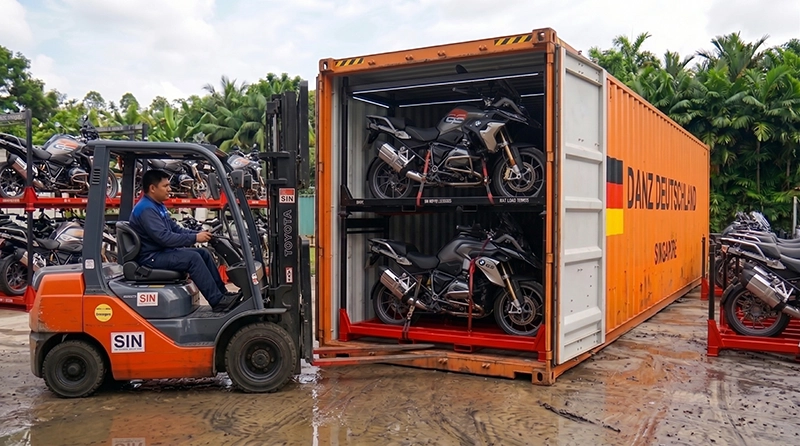
One Box, Dozens of Racks — and an Empty Rack That Comes Back Out of the Way
If you are costing ocean freight on motorcycles, the number that decides the quote is not the rack price. It is how many motorcycle shipping pallets fit in one container, and how much volume the empty racks eat on the way back.
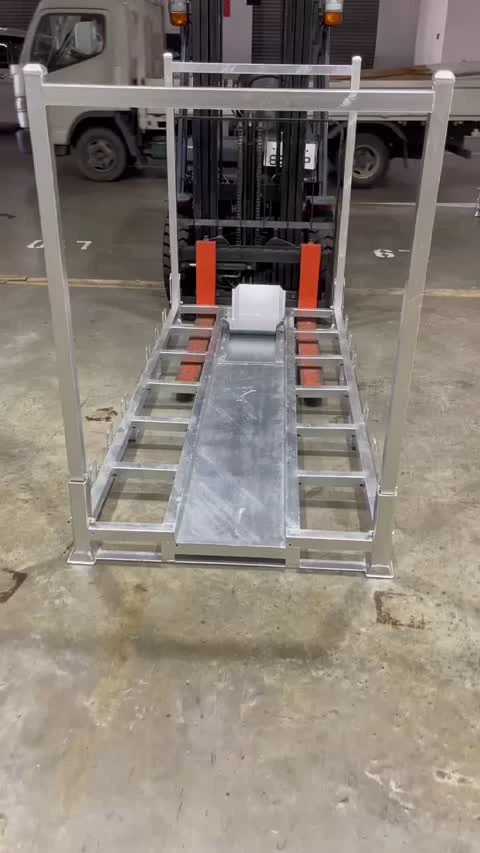
Mtrack is a steel motorcycle pallet built around those two numbers. The uprights are plug-in, so a loaded rack stacks on the rack below with its feet seated on the lower posts, and an empty rack loses its posts or folds down instead of shipping as a full-height frame. For one rack outline, loading schemes were recorded at 8 racks per stack across 10 stacks in a 40 ft high cube and 7 racks per stack across 4 stacks in a 20 ft. Those are scheme values from named projects, not a catalogue rating: the count moves with rack outline, upright type, wheel chock, packing method and loading direction, so the final figure is fixed on your approved drawing.
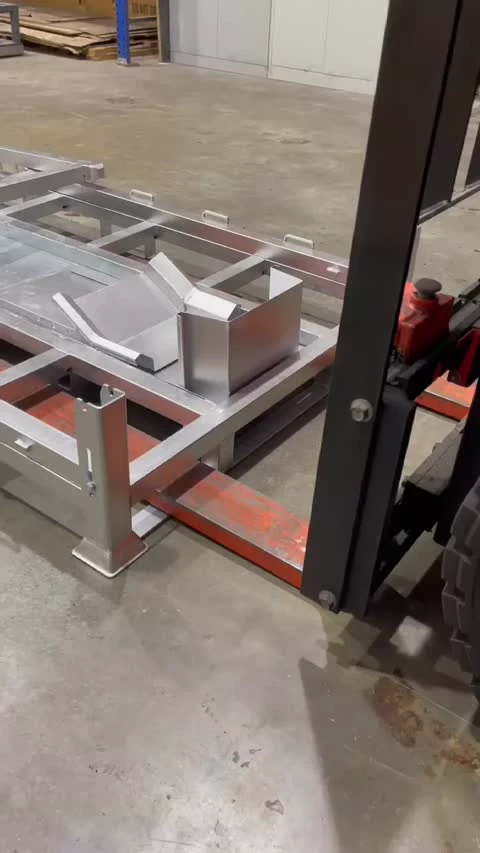
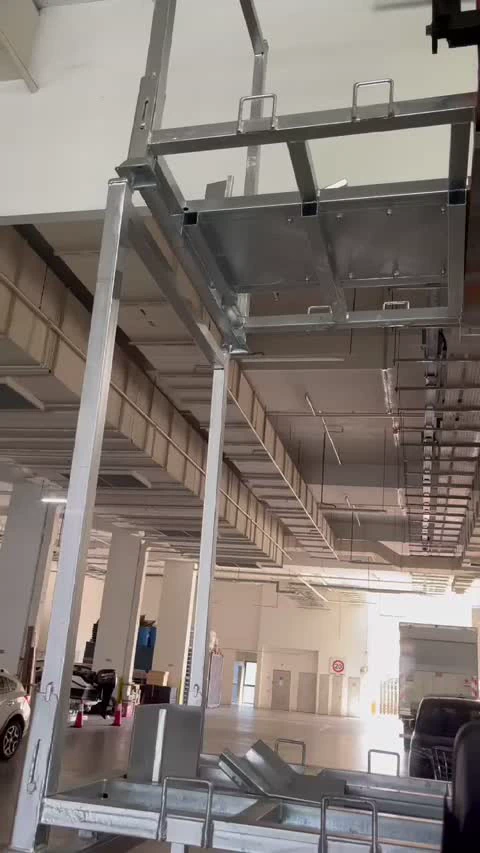
- Steel-to-steel nesting. The upper rack’s feet land on the plug-in posts of the rack below, so each layer is carried by the frame rather than by the motorcycle underneath.
- Stack height guideline. One engineering update asks for total stack height at or below 6 m and recommends four layers at that rack height. Taller or heavier motorcycles reduce the practical layer count.
- 40 ft high cube scheme. 8 high × 10 stacks ≈ 80 racks. The earlier scheme for the same rack recorded 90.
- 20 ft scheme. 7 high × 4 stacks ≈ 28 racks. The earlier scheme recorded 32.
- Empty return. Plug-in or fold-down uprights turn the return load into bases plus bundled posts instead of full rack volume.
How the Rack Counts Land in Practice
40 ft High Cube
8 High × 10 Stacks ≈ 80 Racks
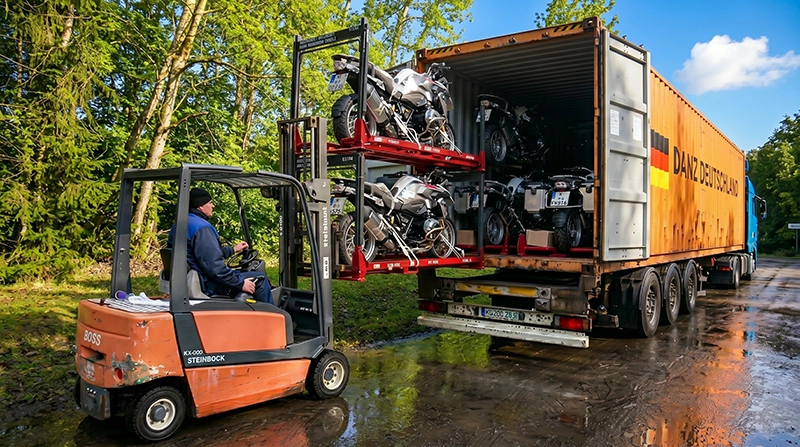
The 40 ft high cube is where the nesting structure pays for itself: a single stack of 8 racks, repeated 10 times across the floor. It is the loading scheme value recorded for one rack outline, and the count is confirmed on the drawing rather than quoted from a table.
- Single stack: 8 racks
- Stacks across the container: 10
- Scheme total: ≈ 80 racks (earlier scheme 90)
- Road Glide project, base bundles 2580×1100×2500 mm: 72 racks
- Collector project, 2320×1050×1400 mm rack: 88 racks
20 ft Container
7 High × 4 Stacks ≈ 28 Racks
A 20 ft box takes the same rack at a lower stack and fewer stacks across the floor. The plan is worth running whenever you split a season between 20 ft and 40 ft sailings, because the per-rack freight figure does not move in a straight line with the container size.
- Single stack: 7 racks
- Stacks across the container: 4
- Scheme total: ≈ 28 racks (earlier scheme 32)
- Collector project, 2320×1050×1400 mm rack: 35 racks
Empty Return
Plug-In Uprights Off, Bases Bundled
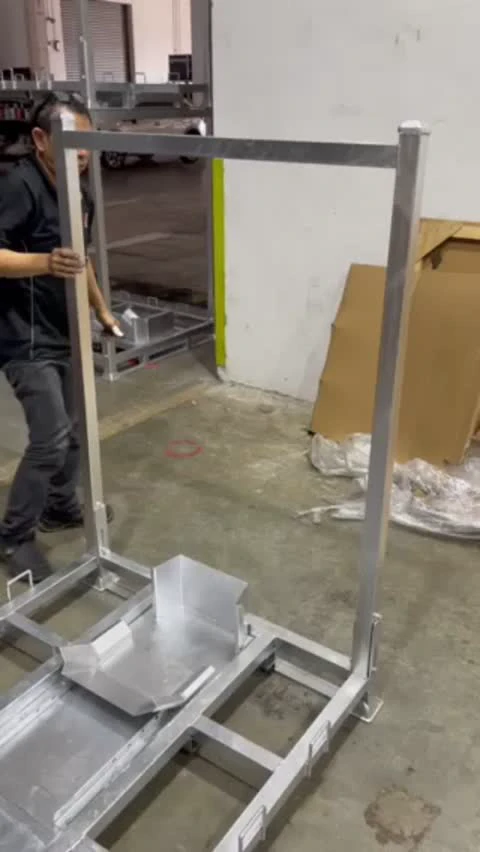
Uprights separate from the base, so the return leg is planned as base bundles plus bundled posts. In one project the bases were packed 12 per bundle at 2580×1100×2500 mm, with 3 racks per bundle at 2580×1100×900 mm for the posts and frames.
- Uprights: plug-in or fold-down, locked with pins after assembly
- Empty handling: base bundles plus bundled uprights
- Project bundle reference: 12 bases at 2580×1100×2500 mm
- Project bundle reference: 3 racks at 2580×1100×900 mm
Four Things That Move the Container Count
Rack outline
Documented rack outlines run from 2320×1050×1400 mm to 2550×1050×1316 mm, and one 650 mm wide variant. A wider or taller rack reduces the number of stacks across the floor before anything else is decided.
Wheel chock and restraint
Adjustable wheel chocks are optional and their position may interfere with the stack above. One customer asked for adjustable chocks rather than a base-fixed position. Whether the chocks change the loaded height has to be checked against the loading plan, not assumed.
Loaded or empty
A rack travelling with a motorcycle inside is counted at rack height plus stack pitch; an empty rack that loses its posts is counted as a base. The two plans give very different freight per unit, and both should be priced before the order is placed.
Packing method
Stretch film and strapping add no packaging cost but leave the coating exposed to contact damage between units. Wooden crating costs more and takes cube, quoted by area at a project reference of about CNY 90 per square metre, and it changes the bundle dimensions.
From Annual Volume to a Confirmed Rack Count
Send volume and port
Annual and per-shipment rack quantity, destination port, plus the largest and smallest motorcycle envelope you ship: length, width, height and single-unit weight.
We run the loading plan
Rack outline, upright type, wheel chock or strap-only restraint, packing method and loading direction are combined into 20 ft and 40 ft high cube scenarios.
Count locked on drawing
The rack count, stack layer number and maximum stack height are issued on the approved drawing. Nothing is quoted from a standing table of container quantities.
Production and return plan
Production follows the released drawing, and the empty-return configuration — posts out or folded — is documented so the back-haul is booked on the real volume.
Container Loading FAQ
Is 80 racks in a 40 ft high cube a guaranteed number?
No. It is a loading scheme value for one rack outline: 8 racks per stack across 10 stacks. The same rack was earlier recorded at 90, one Road Glide project recorded 72 using 2580×1100×2500 mm base bundles, and a collector project recorded 88. The number that counts is the one drawn and signed for your rack, chocks and packing.
Can I stack four layers and stay under 6 m?
One engineering update asks for total stack height at or below 6 m, and at the rack height in that record it recommends four layers. That is stacking guidance from a single project, not a series-wide limit: layer count has to be checked against your rack structure, motorcycle height and floor or transport equipment.
Do wheel chocks change how many racks fit?
They can. Wheel chocks are an option, and their mounting position has to be adjustable in some projects, which can interfere with the rack stacked above. This is an open point that we confirm against the loading plan and the final drawing rather than promising a fixed count.
How do the empty racks come back?
Uprights are plug-in and can be taken off or folded down, so the return load is bases plus bundled posts. A documented project packed 12 bases per bundle at 2580×1100×2500 mm and 3 racks per bundle at 2580×1100×900 mm. Bundle sizes are re-cut for your rack outline and packaging choice.
What is the load rating of one rack?
There is no single series rating. Project designs have been released at 250 kg, 350 kg and 500 kg per rack. One engineering review records an allowable stress of 220 MPa with a 181 MPa maximum at the U-shaped wheel plate under a 500 kg load, and 203 MPa when the middle beams were left unmodified. These are design-review figures, not a certification. Send your heaviest motorcycle and we size the rack to it.
Can a pallet jack pick up the rack on the floor?
In one project the structure was raised by about 1 inch to leave roughly 3.75 inches of clearance for a standard pallet jack, with two extra lifting channels added in heavier material. Fork openings and centre spacing vary by project — recorded values include 175×75 mm, 188×89 mm and 200×69 mm — so the entry geometry is confirmed against your handling equipment.
B2B Racking Structural Engineering Calculator
Input your structural guidelines below. Our math system calculates material deflection, stress bounds, and recommends optimal profiles.
Click Compute to calculate stress factors and display structural drawing recommendations.