
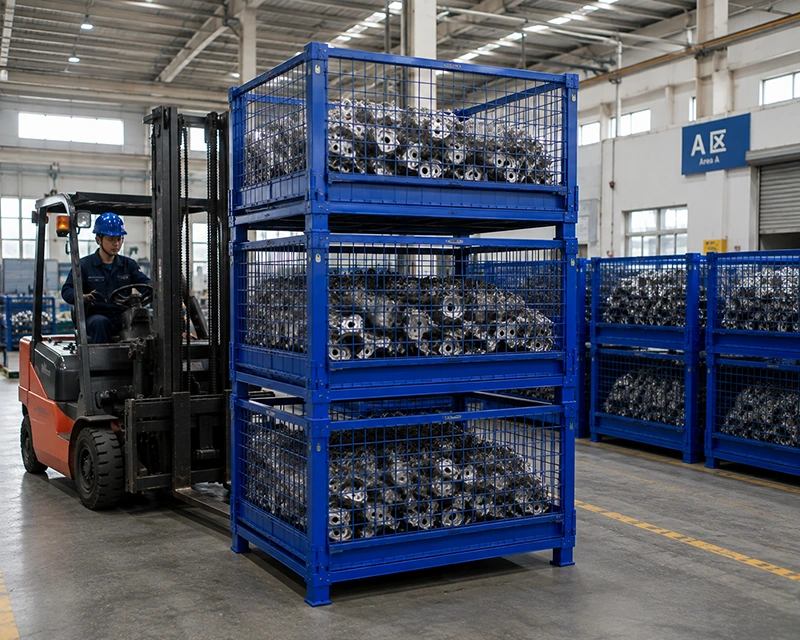
De heenreis krijgt alle aandacht: hoeveel metalen palletboxen er in de container gaan, wat elk weegt beladen, hoe de vorkheftruck hem aan de andere kant oppakt. De terugleweg is waar plannen voor een gesloten lus meestal spaak lopen, want dat is de rit waarvoor je betaalt met een lege box. Als het volume van de lege container nooit wordt gepland, kost de lus stiekem hetzelfde als een enkele reis.
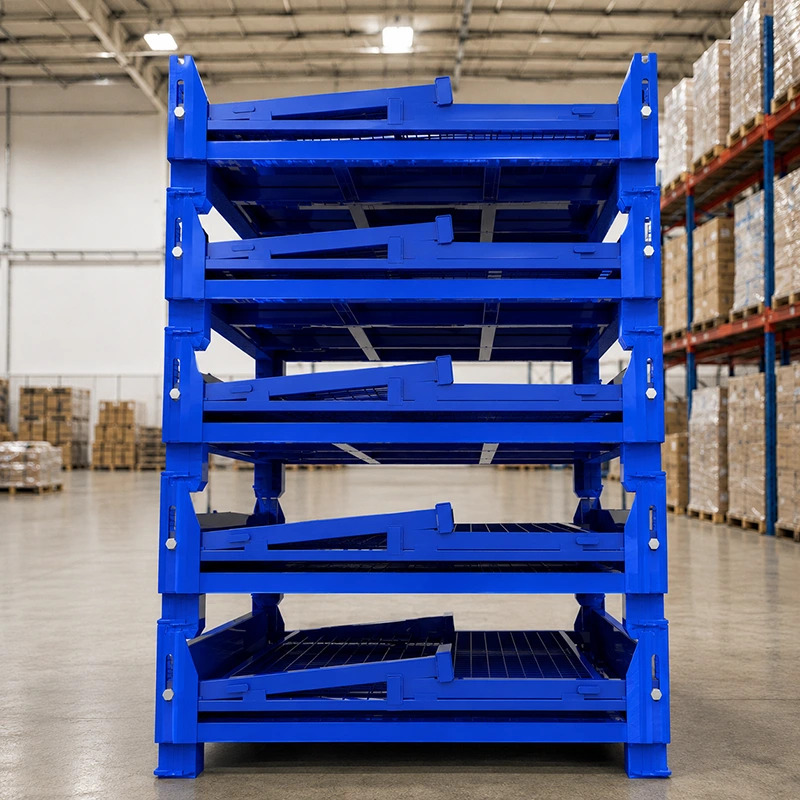
Voor de Sebox inklapbare kooipallet op de voetafdruk van 1000 × 800 mm is het opgevouwen profiel ongeveer 1000 × 800 × 335 mm tegenover circa 840 mm opgebouwd. Dat ene opgevouwen cijfer — niet de beladingscapaciteit en niet het gaaspatroon — is waarop een retourplan wordt gebouwd. Dit artikel zet het om een containeraantal, een stapelkolomhoogte en een kostenvergelijking die een budgetbeoordeling met uw financiële team overleeft.
Bepaal eerst welke optie voor lege retour u daadwerkelijk koopt
Drie verschillende retourstrategieën worden verkocht alsof ze hetzelfde zijn. Een vaste stalen bak keert terug op volledige hoogte, dus elke lege rit kost dezelfde kubieke meters als de beladen rit. Een opvouwbaar corpus, zoals deze inklapbare palletbox, keert terug als een flatpack op de 335 mm-pitch. Een demonteerbaar corpus — vastgeboute panelen en staanders gedemonteerd, of staanders uit de bodem getrokken — keert terug als een bundel panelen plus een bodemplaat, die per stuk nog platter is, maar die aan beide leedelijk meer handlingtijd kost.
De Sebox-documentatie beschrijft zowel opvouwbare corpusvarianten als vastgebouteerde demonteerbare assemblages voor transport, dus de inkooporder moet vermelden welke variant u offerteert. Het plan hieronder gaat uit van een opvouwbaar corpus in de opgevouwen configuratie van 1000 × 800 × 335 mm. Als uw leverancier een variant met demonteerbare staanders offreert, veranderen de kolomhoogte en het containeraantal, en dus ook de arbeidsboete.
What drives the choice is not the catalogue page. It is how many return cycles the loop runs per year, who pays the return freight, and whether the same container can be rescheduled instead of running on a fixed schedule. At fewer than about two cycles per year, collapsible rarely earns its hinge and latch hardware; at weekly or fortnightly cycling, empty cube becomes the largest single figure in the logistics budget.
Converting folded boxes of 1000 × 800 × 335 mm into a container count
The calculation is simple geometry, but the assumptions must be stated, otherwise the figure is worthless in a negotiation. Work it out in five steps and keep the assumptions next to the result.
- Step 1 — floor area. One folded box occupies 1.00 × 0.80 = 0.80 m² of the container floor.
- Step 2 — columns across the width. A container offers about 2,350 mm of internal width. Two columns of 1,000 mm take up 2,000 mm and fit; the remaining ~350 mm carries nothing, because it is narrower than the 800 mm footprint.
- Step 3 — rows along the length. About 5,900 mm of internal length gives 7 rows of 800 mm per row in a 20GP; about 12,000 mm gives 15 rows in a 40ft high cube.
- Step 4 — columns per floor layer. 2 columns × 7 rows = 14 columns in a 20GP; 2 × 15 = 30 columns in a 40HQ.
- Step 5 — stacks. One folded column reaches about 2,150 mm, the height discussed in the next section. Against about 2,390 mm internal height of a 20GP, that is one stack, not two, and the door opening matters as much as the internal height.
Multiply step 4 by the units per column and you get the first-hit number: about 98 folded boxes in a 20GP and about 210 in a 40HQ, before packing loss, dunnage and any mixed loading. Plan with 90 to 98 for a 20GP until your forwarder has checked the loading sequence, and treat all these figures as an estimate on the approved packaging plan rather than a booking promise.
One rule matters more than the arithmetic: do not move numbers between variants. Our own source files record loading samples of 56 units in a 20GP for one larger footprint and 70 units for another, and those numbers belong exclusively to those footprints. The 1000 × 800 × 335 mm folded box is calculated on its own dimensions, and a number copied from another variant is how buyers come up short at the container door.
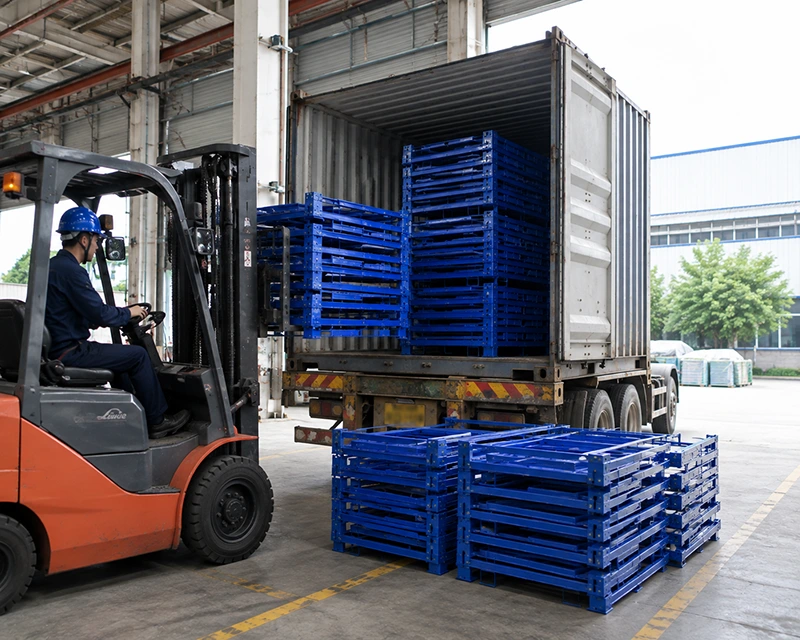
Seven folded boxes as one column of approximately 1000 × 800 × 2150 mm
The practical planning unit is not a single flatpack; it is a banded column. A column of seven units is approximately 1000 × 800 × 2150 mm, the figure used in the container calculation above. It is worth checking the arithmetic behind it, because it shows where the risk lies: seven units of 335 mm each add up to 2,345 mm, not 2,150 mm. The shorter figure applies only if the folded frames nest about 30 mm into each other at each contact surface and the banding compresses the column.
Dat verschil van 195 mm is geen detail. Als nesten op de goedgekeurde tekening is bevestigd, passeert een kolom van 2.150 mm een 20GP-deuropening van circa 2.280 mm en past deze comfortabel binnen de inwendige hoogte van 2.390 mm. Als nesten niet is bevestigd, wordt de kolom 2.345 mm, wat de inwendige hoogte nauwelijks haalt en niet rechtop door de deuropening past. In dat geval zijn de eerlijke opties zes units per kolom (circa 2.010 mm) of de kolom plat leggen en de laagvoordelen volledig verliezen.
De stabiliteit van de opgevouwen kolom komt voort uit drie gewoontes in plaats van uit de box zelf. Elke unit gaat in dezelfde vouworiëntatie in de kolom, zodat de frame-randen, niet het gaaswerk, de belasting door de stapels dragen. Twee stalen banden per kolom met hoekbeschermers houden de raakvlakken gesloten tijdens wegtransport; met één band kunnen de bovenste units draaien. Kolomhoogten blijven gelijk in de hele container zodat de lading vlak is, en de kolommen worden tegen de containerwanden of stophout afgesteund in plaats van vrij te kunnen verschuiven.
Vermijd verwarring met een stapel-belastingswaarde. De 3 tot 4 aanbevolen lagen voor deze variant gelden voor opgebouwde, beladen boxen, en het vouwpatroon onder een lege box is een andere structuur. Een opgevouwen kolomhoogte van circa 2.150 mm is een verpakkingscijfer, en de pletgrens van het opgevouwen frame moet worden bevestigd voordat iemand er iets bovenop stapelt.
De rekenkunde van retourkosten om mee naar Finance te nemen
Retourbesparingen worden meestal als percentage geciteerd, wat de aannames verbergt. Herbouw het getal in vier regels en elke aanname wordt zichtbaar.
- Regel 1 — effectieve vouwsteek. Kolomhoogte ÷ units per kolom: 2.150 mm ÷ 7 ≈ 307 mm per box, of 335 mm per box als nesten niet is bevestigd.
- Regel 2 — retourvolume per box. 1,00 × 0,80 × 0,307 ≈ 0,25 m³ opgevouwen, tegen circa 0,67 m³ voor dezelfde box opgebouwd op 840 mm.
- Regel 3 — retourratio. 307 mm ÷ 840 mm ≈ 0.37, so the empty box takes up roughly 60 to 63 percent less cube than the assembled frame. Our own source files cite a range of 60 to 80 percent for the family; that range covers different box heights, and at 840 mm assembled the geometry cannot reach 80 percent, that would require a pitch of approximately 170 mm. Use the calculated figure for this variant, not the top of the range.
- Line 4 — trips and cost per unit. Total folded cube ÷ usable cube per container yields the number of trips; trips × freight rate per trip, plus handling and tyres, divided by the units in the run, gives the return cost per unit. Compare that with the baseline of fixed bins and subtract the extra folding and strapping hours.
Two effects decide whether the percentage meets the budget. Weight does not shrink: this variant weighs approximately 57 kg per unit, so a 20GP with folded boxes is volume-limited at roughly 5 to 6 tonnes and payload is not the constraint — confirm that with your forwarder for your route. And cube only becomes money when the return leg is the binding constraint. If a truck or container already runs underfilled on a fixed weekly schedule, folding frees up space without removing a trip, and the saving only appears when the volume crosses the next container threshold.
When a folded return plan is the wrong answer
- Low cycle counts. Below roughly two return cycles per year, the hinge and latch hardware and the extra folding time cost more than the cube you recover.
- A return leg that is not the constraint. If the empty leg already runs on a fixed schedule with spare capacity, the volume reduction improves tidiness, not cost.
- Fines, swarf and oil. Mesh lets small particles and coolant through; solid sheet panels keep them in but add weight and hinge points. In either case the column height must be recalculated for the chosen panel specification.
- Height-restricted routes. A column of 2,150 mm plus stop wood leaves little margin under a 20GP internal height, and the door opening — not the internal height — is what stops the taller, straight-through multiplied column.
- Automated load cells. Where a robot or a dedicated gripper loads the container, a rigid body is often required throughout the entire cycle and the folding step moves to a manual station.
- Mixed fleets. Folded columns and rigid bins cannot share one container count. Calculate each type separately and add up the container totals.
What we need to make your return load estimate
We can build the column layout, container count and folded-to-assembled ratio for your loop, but it must be calculated on your box, not copied from another variant. Send the box variant and load per unit, the number of units in the closed loop, return cycles per year, the lane and carrier, the container type you can actually book, the panel and door design, and how much labor you have for folding and strapping. If the return leg can be rescheduled instead of running on the existing schedule, say so — that one answer changes the result more than any other input.
Buyer return logistics questions
How many folded boxes of 1000 × 800 × 335 mm fit in a 20GP?
At this folded footprint, the geometry yields 14 columns per floor layer with seven boxes per column, about 98 boxes, so plan for 90 to 98 until the loading sequence and dunnage are confirmed. The number is specific to the 1000 × 800 × 335 mm folded configuration and is not transferable to the larger variants in the family.
Can seven folded boxes really be stacked in one column?
Ja, als planningseneheid van ongeveer 1000 × 800 × 2150 mm, mits het frame-nesten dat de hoogte van 2.150 mm oplevert, is bevestigd op de goedgekeurde tekening. Elke kolom heeft twee spanbanden met hoekbeschermers nodig, een consistente vouwrichting en gelijke hoogte naast de aangrenzende kolommen. Zonder bevestigd nesten, plan dan zes boxen op ongeveer 2.010 mm of de rechte stapel van 2.345 mm.
Hoe bereken ik de besparing op het lege retourtraject?
Divide the column height by the number of units per column to get the folded pitch, multiply this by the base area of 1000 × 800 mm to get the return volume per box, and compare that with the assembled volume at 840 mm. For this variant, the ratio is approximately 0.37, roughly 60 to 63 percent less volume. Then convert the volume into trips at the usable volume of your container, multiply by freight and handling costs per trip, and subtract the extra folding and strapping labor.
Heeft u een op maat gemaakte opslagoplossing nodig?
Spreek rechtstreeks met onze technische ingenieurs. Wij bieden gratis constructieontwerpen, evaluaties van zwaar belaste catalogi en snelle B2B-prijsopgaven.
Vraag nu een offerte aan →