
A fully loaded die drawer can be structurally suitable for a heavy die and still be uncomfortable to move. The first pull is where load, drawer alignment, bearing condition, and changeover pressure come together. If your team repeatedly handles high-load dies, the right question is not simply whether a die rack can carry the die. It is whether the selected extraction drive makes the first movement controlled, repeatable, and compatible with your lifting process.
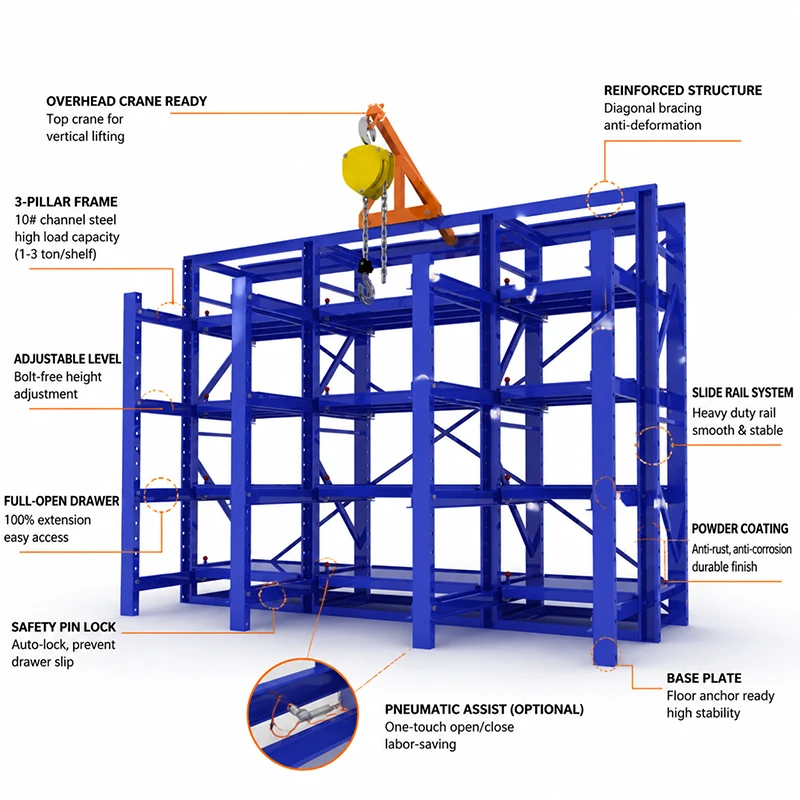
Erack is a heavy-duty pull-out die rack with full extension capability, bearing-supported guide rails, safety pins, mechanical travel limits, and crane-compatible access. Pneumatic assistance is an option—not a requirement. It is most useful when initial drawer force and repeated changeover effort limit the work; it is unnecessary when the die is lighter, access is occasional, or a manual drawer and existing lifting installation already provide a controlled process.
What pneumatic assistance actually changes
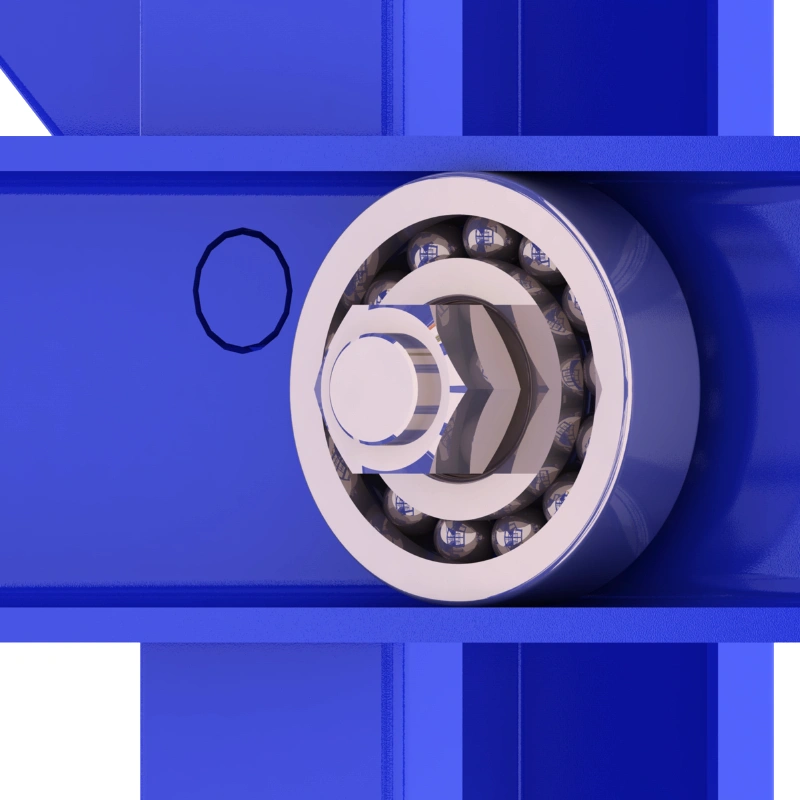
Pneumatic assistance helps with the initial movement of the drawer and can make repeated extraction cycles more consistent under a high working load. It does not change the nominal storage capacity of the rack, does not replace the safety pin, and does not lift the die out of the drawer. After the drawer is extended and the die is accessible, the overhead crane, chain hoist, or electric hoist still performs the vertical lift. In practical terms, pneumatic assistance addresses push-pull force and changeover rhythm—not the entire die handling operation. The final drive choice should be checked against the actual die weight, drawer size, cycle frequency, available air supply, and the site's lifting method.
Manual, pneumatic, or hoist: how to choose
Use a manual drawer when the die is within a manageable pull range, retrieval is occasional, and operators can move the drawer without forcing or sudden release. Choose pneumatic assistance when the same high-load drawers are frequently opened, when initial pull force is a recurring bottleneck, or when the team needs a more repeatable start to each changeover. Use a manual hoist or electric hoist when the biggest challenge is vertical lifting after the drawer is opened, not horizontal drawer movement. These choices can also work together: a pneumatic drawer can reduce initial horizontal effort while a crane or hoist handles the die. Do not select a drive based on rated rack capacity alone; submit the single die weight, dimensions, center-of-gravity information, daily changeover frequency, and available utilities for a project-specific recommendation.
When pneumatic is not necessary
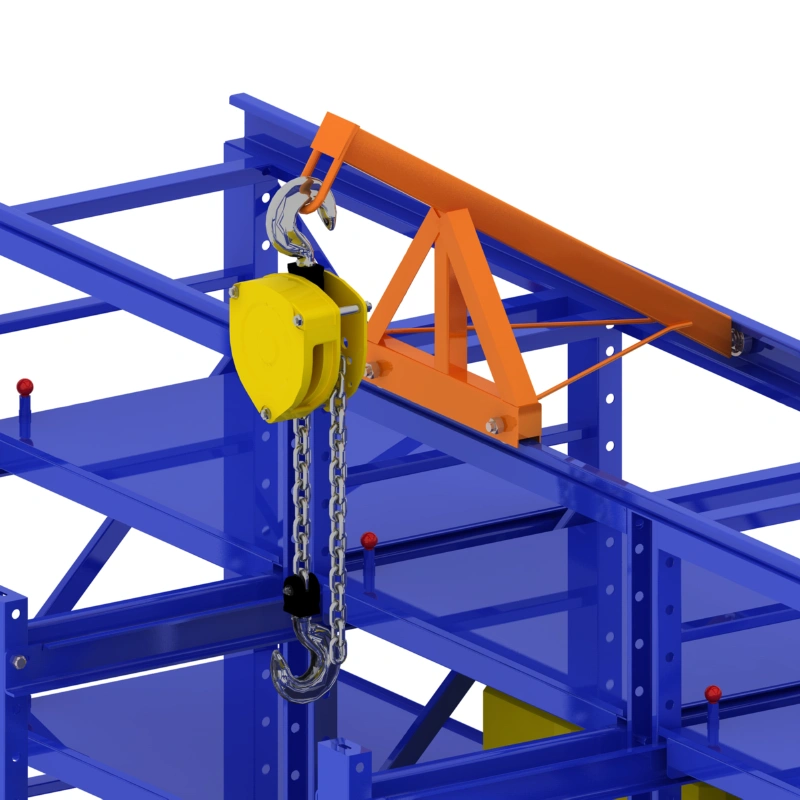
Pneumatic assistance can add complexity without improving the process when dies are light relative to the selected drawer, retrieval is not frequent, or the operator can open the drawer smoothly with a manual setup. It is also not a substitute for a suitable hardened floor, floor anchoring, clear crane access, safety pins, mechanical limits, and a defined lifting procedure. If the site has no compressed air supply, or if the real bottleneck is crane positioning and vertical lifting, resolve that constraint first. Erack can be configured around manual extraction, pneumatic assistance, manual hoist support, or electric hoist support, but the safe choice depends on the full handling path rather than a single feature.
A quick fit check for your die storage area
- High load, high-frequency changeovers: consider pneumatic assistance when repeated initial pull force slows the work or increases operator strain.
- High load, occasional retrieval: a manual drawer with a suitable overhead crane or hoist may be the more proportionate choice.
- Vertical lifting bottleneck: prioritize crane, chain hoist, or electric hoist access after full drawer extension; pneumatic assistance alone does not solve this.
- No hardened floor, anchoring, overhead lifting path, or controlled safety procedure: resolve the site conditions before specifying the rack or drive.
Pneumatic die rack questions from engineers
Does pneumatic assistance increase the load rating of the die rack?
No. Pneumatic assistance is a drawer movement aid. The applicable uniform load remains within the configured Erack range of 0.5–3 tons per level, subject to final design and project verification. It does not replace safety pins, guide rail limits, floor anchoring, or the required lifting equipment.
How should I decide between pneumatic assistance and a hoist?
Separate the two movements. Pneumatic assistance supports the initial horizontal extraction of a loaded drawer. A manual or electric hoist supports vertical lifting once the die is accessible. If both movements cause delays, a combined configuration may be suitable; if only vertical lifting is difficult, improve the hoist and crane runway instead.
Heeft u een op maat gemaakte opslagoplossing nodig?
Spreek rechtstreeks met onze technische ingenieurs. Wij bieden gratis constructieontwerpen, evaluaties van zwaar belaste catalogi en snelle B2B-prijsopgaven.
Vraag nu een offerte aan →