
TTRACK vs. DERACK for Tire Storage: Long-Term Protection or Fast Retrieval?
Technical comparison of the TTRACK folding tire rack and the DERACK plug-in tire rack: upright vs. flat-layer tire storage, whole-layer retrieval, assembly differences, space use and cost, with a selection guide for long-term storage and short-term staging.
TTRACK vs. DERACK for Tire Storage: Long-Term Protection or Fast Retrieval?
A structural comparison of two steel tire-storage racks for warehouse and CFS operations: how the folding TTRACK frame supports upright and cross-stacked tires for long-term storage, how the DERACK base-and-four-uprights system holds four flat tires per shelf for whole-layer retrieval, and which operating factors actually decide the selection.

TTRACK vs. DERACK for Tire Storage: Long-Term Protection or Fast Retrieval?
Two CFS products can be used to store the same material: tires.
Although their structures, assembly methods and handling characteristics differ, the most important distinction is straightforward:
TTRACK stores tires upright or in a cross-stacked arrangement, making it more suitable for long-term storage and reducing the risk of tire deformation.
DERACK stores tires horizontally in defined layers, making complete groups of four tires easier to retrieve during short-term staging and frequent turnover.
The choice therefore depends less on the rack’s nominal capacity or purchase price than on two operating questions:
How long will the tires remain in storage?
How will they be retrieved and handled?
TTRACK protects the tire over the long term. DERACK makes the tire easier to move over the short term.
[Image: Approved photograph of the TTRACK folding tire rack.]
1. TTRACK and DERACK at a Glance
| Vergelijkingsfactor | TTRACK | DERACK |
|---|---|---|
| Product type | Folding and collapsible tire rack | Plug-in tire rack with a base and four uprights |
| Primary application | Long-term tire storage | Short-term staging, temporary stacking and frequent retrieval |
| Tire arrangement | Upright or cross-stacked | Four tires laid flat on each shelf, with shelves stacked upward |
| Frame construction | Folding support frame delivered as one overall assembly | Base with four separately inserted uprights |
| Assembly method | Open the folding frame and install the pull rods | Insert the four uprights into their respective positions one at a time |
| Storage of removable components | Pull rods are stored inside the rack | Uprights must be stored separately when the rack is not in use |
| Risk of missing components | Reduced because the folding structure is retained as one unit | Each of the four uprights must be identified and accounted for |
| Maximum storage height | Approximately five levels in the arrangement discussed | Approximately five levels in the arrangement discussed |
| Ruimtebenutting | Comparable to DERACK | Comparable to TTRACK |
| Manufacturing cost | Slightly higher because the structure is more complex | Slightly lower, although the difference is relatively small |
| Support for tire orientation | Side supports allow tires to remain upright or cross-stacked | No side guardrail; tires must be laid flat |
| Retrieval unit | Individual tires can be removed directly | A complete layer of four tires can be removed together |
| Operating preference | Tires that must remain in storage for an extended period | Tires moved frequently or collected as complete layers |
| Duration guidance in the video | More than approximately one month | Short-term turnover or temporary storage |
The approximately five-level capacity and one-month threshold are the operating references given in the presentation. They should be confirmed against the current product documentation for each specific configuration.
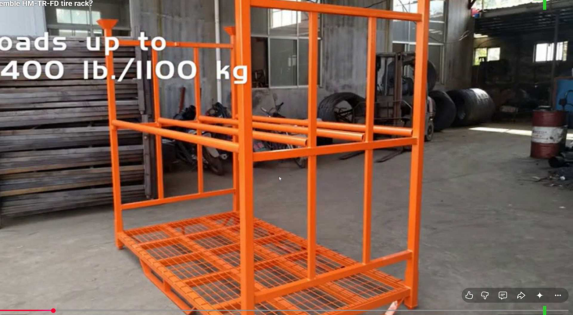
2. The Core Difference Is the Tire Storage Method
Both products can accommodate tires, but the way they support the tires is fundamentally different.
2.1 TTRACK: Upright or Cross-Stacked
The TTRACK uses a folding frame fitted with pull rods. These rods create the side support that allows the tires to be stored in either of two arrangements:
Upright storage: the tires stand vertically;
Cross-stacked storage: the tires are arranged in alternating directions within the rack.
Because the tires are supported by the rack rather than lying unsupported in a loose pile, the frame helps maintain their position.
2.2 DERACK: Flat Layers of Four Tires
DERACK uses a base and four plug-in uprights to create a series of shelf levels.
In the tire-storage application shown in the presentation, the tires are laid horizontally, with four tires forming each layer. The shelves are then stacked upward from the base.
The resulting arrangement allows a complete group of four tires to be removed as one layer.
| Storage Aspect | TTRACK | DERACK |
|---|---|---|
| Basic tire geometry | Upright or cross-stacked | Flat, in groups of four |
| Structural feature enabling the arrangement | Pull rods and side support | Horizontal shelf levels |
| Method of building up storage volume | Within the folding frame | By adding shelf levels upward from the base |
| Primary handling unit | An individual tire | A complete layer of four tires |
| Main operating advantage | Reduced deformation risk during extended storage | Fast and convenient whole-layer retrieval |
| Main limitation | Less convenient when the complete layer must be removed together | Not suitable for the upright or cross-stacked method shown for TTRACK |
The storage arrangement is not merely an operator preference. It is determined by the structure of the rack.
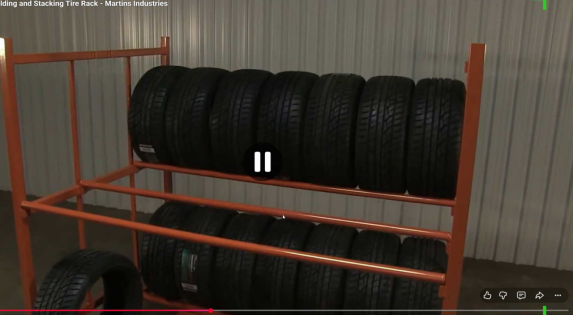
3. TTRACK: A Folding Rack for Long-Term Storage
TTRACK is a folding tire rack designed around two requirements:
the rack should remain complete and easy to transport;
the tires should be stored in a way that helps preserve their shape over an extended period.
3.1 The Folding Frame
The TTRACK’s folding frame is retained as one overall assembly.
This gives it a practical advantage over a rack that must be dismantled into several separate structural components.
| TTRACK Structural Feature | Operating Benefit |
|---|---|
| Folding frame retained as one unit | Fewer separate components to track during transport and storage |
| Pull rods stored inside the rack | The removable components remain with the main structure |
| Simple folding and rod-installation operation | Faster and simpler to erect |
| Upright and cross-stacked configurations | Supports two arrangements suited to long-term tire storage |
| Compact state when folded | Easier to transport and store when not in use |
3.2 Four Pull Rods and Optional Additional Rods
The standard arrangement shown in the presentation uses four pull rods. The presenter also indicated that two additional rods can be configured where required.
These rods do more than divide the rack into storage positions. Their side support creates the geometry needed for the tires to stand upright or be cross-stacked.
| Pull-Rod Arrangement | Functie |
|---|---|
| Four main pull rods | Form the basic supporting structure for the tire-storage modes shown |
| Optional two additional rods | Permit adaptation where an extended or additional support arrangement is required |
| Rod storage within the rack | Keeps the removable parts with the folding structure |
| Rod installation | Open the frame and hang or attach the rods into their working positions |
The exact number and arrangement of rods must be confirmed against the released drawing for the selected configuration.
3.3 Upright Storage
Upright storage places the tires vertically within the rack.
According to the presentation, this method is particularly suitable for long-term storage because it reduces the likelihood that the tire will remain deformed under the weight of other tires.
For customers storing tires that must retain their original condition, this is the strongest argument for selecting TTRACK.
3.4 Cross-Stacked Storage
The cross-stacked method places tires in alternating directions.
The frame and pull rods prevent the tires from simply spreading or rolling away, while the alternating arrangement creates a stable storage pattern.
According to the presentation, both TTRACK arrangements are associated with long-term storage and reduced deformation risk:
| TTRACK Storage Mode | Main Advantage | Best-Fit Use |
|---|---|---|
| Staander | Helps preserve the tire’s shape during extended storage | Long-term storage of tires that must remain in saleable condition |
| Cross-stacked | Maintains a stable stack while retaining direct access to individual tires | Long-term storage with occasional individual retrieval |
| Folded and empty | Compact transport and storage state | Transfer, storage and rapid redeployment |
The relationship between storage orientation and tire deformation is presented as an application advantage. Actual tire-condition requirements should still be confirmed against the tire manufacturer’s storage recommendations.
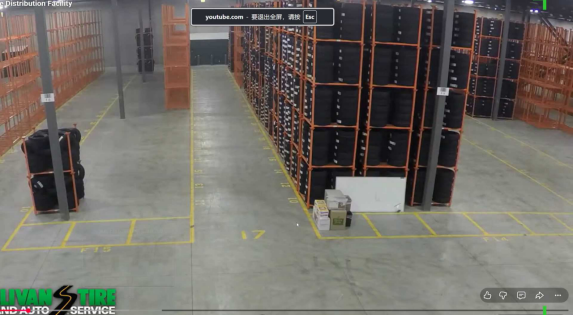
4. DERACK: Layer-Based Storage for Fast Retrieval
DERACK can also be used as a tire-storage system, but its structure supports a different operating method.
4.1 Base and Four Uprights
The DERACK consists of a base and four plug-in uprights. In the tire-storage version shown, the uprights have a distinctive profile:
a flared or bell-shaped top;
and a pointed bottom.
Once the four uprights have been inserted, the shelf levels create the storage volume.
4.2 Why Tires Cannot Be Stored Upright
Unlike the TTRACK, the DERACK arrangement shown does not have the side guardrail or pull-rod support needed to keep a tire standing on edge.
As a result, the tires cannot be stored upright or cross-stacked in the same manner as the TTRACK. They must be laid flat on the horizontal shelf levels.
This is a structural limitation rather than an operator preference.
4.3 Four Tires per Layer
In the arrangement demonstrated, each shelf carries four tires laid flat. Additional shelf levels are stacked upward from the base.
This creates a clearly defined layer that can be retrieved as one group.
| DERACK Feature | Operating Result |
|---|---|
| Four tires laid flat per shelf | Creates a repeatable layer arrangement |
| Shelves stacked upward | Builds storage capacity vertically from the base |
| Complete layer of four tires | Can be removed as one handling unit |
| Equipment handling whole layers | The arrangement is directly compatible with layer-based collection |
| No side guardrail | Tires cannot be stored upright or cross-stacked |
| Separate upright components | Uprights must be inserted, removed and stored individually |
4.4 Why Flat-Layer Storage Is Useful for Short-Term Handling
The main benefit of DERACK is convenient retrieval.
If associated equipment expects to collect a complete group of tires, a removable layer of four tires can be handled directly. The operator does not need to remove the tires individually and rebuild the group.
This makes the system especially useful for:
temporary tire staging;
short-term accumulation;
frequent collection and transfer;
whole-layer mechanical handling;
and production areas where tires move regularly.
When movement speed is the priority, the best arrangement is the one that matches the handling unit used on site.
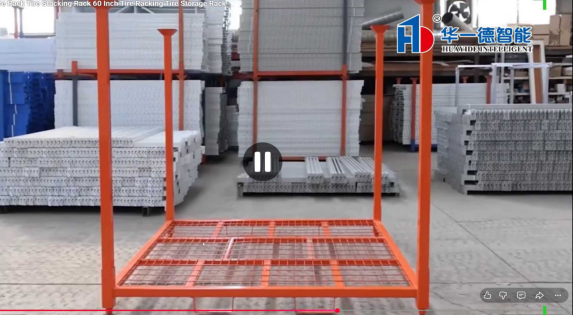
5. Assembly and Component Management
Although storage method is the decisive selection factor, the two products also differ significantly in how they are assembled.
5.1 TTRACK: One Complete Unit with the Rods Stored Inside
The TTRACK folding structure is retained as one overall assembly. Its pull rods are stored within a dedicated space in the rack and can be removed directly when the rack is being erected.
| TTRACK Assembly Characteristic | Practical Benefit |
|---|---|
| Folding frame handled as one unit | Reduced risk of structural components being separated |
| Pull rods stored inside the rack | Removable parts remain with the product |
| Assembly by opening the frame and installing the rods | Simple operation without inserting every upright individually |
| Compact folded state | Easier transportation and temporary storage |
| Repeatable assembly | The same rack can be erected whenever the application requires |
The folding design simplifies ownership of the product: the operator does not need to maintain a separate inventory of four loose uprights.
5.2 DERACK: Four Uprights Inserted Individually
DERACK requires the four uprights to be inserted into the base one at a time.
| DERACK Assembly Characteristic | Practical Consideration |
|---|---|
| Four separate uprights | Each upright must be present, identified and correctly oriented |
| Individual insertion | More assembly steps than the TTRACK folding arrangement |
| Separate component storage | Removed uprights require an organized storage location |
| Misplacement risk | A missing upright interrupts assembly |
| Modular benefit | The rack can be partially dismantled, adjusted or moved as required |
| Application-specific profile | The flared top and pointed bottom are tailored to the tire-storage arrangement |
The trade-off is clear:
TTRACK prioritizes simplicity and self-contained component storage.
DERACK provides the modularity and layered structure needed for efficient whole-layer handling.

6. Space Utilization and Manufacturing Cost
The presentation emphasizes that the two systems are relatively close in both space utilization and manufacturing cost. These factors therefore do not normally determine the final selection.
6.1 Comparable Storage Levels
The presenter indicates that both systems can provide approximately five levels in the configurations discussed.
| Metriek | TTRACK | DERACK |
|---|---|---|
| Maximum storage levels | Approximately five | Approximately five |
| General space utilization | Comparable | Comparable |
| Footprint for the same quantity | Governed by frame dimensions and level count | Governed by base dimensions and level count |
| Main space difference | Created by the operating method rather than a major difference in rack density | Created by the operating method rather than a major difference in rack density |
Actual storage capacity also depends on tire dimensions, the selected configuration, the number of units installed and the available building height.
6.2 Only a Modest Cost Difference
TTRACK is structurally more complex and may therefore cost slightly more to manufacture. However, the presenter states that the difference remains within a relatively narrow range.
| Kostenfactor | TTRACK | DERACK |
|---|---|---|
| Structural complexity | Hoger | Lager |
| Relative manufacturing cost | Slightly higher | Slightly lower |
| Difference in total cost | Matig | Matig |
| Effect on product selection | Secondary | Secondary |
Choosing on purchase price alone would overlook the more important operational difference: whether the customer needs long-term tire protection or rapid layer-based retrieval.
6.3 What Really Determines the Selection
| Decision Factor | Decisive? | Reason |
|---|---|---|
| Ruimtebenutting | No | The products are broadly comparable |
| Manufacturing cost | No | The cost difference is relatively small |
| Assembly method | Partly | Important to the operating team, but secondary |
| Tire storage orientation | Yes | Determines how the tire is supported and handled |
| Storage duration | Yes | Determines whether deformation protection or rapid turnover is the priority |
| Handling unit | Yes | Individual retrieval and whole-layer retrieval require different arrangements |
Once space and cost have been considered, the decision becomes simple: how long will the tires stay here, and how will they be moved while they are here?

7. Long-Term Storage vs. Short-Term Staging
7.1 Long-Term Storage: Select TTRACK
TTRACK is the preferred option when the tires will remain in storage for an extended period and their physical condition is important.
| Long-Term Storage Requirement | Why TTRACK Is Better Suited |
|---|---|
| Minimize deformation during storage | Upright and cross-stacked arrangements are specifically presented as deformation-control methods |
| Store tires that must remain saleable | Keeping the tire in its original shape is more important than removing complete four-tire layers |
| Reduce long-term pressure between stacked tires | The vertical or cross-stacked method avoids the continuous flat-layer arrangement used by DERACK |
| Retain direct access to individual tires | The operator can remove a specific tire without dismantling an entire shelf layer |
| Store in a compact, controlled structure | The folding frame and pull rods support the tires in defined positions |
The presentation uses more than approximately one month as an operating indication for long-term storage. This should be treated as guidance rather than a universal expiry point because tire composition, dimensions, environmental conditions and manufacturer recommendations can affect the appropriate storage duration.

7.2 Short-Term Staging: Select DERACK
DERACK is the preferred option when the tires are expected to move frequently and are stored only temporarily.
| Short-Term Operating Requirement | Why DERACK Is Better Suited |
|---|---|
| Fast whole-layer retrieval | Four tires form a clearly defined removable layer |
| Collection by associated equipment | Layer-based handling is directly compatible with equipment that removes complete groups |
| Temporary accumulation between production steps | The system is designed for frequent in-and-out movement |
| Repeated stacking and transfer | A complete shelf layer can be handled without individually rebuilding a group of tires |
| Short storage duration | Long-term deformation protection is less critical than movement efficiency |
The practical distinction is therefore:
TTRACK stores the tire as the primary object to be protected. DERACK stores the tire as part of a movable four-tire layer.
8. A Practical Selection Guide
| Customer Situation | Recommended Product | Recommended Storage Method | Reason |
|---|---|---|---|
| Tires stored for more than approximately one month | TTRACK | Upright or cross-stacked | Reduces deformation risk during extended storage |
| Tires must remain in saleable condition | TTRACK | Staander | Prioritizes preservation of the tire’s shape |
| Long-term storage with occasional individual access | TTRACK | Cross-stacked | Stable storage with direct individual retrieval |
| Short-term turnover | DERACK | Flat, four tires per shelf | Faster whole-layer retrieval |
| Tires collected by equipment in groups | DERACK | Flat, four tires per shelf | Directly compatible with layer-based handling |
| Temporary staging between production steps | DERACK | Flat, four tires per shelf | Supports frequent in-and-out movement |
| Customer wants one self-contained unit | TTRACK | Upright or cross-stacked | Folding frame and pull rods remain together |
| Customer values modular adjustment | DERACK | Flat, four tires per shelf | Uprights and shelf levels can be configured as required |
| Approximately five levels are required | Either | Depends on duration and handling | Both provide broadly comparable space utilization |
| Both long-term protection and complete-layer retrieval are essential | Review the operating priorities | Define the dominant requirement before selecting | One product cannot optimize both objectives equally |
8.1 A Three-Question Selection Method
Question 1: How Long Will the Tires Remain in Storage?
More than approximately one month, or the tire condition must be preserved: select TTRACK.
Short-term turnover or temporary staging: select DERACK.
Question 2: How Will the Tires Be Retrieved?
Individually, by hand: select TTRACK.
As a complete layer, by manual handling or equipment: select DERACK.
Question 3: What Is the Dominant Business Objective?
Prevent tire deformation and maintain appearance: select TTRACK.
Maximize handling speed and whole-layer movement: select DERACK.
9. Practical Operating Considerations
The following recommendations are based on the structures described in the presentation. They are engineering recommendations rather than additional product claims confirmed by the video.
9.1 TTRACK
| Operating Area | Recommended Practice |
|---|---|
| Frame deployment | Confirm that the folding frame is fully opened and securely locked before loading |
| Rod installation | Confirm that every pull rod is correctly seated and secured |
| Rod storage | Return the rods to their storage location inside the rack when the unit is not in use |
| Upright tire stability | Confirm that the tires remain securely positioned and cannot roll out |
| Cross-stack stability | Check that the alternating tire arrangement remains stable before leaving the storage area |
| Load distribution | Confirm that the tire weight remains within the level rating for the selected storage mode |
| Component inspection | Check the folding mechanism, rod fixings and retaining devices during scheduled maintenance |
| Floor condition | Keep the storage floor level, clean and free from standing water |
| Tire support | Do not use tires as structural support for other stored products unless the arrangement has been specifically approved |
9.2 DERACK
| Operating Area | Recommended Practice |
|---|---|
| Upright installation | Confirm that each upright is fully seated and correctly oriented |
| Upright identification | Match each application-specific upright to its correct position |
| Removed-component storage | Provide a dedicated, labeled storage area for the four uprights |
| Shelf loading | Distribute four tires evenly across each shelf |
| Layer retrieval | Confirm that the forklift or other handling equipment can remove a complete layer safely |
| Upright retention | Verify that all upright-retention devices are correctly fitted and locked |
| Periodic inspection | Inspect shelf connections, upright sockets and retaining devices according to the maintenance plan |
| Site conditions | Confirm floor level, floor capacity and clearance required for layer removal |
| Load rating | Do not exceed the approved capacity of the base, uprights or shelf levels |
10. Six Lessons from the TTRACK–DERACK Comparison
1. Structural Similarity Does Not Mean Operational Equivalence
TTRACK and DERACK provide comparable storage levels and occupy broadly similar space, yet they create very different handling workflows.
2. Storage Orientation Is Determined by the Frame
DERACK cannot store tires upright in the same manner as TTRACK because it does not have the necessary side support. The operating method follows from the structure.
3. Deformable Products Create a Storage-Duration Requirement
Tires that must not change shape are fundamentally a long-term storage problem. Upright or cross-stacked TTRACK storage is presented as the preferred response.
4. Retrieval Unit Matters in Short-Cycle Operations
When material moves daily and is handled in groups, a flat layer of four tires is more efficient than removing individual tires from an upright position.
5. A Folding Frame Simplifies Component Management
Keeping the folding structure and pull rods together reduces component tracking and makes the rack quicker to deploy.
6. Cost Should Not Decide the Selection
The manufacturing-cost difference is relatively small. The deciding factors are tire condition, storage duration and the method required to retrieve the material.
11. Conclusion
TTRACK and DERACK can both store tires, but they optimize different parts of the handling process.
TTRACK: The Long-Term Storage Solution
TTRACK uses a folding frame with pull rods to support tires in an upright or cross-stacked arrangement. The presenter associates these configurations with long-term storage and a reduced risk of tire deformation.
It is also the simpler assembly:
the folding frame is retained as one unit;
the pull rods are stored inside the rack;
the rack is opened and the rods installed;
and no separate storage arrangement is required for four loose uprights.
DERACK: The Short-Term Handling Solution
DERACK uses a base and four plug-in uprights to create horizontal shelf levels. Four tires are stored flat on each level, allowing the complete group to be removed efficiently.
It is therefore better suited to:
temporary staging;
frequent turnover;
short-term accumulation;
and associated equipment that handles complete layers.
The Selection Rule
| Storage Condition | Recommended Product |
|---|---|
| Long-term storage, especially beyond approximately one month, or where tire condition must be preserved | TTRACK |
| Short-term staging, frequent turnover or fast whole-layer retrieval | DERACK |
The deeper engineering principle is straightforward:
Choose the rack according to how the material rests in it and how it is taken out. Storage levels, footprint and purchase price are secondary considerations.
Send us the tire sizes, the number of tires you hold at peak, how long each group stays in the warehouse and how it is picked — individually by hand or as a complete layer by forklift. Our engineers will confirm the level count, the upright and pull-rod configuration and the floor and clearance requirements for your site. Contact Steel Pallet for a DERACK layout review