
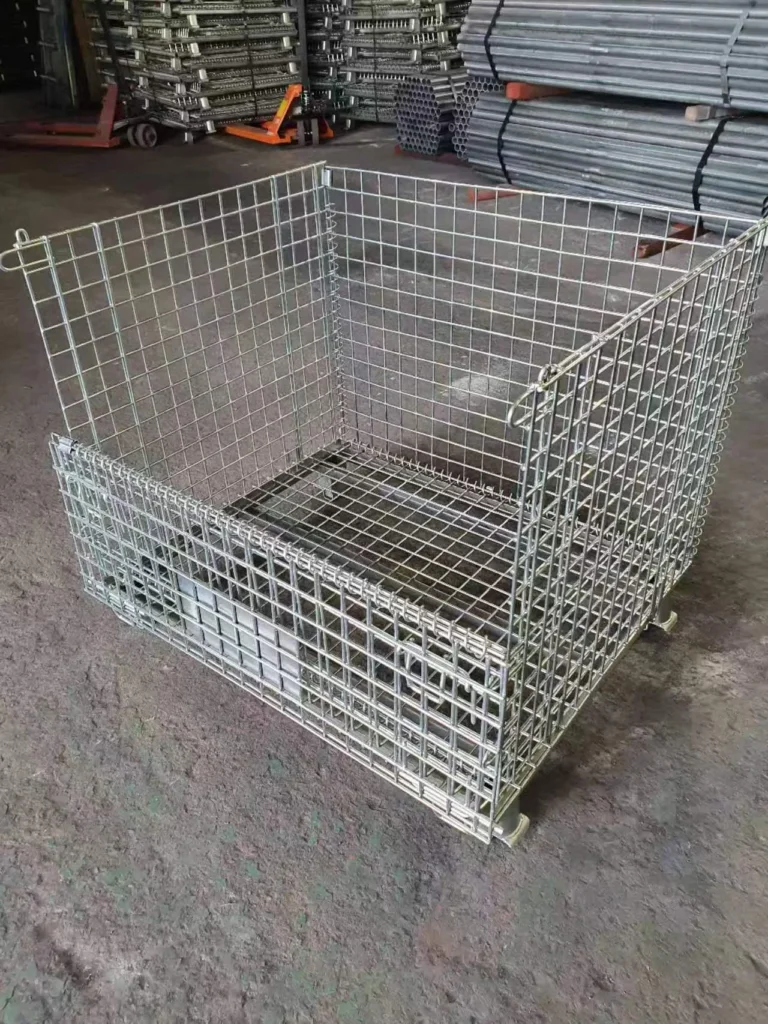
Um buffer lateral de linha só ganha seu espaço no piso enquanto o operador consegue realmente alcançá-lo. Empilhe os contêineres e encha-os com peças fundidas, e a peça de que o operador precisa frequentemente está na gaiola no fundo da pilha. Isso transforma uma coleta curta em uma chamada de empilhadeira, um desempilhamento, uma busca pelo contêiner superior e um reempilhamento, com a linha parada durante todo esse processo. Esse desempilhamento, não o preço do contêiner, é o custo que silenciosamente corrói um estoque lateral de linha.
Um contêiner de tela metálica com portinhola basculante foi projetado em torno desse momento. Uma face do contêiner possui uma portinhola com descida parcial: a metade superior do painel frontal de tela se destrava e se dobra para baixo, permitindo que o operador faça a coleta pela face do contêiner na altura de trabalho enquanto a pilha acima permanece encaixada. A mesma gaiola ainda se dobra plana quando vazia e ainda aceita o manuseio com empilhadeira e transpalete, de modo que o recurso de coleta não custa o trecho de retorno vazio. A seguir, veja como a portinhola funciona em um fluxo lateral de linha, o que a malha de 50×50 mm faz — e o que não faz — pela visibilidade do estoque, quando peças pequenas precisam de um forro interno e como orientar a face da portinhola em relação ao corredor.
Como uma portinhola com descida parcial permite fazer a coleta sem rebaixar a pilha?
In the documented configuration, the partial-drop gate is a single-face feature. The upper half of the front panel is carried on a helical hinge line, releases, and folds down through roughly 180° until it rests against the outside of the lower panel. The lower half of the panel, the base frame, and the molded stacking feet stay exactly as they were. This matters more than it sounds: the load of a stack is carried through the feet into the base channels, so folding only the upper panel leaves the seat under the container above undisturbed. The operator reaches into the interior over the folded-down panel and takes the part, with no forklift, no depalletizing, and no restacking.
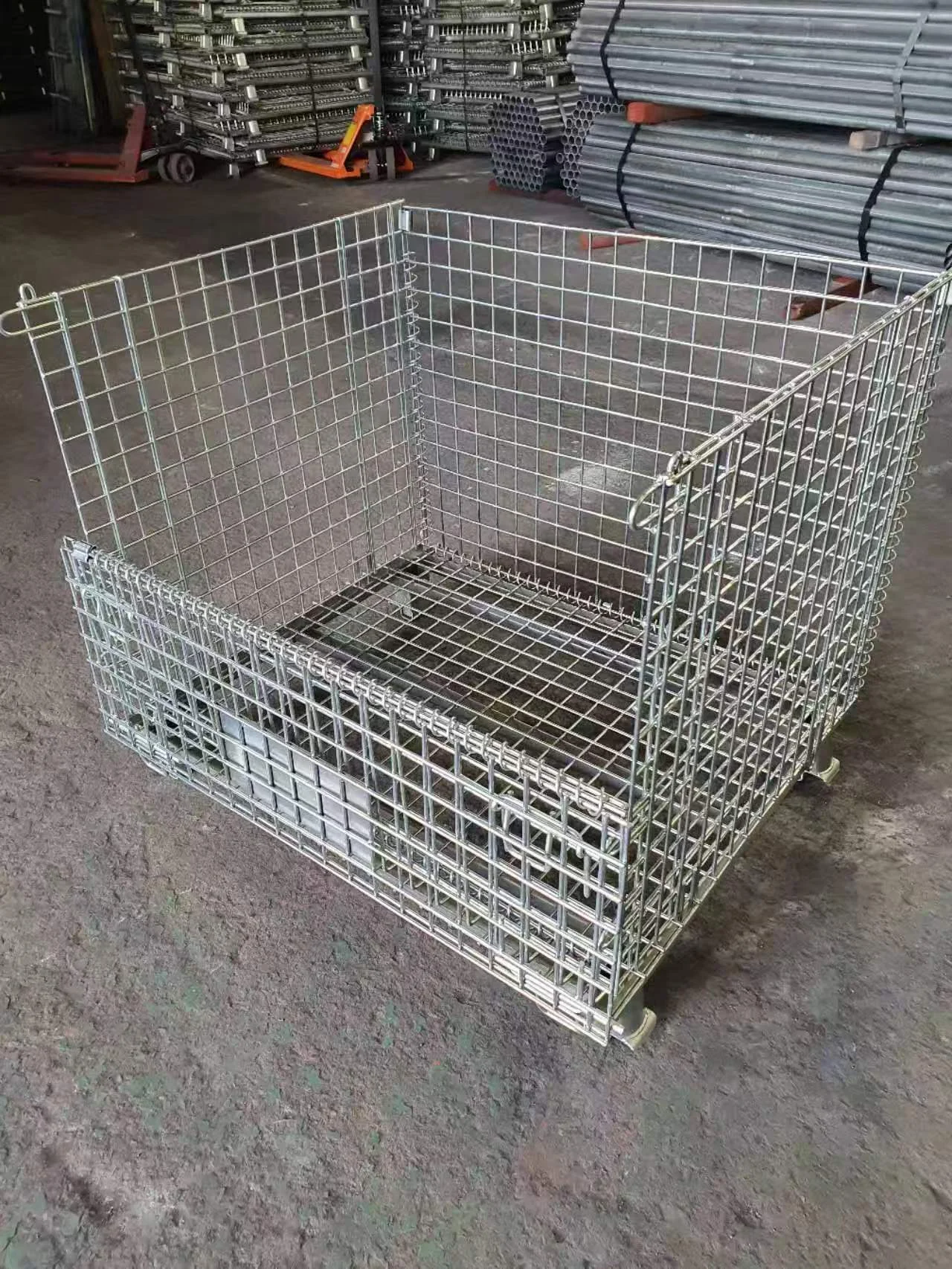
The floor-picking sequence
- Walk to the gate face; nothing above or below the container needs to move.
- Release the latch pins on the upper panel.
- Fold the upper panel down until it rests against the lower panel.
- Pick the part through the exposed face; the lower panel keeps the remaining parts contained.
- Fold the panel back up, relatch, and confirm the face is closed before the container is moved or stacked.
Where the gate stops helping
A portinhola é um acesso de picking, não uma porta de descarga nem um extensor de alcance. Se a peça de que você precisa estiver em um contêiner empilhado acima da sua altura de alcance, o painel ainda abre, mas seu braço não fica mais comprido, de modo que esse nível precisa de uma plataforma, um degrau ou um elevador. Se o picking consistir na descarga do contêiner inteiro, em que todo o conteúdo vai para a linha de uma só vez, uma portinhola com descida parcial adiciona uma etapa a um trabalho que um contêiner aberto simples ou um quadro basculante resolve mais rápido. E se o contêiner for ser tombado ou esvaziado por máquina, a portinhola deve estar travada antes do içamento: um painel destravado sob uma carga tombada é um acidente esperando para acontecer.
Uma malha de 50×50 mm fornece uma contagem confiável?
A malha nos projetos registrados é uma grade de 50×50 mm de arame de aço soldado, e é a razão pela qual um operador consegue enxergar dentro de um contêiner fechado. Pelo painel lateral ou pela portinhola aberta, é possível ler o nível de enchimento, identificar um contêiner que está quase vazio antes que a linha pare por causa dele e confirmar que o buffer contém os códigos de peça que deveria. Tudo isso acontece sem abrir uma tampa, destravar um painel ou retirar uma gaiola de uma pilha.
This is visual control, and it is genuinely useful between counts. It is not a count. Depth stacking hides each layer under the layer above it; identical small parts loose in bulk cannot be counted through a grid, no matter how good the lighting; and a container with mixed part codes makes visual verification completely useless. The side-line rule of thumb is to use the mesh view as a between-counts check, keep a single part code per container, keep a label or kanban card on the gate face at eye level, and still run cycle counting on its own schedule. Visual control reduces how often you have to open, dig through, and recount a container. It does not eliminate counting, and no mesh opening can promise zero inventory errors.
Will small parts fall through the mesh?
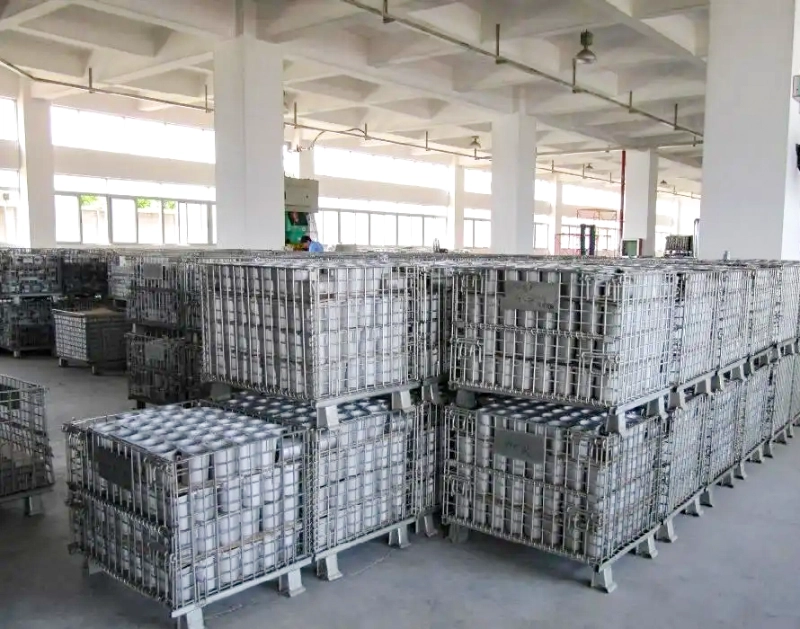
Mesh is a hole with a frame around it. A 50×50 mm opening retains most industrial components and lets anything smaller than the opening through: out the side panel during handling, out the gate when it is down, or onto the floor when the container is moved with a pallet truck. So the check should be made against the smallest dimension of the smallest unit part you intend to store, not the average part and not the package size.
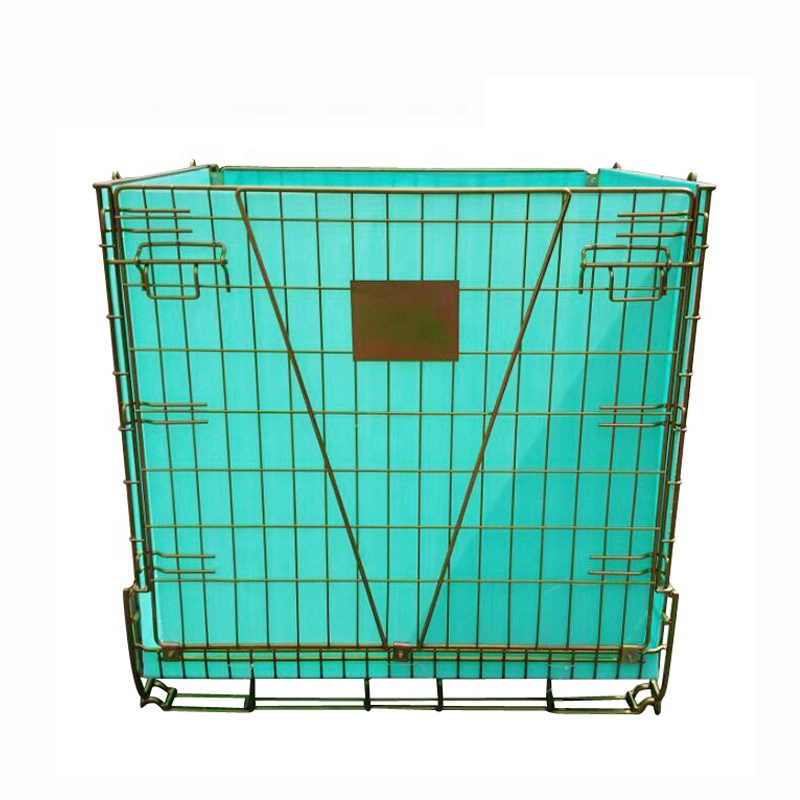
If that dimension passes through the opening, the simple screen container is the wrong container for that part. The options are a PP hollow-sheet liner that turns the cage into a five-sided barrier, a screen specification with smaller openings quoted as a variant, or a solid-wall container. Two consequences are easy to overlook. A liner blocks the view through the screen, so a lined cage gives up visual counting on the lined faces. And long, thin parts can project through the open gate, so measure the swing zone of the gate and keep it clear of pedestrian paths and forklift routes. If parts can bounce or be thrown out of an open top, a lockable lid variant closes the container.
Which side should the gate face?
Gate orientation is a layout decision, and it is far cheaper to set before the order than after the first delivery. Four things to fix in the floor plan:
- Picking side: the gate faces the operator's walking route, never a powered forklift lane. A panel that folds down into forklift traffic is a collision, not a feature.
- Handling side: the registered base accepts forklift and pallet-truck entry from four directions, so the forklift can approach from any face, which leaves the gate side free to be chosen for the picker rather than for the forklift.
- Height: configure the buffer so that the containers whose gates are used for picking are the ones within reach. A two-high stack with the gate on the lower container at picking height is the simplest arrangement; the upper container is stock, not a picking face.
- Movement: if the buffer is moved by pallet truck between stations, the gate comes back on a different side each time. Mark the container orientation on the floor layout so the gate returns to the same side, or use a caster-base variant and turn the gate to the station with the brakes engaged.
Configuration options and when each one fits. The variants below follow the documented set of configurations and the indexed images; confirm the variant list on the drawing before ordering.
| Configuração | What it solves | When it is not the answer |
|---|---|---|
| Single-face half-drop gate, fixed base | Picking from a stacked container without breaking down the stack | Full-container unloading, or parts stored above reach height |
| Half-drop gate with PP hollow-sheet liner | Small or precision parts that would pass through the screen or rub against it | Where the fill level needs to remain readable through the screen |
| Half-drop gate with caster base | A buffer that needs to travel to the station | Routes where a rolling load is not under control |
| Lockable lid variant | Parts that can bounce out, or that need security | Frequent top loading, where the lid adds a handling step |
| Simple screen container, no gate | Containment where picks only happen when breaking down the stack | Any line-side flow where a pick cannot wait for a forklift |
Where a container with a drop-down gate fits in a line-side warehouse
- Machining cell buffer: one part code per container, gate facing the operator's walking route, buffer sized for one shift.
- Assembly line-side warehouse: two-high stack, gate on the lower container at picking height, upper container kept as stock.
- Mixed-model changeover: label the gate face and keep the container unlined where the fill level needs to remain readable.
- Precision components and electronics: lined container with lid where the smallest part is smaller than the screen opening.
- Mobile buffer: caster base so the gate can be presented to the station, brakes engaged before picking.
- Not indicated for: full-container unloading, loose parts smaller than the screen opening without a liner, and parts whose length exceeds the swing zone of the open gate.
Perguntas frequentes
How much picking time does a half-drop gate really save?
It removes steps, not a fixed number of seconds: the forklift call, breaking down the stack, digging and rebuilding the stack disappear for parts kept in a container the operator can reach. The value depends on your picking frequency, your stack height and how often the wanted part is in the bottom container. Measure those three and the saving follows from your own cycle data; we do not publish a percentage that was not measured in your layout.
Can we stop counting and rely on the view through the screen only?
No. The screen provides a fill-level and presence check between counts. Deep stacking, small bulk parts and mixed part codes break that check, so cycle counting continues on its own schedule and visual inspection remains the quick check between counts.
Can the container be moved or stacked with the gate folded down?
No. Fold the panel back and lock it again before the container is lifted or stacked, and confirm the lock before the unit leaves the picking position.
If the line-side buffer is where your takt is being lost, send the parts list, the smallest part dimension, the stack height you operate and the aisle width. We will confirm the gate face, the container size and the liner decision against the drawing before you order, and the empty-return leg of the same container is covered in the companion article on folding.
Precisa de uma Solução de Armazenamento Personalizada?
Fale diretamente com nossos engenheiros técnicos. Oferecemos projetos estruturais gratuitos, avaliações de catálogos de alta capacidade e orçamentos rápidos para B2B.
Solicite um Orçamento Agora →