
Can a Collapsible Wire Mesh Container Replace Wooden Crates for Auto Parts Storage?
Collapsible galvanized wire mesh containers fold flat for return freight, allow four-way forklift access and visible parts inventory, and replace single-use wooden crates in looping auto parts storage. Send part weights and return conditions for a replacement plan.
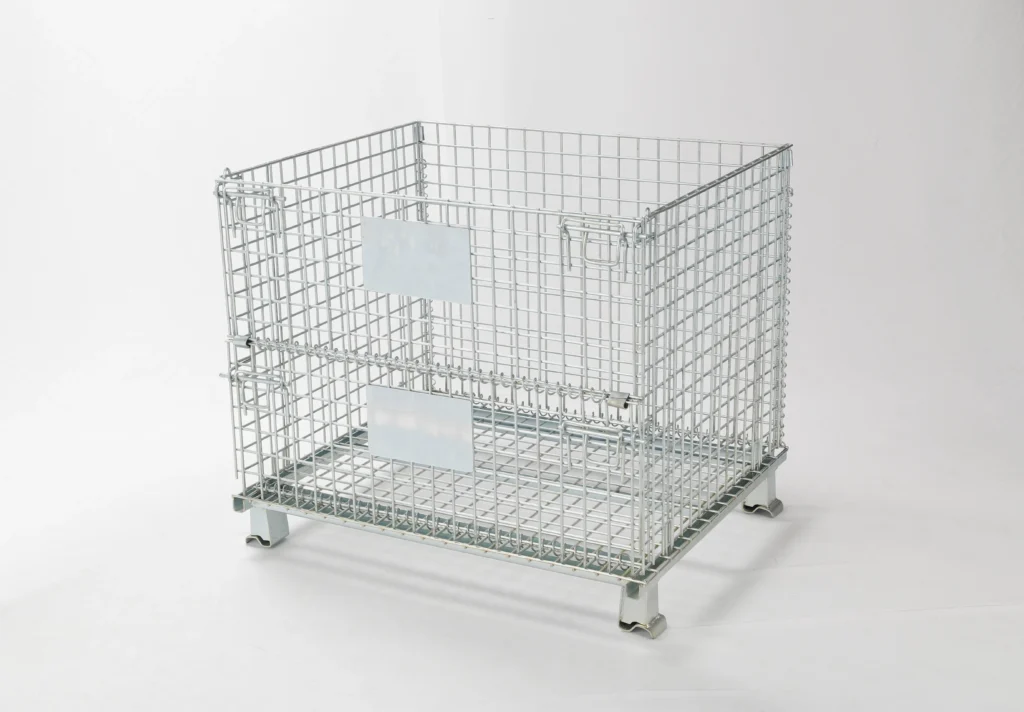
Reusable steel instead of single-trip wood — with the wooden crate still in the picture
A collapsible wire mesh container is an asset you buy once and send out again; a wooden crate is a consumable you pay for on every shipment. That is the whole comparison — and it is why the answer depends on how many trips your auto parts actually make, not on which material looks stronger.
Stbox is an industrial wire mesh container built for parts storage and in-plant circulation: a Q235 steel frame with welded mesh panels, a reinforced base on U-channel steel, formed stacking feet, and a single-side half-drop gate for manual loading and picking. Empty, the unit folds down so the return leg carries far less volume. Loaded, it is a rigid, forklift-and-pallet-jack movable container. The mesh records we work from are 50 × 50 mm openings with wire around 5.8–6.0 mm depending on the project drawing.
What follows is not a claim that wooden crates are wrong. For a one-way export with no return leg, a crate often is the cheaper and simpler choice. This page sets out where the container saves, how to calculate the break-even trip count, what the recorded load and stacking boundaries are, and which scenarios should stay on wood.
- Reusable per trip, not per shipment: one galvanized cage replaces a series of crates across its trip life.
- The empty leg stops carrying air: folded units stack, so return volume is a fraction of assembled or boxed empties.
- Visual inventory through the mesh: 50 × 50 mm openings let you count and identify parts without opening a container.
- Handling is designed in: project records show diesel forklift stacking and manual pallet-jack handling.
- Half-drop gate access: reach stock at the front face without unloading the layer above.
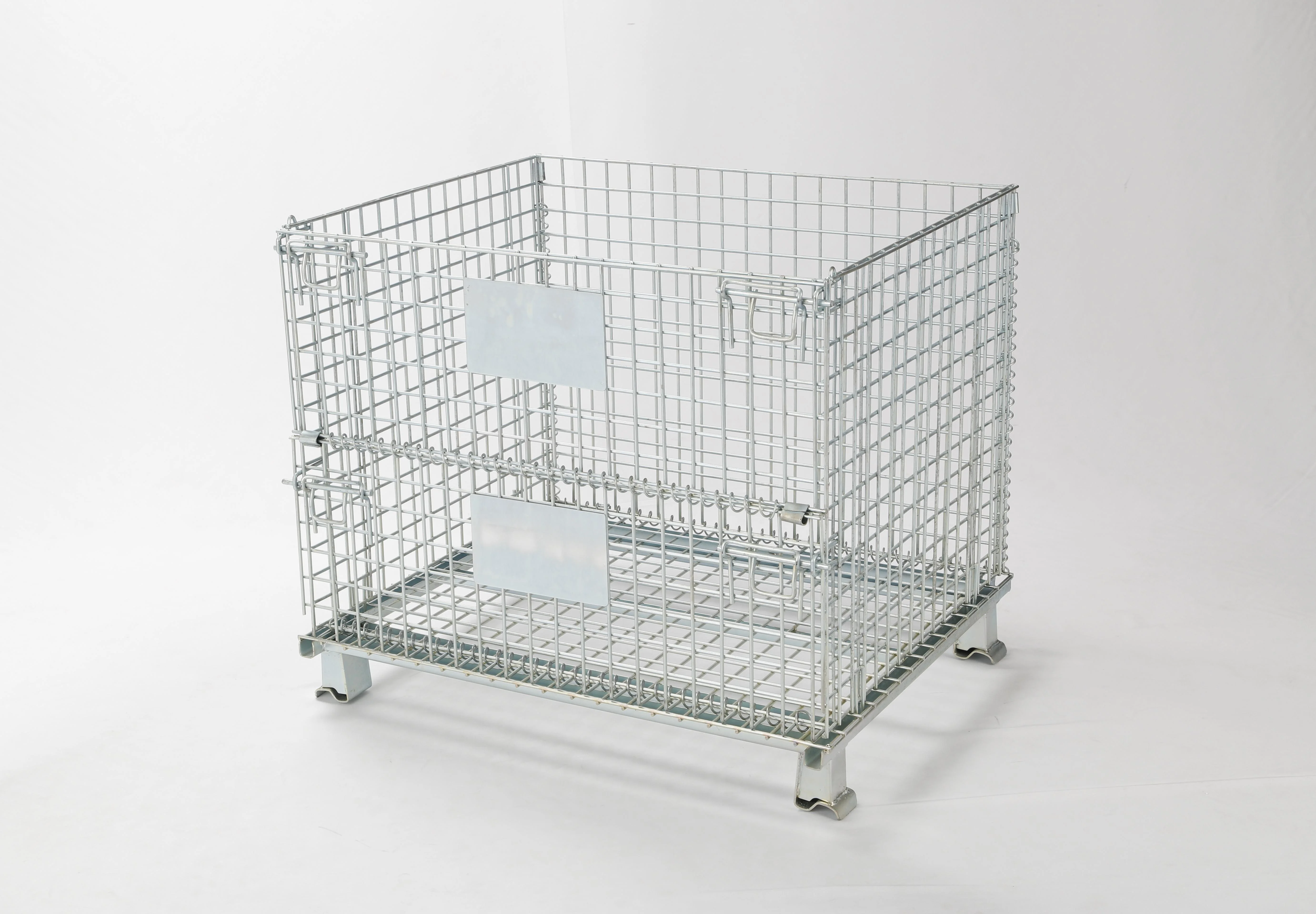

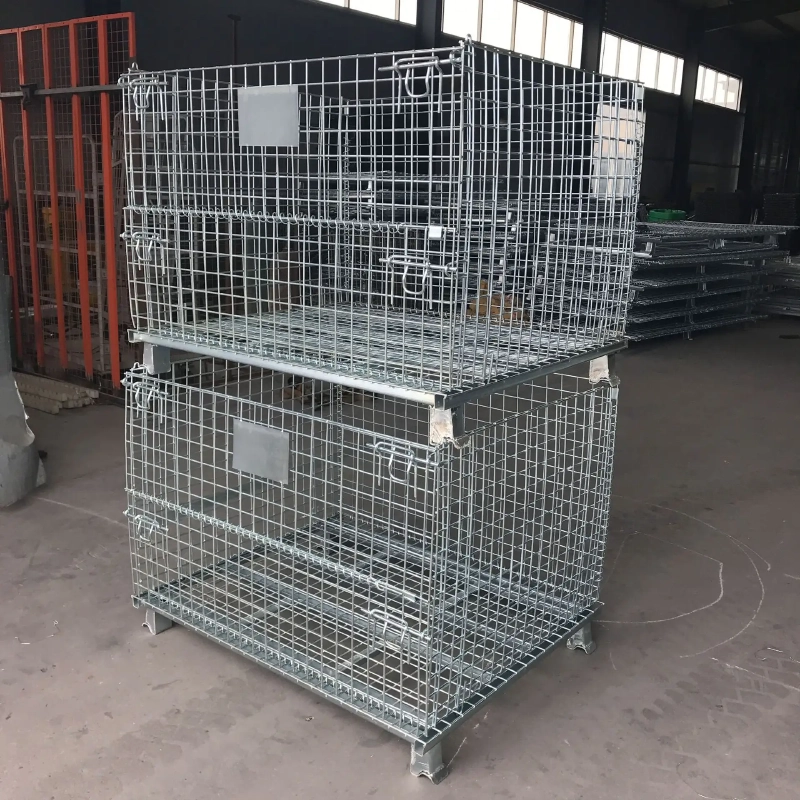
Wire mesh container vs wooden crate: where the saving actually comes from
Compare the two options on the cost model first, then on the physical properties. A crate wins on cushioning and full enclosure; a galvanized cage wins on trip count and on the empty return leg. Everything else is decided by your part and your loop.
| Decision point | Stbox wire mesh container | Wooden crate |
|---|---|---|
| Cost model | One purchase, repeated trips; cost per trip falls as trip count rises. | Consumable per shipment; cost repeats on every load, plus assembly labour, nails and banding. |
| Empty return | Folds flat for the empty leg; folded units stack and can be banded for freight. The 13967 project records a folded height of 190 mm for its size. | Broken down, stacked as loose timber, or shipped empty; often written off rather than returned. |
| Inventory visibility | 50 × 50 mm mesh openings allow visual counting and identification without opening the container. | Requires opening, panel removal or a parts list to see the contents. |
| Moisture, mould and wood packaging rules | Galvanized steel does not absorb water or feed mould; not a wood-based package, so wood treatment rules do not apply to the container itself. | Wood can take on moisture in humid storage and is subject to wood-packaging treatment and marking requirements for export in many markets. |
| Very small or scratch-sensitive parts | Needs a PP hollow-board liner or a finer mesh specification; the liner is an option, not standard. | Holds bulk small parts, but usually still needs bags, dividers or cushioning to stop movement and abrasion. |
| Impact and enclosure | Open mesh with optional top lid; use liner and lid where dust, loss or light knocks matter. | Fully enclosed and more forgiving on impact and weather — the reason heavy one-way crates still exist. |
| Repair | Feet, mesh panels and base reinforcement are inspected and repaired or replaced; damaged containers can be withdrawn from service. | Normally scrapped after the shipment or after the first serious impact. |
| Tare weight | Project records show 42 kg, 47 kg and 53 kg self-weight for different sizes — count this against your payload and vehicle limits. | Lighter than steel for the same internal volume, but adds one-way packaging volume. |
Where a wooden crate is still the better answer
- One-way export with no return leg: if the container will not come back, you are buying steel to leave behind — stay with wood.
- Low trip count: if annual trips sit below the break-even number, amortization never happens.
- Loads needing full enclosure plus cushioning: fragile, oversized or irregular parts where a liner and lid are not enough.
- No handling equipment on site: a loaded steel cage needs a forklift or pallet jack; a crate can be moved by hand or with simple skids.
- Returnable assets cannot be managed at destination: no place to store folded units, no process to send them back, no one to inspect them.
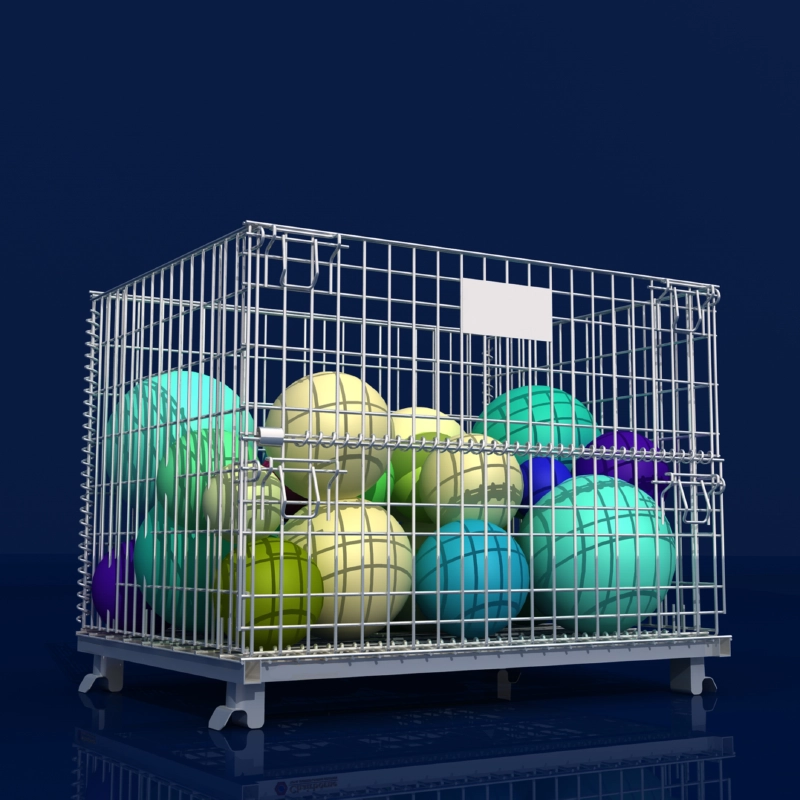
Mesh containment is sized from the smallest part you handle: 50 × 50 mm openings work for larger workpieces; finer parts call for a liner or a different mesh specification.
Three ways to configure the container around your parts flow
Manual access
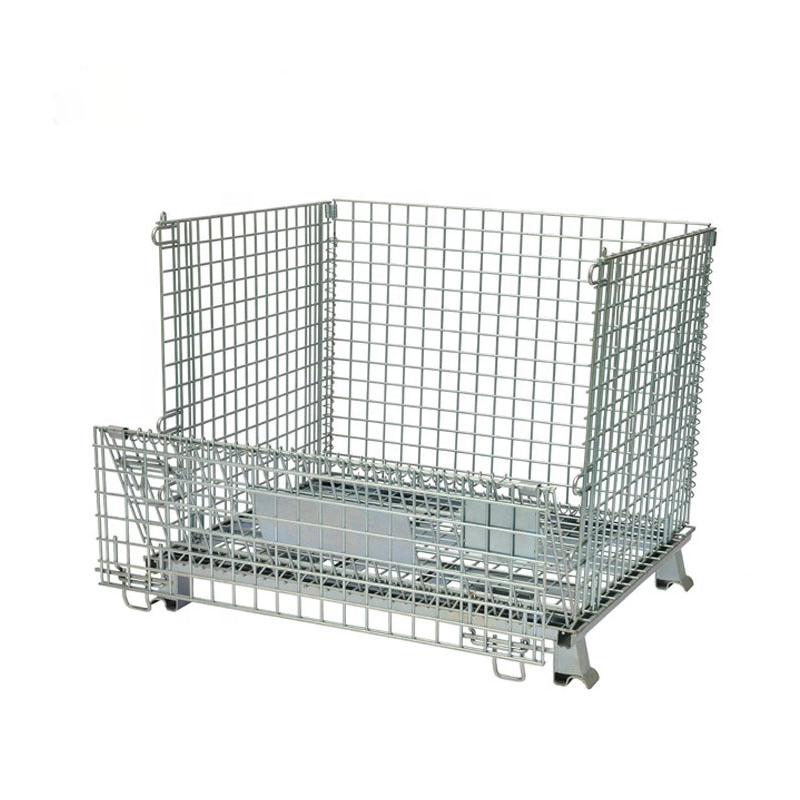
Half-drop gate for line-side picking
One side carries a half-drop gate that hinges down so an operator can load and pick at the front face. The 13967 project specified the opening on the 800 mm side — orientation, opening height and latch arrangement are confirmed against the final drawing, not assumed.
- Gate: single-side half-drop, helical hinge construction
- Use: manual loading, picking, WIP buffering at the station
- Confirm: opening side, gate height, latch type, reach height when stacked
Empty return
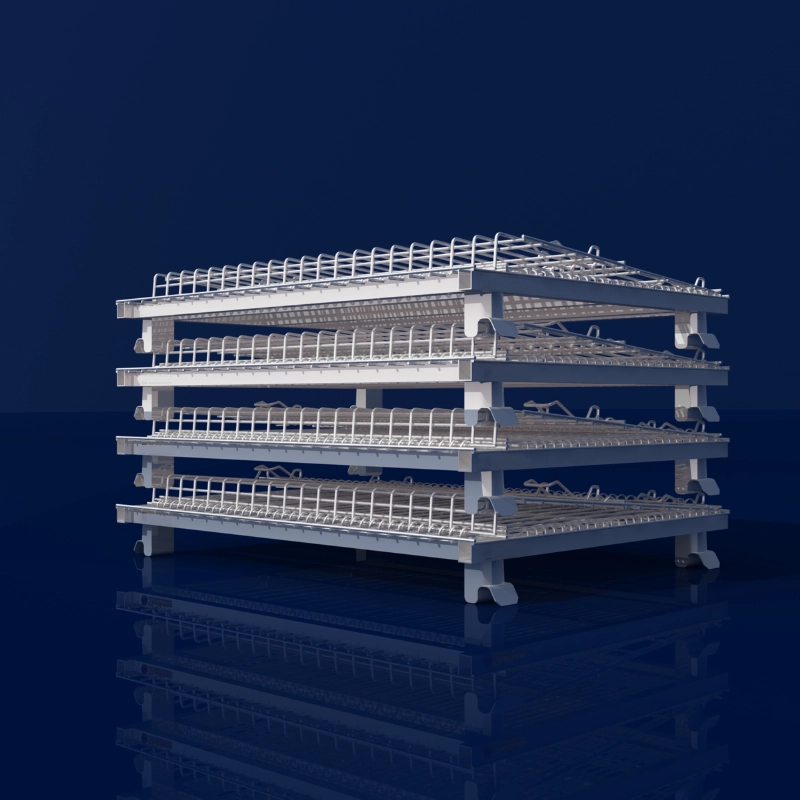
Flat-fold for the return leg
Empty containers collapse so the return trip carries a fraction of the volume of assembled empties. The 13967 project records a folded height of 190 mm for its size; the other projects confirm folding without publishing a folded height, so folded dimensions must come from your drawing.
- Folded height: 190 mm — 13967 record only, one size
- Folded stacking: project-planned count per stack
- Dispatch packing: stretch film and PET strapping per project record; wooden crates quoted separately if requested
Options
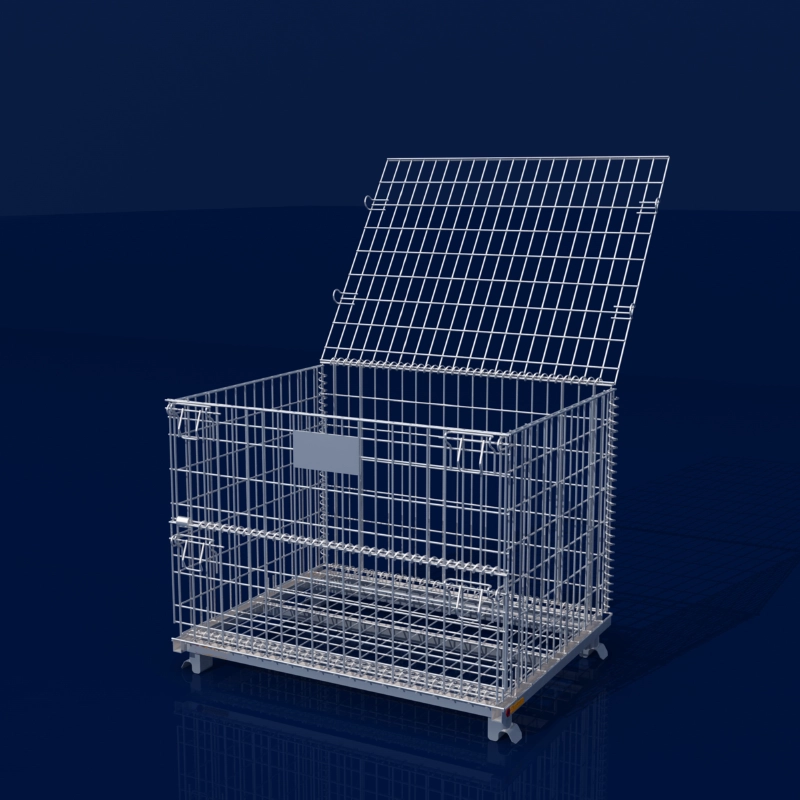
PP liner, top lid and caster options
Where parts are smaller than the mesh or need protection from the wire surface, a PP hollow-board liner backs the panels. A hinged lockable top lid closes the container for containment and light security. Casters add mobility — and change the support points.
- Mesh: 50 × 50 mm; check against the smallest part
- Liner: black or light-green PP hollow board in project images; thickness not confirmed
- Lid: hinged mesh top, lockable — option, not standard
- Castors: polyurethane, braked in project images; a caster-fitted unit is not automatically approved for static stacking
Four numbers decide whether the container beats the crate
Trips per container, per year
The reuse case is arithmetic, not a slogan: total container cost divided by the crate cost you avoid per shipment gives the break-even trip count. Add the empty return cost per trip and an inspection and repair allowance. Below that number, wood is usually cheaper.
Payload per container
Project records show single-container figures of 1000 kg, 1400 kg and 1000 kg across three separate projects — not one catalogue rating. Confirm whether the figure is static or dynamic, how the load is distributed, and how the container is lifted at full weight.
Stack height and upper-layer load
The recorded schemes all use up to four layers, but the upper-layer totals differ by project: about 500 kg per upper container in one, 1200 kg in another, 2000 kg in the third. The bottom container carries everything above it, so the stack limit — not the single-container rating — governs.
Folded volume on the way back
The saving on the return leg depends on how low your unit folds, how many folded units make a strapped column, and how that column loads into the truck or container. Without a folded dimension for your size, the return saving cannot be calculated.
Four inputs, then we can quote the replacement
Part data
Send part weight, part size, smallest dimension, sharp edges or machined surfaces, and whether parts may touch steel. This decides mesh opening, liner need and loading method.
Trip profile
Loaded trips per month, loaded and empty legs, whether the container returns, and the crate cost you pay per shipment today. This is the break-even calculation input.
Load and stack definition
Static or dynamic rating, number of layers, permitted upper-layer total, forklift or pallet-jack entry, and floor conditions. Stacking approval is issued against this definition.
Drawing freeze and quote
Dimensions, wire diameter, mesh opening, base reinforcement, coating, gate orientation and options are frozen on the drawing, then quoted with packing and container loading — with the container count per 20 ft and 40 ft recalculated for your size.
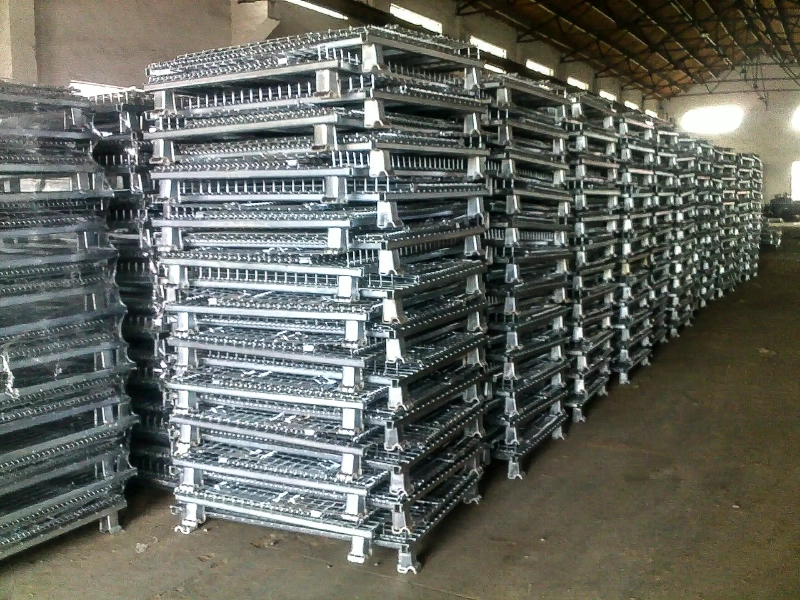
Folded containers stacked and strapped before dispatch. Recorded loading plans differ by size: about 250 units per 20 ft and about 638 per 40 ft HC in one project, about 150 per 20 ft in another — always recalculated against your dimensions and packing.
The questions buyers ask before switching from wooden crates
Where exactly does the container save money against a wooden crate?
In two places. First, reuse: one container serves many shipments, so its cost is spread over trips instead of repeated per crate. Second, the return leg: a folded container lets the empty trip carry far less volume than assembled empties or stacked crate timber. Both depend on your numbers, so we do not publish a fixed saving percentage.
How do I calculate the reuse cycle count?
Break-even trips = container landed cost ÷ crate cost avoided per shipment. Then add the empty return cost per trip (folding, strapping, freight per folded column) and an inspection and repair allowance per trip. If your realistic annual trip count is below the break-even number, a wooden crate is usually the cheaper route.
What load and stack height can one container take?
Project records show single-container figures of 1000 kg, 1400 kg and 1000 kg in three separate projects, and stacking schemes of up to four layers — with upper-layer total limits of about 500 kg, 1200 kg and 2000 kg depending on the project. These are project values, not a universal rating. Confirm static or dynamic definition, load distribution, lifting method and stack height before you commit to a number.
When should I stay with wooden crates?
One-way export with no return leg, a trip count too low to amortize the container, loads that need full enclosure plus cushioning, sites without forklift or pallet-jack handling, and destinations where a returnable steel asset cannot be stored or sent back. A crate is not a mistake in those cases.
Will small parts fall through the mesh?
Mesh records are 50 × 50 mm. Check your smallest part dimension and how it sits in the load, not just its nominal size. Where parts are smaller, or scratching and dust are a concern, a PP hollow-board liner (black or light green in project images) or a finer mesh specification is used.
Can a forklift and a pallet jack both handle it?
Project records show diesel forklift stacking and manual hydraulic pallet-jack handling of loaded containers. Fork entry height, foot opening, full-load centre of gravity and whether entry is genuinely four-way must be confirmed on the final base drawing before you rely on a specific truck or jack.
Are the lid, lock, casters and liner standard equipment?
No. They appear in project images as variants and options. In particular, a caster-fitted container is not automatically approved for static stacking: casters change the support points, the centre of gravity and the floor loading, so stacking must be re-approved for that configuration.
What surface finish do you supply, and is it suitable for outdoor staging?
Project records include electro-galvanized ≥8 μm, cold-galvanized around 10 μm, and a cold or hot option quoted at roughly 10 μm and 40 μm. Choose by actual exposure — rain, condensation, coastal air, chemicals — and confirm the acceptance standard. We do not publish a universal rust-life guarantee for outdoor storage.
Have your part weight, monthly trip count and return conditions ready? Send them to us and we will turn them into a crate-replacement comparison for your parts flow.