
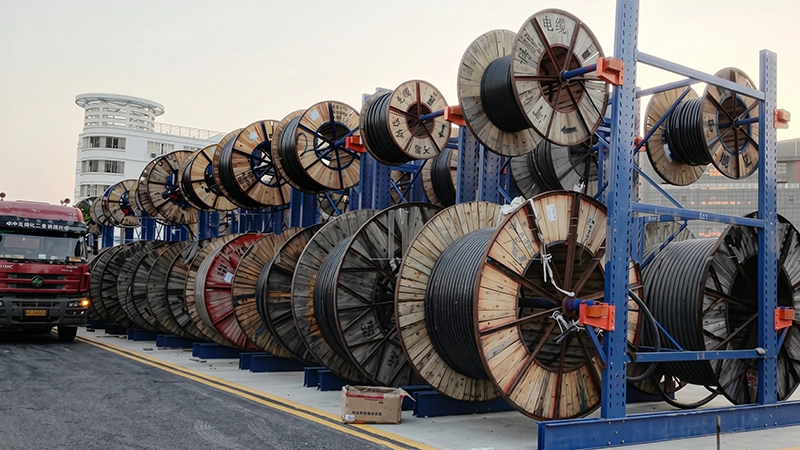
Cable reels that live outside are the hardest version of this storage job. Rain, standing water on the pad, wet cable and wooden drums that hold moisture all work on the steel at the same time, and in most outdoor projects the finish question is settled before the layout is drawn.
A galvanized cable drum rack such as Carack is still a fixed steel structure with bolted joints, punched uprights and hollow sections. Hot-dip galvanizing changes how the steel surface reacts to weather; it does not turn the rack into a sealed, maintenance-free object. This article explains why galvanizing is specified for an outdoor cable yard, what actually drives service life, and the rain-water and inspection points that decide how the rack ages.
Why Hot-Dip Galvanizing Is Specified for an Outdoor Cable Yard
Zinc protects steel in two ways at once. As a barrier it keeps water and oxygen off the steel surface. Where the coating is scratched or cut, the zinc around the damage still corrodes preferentially and holds the exposed steel back. That second behaviour matters on a reel rack, because the surfaces that take the hits are exactly the ones a paint film struggles to survive: the upright face a forklift mast passes, the bracket edge a steel drum flange lands on, and the base plates that sit in the wet.
Outdoor storage is a specification decision, not an assumption. In one documented project the customer asked for hot-dip galvanizing specifically because the racks were going into an outdoor storage area: one main frame plus two auxiliary frames, four reel positions per rack unit for reels of 1,400 mm diameter and 800 mm width, an overall rack width and height of 3,000 mm, and a roller-bearing support specified so a reel can be rotated for partial cable withdrawal. Reference weights were 583 kg for the main frame and 302 kg for an auxiliary frame. Those are project figures for that configuration, not a universal rating.
The same logic runs the other way indoors. Where reels are stored in a dry, sheltered warehouse, an indoor coating is normally the sensible specification and galvanizing adds cost without adding much. Unsheltered outdoor exposure is the trigger for the zinc route.
The Rain Problem: Water Inside the Frame and Rust Bleed at the Joints
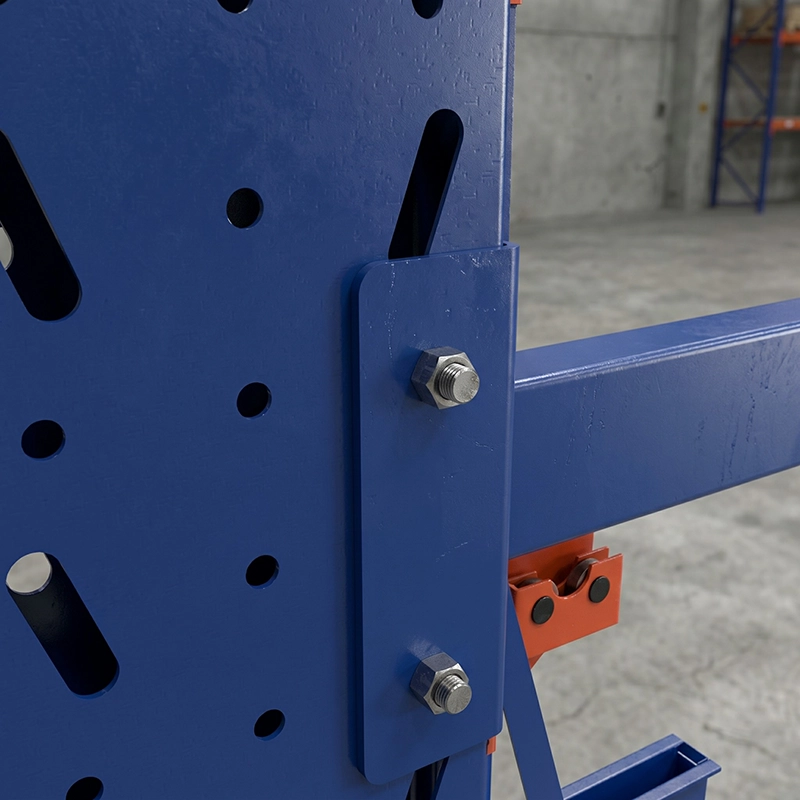
Galvanizing protects the surfaces the zinc can reach. The weak point in any outdoor steel rack is the surface it cannot reach: the inside of a hollow section with no drain or vent, and the narrow gap inside a bolted joint. Water enters through an open tube end, a punched adjustment hole or a joint gap, sits there, and starts working from the inside out.
You rarely see that corrosion where it starts. What the yard sees is the symptom: brown rust staining weeping out of a punched hole or a base-plate connection, and dripping onto the cable drums, the cable itself and the concrete below. Rust bleed is also a warning about the neighbouring joints, because if one connection is passing water the ones beside it usually are too.
The controls for this are drawing-stage decisions rather than maintenance improvisations: drain and vent provisions for hollow members, uprights oriented so a punched profile cannot act as a water cup, base plates set clear of ponding water, and a pad that drains instead of holding a film of water under the rack. Confirm on the approved drawing that water can leave the frame, and check after installation that nothing in the assembled structure blocks that path.
What Drives Service Life in an Outdoor Yard
There is no single number for how long a galvanized cable drum rack lasts outdoors, and a supplier who gives you one without asking about your site is guessing. The outcome is set by a short list of conditions:
- The specified coating system. Galvanized is a family, not one grade. Coating process and thickness are quoted per project, and an indoor-grade coating is not the same product as a yard specification.
- Water contact time. Steel that dries between rain events ages very differently from steel standing in a puddle or in permanently damp ground contact at the base plates.
- Drainage and internal water. A frame that sheds water and vents its hollow sections behaves better than the same frame with blocked holes and water sitting in the tube.
- Site chemistry. Coastal salt, industrial atmospheres, fertiliser or chemical dust, and wash-down water are all more aggressive than clean rain.
- Abrasion and impact. Forklift contact, drum flanges and sliding loads damage coatings, and damaged areas are where corrosion starts if they are left alone.
- What is stored on it. Wet cable and moisture-holding wooden drums keep the contact areas damp long after the rain stops.
- Inspection and repair discipline. A rack that is checked after the first wet season, then on a fixed interval, holds its condition better than one nobody looks at.
Maintenance Points for a Galvanized Rack in a Yard
Maintenance here is mostly looking, early and regularly. A practical list for a yard rack:
- Walk the rack after the first full wet season, then on a fixed interval. Look for rust bleed at joints, punched holes and base plates instead of waiting for visible section loss.
- Check that drain and vent paths are open. A hole blocked by debris, packaging film or a concrete splash keeps water inside the frame.
- Check the base area: standing water, soil or debris piled against the base plates, and any sign that the pad no longer drains away from the rack.
- Check bolted connections for tightness and for water sitting in the joint gap. A loose connection works and traps water at the same time.
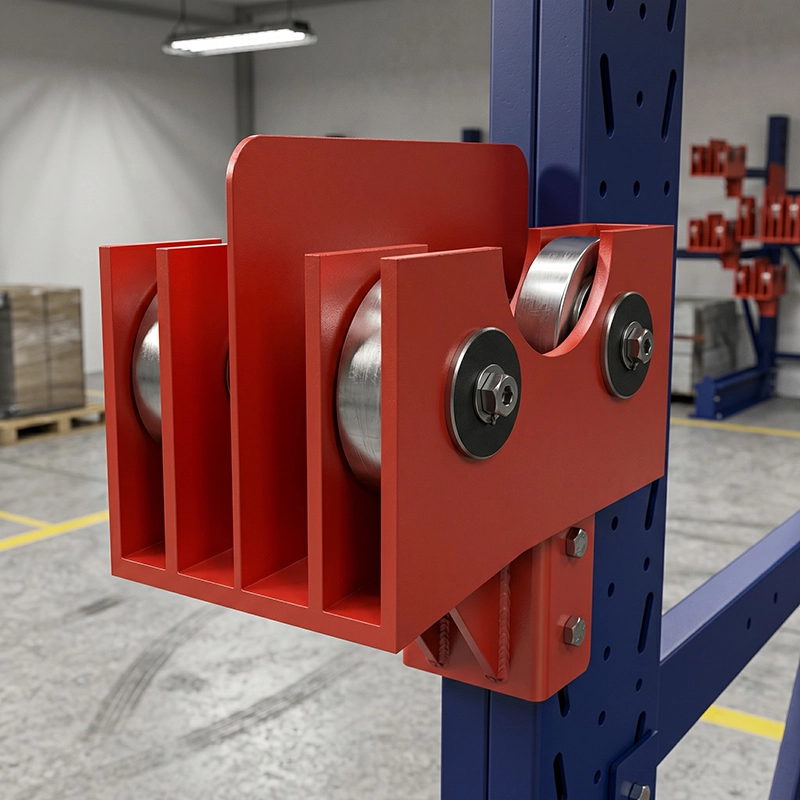
- Check the reel support brackets, including roller-bearing supports where rotation is specified. Rollers must turn freely; a stiff or seized roller loads the drum and the bracket instead of letting the reel rotate.
- Check contact pads and protective strips where the design includes them, and keep them in place so reels do not bear directly on bare steel.
- Repair coating damage as it appears, using the repair method stated for the specified finish. On galvanized steel, a repair coating has to be compatible with zinc.
- Keep reels out of prolonged standing water, and clear the yard so the forklift approach does not scrape the rack every cycle.
Two limits belong on the same list. First, this is a storage structure: if reels are lifted out and transferred to a trolley, that needs a confirmed fork clearance and support geometry, not just a rotating support. Second, layout is a separate exercise from finish. On one documented 10 by 4.3 m strip, two rows of 1,200 mm deep racks left only about 1,550 mm of aisle, so the plan used one row per strip. Confirm aisle and handling clearances for your own yard before the finish is ordered.
When Galvanizing Is Not the Answer
Hot-dip galvanizing is the usual outdoor route, but it is not a blanket rule and it is not a substitute for design:
- Dry, sheltered indoor storage. An indoor coating is normally sufficient. Galvanizing is not required just because the product can be galvanized.
- Aggressive chemical or heavy salt exposure. Where the atmosphere is more severe than weather, the corrosion-control system has to be specified for that environment. It is a project engineering question, not a catalogue choice.
- No drainage in the design. If water cannot leave the frame and the pad, a coating alone does not fix the mechanism; the water path has to be solved first.
- The wrong device for the job. Carack is a fixed, modular steel storage structure. It is not an automated cable carousel, a cable winding machine or a pay-out stand, and an auxiliary frame is not a free-standing unit, because it relies on the main frame upright for support.
We do not publish a guaranteed outdoor service life in years. The finish, drainage arrangement and inspection regime for your project are confirmed in the quotation and drawing, and that is the only basis on which an outdoor figure can be discussed.
Where an Outdoor Galvanized Reel Rack Fits
- Cable manufacturer yard buffer storage between production, testing and dispatch, with reels kept off the ground in defined bays.
- Power and electrical equipment sites holding drums of mixed diameters outdoors beside the workshop.
- Cable distributor and wholesale yards where reel sizes change and a fixed shelf height wastes space.
- Project and construction collection points where drums wait on a galvanized rack for the next dispatch instead of sitting on the pad.
FAQ
How long will a galvanized cable drum rack last in an outdoor yard?
There is no figure we will put on it without your site conditions. Service life follows the specified coating system, how long water stays in contact with the steel, whether the frame and the pad drain, the local atmosphere, and how consistently damage is repaired. The corrosion-control finish and drainage arrangement are confirmed for your configuration in the quotation and drawing, and a year figure quoted without that information is not engineering.
What should we check after the first rainy season?
Start with water: rust bleed at bolted joints, punched holes and base plates, water still sitting inside any hollow member, and blocked drain or vent openings. Then check bolted connections, the reel support brackets, where roller-bearing supports must rotate freely, and any coating damage from forklift or drum contact, and repair it while the damaged area is still small.
Can we repaint a galvanized rack that has started to stain?
Staining is a symptom first. Find where the water is coming from and whether the drain path is blocked before adding a coating, because paint over a wet joint traps the same water. Any repair or over-coating on galvanized steel must use a system compatible with zinc and must be applied to a prepared surface, and the repair method belongs in the project specification.
To move from a general finish discussion to a configuration you can quote, send the reel list with diameters and weights, the yard footprint and how the racks will be arranged, the aisle and forklift details, whether the storage is fully unsheltered, how the pad drains, and the corrosion-control finish your site requires. Those inputs are what set the frame layout, the reel support arrangement and the galvanizing specification for an outdoor cable reel rack.
Need a Custom Storage Solution?
Speak directly with our technical engineers. We offer free structural designs, heavy-duty catalog evaluations, and quick B2B price quotations.
Request a Quote Now →