
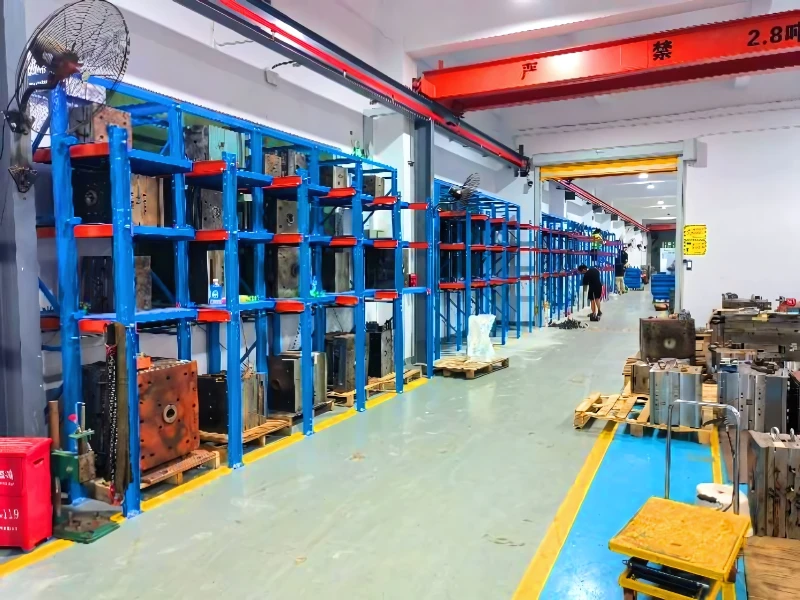
When dies and injection molds are left on pallets, blocks, or directly on the floor, the storage decision becomes part of every changeover. Operators may need to move one mold to reach another, work around occupied aisles, or identify a tool from a crowded group before lifting it. That can make retrieval slower and can introduce uncontrolled handling around heavy loads. Floor stacking is not automatically wrong, but it needs a disciplined layout, enough clear access, and a tool inventory that does not justify a dedicated rack system.
A roll-out mold rack changes the sequence rather than simply adding another shelf. Each mold is assigned to a defined bay; the full-extension drawer brings that bay into the working aisle; and, where the site has a suitable overhead crane or hoist, the mold can be lifted vertically after the drawer is secured. The practical result is a clearer SMED handoff and more visible EHS control points—not a guaranteed percentage improvement or an automatic compliance claim.
What floor stacking changes in the work sequence
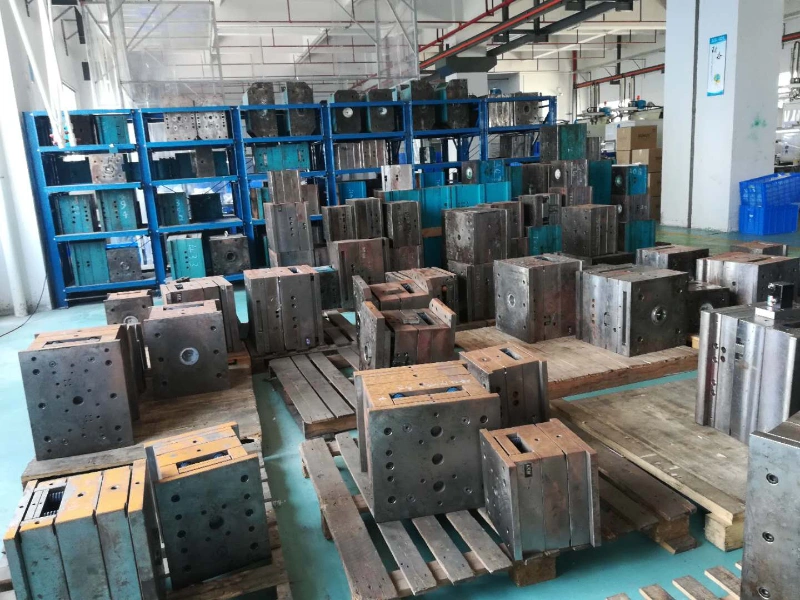
Floor stacking keeps the entry cost low and can work for a small number of light, low-frequency tools. The trade-off appears when molds become dense, heavy, or mixed in size. A mold at the back or underneath another load is no longer a one-step retrieval: the team may have to clear neighboring tools, bring in a forklift or pallet equipment, recreate a safe lifting position, and then return the displaced items. Labels can also become difficult to see when molds are stored as a group rather than in individual, accessible locations. For a supervisor comparing mold rack vs floor stacking, the key question is not only floor area; it is whether every planned changeover has a clear access path and a defined next move. The photo shows the kind of floor-level mold handling environment that should be assessed before choosing a storage method.
What full-extension drawers solve—and what they do not
A full-extension drawer separates one mold from the surrounding inventory. The three-post structure supports a 100% pull-out layout so the selected load is presented at the front instead of being buried behind another tool. Bearing-assisted guide rails change much of the sliding friction into rolling motion, while safety pins, mechanical limits, back bracing, base anchoring, and guide-rail control help manage the drawer and its center-of-gravity shift. Typical Erack configurations are engineered around 0.5–3 tons per level, with two to four layers and drawer sizes selected for the inventory; the final configuration still needs a project-level load and floor review. The drawer does not make an unsuitable floor safe, remove the need for trained lifting practice, or replace a correctly rated crane, hoist, sling, or rigging plan. Review the rack configuration in <a href="/pdp-04/">PDP-04</a> before comparing it with the storage layouts in <a href="/pdp-01/">PDP-01</a> and <a href="/pdp-02/">PDP-02</a>.
What changes for SMED and EHS
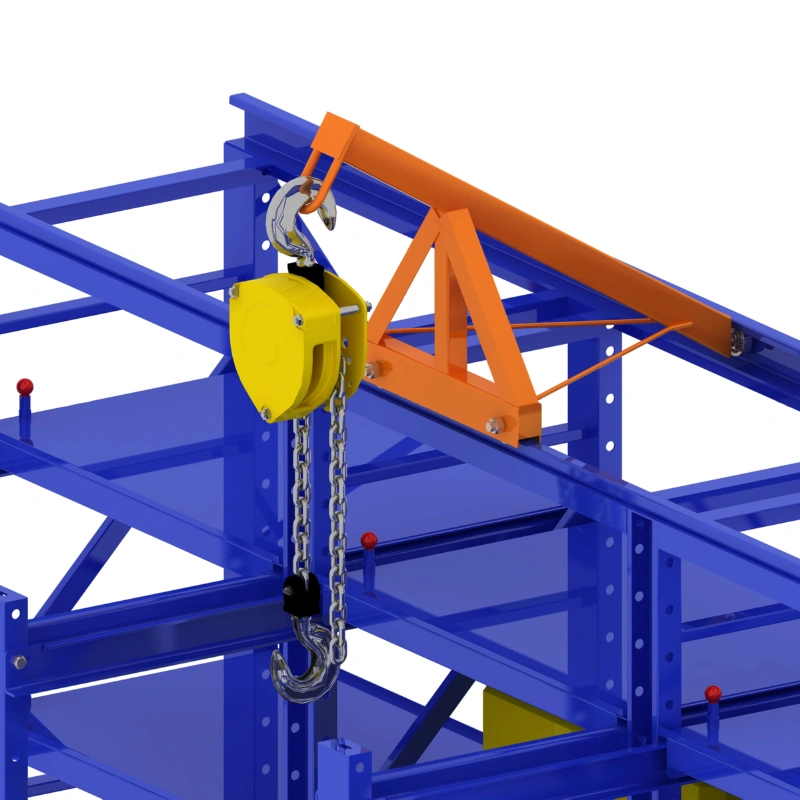
For SMED, the improvement is mainly in repeatability: a tool has a known bay, the drawer exposes the full load, and the lifting point can be planned before the changeover starts. That reduces avoidable searching, shuffling, and re-positioning around the mold. For EHS, the rack creates more observable controls: one bay at a time, a positive safety-pin and mechanical-limit check, a defined overhead lifting path, and floor anchoring on a hardened floor. The overhead crane or hoist must match the site plan and the load; the full-extension drawer must be secured before lifting. A rack can therefore support a safer method, but it does not by itself make a task compliant or eliminate all suspended-load risk. The image shows the crane-and-rack relationship that must be checked during layout planning.
When each storage option makes sense
- Choose disciplined floor stacking for a small inventory of light, stable, infrequently accessed tools when each load can be reached without moving another load and the floor layout preserves a safe handling path.
- Choose a roll-out mold rack for heavy dies or molds that are accessed repeatedly, stored in mixed sizes, or handled in a mold room where defined bays and direct crane access can improve the changeover sequence.
- Specify the rack only after checking hardened-floor condition, anchor locations, overhead lifting coverage, drawer dimensions, layer spacing, and the load of each mold—not from a generic shelf rating.
- Consider a hybrid layout when low-frequency light tools can remain on controlled floor positions while high-value, heavy, or frequently changed tools move into roll-out storage.
Buyer questions before switching from floor stacking
Is a roll-out mold rack always better than floor stacking?
No. Floor stacking can remain practical for low-frequency, light-load storage with clear access and controlled identification. A roll-out mold rack becomes more relevant as tool weight, retrieval frequency, inventory density, or changeover exposure increases. Compare the actual mold list, not just the number of storage positions.
Does a full-extension drawer automatically improve safety and SMED?
No. It provides a more defined retrieval position and can support a repeatable lifting path, but operators still need the correct safety-pin and limit checks, rated lifting equipment, suitable rigging, floor anchoring, and a documented work method. The expected benefit is qualitative: less searching and re-handling for SMED, and more visible controls for EHS.
Need a Custom Storage Solution?
Speak directly with our technical engineers. We offer free structural designs, heavy-duty catalog evaluations, and quick B2B price quotations.
Request a Quote Now →