
A motorcycle does not stay upright on a pallet because it is heavy. It stays upright because the front wheel cannot turn or move sideways, the rear wheel cannot step out, and the whole can be lifted with forks without the bike falling onto its side stand. Loose on a load floor, a 200 kg motorcycle will already lean within the first metre of a fork turn. Secured at three points, it behaves as cargo.
This is how the three securing elements work together on an Mtrack motorcycle shipping pallet: a handwheel front-wheel clamp, U-shaped strap hooks on both sides, and a ramp to push the motorcycle into place. Each element answers a different failure mechanism, and each has a limit set by your motorcycle, not by a catalogue.
Why a motorcycle falls over on a pallet
Three things move a parked motorcycle. The steering turns, because a front wheel without any hold follows the smallest lateral force and the motorcycle then falls in the direction the wheel was pointing. The rear wheel walks, because a tyre resting under its own weight on smooth steel offers very little resistance to lateral friction. And the suspension unloads, because picking up the pallet with forks causes a short vertical jolt that compresses and releases both ends on each side at a different rate.
None of these is solved by a flat platform. A flat deck gives a motorcycle a floor, not a position. The securing must hold the angle of the front wheel, pull the chassis down into a fixed wheel position, and contain the base so that the loaded assembly can be moved as a single package handleable with forks, for a motorcycle parking reorganisation or a container shipment.
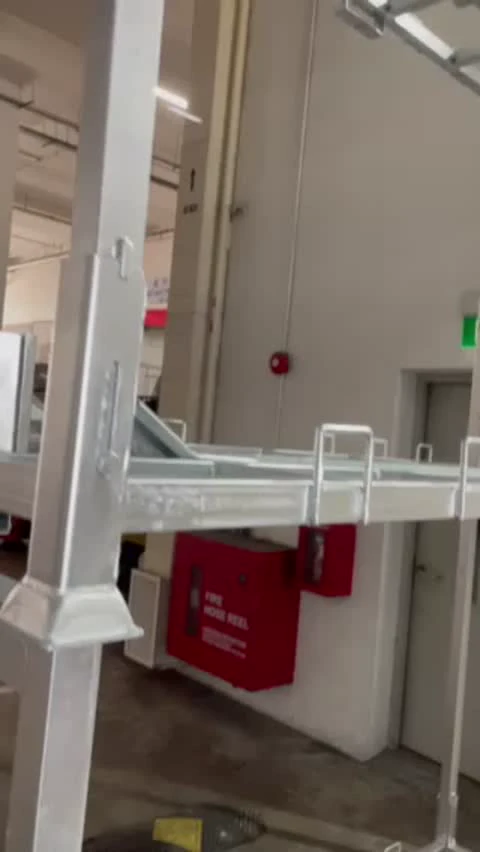
Element one: the handwheel front-wheel clamp
The clamp closes on the front tyre from both sides of the wheel groove. A handwheel drives the jaw in and out, so that the same holder is tightened to clamp the tyre before transport and loosened to ride the motorcycle out afterwards. That single operating action matters in fleet management: no tools, no loose pins to lose, and no argument about how tight 'tight' is enough.
What the clamp actually provides is steering lock. With the front wheel gripped, the motorcycle can no longer rotate about its steering axis, and that is the mechanism behind most "it just fell over" incidents during transport. In addition, it keeps the wheel centred in the groove, making the strap geometry predictable in the next step.
Two limits belong here. A handwheel clamp closes on the tyre, not on the rim, and its usable range is a design value: front wheel diameter, tyre width and mudguard clearance are confirmed before the jaw is tightened. If a motorcycle falls outside that range, the answer is a different jaw or a different holder, not more turning force on the handwheel.
Element two: U-shaped strap hooks on both sides
The hooks are U-shaped so that a hook or strap end rests on a defined point instead of being wrapped around an arbitrary tube or sharp edge. They are placed on both sides of the pallet, and that symmetry is the core: pulling down and forward from two sides loads the motorcycle into the wheel position, while single-sided anchoring pulls diagonally and drags the rear out of line.
A strap specification is a calculation, not a habit. The working load of the strap and the rating of the hook are matched to the weight of the motorcycle and the angles at which it will actually be pulled, and then fixed on the drawing. A project of 250 kg per pallet and a project of 500 kg per pallet do not get the same strap hardware, and neither gets the same clamp setting.
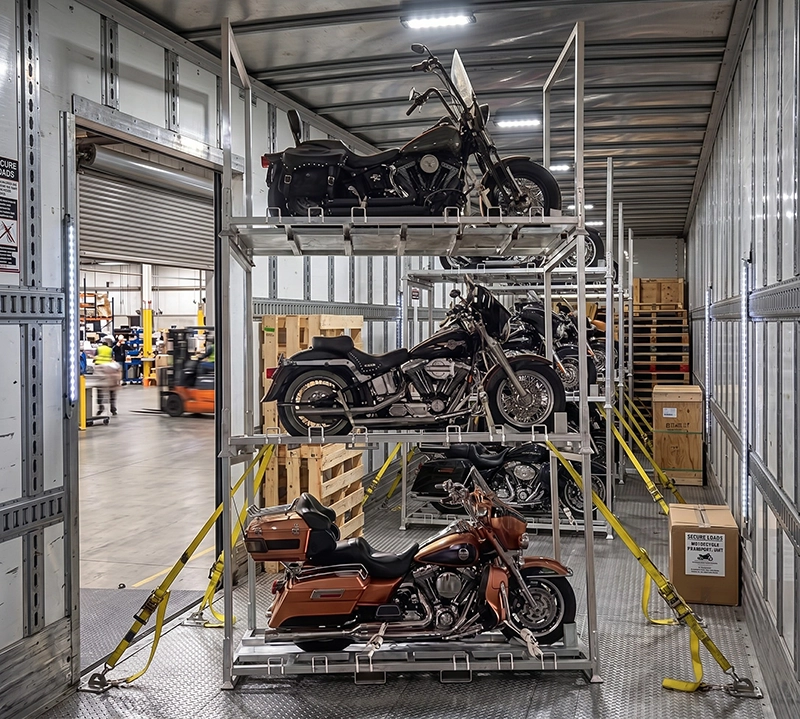
Element three: the ramp is a loading path, not a securing device
A loaded touring motorcycle cannot be lifted onto a pallet by hand, and riding it up against a loose plank is how paint and bodywork get damaged. The ramp provides a controlled push line aligned with the wheel groove, so that the motorcycle enters straight already, with the front wheel rolling into the clamp instead of being steered towards it.
Keep the roles separate. Once the motorcycle is in place, the ramp has finished its job; the clamp and the two-sided straps are what hold the motorcycle transport pallet. Crews that treat the ramp as part of the securing method, or that skip the clamp because the straps "feel firm", are the ones who find a motorcycle askew after a lift.
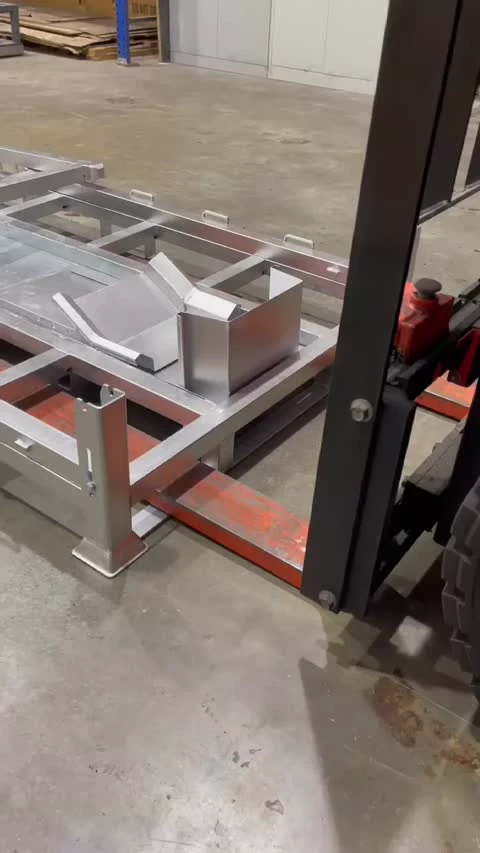
What the side rails and wheel groove do — and do not do
The wheel groove is a positioning feature: it gives the front tyre a channel to sit in, so that the position of the motorcycle is repeatable from load to load, which makes one drawing usable for a whole fleet. The side rails and the perimeter provide lateral containment at base level and protect the assembly during fork handling and stacking.
What they do not do is replace the straps. A rail prevents the base of the tyre from sliding along the frame edge; it does not prevent a motorcycle from tipping over the top of the rail. That is why the securing system is specified as a combination and why a bare flat metal motorcycle pallet with side rail and without clamp is not the same product as an Mtrack unit with clamp.
Load, clamp force and strap rating are project values
Registered Mtrack projects are designed at 250 kg, 350 kg and 500 kg per rack, with motorcycles up to approximately 2,270 to 2,410 mm long, 850 to 1,000 mm wide and about 1,200 to 1,315 mm high. These are project references, not a table of standard values. What you get is fixed on the approved drawing after design review.
| Input you confirm | What it determines |
|---|---|
| Motorcycle weight and loaded centre of gravity | Working load per rack, frame member dimensions, clamp mounting |
| Front wheel diameter and tyre width | Clamp jaw range and handwheel travel |
| Rear wheel width and exhaust clearance | Groove width, hook positions, strap angle |
| Strap fittings you intend to use | Hook shape and rated anchor points; strap rating matched to motorcycle weight |
| Fork entry direction and fork opening | Base channel position; registered openings include 175 x 75, 188 x 89 and 200 x 69 mm |
| Stacking plan or container height | Upright type, number of tiers and total stack height, at or below 6 m with four tiers in one registered scheme |
Nothing in that table is to be guessed from a photo. A photo proves the configuration exists; the drawing proves it fits your motorcycle.
When the three-part method is not the right choice
Be clear about the exclusions, because they determine whether you should order this at all. If a motorcycle's front wheel falls outside the confirmed clamp range, or the tire is too wide for the jaw, this fixture is not approved for lifting. If a motorcycle is fitted with accessories that obstruct two-sided strap routing, the anchor positions must be re-planned rather than forced. If the vehicle is not a motorcycle at all — irregular cargo, engines or an awkwardly assembled whole — then the clamp and groove geometry serves no purpose and a different platform configuration is the honest advice.
There is also a handling condition that no frame design removes: an operator who lifts before the clamp is placed and both straps are tensioned. The hardware makes the fixation possible; the pre-lift check makes it real.
Where this configuration is used
- Factory dispatch and dealer-network transfer, where every motorcycle must leave on its own fork-operated unit.
- Container loading of motorcycles, where the clamp and strap points are fixed so the same crew repeats the same procedure.
- Dealer warehouses and distribution centers with stacked motorcycle storage of mixed models at different heights.
- Racing, touring, events and collector transport, where a paint chip on a wheel or fairing is an expensive consequence.
Frequently asked buyer questions about a non-tipping motorcycle pallet
Will the motorcycle roll or tip while the loaded pallet is being lifted?
With the front wheel clamped and both sides strapped to the U-shaped hooks, the motorcycle is held by the wheel and pulled into a fixed position — this is the state the frame is designed for. It remains a procedure: clamp placed, straps tensioned, forks fully in the channels, then smooth lifting. A unit lifted with the clamp open is not a fixed unit, whatever the drawing says.
Can you guarantee the motorcycle will not move at all on any model?
No, and any supplier who says yes without your wheel dimensions is guessing. Clamp force, jaw range and strap specification are set from your motorcycle weight, front wheel size and strap angles. Within the confirmed envelope we design for a fixed position; outside it we specify a different clamp or holder, or we tell you the configuration is not suitable.
Will the clamp damage the wheel or rim?
The jaw is specified to close on the front tire, and the contact surfaces are a detail on the drawing, not an on-site adjustment. Tell us wheel and tire dimensions plus any coating you must preserve, and that becomes part of the drawing review. After delivery, do not add shims or spacers to change the grip of the clamp.
How many tiers can be stacked once the motorcycles are loaded?
The number of tiers follows the structure and the vehicles, not a general rule. One engineering update advises a total stack height of 6 m or less with four tiers; other projects are specified at three tiers, or at two levels for transport. The number that applies to your site or container is fixed when the rack size and upright type are set.
Send the motorcycle, not the model number
The fastest way to get a fixation plan that survives a real lifting operation is to send us the motorcycle: make, model year, front wheel diameter and tire width, rear wheel width, weight including fuel, and a photo of the motorcycle from the front and from the side. With that we can determine whether the handwheel clamp range fits your wheel, where the U-hooks should be placed, and what strap rating your motorcycle needs. For the hardware itself, see the configuration of the motorcycle rack with front wheel clampVoor meer informatie over hoe de werkbelasting per project wordt bepaald, lees reinforced motorcycle pallet rack for multi-level loading, and for what happens to the racks on the empty return trip, see flat-folding motorcycle rack for empty returns.
Heeft u een op maat gemaakte opslagoplossing nodig?
Spreek rechtstreeks met onze technische ingenieurs. Wij bieden gratis constructieontwerpen, evaluaties van zwaar belaste catalogi en snelle B2B-prijsopgaven.
Vraag nu een offerte aan →