
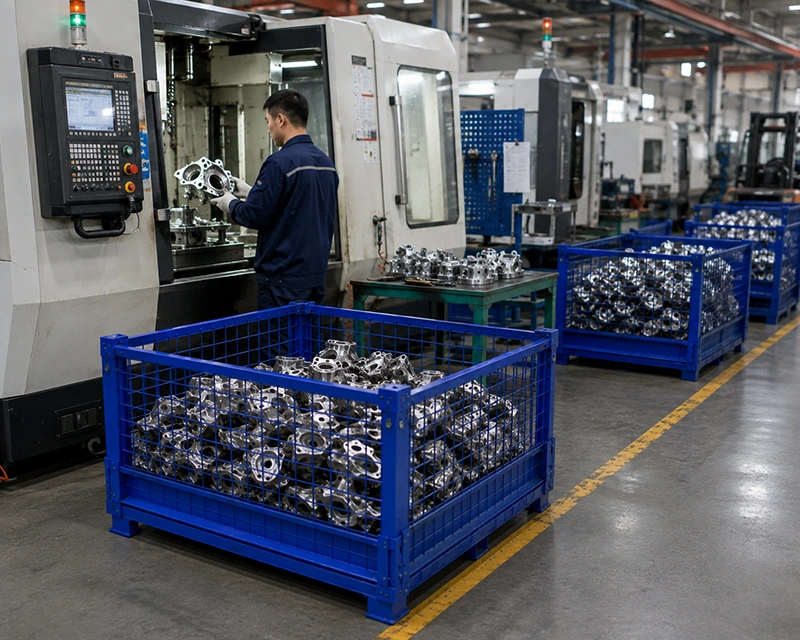
Between two assembly stations, the distance is often short and the cost is not. Loose castings, machined housings and pressed brackets leave one station in a tote or on an open pallet, are counted, carried, set down, waited on, then lifted part by part into the next fixture. Every one of those steps is a handling event that consumes labour time and creates a chance for a part to be dropped, mixed with another batch, or damaged against the floor.
The alternative is to stop treating the transfer as a loose-material problem. A collapsible cage pallet changes the unit of work: the batch leaves a station already inside a rigid, palletized, stackable steel container that a forklift or pallet jack moves in one motion, and the next station draws parts out of it without unpacking. This article sets out how that closed loop is designed between stations, what it costs to keep doing it manually, and the conditions where a cage pallet is the wrong container for the job.
Why Inter-Station Transfer Needs a Fixed Unit, Not Whatever Container Is Nearby
Assembly-line logistics depends on repeatable geometry. Aisle width, line-side footprint, forklift fork spacing, rack beam level and dock turning radius are all planned around one standard load envelope. A loose tote that changes size every shift breaks that planning: the same batch may occupy a different footprint on Monday and Wednesday, and a stack of mismatched containers cannot be planned at all. A cage pallet fixes four things at once — external footprint, internal clearance, base entry, and tare weight. That gives the line engineer something to design to: one position on the floor per load, one fork entry per move, one empty footprint when the container is folded.
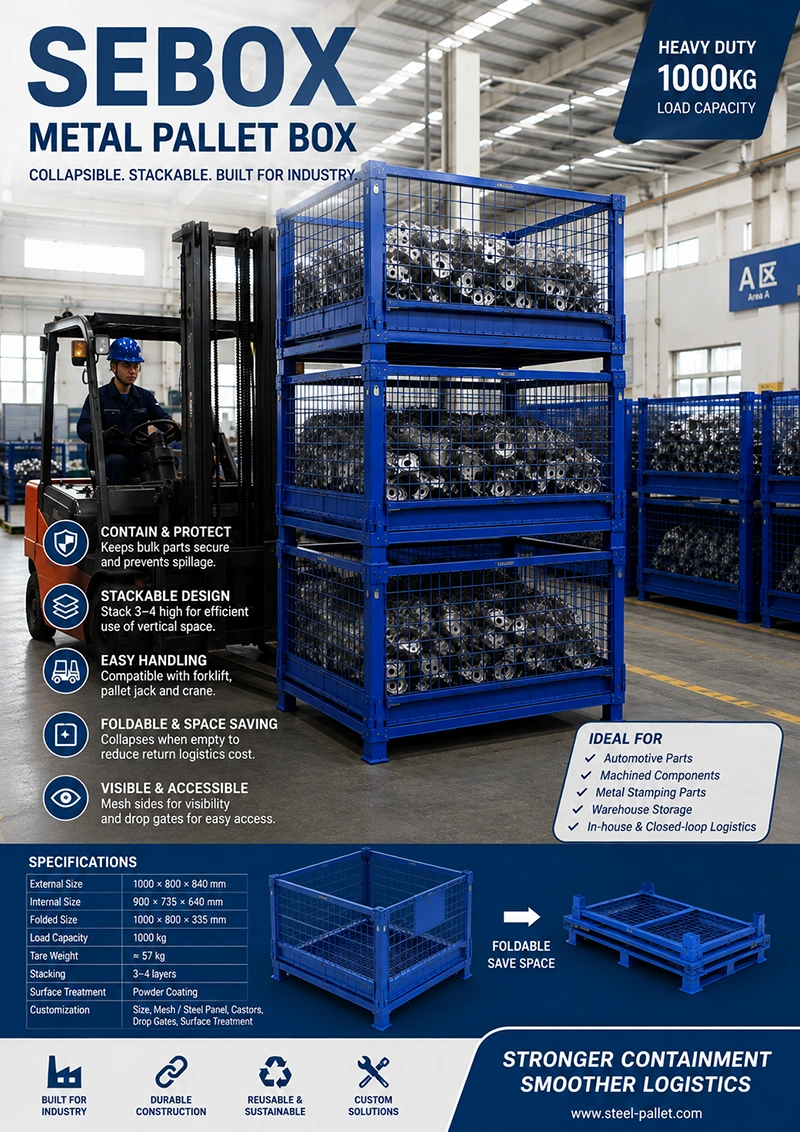
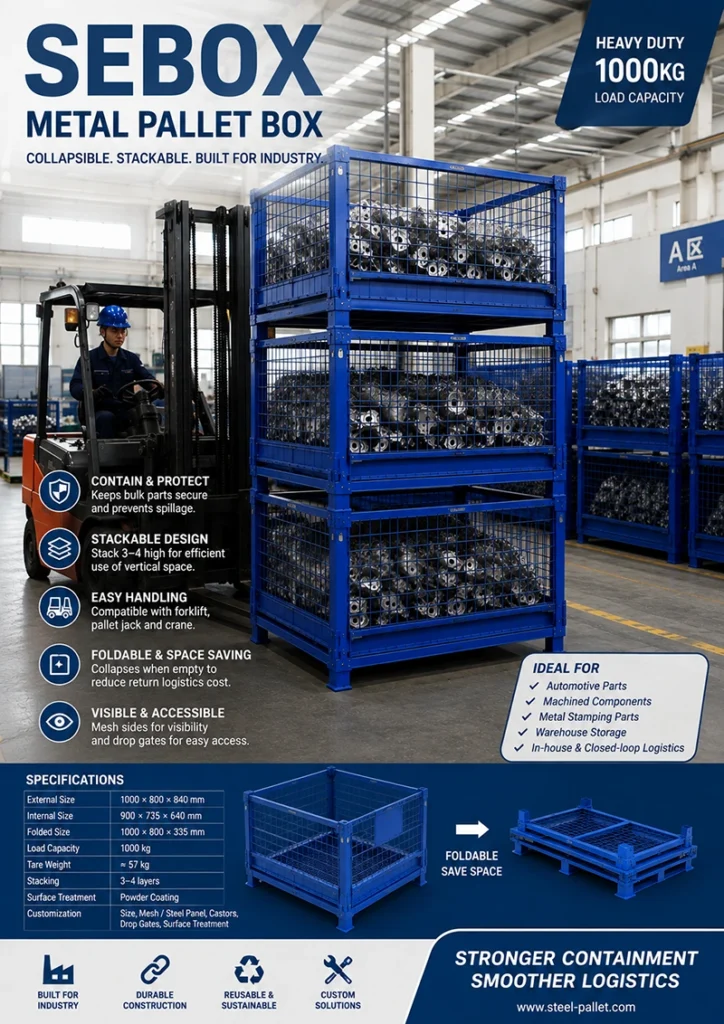
The load figure on a product image is not a series-wide rating. The Sebox family is documented with at least three distinct variants — one at a 1000 kg design load with a folded height of 335 mm, one at 1300 kg uniformly distributed, and one at 1500 kg uniformly distributed, on different external footprints and weights. Which number applies to your line is fixed on the approved drawing for that SKU, together with the base plate thickness, the tube profile and the panel type.
Where Manual Handling Cost Actually Accumulates
Manual transfer is rarely one big cost. It is a chain of small ones, and the chain repeats once per batch per shift. A typical loose-part handover between a machining cell and an assembly bench contains the following events: pick parts off the machine outlet; place into a tote; stack or carry the tote; set it down at the station; wait for a free operator; lift parts out and place them into the fixture; return the empty tote. Six or seven touches, each with its own risk of a dropped part, a mixed batch and a reach-and-bend injury, and each absorbing an operator minute that adds nothing to the product.
Unitizing the batch cuts the chain down to a mechanical move plus a pick. The container is loaded once at the supply side, moved as one load by forklift or pallet jack, and set at the next station at working height. The operator touches the part twice — once into the container, once out of it — instead of six times. Nothing in that calculation is a fixed saving percentage; the real number depends on your batch size, your station spacing and your current tote handling, which is why the change should be measured on one loop before it is rolled out across the plant.
Visual Inventory Is What Keeps the Line From Stopping
Line stoppage usually starts as a surprise: the station ran dry because nobody saw it coming, because the batch was inside a closed bin at the back of a stack, or because the part could not be counted without unloading. Wire mesh sides answer the visibility problem directly — a supervisor walking the aisle can read fill level, part shape and batch mix through the panel, and a low container is visible before it becomes an andon call. That is the practical reason assembly plants put mesh rather than sheet steel at line side.
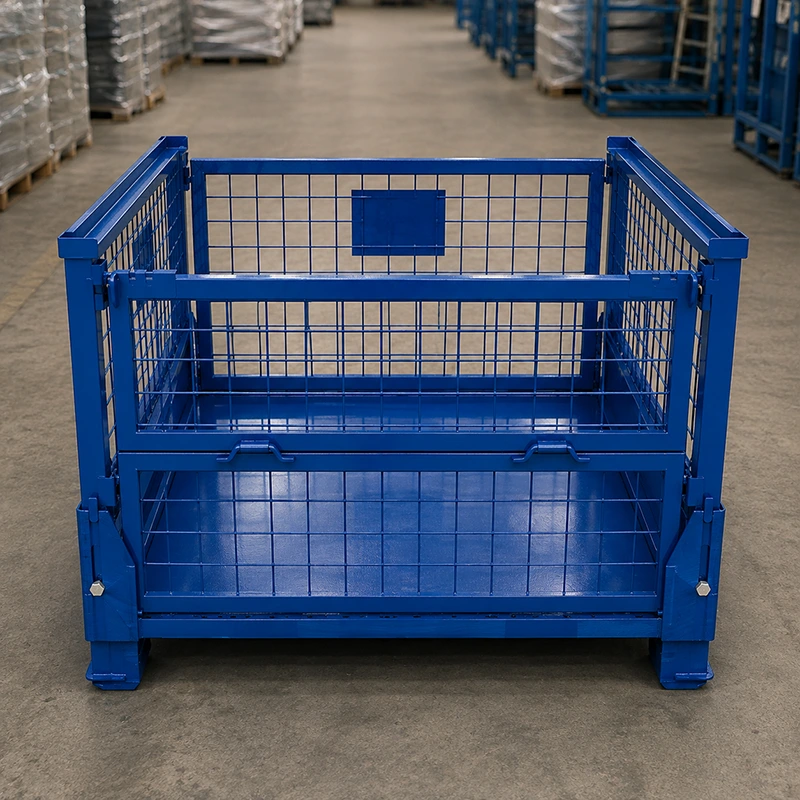
Visibility has limits that should be stated up front. Mesh lets you see a large, uniform part; it does not let you count a heap of small loose pieces through the panel, and it does not stop swarf, dust or coolant mist from passing through. Nor does it help if the container is buried in the third layer of a stack — which is why the gate face matters as much as the panel. A half-drop front gate, documented on several Sebox configurations, allows an operator to unlatch the upper half of the front panel, hinge it down, take the part and close it again while the container stays in the stack. Used together — mesh to see, gate to reach — the station can be re-supplied and picked without breaking the stack down for access.
Making the Mechanical Loop Work: Base Entry, Mobility and the Empty Return
A closed loop has three states: loaded, empty, and in transit. The base decides the first two. Sebox bases are documented with forklift-compatible feet and pockets, with four-way entry on some configurations, so the container can be approached from the aisle it actually stands in rather than a theoretical one. Where the loop runs short and flat, casters and a tow arm appear in documented and pictured configurations, turning the container into a mobile unit that an operator can push from the cell to the bench without a truck; that option has to be specified per SKU, because caster capacity and floor condition both affect it.
The empty state is where a fixed steel container loses money if it is designed badly. Folding addresses it: the documented Variant C folds to a 1000 × 800 × 335 mm profile from an 840 mm working height, and the 1220 × 1015 mm variant folds to 335 mm as well. Those are variant-specific figures, not a family rule, but the principle holds across the range — an empty box that stacks flat returns in a fraction of the cube it occupied loaded, which is what makes a closed loop between stations cheaper than a one-way packaging stream.
Conditions Where a Cage Pallet Is Not the Right Answer
A cage pallet is a containment device for parts that loop back, and it should be refused where that is not the case. The following conditions require a different specification or a different product, and they should be settled before any quotation is issued:
- Parts smaller than the mesh aperture, or parts that produce fine swarf: mesh alone lets material escape. Specify solid steel panels, a liner, or a mixed base-and-gate arrangement instead of an all-mesh container.
- A one-way export leg with no return loop: if the container never comes back, folding and reusability buy nothing, and single-use packaging is likely cheaper per shipment.
- Stacking claims beyond the drawing: documented sources give a 3–4 layer recommendation for one variant and a 5 m maximum stacking height for another. Both are configuration and site dependent, so the layer count, the permitted total load on the bottom container and the floor or rack condition must be confirmed for your SKU.
- Load assumptions taken from a picture: a poster figure such as 1000 kg belongs to the variant it is printed for. Uniformly distributed load and impact load from a dropped casting are different cases and are not interchangeable.
- Corrosive, wet or unsheltered service: the standard finish is a powder or spray coating, with galvanizing and stainless options listed in the customization table but not mapped to every variant. Outdoor or wash-down duty needs that mapping confirmed.
- Certification-led procurement: Gitterbox is a strong European search term and a useful size reference, but it is a descriptor here, not an evidenced compliance certificate. Buyers who need formal conformity documentation must raise it as an explicit requirement rather than assume it from the product name.
What to Put in the Line-Side Requirement
A supplier cannot size a cage pallet loop from the phrase “we need some cages”. The loop is defined by your data. Send the part list with weights and the largest dimension, the batch quantity per station per shift, the working height of the pick face at both ends, the forklift or pallet jack you intend to use and its fork spacing, the available line-side footprint including the approach aisle, the number of layers you want to stack and what sits above the bottom container, the empty-return route and its vehicle, and the finish or wash-down requirement. With those inputs the container can be configured — panel type face by face, gate arrangement, base entry, caster specification and folded shipping size — and the load figure can be frozen on a drawing that the line engineer signs off.
To take the next step, review the inter-station transfer scheme for collapsible cage pallets, or send your line-side requirement with the part list and station layout so the loop can be quoted against your own numbers rather than a catalogue average.
Where This Configuration Fits
- Machining cells and CNC workshops routing batches of finished parts to a downstream assembly bench.
- Automotive sub-assembly lines where castings and pressed parts must arrive at the fixture in a known quantity and orientation.
- Work-in-process buffering between processes, with optional casters where the move is short and the floor is flat.
- Plants that need the same container to work line-side, in warehouse block stacking, and in an overseas container on the return leg.
Frequently Asked Questions
Can one cage pallet design serve every station on the line?
Only if the part envelope and the batch quantity are genuinely similar. A single footprint simplifies forklift and layout planning, but the load rating, panel type and gate arrangement must still be valid for each station’s heaviest part. Where one cell runs large castings and the next runs small fittings, two configurations of the same family are usually cheaper than forcing one oversized container through both.
Do I need a half-drop gate on every face?
No. Access is needed where the pick happens, which in most layouts is one face pointing at the aisle or at the operator’s position. Gating every face adds cost and hardware without adding throughput. The exception is a container that is rotated during the loop, in which case two opposite gate faces are worth specifying.
How do I confirm the stacking height before I buy?
Ask for the approved drawing for your exact SKU, and check three figures together: the permitted load inside one container, the permitted total load resting on the bottom container, and the maximum stack height permitted for the floor or rack condition on your site. Published recommendations for the family differ because the variants differ; the drawing is the only document that binds the answer to your container.
Need a Custom Storage Solution?
Speak directly with our technical engineers. We offer free structural designs, heavy-duty catalog evaluations, and quick B2B price quotations.
Request a Quote Now →