
More than 200 motorcycles in one warehouse is not a display problem. It is a floor-space and retrieval problem. On project record 15385 the bikes were standing flat on the warehouse floor, each machine holding its own footprint plus the clearance needed to walk around it. The floor filled up, and pulling out a bike in the middle of the room meant moving the machines around it first. Nothing was broken — the storage method had simply stopped scaling.
Making the same building hold far more bikes means changing the unit of storage. A motorcycle pallet rack puts one motorcycle on a steel base, gives a forklift a defined way to pick it up, and lets those units stack. This article walks through how the density is actually created, where the limits sit, and what has to be measured before a layout is drawn.
Why flat floor storage runs out of room long before the building is full
Every motorcycle parked on the floor consumes more space than its own outline. You need a walking gap to reach it, a turning gap to wheel it out, and a clear route to the door. In a large collection those gaps multiply: a few hundred machines that each occupy a little over one square metre of bodywork can hold two or three times that in aisle. The result is a room that looks full of motorcycles and still leaves no practical way to reach most of them.
The second cost is retrieval. When bikes are on the floor, the machine at the back is behind everything in front of it. Each request becomes a move of three or four other motorcycles, and the risk of a tip-over or a scratched fairing rises with every move. Storage density and retrieval speed are the two numbers that decide whether a large collection is manageable, and both are set by how the bikes are held, not by how big the room is.
One universal rack footprint instead of one design per motorcycle
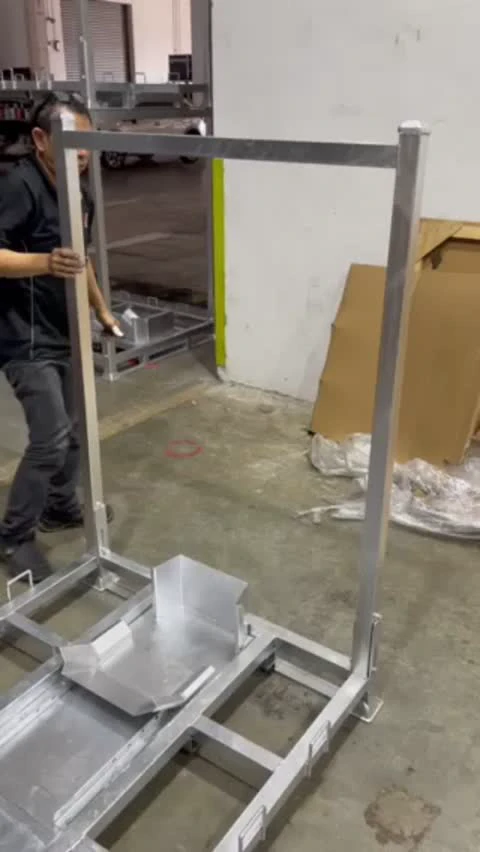
A mixed collection is the hard part: a small single-cylinder bike and a full-dress tourer do not share a footprint. Project 15385 solved that by setting one universal rack size around the largest machine. The rack measured 2320 x 1050 x 1400 mm, weighed 88 kg, carried a recorded working load of 350 kg for that project, and accepted motorcycles up to 2270 x 850 x 1300 mm, which covered the largest bike in that collection. The 2320 x 1050 mm length-to-width ratio also loaded well into containers.
Fork access was part of the same design: a 188 x 89 mm fork opening on a 685 mm centre distance, sized around motorcycles no taller than 1300 mm. Smaller bikes then load into the same steel base, so the warehouse runs one motorcycle shipping pallet type instead of a custom frame for every model. Those figures are project values, not a series table — other recorded Mtrack schemes use different outer sizes, tare weights and working loads (250 kg, 350 kg or 500 kg in named projects), and the final envelope is fixed on the approved drawing.
Where the density comes from: levels over the same footprint
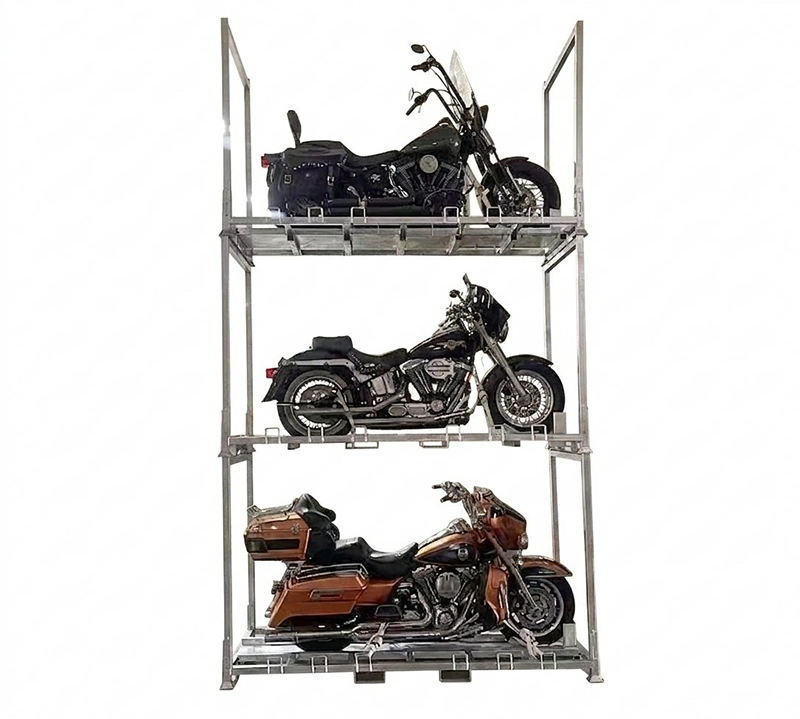
Stacking is the whole point of motorcycle pallet rack storage. A rack that holds a motorcycle at ground level and again at 1.4 m, 2.8 m and 4.2 m turns one parking position into four. One Mtrack engineering record recommends a total stack height of no more than 6 m with four layers at that rack height; other projects specify three layers, or two levels for transport only. The number is never a catalogue constant, because motorcycle stacking storage depends on clear building height, the floor’s bearing capacity, rack height, the height of the motorcycles themselves, and the aisle the forklift needs to place the upper units.
Density also depends on which bikes go where. Motorcycles used often belong on the lower levels, where they can be taken off without touching the stack; long-term or display machines can live on the top. Bikes taller than the fork-entry record for a given design (1300 mm in the 15385 configuration) need a separate height check before they are assigned to a level.
Retrieval: stacking only works if one bike can come out on its own
Density that cannot be accessed is just a pile. The Mtrack base is designed around loading a motorcycle rather than general cargo: a wheel groove, a loading ramp, front-wheel locating or clamping options, and U-shaped strap hooks so the bike is restrained to its own rack rather than to its neighbours. On the 15385 racks the strap hooks sit on both sides, so a machine can be tied down from either side of the aisle.
Because the bike and its base travel together as one fork-handled unit, taking a bike out means lifting that unit, not reshuffling the row. That is the practical difference between a stacked collection and a flat one: the machine in the middle of a row can be picked without moving anything else, as long as the stack order and the aisle were planned for it.
Where the empty racks give the space back
A collection that keeps growing also keeps buying racks, and empty racks are dead volume if the posts stay up. In the 15385 design the posts fold inward, which collapses the empty rack for storage and for the empty return leg. Plug-in uprights are the other route used on Mtrack projects: the posts pull out of the base and travel as a bundle. Either way the empty unit is a base plus posts rather than a full-height frame.
The same geometry drives container counts. The 15385 record shows 35 racks in a 20 ft container and 88 in a 40 ft high cube. Other Mtrack records range from 28 to 56 sets in 20 ft containers and 72 to 140 in 40 ft high cube projects, because the count moves with outer dimensions, folding, post type, wheel chocks, packing and loading direction. Container quantity is calculated for the configuration, never quoted as a fixed figure. Packaging is the other variable: stretch film plus strapping adds no packaging cost but does not fully protect the paint film in transit, while a wooden crate, quoted at a project reference of about CNY 90 per square metre, does. Cold galvanizing around 10 μm or powder coating are the finish options recorded on Mtrack projects; hot-dip galvanizing is advised against for the referenced structure because the heat can distort it.
When a stacked rack is the wrong answer
Stacking is the right move for a collection or dealer stock that sits on a firm floor under a tall roof and moves by forklift. It is the wrong move in several common situations, and it is better to know them before ordering:
- No forklift or reach truck, and no plan to use one: the whole density gain comes from mechanical handling, so a hand-carried motorcycle transport pallet loses most of its value.
- Low clear height or a suspended ceiling: every layer has to fit under the lowest obstruction, and four layers will not always be possible.
- Floor loading not confirmed: stacked racks concentrate load through the feet, so the slab and the point loads need a check before the layout is fixed.
- Motorcycles outside the confirmed envelope or load: machines longer than about 2410 mm, wider than about 1000 mm, or heavier than the project working load need their own design review.
- Long-term unsheltered outdoor storage: rain can collect inside hollow tubes and cause internal rust, so covered storage or a matched rain cover is required.
- A collection that needs climate control, or irreplaceable machines that must never be lifted by fork: a stacked rack is a handling system first, and those requirements belong to a different storage decision.
Where stacking does not fit, the alternatives are a fixed multi-level motorcycle storage rack in the same building, or keeping the machines on the floor. Both still need the same checks on aisle width, floor capacity and access.
What we need before we draw your collection layout
Storage count, layer count and rack size are all derived, so the layout work starts with your numbers rather than ours. Send the following and the first drawing can be a real one:
- Bike list: model, length, width, height and weight, with the largest and the smallest machine marked.
- Building: clear height, floor construction and loading limit, column grid, door sizes.
- Handling: forklift, pallet jack or reach truck, and the direction the forks can enter.
- Stack plan: how many layers you want, the total height allowed, and who places the upper units.
- Restraint: whether you need front-wheel clamping, chocks or extra strap points, and on which bikes.
- Posts and return: fold-down or plug-in uprights, and what happens to the empty racks.
- Finish, packing, quantity and delivery target.
Questions collectors, clubs and dealers ask before ordering
How many motorcycles will actually fit in my warehouse?
It is a layout calculation, not a product rating. Take the usable floor, subtract the aisles the forklift needs, divide by the rack footprint, and multiply by the confirmed number of layers. On the 15385 project that logic produced a working scheme for a collection of more than 200 motorcycles using one universal rack size — a single-project outcome, not a capacity promise for another building or another rack size.
Does the 350 kg figure apply to my motorcycles?
No. 350 kg is the working load recorded for the 2320 x 1050 x 1400 mm rack on project 15385. Other Mtrack projects were designed around 250 kg, 350 kg or 500 kg, and one client requirement of 1,000 lb. We size the rack to your heaviest machine and confirm the working load on the approved drawing.
Can the racks be stacked four high everywhere?
Only where the structure, the floor and the motorcycles allow it. One Mtrack record recommends a total stack height of 6 m or less with four layers; other projects specify three layers or two-level transport. Clear height, slab capacity, rack height and bike height decide the number for your site.
If your collection, club store or dealership is running out of floor and running out of patience with retrieval, start with the bike list and the building measurements. We will come back with a rack size, a layer count and a layout, plus the container count for the first shipment — and a straight answer if a fixed racking arrangement suits your site better. For the universal-footprint configuration used on the 200-bike collection, see the universal-footprint motorcycle rack; for a rack that also folds for the empty return leg, see the foldable motorcycle rack for load, stack and return logistics; and for container loading maths, see nesting motorcycle shipping racks in a 40 ft container.
Need a Custom Storage Solution?
Speak directly with our technical engineers. We offer free structural designs, heavy-duty catalog evaluations, and quick B2B price quotations.
Request a Quote Now →