
Most motorcycle pallet problems are not discovered in the warehouse office. They are discovered on the floor, at the moment a forklift driver lowers the forks and they will not slide into the base — or they slide in, lift, and the base members bow because the forks were wedged into a channel that was never sized for them. By then the bike is already loaded and the trailer is waiting.
Whether a motorcycle pallet rack works as a warehouse-handling motorcycle rack comes down to a handful of millimetres in the base: how thick the fork channels are, how wide the openings are, how far apart their centre lines sit, and how much daylight is left under the frame when the pallet is standing on the floor. This article walks through those numbers using recorded Mtrack project data, and answers the question buyers actually ask: can my forklift pick this up.
Measure the Fork Before You Choose the Pallet
A motorcycle transport pallet is handed over to whatever lifting equipment the site already owns. So the design input list starts with the truck, not the bike. Four dimensions decide whether the interface works: fork blade thickness, fork blade width, the spread between the two blade centre lines, and the clear height under the pallet base.
Recorded Mtrack drawings have used fork openings of 175 x 75 mm, 188 x 89 mm and 200 x 69 mm across different projects. In one motorcycle club project (reference 14905 / 15052) the approved interface was a 200 x 69 mm opening with 820 mm centre spacing, matched to the club’s own forklift. Those figures belong to that drawing. They are useful as a reference band and as proof that the opening is treated as a design variable — not as a catalogue figure you can assume for your own site.
The 1 in Raise and the 3.75 in Gap Under the Base
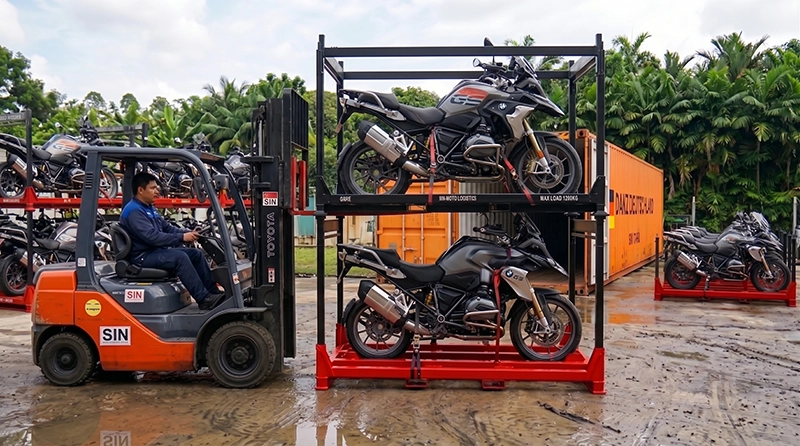
A forklift is only half the story. Many sites move loaded pallets with a hand pallet truck or a powered pallet truck, and those need a different thing than a forklift: clearance under the base for the entry rollers and steer wheels, measured from the floor up.
In the 500 kg engineering review for this pallet family, the base structure was raised 1 in (about 25 mm) and the resulting clearance under the frame was recorded at 3.75 in (about 95 mm). That gap is what lets a pallet truck nose in under a loaded motorcycle pallet instead of scraping the base or lifting it off the stack feet. It is a project record on a specific structure, so the figure to quote your own team is the one on your approved drawing — but the principle holds: pallet-truck entry is designed into the base, not left to chance.
If your handling mix includes both a forklift and a pallet truck, tell us both. A base that suits a 3,000 kg counterbalance truck and a base that suits a pallet truck with small entry rollers are not automatically the same base.
Four-Way Entry: The Aisle Usually Decides
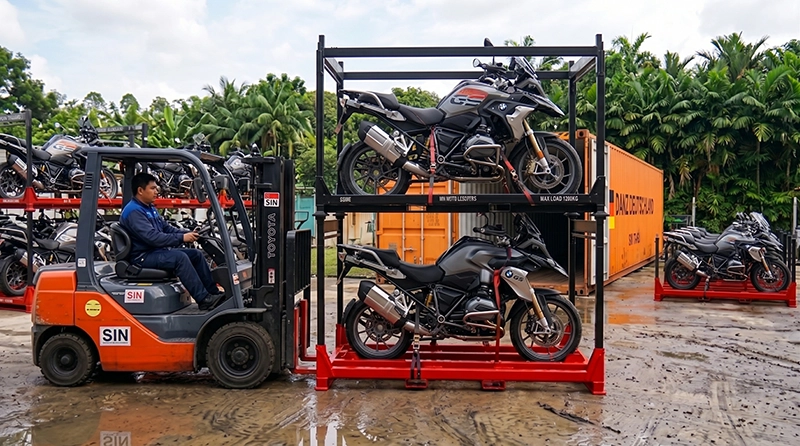
Two-way entry assumes the truck always approaches from one end of the pallet. That is fine when a rack sits nose-in to a warehouse aisle. It stops being fine when the same pallet has to be loaded into a trailer from the side, or when a container door is too narrow to line the truck up square.
In the cross-border freight project (reference 15575), the buyer asked for four-way entry so their trucks could pick from either the long side or the short side depending on where the trailer was spotted. To make the long-side channels usable, the overall pallet width was brought in to 750 mm, which left roughly 150 mm of fork channel on each side of the base. That is the trade-off in one sentence: four-way entry costs width, and width is exactly what a motorcycle envelope wants.
Practically, four-way entry is worth specifying when handling direction actually changes during the trip — yard to trailer, trailer to container, container to storage. If every move on your site is end-on, two-way entry keeps more of the pallet width for the bike.
Can My Forklift Pick It? The Six Numbers We Need
There is no way to answer the question from a truck’s brand name alone. Send these six inputs and the interface can be checked against the drawing instead of guessed:
- Fork blade thickness and width, measured at the heel, not from a brochure.
- Fork spread: the centre distance between blades, and whether it is fixed or adjustable.
- Rated capacity at the load centre you will actually use with a loaded motorcycle pallet.
- Entry type: forklift only, hand pallet truck, or powered pallet truck, including roller and wheel dimensions.
- Handling direction: end-on only, or side entry needed at trailer or container loading.
- Site constraints: aisle width, trailer deck height, and maximum stack height in the storage bay.
Fork Entry Is Not a Force Fit
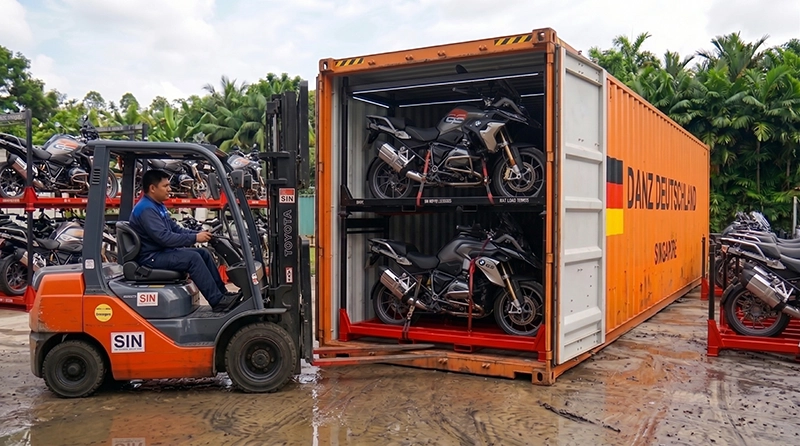
If the forks do not enter with clearance, the pallet or the interface is wrong — the answer is a drawing change, never a bigger run-up. Forcing blades into a tight channel distorts base members and loads welds in a direction they were not designed for, and the damage often shows up as a bent base rail long after the bike has been delivered.
Operators should lift smoothly, stop if a blade catches, and inspect base members, upright posts, bolts and pins before each loaded move. Where racks are stacked, confirm the stack feet are properly seated on the lower posts before the truck is withdrawn. Working load, fork channel size and stack layer count are frozen on the approved drawing for each project; this page does not publish a series load table, because a number taken out of context is how overloads start.
Where This Setup Does Not Fit
An open steel motorcycle pallet is not an enclosed shipping crate, and it is not the right answer for every fleet. If bikes must travel weather-tight for weeks, or if the site cannot guarantee that only trained operators handle the empty racks, the interface discussion is premature. It also does not fit where the aisle is too narrow for a loaded pallet to be turned at all, or where a mixed rental truck fleet changes every week and no single interface can be guaranteed.
Within those limits, the base can be configured around your equipment: openings and centre spacing to your forks, a raised base for pallet-truck entry, two-way or four-way entry depending on loading direction, and stacking posts when the storage bay needs height rather than floor area. Related reads: how the same base is reinforced for multi-level loading in the reinforced motorcycle pallet rack review, how footprint is set for mixed bike lengths in the universal footprint guide, and how uprights fold away on the return leg in the flat-folding return shipping article.
Motorcycle Pallet Handling FAQ
What fork opening does an Mtrack motorcycle pallet use?
Recorded project openings are 175 x 75 mm, 188 x 89 mm and 200 x 69 mm, with centre spacing set per truck. One club project used a 200 x 69 mm opening at 820 mm centres. The opening on your order is confirmed on the drawing against your own forklift.
Will a pallet truck lift a loaded motorcycle pallet?
It can, when the base is raised for entry clearance. In the 500 kg review the base was lifted 1 in and about 3.75 in of clearance was recorded under the frame. Confirm your pallet truck’s entry roller height and the loaded weight before relying on that arrangement.
Can the rack be made narrow enough for four-way entry?
Yes, with a width trade-off. In the freight project (15575) the overall width was pulled in to 750 mm to leave around 150 mm of fork channel per side for side entry. Check the resulting platform against your longest and widest motorcycle before approving that route.
Is there a standard load rating for this rack?
No. Recorded project design loads are 250 kg, 350 kg and 500 kg depending on the scheme, and the working load is frozen on the approved drawing. Tell us the bike weight and handling method and the base, posts and interface are sized together.
Send Your Forklift, Get the Interface Drawn
The fastest way to close this out is to send your forklift make and model, the measured fork thickness, width and spread, your pallet truck entry dimensions if you use one, and how the loaded pallet is turned at the trailer or container. With those inputs the fork openings, centre spacing, base height and entry direction are drawn together with the motorcycle envelope, and you get a pallet you can check against your own truck before anything is built. The full configuration range is on the foldable motorcycle pallet rack page.
Need a Custom Storage Solution?
Speak directly with our technical engineers. We offer free structural designs, heavy-duty catalog evaluations, and quick B2B price quotations.
Request a Quote Now →