
Every export cycle starts with the same purchase: another crate. A wooden motorcycle crate is quoted by surface area, around CNY 90 per square metre as a project reference, and it is consumed on the way out. It protects one bike once, then it is landfill, broken panels or a stack of scrap waiting for a skip. Nothing about it comes back to you.
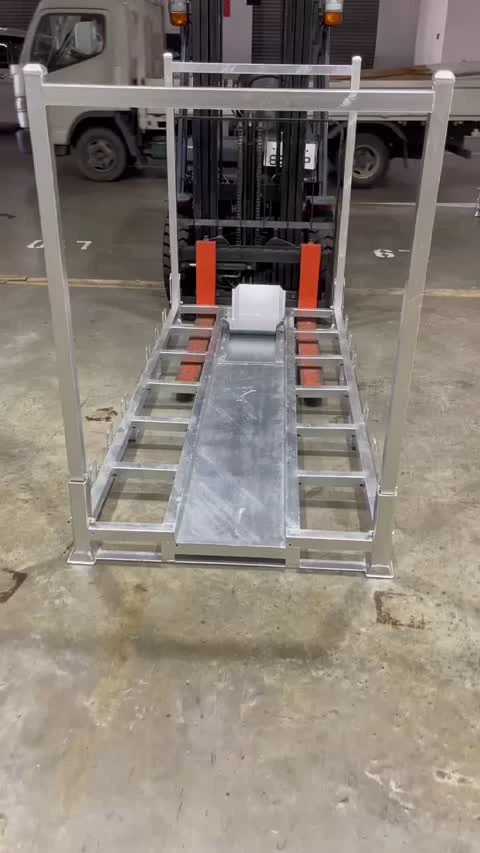
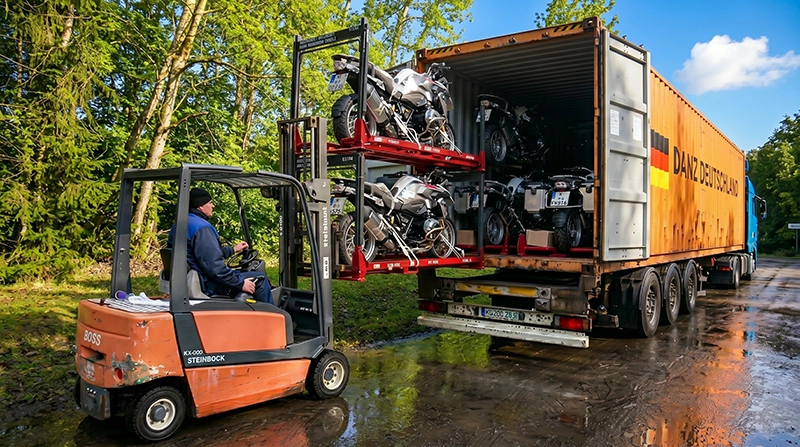
A reusable motorcycle shipping rack is bought once and works the next shipment too. The Mtrack steel pallet carries the bike as a forklift-handled unit, stacks under a second layer when the structure allows it, and comes home as a folded or knocked-down base instead of an empty box. The argument is not that steel is stronger than wood. The argument is that one of the two is thrown away after every trip.
What a disposable wooden crate really costs per shipment
The CNY 90 per square metre reference is a panel-area price, so the invoice arrives with the geometry of your crate: the bigger the bike and the more clearance you want around it, the more square metres of board, batten and blocking you buy. Then the crate is used — once. If the destination dealer damages a panel during opening, the crate is finished even if the bike arrives clean.
There are three costs hiding behind that single invoice. The first is repeat buying: ten shipments means ten crate purchases, ten sets of labour hours and ten removal costs at the far end. The second is packaging cube and mass, which eat into what you can load. Third is the treatment and documentation burden that solid-wood packaging carries in many markets — check the entry rule for your destination, because it applies to the crate, not to the motorcycle.
Where the reusable rack changes the arithmetic
Mtrack is a steel motorcycle pallet, not a model-numbered catalogue item. Wheel groove, ramps, front-wheel locating or clamping, U-shaped strap hooks, fork entry in two or four directions and stackable posts are configured against your bike envelope, your forklift and your container or trailer limits. That configuration is what makes reuse practical: the rack locates the same bike the same way on cycle one and on cycle forty.
The empty leg is where a fixed rack would lose the case. With fold-down posts, plug-in uprights, or one folding side plus one removable side, the loaded rack goes out as a full unit and comes back as bases plus bundled posts. One recorded project nested 12 empty racks into a 2,490 mm column. That is a project record, not a standard, but it shows how the return leg is plannable rather than a wall of empty crates.
- The rack is used again: the same unit absorbs the next bike, the next container, the next season.
- Empty return is designed: fold or pull-out uprights turn height into a compact base stack.
- Handling is repeatable: fork openings, wheel position and strap points stay identical cycle to cycle.
- Damage is inspectable: posts, pins, welds and base members can be checked and repaired, unlike a crushed board.
How many racks fit: 40HQ and 20ft figures that move with the project
On the loaded leg, recorded Mtrack schemes land at 72, 88 and 90 racks in a 40ft high cube, and 28, 32, 35 or 56 in a 20ft container. A further recorded scheme reached 135 racks in a 40HQ with a different rack size and a different loading direction. Read those numbers the way we do: as project outcomes, not as a series specification. Rack footprint, post type, folding, wheel chocks, packaging and the direction the bikes are loaded all move the count.
This is also why we will not convert a crate into a rack on paper. A crate is a one-way package measured in square metres; a rack is an asset measured in cycles. There is no fixed equivalence factor between them, and quoting one would only hide the variables that decide your real cost. The container quantity is confirmed against the final approved packing, together with the drawing.
The cost lines that actually change
| Cost line | Disposable wooden crate | Reusable steel motorcycle rack |
|---|---|---|
| Purchasing pattern | Bought again every shipment | One capital unit, reused each cycle |
| Reference price basis | About CNY 90 per square metre of panel | Quoted per rack from the approved drawing |
| After delivery | Consumed, not recovered | Recovered as folded frame or bases plus posts |
| Empty return leg | Nothing to return | Designed return volume, confirmed per project |
| Repeat handling | New build, new fit each time | Same fork entry, wheel position and strap points |
Recorded project working loads sit at 250, 350 or 500 kg per pallet, subject to design review, and reference tare weights run 70 to 108 kg. Those ranges exist because the rack is engineered, not selected from a list. Your working load, layer count and finish are frozen on the drawing, and any saving figure only becomes real after that — which is the honest limit of this article. How much a return leg saves depends on distance, carrier tariff, container utilisation and how many racks you can recover per trip. We will not publish a percentage we cannot support for your lane.
When the wooden crate is still the right answer
A reusable rack is a closed-loop decision, and some shipments are not a loop.
- One-way export with no return path: nobody is shipping the rack back, so it becomes an expensive crate.
- Very low frequency: a single bike every few years does not earn a steel asset.
- No forklift or handling partner at destination: a crate can be broken down on site, a rack needs equipment to move.
- Long unsheltered storage: rain standing inside hollow sections can start internal rust, so covered storage or an agreed finish is required.
If two or more of those apply, buy the crate and put the budget into protection instead. If your bikes come home, keep reading.
What to send us for a shipment-based cost scheme
We quote from your shipping pattern rather than from a price list. Send the number of shipments per month or per season, the container type you load (20ft, 40ft, 40HQ), your motorcycle envelope and weight, whether the rack returns to you or to the dealer, the destination market, and how the loaded rack has to be handled at both ends.
With those inputs we can size the rack, fix the folding or removable arrangement for the return leg, and confirm the container count on the approved packing instead of a guess. Start with the foldable arrangement in flat-folding motorcycle rack for low-cost empty return shipping, the loading plan in nesting motorcycle shipping rack for 40ft container loading, or the full configuration in all-in-one foldable motorcycle rack for load, stack and return logistics.
FAQ
Is a reusable motorcycle rack cheaper than a wooden crate from the first shipment?
No, and we will not claim it. The crate is a smaller one-off invoice; the rack is a capital unit that pays back over cycles. The break-even point depends on your shipment frequency, how many racks you recover per return trip and the freight rate on that lane, so it is calculated per project.
Can you tell me exactly how many racks fit in my container before I order?
We can commit to a figure once the rack dimensions, post or folding arrangement, wheel chocks, packing method and loading direction are fixed. Recorded schemes of 72 to 90 racks in a 40HQ and 28 to 56 in a 20ft show the spread that those variables create, not a promise for your cargo.
What happens to the racks on the return leg?
The uprights fold, pull out, or one side folds while the other detaches, so the empty racks travel as bases plus bundled posts. One recorded project nested 12 empty racks into a 2,490 mm column. The exact arrangement, stack height and recovery ratio are agreed on the drawing before production.
Need a Custom Storage Solution?
Speak directly with our technical engineers. We offer free structural designs, heavy-duty catalog evaluations, and quick B2B price quotations.
Request a Quote Now →