
All-in-One Foldable Motorcycle Rack for Load, Stack and Return Logistics
Mtrack is a foldable steel motorcycle rack configured to your cargo envelope, unit weight, stacking level and forklift: plug-in uprights, four-way fork entry, folded empty return. No universal load rating — every configuration is calculated per project.
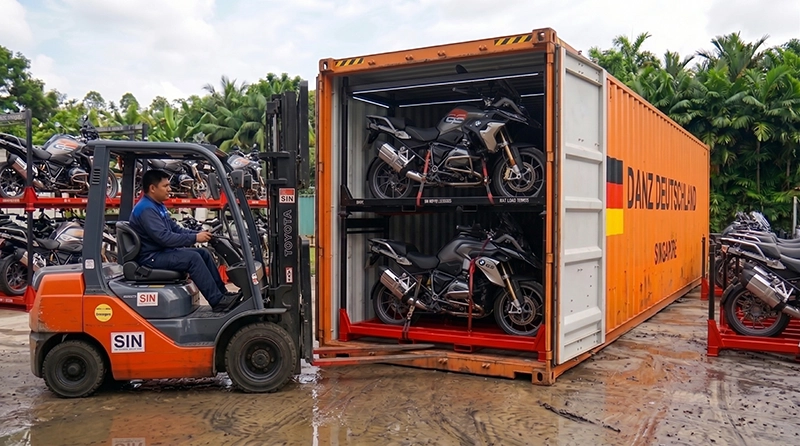
Not sold by model number: the rack is built around your bike and your forklift
Mtrack is a foldable steel shipping rack for motorcycles and other large, awkward cargo. You give us the cargo envelope, the unit weight, the stacking level you need and the way your forklift enters — the rack is engineered to that combination.
That makes Mtrack a project-configured product rather than a catalogue item. There is no series-wide rated capacity and no published rating table: the frame, the wheel location, the fork channels and the uprights follow your vehicle and your handling equipment, and the load figure is fixed on the approved drawing for your configuration. Mtrack is not a static storage rack, not a general-purpose flat pallet and not a closed motorcycle shipping crate. Typical jobs include a motorcycle club moving event bikes, a dealer exporting a batch, an overseas warehouse or freight forwarder consolidating units, and project teams turning over military or telecom equipment.
- Plug-in or removable uprights: stack while loaded, pull them off when empty
- Folding structure that cuts empty-return volume and idle storage footprint
- Two-way or four-way fork entry, set to your fork width and lift height
- Wheel slot and front-wheel location, with an optional wheel clamp where the project needs it
- Tie-down points on both sides of the frame so the bike and rack move as one unit
- Ramp-assisted loading, so the bike rolls into position instead of being lifted in
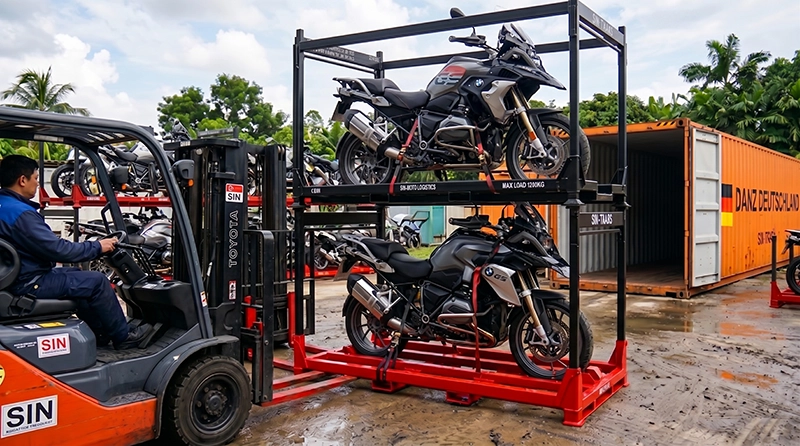
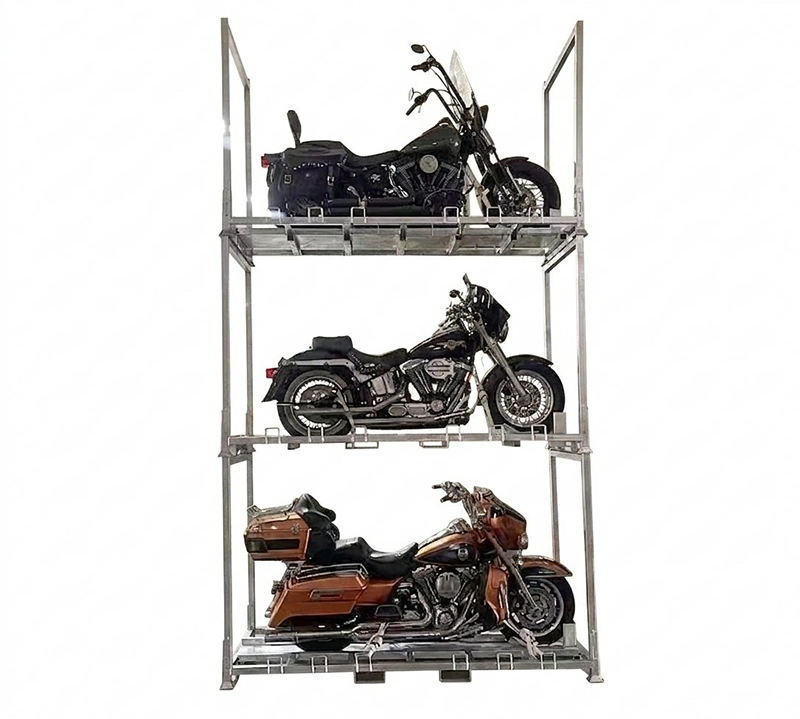
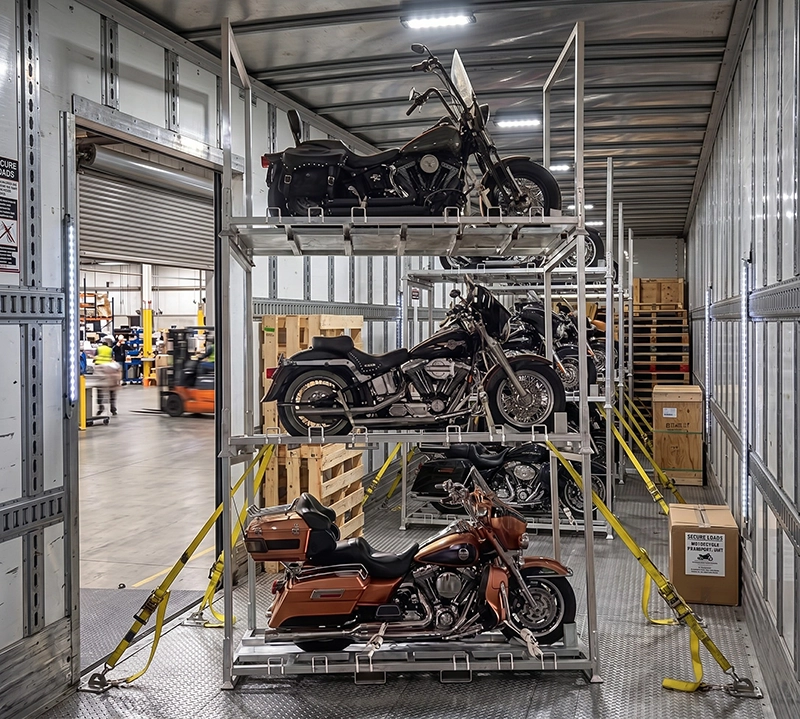
Three decisions drive the drawing: the stack, the fleet and the restraint
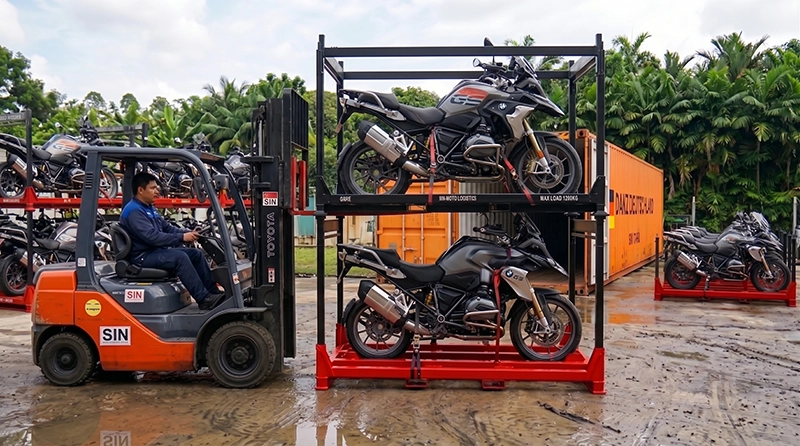
Stack & load
Plan the stack, then the container
Loaded stacking and container loading are planned together, because the bike height decides both. One engineering record works to a maximum total stack height of about 6 m with four levels recommended, and its 20 ft and 40HQ counts move with rack size, folding state, accessories and loading direction. Your layer count and loading plan are recalculated from your drawing.
Layers: 4 levels recommended on that project
Container quantity: project-based, not fixed
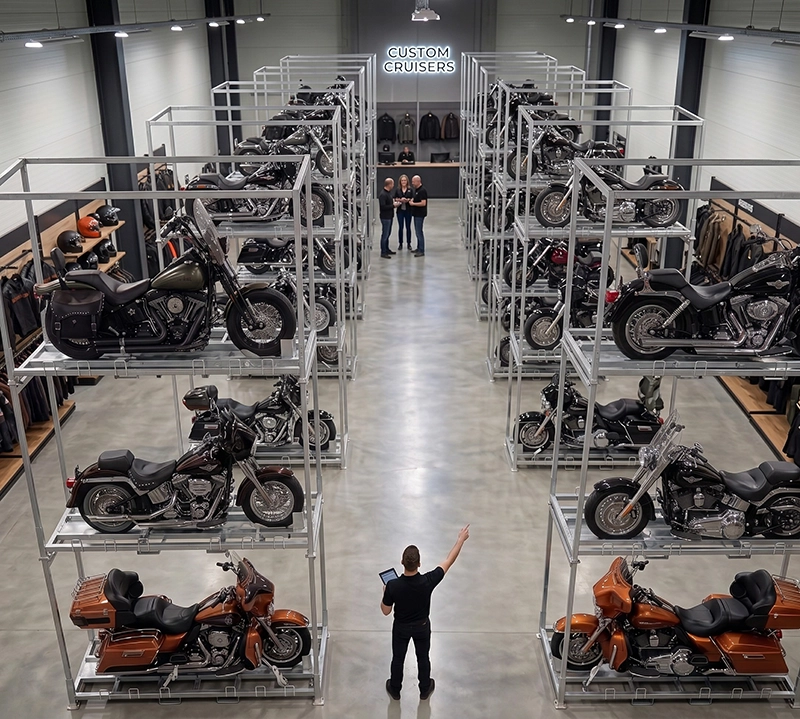
Mixed fleet
One rack for the fleet, or two sizes
When small and large bikes share a fleet, one rack can be sized around the largest machine — recorded project references run up to about 2,380–2,410 mm long and 1,000 mm wide — provided the small bike is allowed to sit inside that envelope. A two-size split is the honest alternative when the spread is too wide, or when overhang is not acceptable in storage.
Option A: single size around the largest bike
Option B: two sizes, small and large
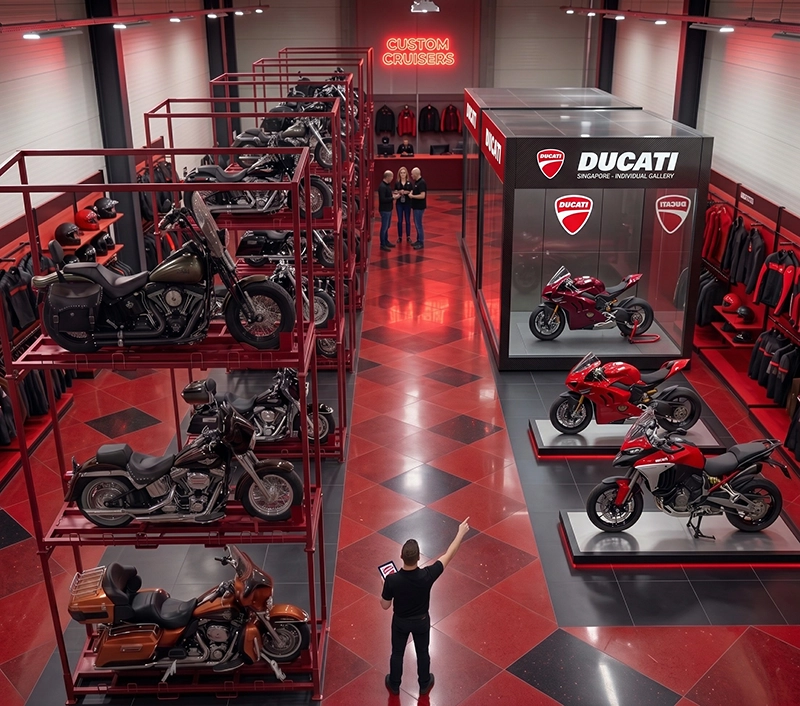
Restraint
Front-wheel clamp and tie-down points
Restraint is chosen for the journey, not for the brochure. A configuration can carry a handwheel-controlled front-wheel clamp, two-sided U-shaped tie-down hooks and ramp-assisted loading; another project keeps only basic wheel location and relies on straps. Clamp type, hook count, positions and centre distances are confirmed per project.
Tie-down points: both sides, count per drawing
Ramp: included where loading needs it
Engineered per project, foldable when empty, honest about limits
Built from your data, not a size list
Frame, wheel slot, fork channels and uprights follow the cargo envelope, the unit weight, the stack policy and the forklift. Two buyers with the same bike can still need different racks, because the handling and the storage are different.
Uprights you can take off
Plug-in or removable uprights carry the stacking load when the racks are loaded. Empty, the uprights come off or the structure folds, so the return leg and the idle storage bay take far less volume than the same racks erected.
One unit from factory to container
Two-way or four-way fork entry lets the same loaded rack travel from the assembly area to the warehouse and into the container without the bike being re-loaded. Fork entry dimensions and centre spacing are set per project.
A stated boundary, not a marketing number
We do not publish a universal rated load or a series safety factor, because none exists for a configured product. Load, layer count, finish and packing are confirmed on the approved drawing, and every order is reviewed against that drawing.
Four inputs turn into one approved drawing
Send the cargo data
Maximum and minimum bike length, width and height, wheelbase, tyre or wheel size, and the unit weight of the heaviest machine. Say whether the bike is allowed to overhang the base, and whether that is acceptable in storage as well as in transit.
Confirm the handling
Fork direction — two-way or four-way — plus fork width and thickness, lift height, and the aisle and rack clearance at your site. This is what fixes the fork channels and the base structure of the rack.
Fix the stack and the journey
Target number of layers, maximum total stack height, floor condition, and the internal dimensions and loading direction of the 20 ft, 40HQ, trailer or existing rack the units must fit. State whether the container is loaded with bikes on the racks or with empty racks.
Approve the drawing, then build
The frame, uprights, wheel location, tie-down points, finish and packing are frozen on the drawing. Only at that point is the load figure for your configuration fixed — not before, and never as a series-wide number.
What buyers ask before they send a drawing
Is Mtrack a standard SKU with one load rating?
No. Mtrack is configured, so there is no series-wide rated capacity and no published safety factor. The load for your rack is calculated from the frame, the cargo envelope, the stacking level and the handling method, and it is confirmed on the approved drawing.
Can I stack loaded racks?
Yes, when the project confirms it. The upper unit’s feet must seat fully on the lower unit’s uprights, and the layer count and total height are limited by the frame, the bike height, the floor and the transport equipment. One engineering record works to a maximum total stack height of about 6 m with four levels recommended — that is one project record, not a series standard.
What happens to the racks on the empty return leg?
Empty racks fold, or their uprights are pulled out, so a batch of empties occupies far less volume than the same racks erected. How much you save depends on rack size, folding state, whether accessories such as wheel clamps stay fitted, and how the batch is packed and strapped.
How many racks fit in a 20 ft or a 40HQ container?
There is no single number. Recorded empty-rack projects run from roughly 28 to 56 units per 20 ft and about 72 to 140 units per 40HQ, and those figures move with rack size, folding state, accessories, packing and loading direction. The count for your order is recalculated from your drawing, not copied from a table.
What is Mtrack not suitable for?
It is not a closed motorcycle shipping crate, not a general-purpose flat pallet and not a static shelf. Carrying two motorcycles on one rack is a function our engineering record marks as not currently achievable. Long-term unsheltered rain exposure is also outside the standard recommendation, because water standing inside the tube can rust from the inside and run out at the joints.
What if I only want one fixed size?
Say so in the enquiry. A single size built around your largest bike can be quoted. For a mixed fleet we will show the single-size option and the two-size split side by side, so you can judge which one fits your storage bays and your loading plan before you commit.
Related reading: forklift clearance and fork entry planning for a motorcycle shipping rack · foldable or fixed rack for overseas shipping
B2B Racking Structural Engineering Calculator
Input your structural guidelines below. Our math system calculates material deflection, stress bounds, and recommends optimal profiles.
Click Compute to calculate stress factors and display structural drawing recommendations.