
More than 200 motorcycles in one hall is not a display problem. It is a floor space and retrieval problem. In project 15385, the motorcycles stood flat on the hall floor, each machine taking up its own footprint plus the clearance needed to walk around. The floor filled up, and pulling out a motorcycle in the middle of the room meant first moving the machines around it. Nothing was broken — the storage method simply no longer scaled.
Fitting substantially more motorcycles into the same building means changing the storage unit. A motorcycle pallet rack places a motorcycle on a steel base, gives the forklift a defined pick-up point, and allows these units to be stacked. This article explains how the density is actually created, where the limits lie, and what must be measured before a layout is drawn.
Why flat-floor storage exhausts the space long before the hall is full
Every motorcycle parked on the floor consumes more space than its own footprint. You need a walkway to reach it, a turning area to push it out, and a clear route to the door. In a large collection, these clearances multiply: several hundred machines, each occupying slightly more than one square meter of body area, can take up two to three times that in the aisles. The result is a room that looks full of motorcycles and yet offers no practical way to reach most of them.
The second cost center is retrieval. When motorcycles stand on the floor, the machine at the very back is behind everything in front of it. Every request becomes moving three or four other motorcycles, and the risk of a tip-over or a scratched fairing increases with every movement. Storage density and retrieval speed are the two metrics that determine whether a large collection is manageable, and both are determined by the type of motorcycle support, not by the size of the room.
One universal rack size instead of one design per motorcycle
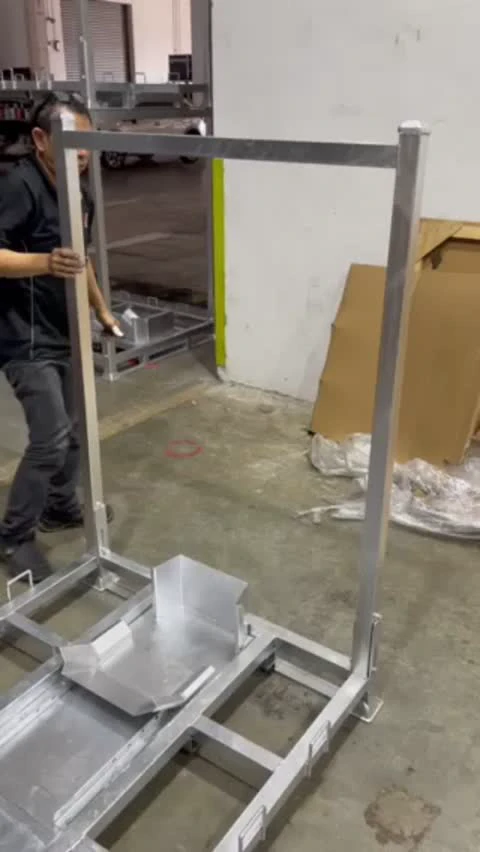
A mixed collection is the difficult part: a small single-cylinder motorcycle and a fully equipped tourer do not have the same footprint. In project 15385, this was solved by defining a universal rack size around the largest machine. The rack measured 2320 x 1050 x 1400 mm, weighed 88 kg, carried a documented payload of 350 kg for this project, and accommodated motorcycles up to 2270 x 850 x 1300 mm, which covered the largest motorcycle in this collection. The length-to-width ratio of 2320 x 1050 mm also loaded well into containers.
Fork access was part of the same design: a fork opening of 188 x 89 mm on a center spacing of 685 mm, dimensioned for motorcycles with a maximum height of 1300 mm. Smaller motorcycles are then loaded into the same steel base, so the storage system carries one motorcycle shipping pallet type instead of a special frame for each model. These values are project values, not a standard table — other documented Mtrack concepts use different external dimensions, dead weights, and payloads (250 kg, 350 kg, or 500 kg in named projects), and the final envelope is defined on the approved drawing.
Where the density comes from: levels above the same footprint
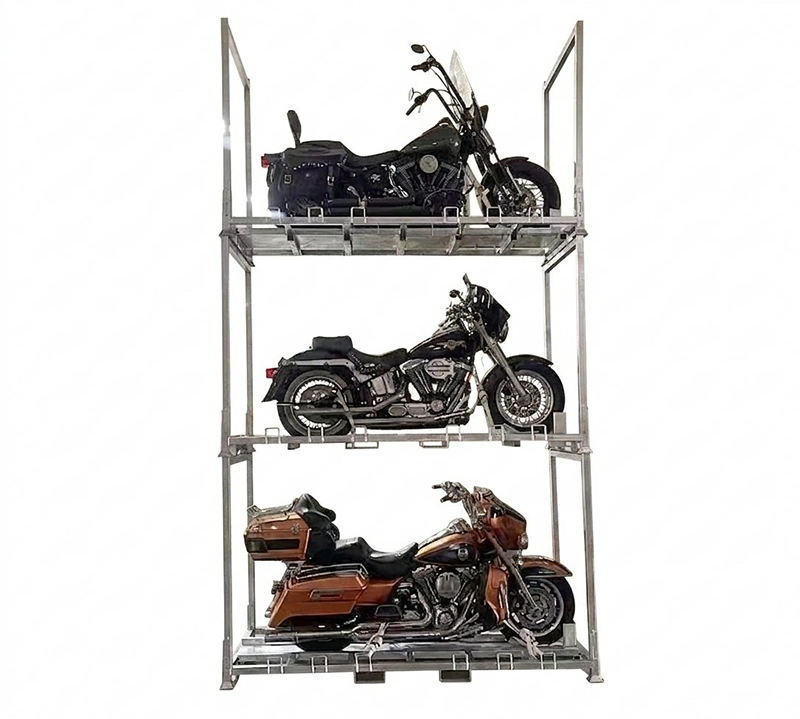
Stacking is the whole point of motorcycle pallet rack storage. A rack that holds one motorcycle at floor level and again at 1.4 m, 2.8 m, and 4.2 m turns one parking position into four. An Mtrack engineering record recommends a total stack height of no more than 6 m with four levels at this rack height; other projects specify three levels or two tiers for transport only. The number is never a catalog constant, because motorcycle stack storage depends on the clear hall height, the load-bearing capacity of the floor, the rack height, the height of the motorcycles themselves, and the aisle the forklift needs to place the upper units.
The density also depends on which motorcycles stand where. Frequently used motorcycles belong on the lower levels, where they can be retrieved without touching the stack; long-term stored or display machines can live on top. Motorcycles taller than the fork entry specification for a given design (1300 mm in the 15385 configuration) require a separate height check before being assigned to a level.
Retrieval: stacking only works if a single motorcycle can be retrieved independently
Density that cannot be accessed is just a pile. The Mtrack base is designed for picking up a motorcycle rather than general cargo: a wheel guide, a loading ramp, front-wheel positioning or clamping options, and U-shaped tie-down hooks so that the motorcycle is secured to its own rack rather than to its neighbors. On the 15385 racks, the tie-down hooks sit on both sides, so a machine can be strapped down from either side of the aisle.
Because the motorcycle and its base are transported together as one forklift-handleable unit, taking out a motorcycle means lifting that unit, not rearranging the row. That is the practical difference between a stacked collection and a flat one: the machine in the middle of a row can be retrieved without moving anything else, as long as the stacking order and the aisle were designed for it.
Where empty racks create space again
Eine Sammlung, die ständig wächst, kauft auch ständig neue Regale, und leere Regale sind totes Volumen, wenn die Pfosten stehen bleiben. Beim 15385-Design klappen die Pfosten nach innen, wodurch das leere Regal für die Lagerung und für den Leertransport kompakt zusammengefaltet werden kann. Steckbare Stützen sind die andere Variante, die bei Mtrack-Projekten verwendet wird: Die Pfosten werden aus dem Sockel gezogen und als Bündel transportiert. In beiden Fällen besteht die leere Einheit aus einem Sockel plus Pfosten statt aus einem Regal in voller Höhe.
Die gleiche Geometrie bestimmt auch die Container-Stückzahlen. Die 15385-Aufzeichnung zeigt 35 Regale in einem 20-Fuß-Container und 88 in einem 40-Fuß-High-Cube-Container. Andere Mtrack-Aufzeichnungen reichen von 28 bis 56 Sets in 20-Fuß-Containern und 72 bis 140 in 40-Fuß-High-Cube-Projekten, da die Anzahl je nach Außenmaßen, Klappmechanismus, Pfostentyp, Radauflagen, Verpackung und Beladungsrichtung variiert. Die Containermenge wird für die jeweilige Konfiguration berechnet, nie als feste Zahl angeboten. Die Verpackung ist die andere Variable: Stretchfolie plus Umreifung verursacht keine zusätzlichen Verpackungskosten, schützt aber den Lackfilm im Transport nicht vollständig, während eine Holzkiste – bei einem Projektreferenzpreis von ca. CNY 90 pro Quadratmeter – dies tut. Kaltverzinkung mit ca. 10 μm oder Pulverbeschichtung sind die bei Mtrack-Projekten dokumentierten Oberflächenoptionen; eine Feuerverzinkung wird für die referenzierte Konstruktion nicht empfohlen, da die Hitze sie verformen kann.
Wenn ein stapelbares Regal die falsche Lösung ist
Stapeln ist die richtige Entscheidung für eine Sammlung oder Händlerbestände, die auf einem festen Boden unter einem hohen Dach stehen und per Gabelstapler bewegt werden. In mehreren gängigen Situationen ist es jedoch die falsche Wahl, und es ist besser, diese vor der Bestellung zu kennen:
- Kein Gabelstapler oder Schmalgangstapler und keine Pläne, einen einzusetzen: Der gesamte Dichtevorteil beruht auf mechanischer Handhabung, daher verliert eine von Hand getragene Motorrad-Transportpalette ihren größten Nutzen.
- Geringe lichte Höhe oder eine abgehängte Decke: Jede Ebene muss unter das niedrigste Hindernis passen, und vier Ebenen sind nicht immer möglich.
- Nicht bestätigte Bodenbelastbarkeit: Stapelregale konzentrieren die Last über die Füße, daher müssen Bodenplatte und Punktlasten geprüft werden, bevor das Layout festgelegt wird.
- Motorcycles outside the confirmed dimension or load range: machines longer than approx. 2410 mm, wider than approx. 1000 mm, or heavier than the projected payload require their own structural verification.
- Long-term unprotected outdoor installation: rain can collect in hollow tubes and cause internal rust, so a covered installation or a suitable rain protection cover is required.
- A collection that requires air conditioning, or irreplaceable machines that must never be lifted by forklift: a pallet racking is primarily a handling system, and these requirements belong to a different storage decision.
Where stacking does not fit, the alternatives are a permanently installed multi-level motorcycle storage rack in the same building or placing the machines on the floor. Both still require the same checks regarding aisle width, floor capacity, and access.
What we need before we draw your collection layout
Storage quantity, number of levels, and rack size are all derived, so the layout work begins with your figures, not ours. Send us the following information, and the first drawing can be a binding one:
- Motorcycle list: model, length, width, height, and weight, with the largest and smallest machine identified.
- Building: clear height, floor construction and load limit, column grid, door sizes.
- Handling: forklift, pallet truck, or narrow-aisle forklift and the direction from which the forks can enter.
- Stacking plan: desired number of levels, maximum permissible overall height, and who places the upper units.
- Securing: whether you need front wheel clamping, wheel supports, or additional strap points, and on which motorcycles.
- Posts and return transport: folding or plug-in supports and what happens to the empty racks.
- Surface, packaging, quantity, and delivery date.
Questions that collectors, clubs, and dealers ask before ordering
How many motorcycles actually fit in my hall?
This is a layout calculation, not a product specification. Take the usable floor area, subtract the aisles the forklift needs, divide by the rack footprint, and multiply by the confirmed number of levels. In project 15385, this logic produced a workable plan for a collection of more than 200 motorcycles with a single universal rack size — a single result, not a capacity promise for another hall or another rack size.
Does the 350 kg figure apply to my motorcycles?
No. 350 kg is the payload documented for the 2320 x 1050 x 1400 mm rack in project 15385. Other Mtrack projects were designed for 250 kg, 350 kg, or 500 kg, and one customer requirement was 1,000 lb. We size the rack to your heaviest motorcycle and confirm the payload on the released drawing.
Can the racks be stacked four high anywhere?
Only where structure, floor, and motorcycles allow it. One Mtrack record recommends a total stack height of 6 m or less at four levels; other projects use three levels or two-tier transport. Clear height, floor capacity, rack height, and motorcycle height determine the number for your site.
If your collection, club store, or dealer is running out of floor space and losing patience with fetching bikes, start with the motorcycle list and building dimensions. We come back with a rack size, a tier count, and a layout — plus the container count for the first shipment — and a clear answer on whether a fixed rack arrangement fits your site better. For the universal-footprint configuration used at the 200-motorcycle collection, see the universal-footprint motorcycle rack; for a rack that also folds for empty return transport, see the folding motorcycle rack for loading, stacking, and return logistics; and for container math, see nestable motorcycle shipping racks in a 40-foot container.
Benötigen Sie eine individuelle Lagerlösung?
Sprechen Sie direkt mit unseren technischen Ingenieuren. Wir bieten kostenlose Strukturplanungen, Bewertungen von Hochlast-Katalogen und schnelle B2B-Preisangebote.
Jetzt Angebot anfordern →