
Over 200 motorcycles in a single warehouse is not an exposure problem. It is a floor space and retrieval problem. In project record 15385, the bikes were parked on the warehouse floor, each machine taking up its own footprint plus the clear space needed to walk around it. The floor filled up, and pulling one bike out of the middle of the room meant moving the machines around it first. Nothing was broken — the storage method had simply stopped scaling.
Making the same building hold far more bikes means changing the unit of storage. A motorcycle pallet rack puts one motorcycle on a steel base, gives the forklift a defined way to lift it, and lets those units be stacked. This article explains how the density is actually created, where the limits are, and what needs to be measured before a layout is drawn.
Why flat floor storage runs out of room long before the building is full
Every motorcycle parked on the floor consumes more space than its own silhouette. You need clearance to walk to it, clearance to maneuver it out, and a clear route to the door. In a large collection those clearances multiply: a few hundred machines that take up just over a square meter of bodywork each can hold two or three times that in aisle. The result is a room that looks full of motorcycles and still leaves no practical way to reach most of them.
The second cost is retrieval. When bikes are on the floor, the machine at the back sits behind everything in front of it. Every request becomes moving three or four other motorcycles, and the risk of a tip-over or a scratched fairing rises with every move. Storage density and retrieval speed are the two numbers that decide whether a large collection is manageable, and both are set by how the bikes are cradled, not by the size of the room.
One universal rack dimension instead of a per-motorcycle design
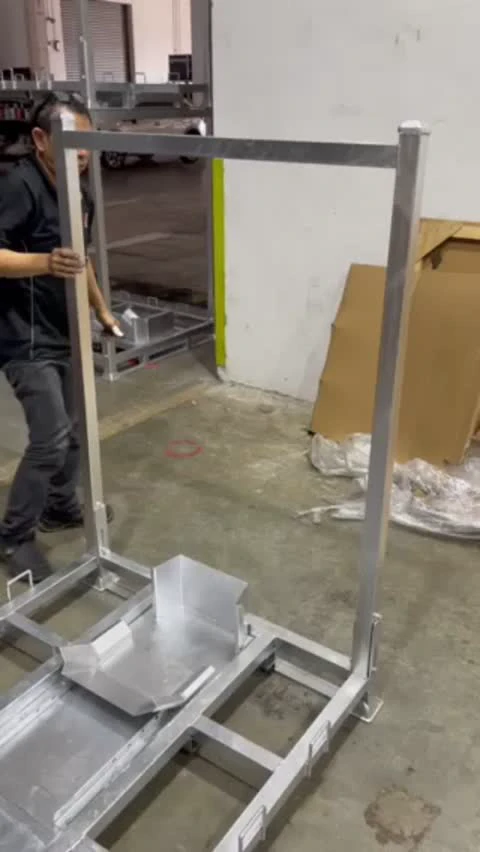
A mixed collection is the hard part: a small single-cylinder bike and a fully equipped tourer do not share the same footprint. Project 15385 solved this by setting a universal rack size around the largest machine. The rack measured 2320 x 1050 x 1400 mm, weighed 88 kg, had a recorded payload of 350 kg for that project, and accepted motorcycles up to 2270 x 850 x 1300 mm, covering the largest bike in that collection. The 2320 x 1050 mm length-to-width ratio also loaded well into containers.
Fork access was part of the same design: a fork opening of 188 x 89 mm with a center distance of 685 mm, sized for bikes no taller than 1300 mm. Smaller bikes then ride on the same steel base, so the warehouse runs one pallet type for motorcycle transport instead of a custom frame for every model. These values are project numbers, not a series table — other recorded Mtrack schemes use different outer dimensions, tare weights and payloads (250 kg, 350 kg or 500 kg on named projects), and the final envelope is fixed in the approved drawing.
Where the density comes from: tiers over the same footprint
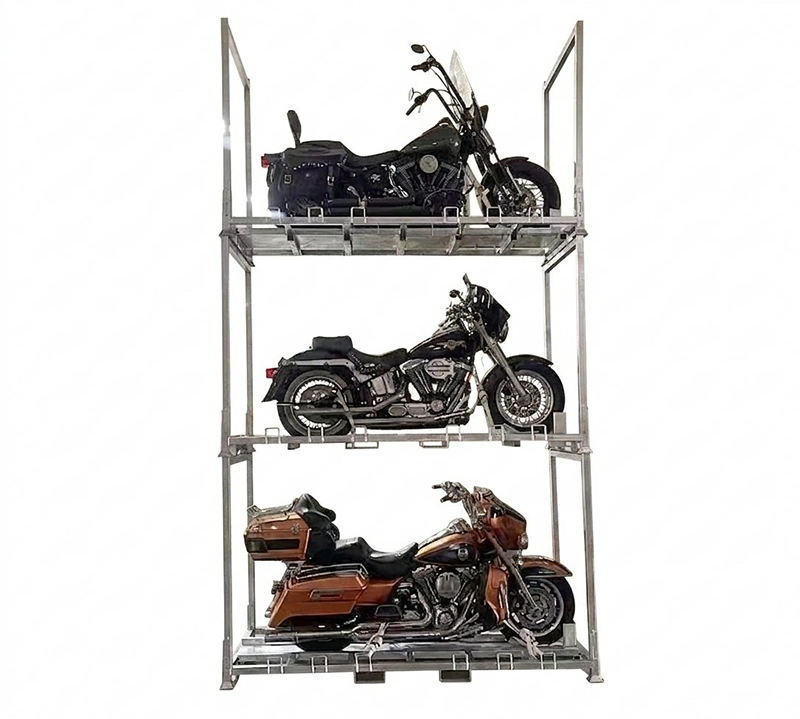
Stacking is the whole point of motorcycle pallet racking. A rack that holds one motorcycle at ground level and again at 1.4 m, 2.8 m and 4.2 m turns one parking position into four. One Mtrack engineering record recommends a total stack height of no more than 6 m with four layers at that rack height; other projects specify three layers, or two tiers for transport only. The number is never a catalog constant, because stacked motorcycle storage depends on the building's clear height, the floor load capacity, the rack height, the height of the motorcycles themselves, and the aisle the forklift needs to place the upper units.
Density also depends on which bikes go where. Frequently used motorcycles belong on the lower tiers, where they can be pulled without touching the stack; long-term or display machines can sit on top. Bikes taller than the fork entry record for a given project (1300 mm in the 15385 configuration) need a separate height check before being assigned to a tier.
Retrieval: stacking only works if a bike can come out on its own
Density that cannot be accessed is just a pile. The Mtrack base is designed around loading one motorcycle rather than general cargo: a wheel trough, a loading ramp, front-wheel locating or fixing options, and U-shaped tie-down hooks so the bike is secured to its own rack and not to its neighbors. On the 15385 racks the tie-down hooks sit on both sides, so a machine can be strapped from either side of the aisle.
Because the bike and its base travel together as a single forklift-handled unit, pulling a bike means lifting that unit, not reordering the queue. That is the practical difference between a stacked collection and a flat one: the machine in the middle of a row can be taken out without moving anything else, provided the stack order and the aisle were planned for it.
Where empty racks give the space back
A collection that keeps growing also keeps buying racks, and empty racks are dead volume if the posts stay standing. In the 15385 design the posts fold inward, which collapses the empty rack for storage and for the empty return leg. Plug-in uprights are the other route used in Mtrack projects: the posts come off the base and travel as a bundle. Either way, the empty unit is a base plus posts rather than a full-height frame.
A mesma geometria rege as quantidades em contêineres. O registro do 15385 mostra 35 estantes em um contêiner de 20 pés e 88 em um high cube de 40 pés. Outros registros Mtrack variam de 28 a 56 conjuntos em contêineres de 20 pés e de 72 a 140 em projetos high cube de 40 pés, porque a quantidade muda com as dimensões externas, o dobramento, o tipo de poste, os calços de roda, o empacotamento e a direção de carregamento. A quantidade de contêineres é calculada para a configuração, nunca cotada como um valor fixo. A embalagem é a outra variável: filme stretch mais cintagem não acrescentam custo de embalagem, mas não protegem totalmente a película de tinta durante o transporte, enquanto uma caixa de madeira, cotada em uma referência de projeto de cerca de CNY 90 por metro quadrado, protege. Galvanização a frio em torno de 10 μm ou revestimento em pó são as opções de acabamento registradas nos projetos Mtrack; a galvanização por imersão a quente é desaconselhada para a estrutura referenciada porque o calor pode distorcê-la.
Quando uma estante empilhada é a resposta errada
Empilhar é a decisão certa para uma coleção ou estoque de concessionária que fica em um piso firme sob um teto alto e se move por empilhadeira. É a decisão errada em várias situações comuns, e é melhor conhecê-las antes de fazer o pedido:
- Sem empilhadeira ou transpaleteira elétrica, e sem plano de usar uma: todo o ganho de densidade vem do manuseio mecânico, então um pallet de transporte de motocicleta carregado manualmente perde a maior parte do seu valor.
- Pé-direito baixo ou teto suspenso: cada camada tem que caber sob a obstrução mais baixa, e quatro camadas nem sempre serão possíveis.
- Carga do piso não confirmada: estantes empilhadas concentram a carga pelos pés, então a laje e as cargas pontuais precisam de uma verificação antes que o layout seja definido.
- Motorcycles outside the envelope or confirmed cargo: machines longer than about 2410 mm, wider than about 1000 mm, or heavier than the design working load need their own design review.
- Outdoor storage without long-term cover: rain can pool inside hollow tubes and cause internal rust, so covered storage or a compatible rain cover is needed.
- A collection that needs climate control, or irreplaceable machines that must never be lifted by forklift: a stacking rack is first a handling system, and those requirements belong to a different storage decision.
Where stacking does not fit, the alternatives are a fixed multi-level motorcycle storage rack in the same building, or keeping the machines on the floor. Both still need the same aisle width, floor capacity and access checks.
What we need before we design your collection layout
The amount of storage, the number of layers and the rack size are all derived, so the layout work starts with your numbers instead of ours. Send the following and the first drawing can be a real drawing:
- Motorcycle list: model, length, width, height and weight, with the largest and smallest machine marked.
- Building: clear height, floor construction and load limit, column grid, door sizes.
- Handling: forklift, manual pallet truck or electric pallet truck, and the direction the forks can enter.
- Stacking plan: how many layers you want, the total height allowed and who places the upper units.
- Restriction: whether you need front wheel fixation, chocks or extra tie-down points, and on which motorcycles.
- Posts and return: folding or plug-in uprights, and what happens to empty racks.
- Finish, packaging, quantity and delivery time.
Perguntas que colecionadores, clubes e concessionárias fazem antes de pedir
Quantas motocicletas realmente caberão no meu armazém?
É um cálculo de layout, não uma classificação de produto. Pegue o piso utilizável, subtraia os corredores que a empilhadeira precisa, divida pelo footprint da estante e multiplique pelo número confirmado de camadas. No projeto 15385 essa lógica produziu um esquema de trabalho para uma coleção de mais de 200 motocicletas usando um único tamanho de estante universal — um resultado de projeto único, não uma promessa de capacidade para outro prédio ou outro tamanho de estante.
O valor de 350 kg se aplica às minhas motocicletas?
Não. 350 kg é a carga de trabalho registrada para a estante de 2320 x 1050 x 1400 mm no projeto 15385. Outros projetos Mtrack foram projetados em torno de 250 kg, 350 kg ou 500 kg, e um requisito de cliente de 1.000 lb. Dimensionamos a estante para a sua máquina mais pesada e confirmamos a carga de trabalho no desenho aprovado.
As estantes podem ser empilhadas em quatro alturas em qualquer lugar?
Apenas onde a estrutura, o piso e as motocicletas permitem. Um registro Mtrack recomenda uma altura total de empilhamento de 6 m ou menos com quatro camadas; outros projetos especificam três camadas ou transporte de dois níveis. O pé-direito livre, a capacidade da laje, a altura da estante e a altura da moto decidem o número para o seu local.
Se a sua coleção, loja do clube ou concessionária está ficando sem espaço no chão e sem paciência com a movimentação das motos, comece pela lista de motos e pelas medidas do galpão. Nós retornaremos com o tamanho da estante, a quantidade de níveis e o layout, além da quantidade de contêineres para o primeiro envio — e uma resposta direta se um arranjo fixo de estantes é mais adequado ao seu espaço. Para a configuração de footprint universal usada na coleção de 200 motos, veja a estante para motos de footprint universal; para uma estante que também dobra para o retorno vazio, veja o rack dobrável para motocicletas para carga, empilhamento e logística de retorno; e para os cálculos de carregamento em contêiner, veja racks de envio de motocicletas encaixáveis em um contêiner de 40 pés.
Precisa de uma Solução de Armazenamento Personalizada?
Fale diretamente com nossos engenheiros técnicos. Oferecemos projetos estruturais gratuitos, avaliações de catálogos de alta capacidade e orçamentos rápidos para B2B.
Solicite um Orçamento Agora →