
What Is a Demountable Post Pallet (Derack) and When Should I Use It Instead of Wooden Pallets?
Demountable post pallet (Derack) explained: structural load via posts, 4–5 layer stacking, nestable empty return saving 75–80% backhaul space, hot-dip galvanized for ISPM 15 export. Best-fit vs. unsuitable scenarios.
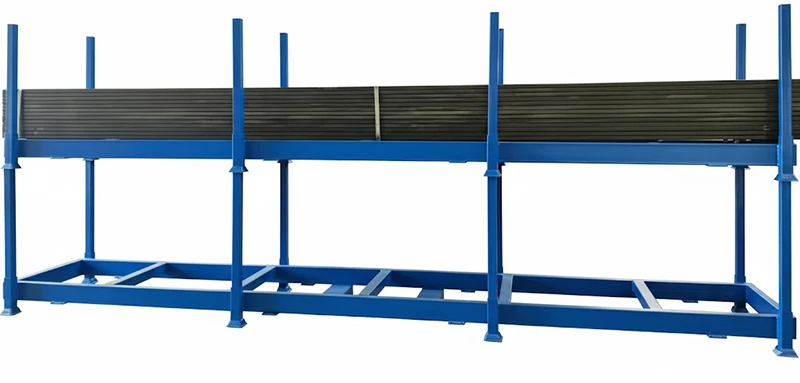
What Is a Demountable Post Pallet (Derack)?
A demountable post pallet — also called a portable stack rack, stillage, manurack or stack rack — is a hybrid load unit that sits between a flat pallet and a fixed racking system. Derack is the engineering name we use for this category: a welded steel base frame with four (sometimes six or eight) detachable upright posts that lock into the base and carry the load of every stacked level above.
Instead of asking the bottom layer of cargo to carry the weight of the layers above it, Derack transfers that vertical load through the steel posts directly to the warehouse floor. The bottom layer of product sits inside a three-dimensional zero-pressure cage, protected from crush, deformation, sintering and ground moisture while the unit stacks 4–5 levels high inside a 6–8 m clear warehouse height.
- Structural load-bearing replaces cargo load-bearing — posts route upper-tier weight to the floor
- Detachable posts enable 4:1 to 6:1 nesting for empty return freight (about 75–80% savings per leg)
- Hot dip galvanized steel passes ISPM 15 without fumigation and resists cold-store corrosion
- No bolting, no floor anchoring — layout changes with seasonal batches
- Engineered base variants for tires, long pipes, fabric rolls, feed & fermentation bags, sheet panels
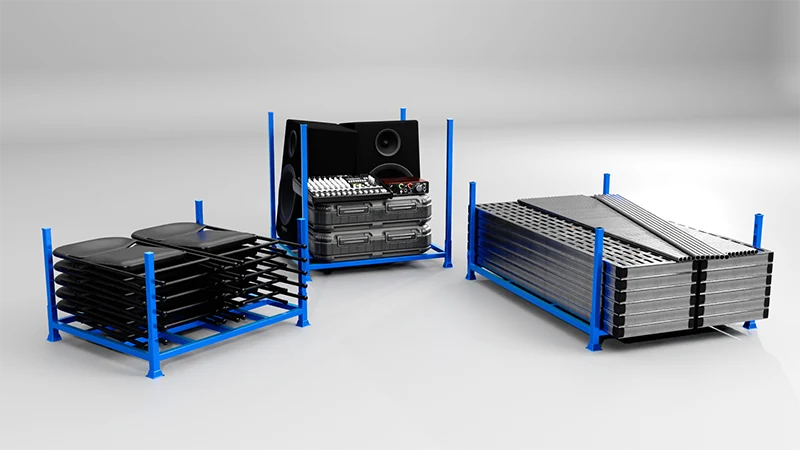
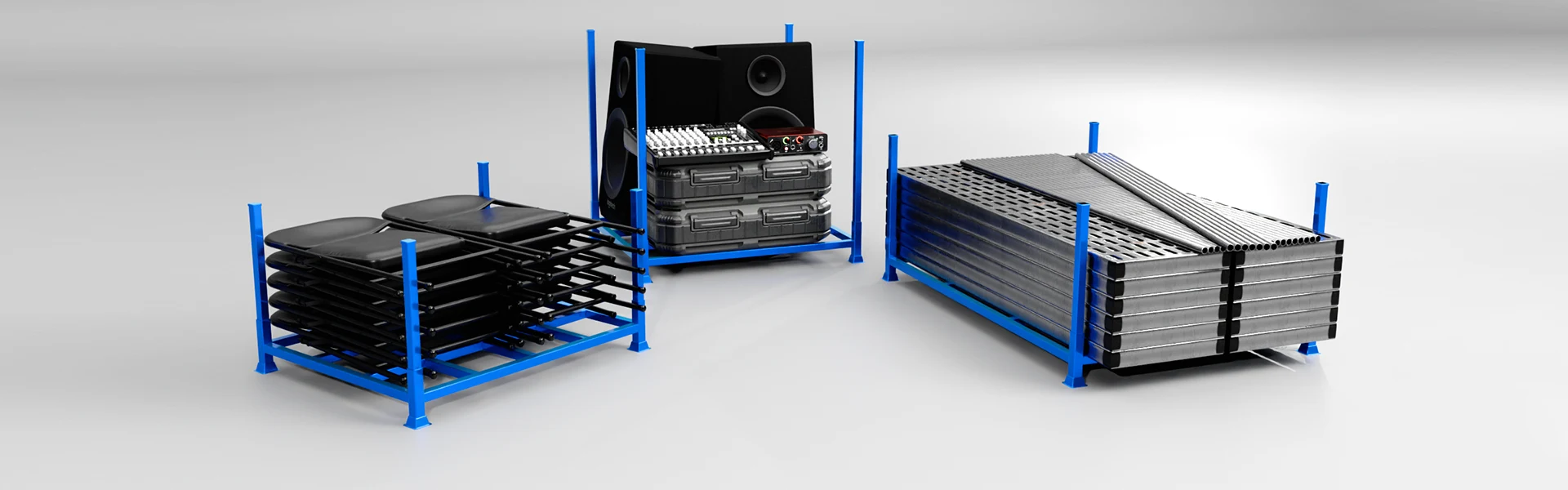
Which Derack Base Fits Your Load?
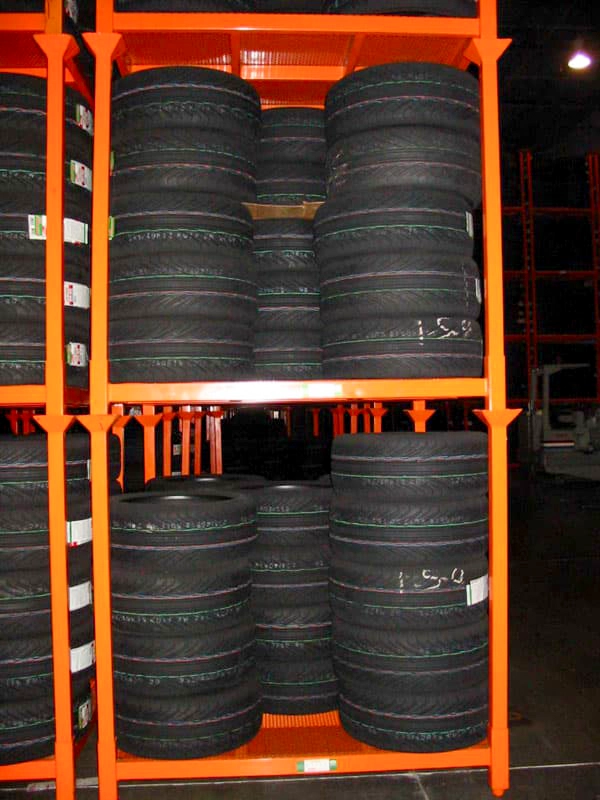
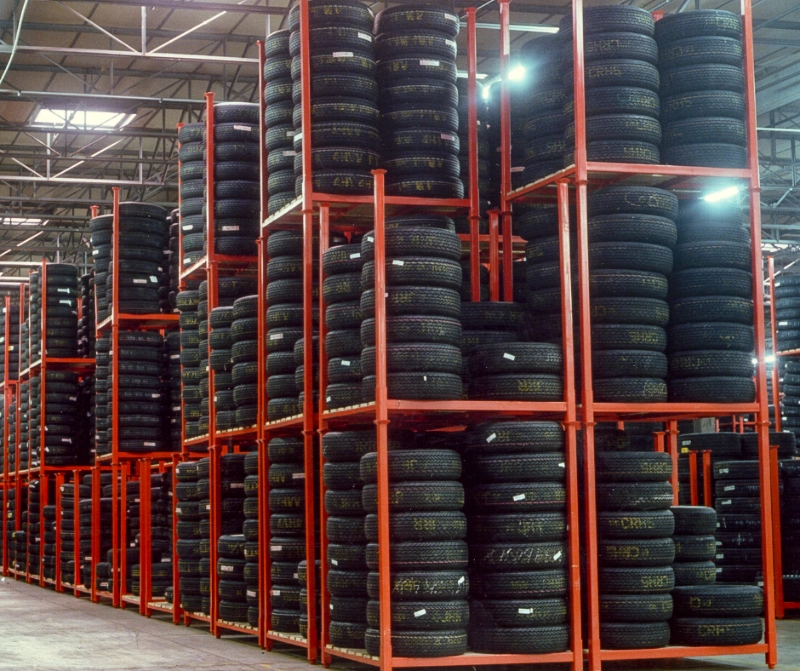
Tires
Tire Storage Base (PCR / TBR)
Open channels sized by tire diameter (D < 800 mm PCR vs D ≥ 800 mm TBR) keep each tire upright and bead-free. The post frame stops multi-direction compression that floor stacking creates, and inventory accuracy climbs because each tire occupies a known slot.
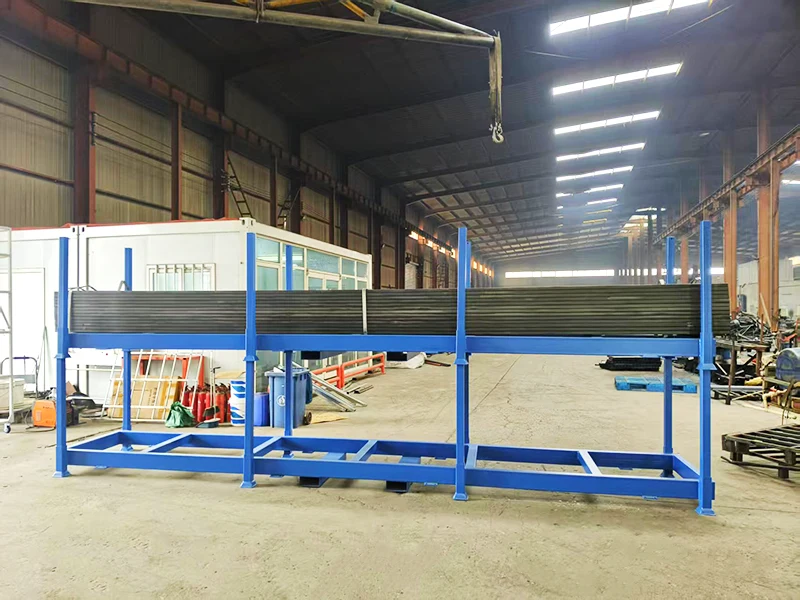
Pipes & Profiles
Long-Pipe Rack (4 / 6 / 8 Posts)
For 6 m, 7 m or 12 m PVC, PE, aluminium and stainless pipes, the base is lengthened and intermediate posts are added (6 or 8 instead of 4) so the unsupported span shrinks. Outer width is locked to 1100–1140 mm for double-row 40 ft HC container loading.
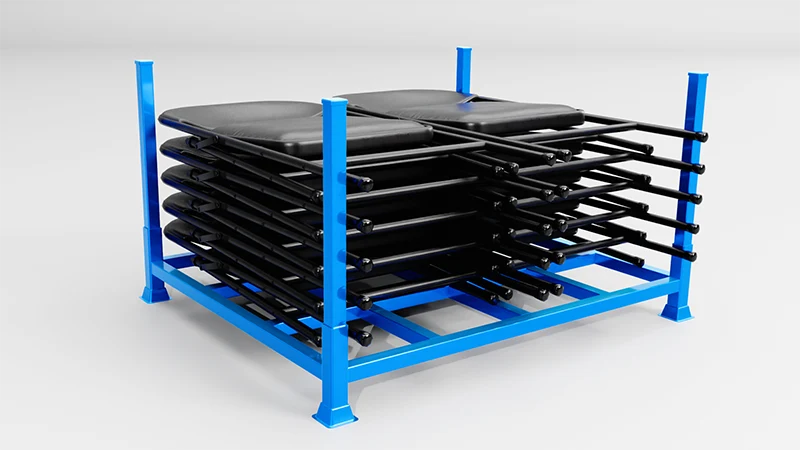
Panels, Sheets & Coils
Sheet & Coil Base with Side Frames
For stacked metal panels, glass sheets, fabric rolls and steel coils, side frames or V/U cradles stop lateral rolling while the post frame carries vertical load. Open grid decks let cold-store airflow pass through instead of forming condensation pockets.
Why a Post Pallet Beats Wood, Painted Steel and Fixed Racking
Structural Load, Zero Pressure
The four (or six / eight) steel posts take every kilogram from the upper tiers and route it to the ground. Your bottom layer of cargo carries only its own weight inside a zero-pressure cage, so tires do not deform, fabric does not crease and powder does not sinter.
Detachable & Nestable
When the rack is empty, posts come out and the base nests into the next one at roughly 4:1 to 6:1 ratio. One 40 ft high-cube returns the empty footprint of four to six loaded units, cutting return freight and idle warehouse floor by 75–80%.
Hot Dip Galvanized for Cold & Export
A full-immersion hot dip galvanized coating above 60 μm resists cold-store condensation, tropical humidity and salt air, and the unit is naturally ISPM 15 exempt — no fumigation, no port-of-entry delays. Electro-zinc and painted finishes are also available and must be project-confirmed.
No Bolting, Real Layout Freedom
Derack sits free on the floor and stacks 4–5 levels high inside a 6–8 m warehouse. Move whole aisles when the season changes, shrink the active zone during off-peak, and convert the freed-up floor to cross-docking without a single anchor bolt.
How a Derack Project Moves Through Our Team
Cargo & Site Profile
You tell us the cargo (tires, pipes, fabric rolls, feed bags, sheet panels, bagged powder), the unit weight and stack height, the warehouse clear height, and whether the loop is one-way export, closed-loop RTP, or domestic pooling. We use this to short-list the right base family.
Engineering Match
Our engineers lock the base footprint, post count (4, 6 or 8), cup-foot geometry, forklift pocket position and surface treatment (hot dip galvanized, electro-zinc or painted). Final dimensions and load ratings are confirmed in writing against your container, truck and racking interfaces.
Sample & Trial
A prototype lot is built, hot dip galvanized to specification and trial-stacked at your site. We measure alignment tolerance, forklift cycle time and nesting density together with your operators before any production run is released.
Production, Delivery & Support
Production runs are released against the locked drawing. Shipments leave with container-loading plans for double-row 40 ft HC packing. We stay on call for stack-height retrofits, post replacements and surface repair during the full 20-year service life.
Demountable Post Pallet — Frequently Asked Questions
How is Derack different from a wooden pallet?
A wooden pallet asks the bottom layer of product to carry every layer above it. Derack adds four (or six or eight) detachable steel posts that carry the upper-tier load straight to the floor, so the bottom layer sits inside a zero-pressure cage. Wood also breaks, molds, fails ISPM 15 at export and is typically replaced every 1.5 years; a hot dip galvanized Derack unit is engineered for 20+ years of closed-loop service.
How is Derack different from a fixed selective rack?
A selective rack is bolted to the floor and demands permanent aisles and lifting equipment paths. Derack is a free-standing, relocatable unit — no anchor bolts, no civil works — that you can re-arrange between batches or shrink into nesting when utilization drops. Fixed racking wins only when 100% random single-SKU picking is required at very high hourly throughput.
How is Derack different from a plain painted stillage?
Plain painted stillages are usually welded without cup-foot geometry and finished with a spray coat that chips in cold-store condensation. Derack specifies full-immersion hot dip galvanizing above 60 μm and uses self-aligning cup feet so forklift stacking finds its own center of gravity. Painted or electro-zinc finishes remain available for indoor dry use and must be project-confirmed.
How high can a Derack stack?
Standard Derack units are rated for 4–5 fully loaded tiers inside a typical 6–8 m warehouse clear height. The exact stack rating is confirmed per project against the base footprint, post section, cargo density and forklift capability. Beyond that, please contact our engineers for a higher-stack or mezzanine interface review.
What does the empty return look like?
Posts are pulled out, the base is nested into the next base at a 4:1 to 6:1 ratio, and posts are bundled inside the column. The empty footprint of one loaded unit can carry the empty equivalent of four to six units, which is where the 75–80% return-freight saving comes from. Detailed numbers are published on the nestable return freight page.
Is hot dip galvanizing the only surface option?
Hot dip galvanizing above 60 μm is our default for cold store, tropical humidity, salt air and any ISPM 15 export flow. For dry indoor use, electro-zinc plus paint or zinc-rich primer plus top-coat are also possible and must be project-confirmed. We do not recommend a single universal surface specification — the right answer depends on cargo, environment and cleaning regime.
Does Derack need ISPM 15 fumigation for export?
No. As an all-steel construction, Derack is naturally exempt from ISPM 15 heat treatment and fumigation. No phytosanitary certificate is required at the port of entry, which removes a real source of demurrage for tire, pipe, fabric roll and food-grade export flows.
Which cargoes fit Derack — and which do not?
Strong fits: tires (PCR/TBR), 6–12 m PVC/PE/aluminium/stainless pipes, fabric rolls, sheet metal and glass panels, bagged feed and bio-fermentation powders, automotive WIP, closed-loop RTP pools. Weak fits: extremely low-value single-way consumables where CAPEX cannot be amortized, very high-SKU 100% random pick operations where automated shuttle or fixed aisle racking is structurally faster. See the cold-store & HACCP variant and the load & stack limits page for deeper boundary conditions.
B2B Racking Structural Engineering Calculator
Input your structural guidelines below. Our math system calculates material deflection, stress bounds, and recommends optimal profiles.
Click Compute to calculate stress factors and display structural drawing recommendations.