
Front-Wheel-Clamp Motorcycle Rack for Scratch-Free Wheel Transport
Front-wheel-clamp motorcycle rack for controlled wheel transport: handwheel tightening, two-sided U-shaped strap hooks and ramp-assisted loading. Confirm wheel fit, clamp force, straps and load for your bike.
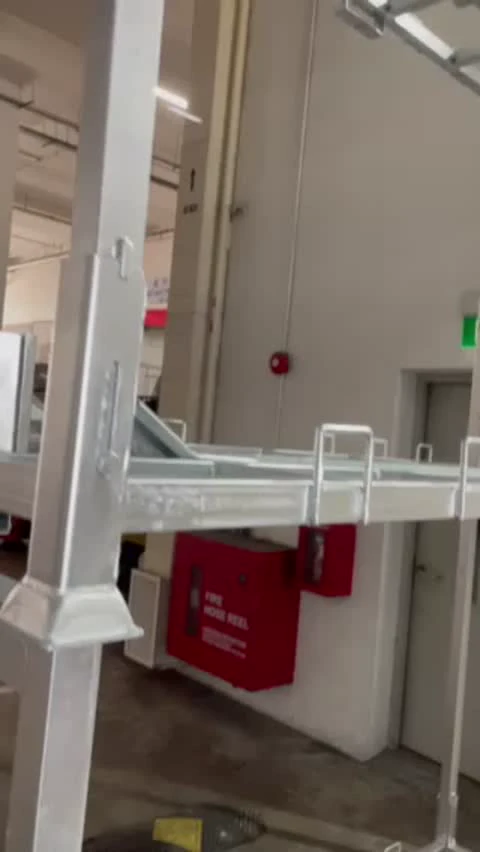
Clamp the front wheel, hook the straps, roll it in
Mtrack locates a motorcycle by its front wheel: a handwheel-operated clamp closes on the wheel, U-shaped hooks on both sides take the tie-down straps, and ramps let the bike roll into position instead of being lifted.
The base carries the vehicle and provides the fork access. Two ramp areas on the base let the front wheel roll up and drop into the wheel position. The clamp sits at the front locating point and is tightened or released by turning the handwheel — slacken it, roll the wheel in, close it. Both sides of the base carry U-shaped hooks so straps can run left and right of the bike, and the loaded rack is then handled as one forklift unit into storage, a trailer or a container.
What is not fixed across the range: clamping force, strap specification and the wheel diameters the clamp accepts. Project 14476 records a handwheel-controlled front-wheel clamp drawn for a Ø480 mm wheel, and projects 14905 and 15052 record strap hooks on both sides — those are project inputs, not a published fit range. Send us the bike model, tyre size and weight and the clamp position, hook layout and restraint are confirmed on the drawing.
- Handwheel-operated front-wheel clamp: tighten and release by turning the handle
- U-shaped strap hooks on both sides of the base, so the bike can be tied on left and right
- Entry ramps roll the front wheel into the wheel position without lifting the bike
- Wheel groove and front locating stop hold the bike square to the base
- Working load fixed per project — recorded at 250, 350 and 500 kg on different projects
- Forklift access configured two-way or four-way depending on the drawing
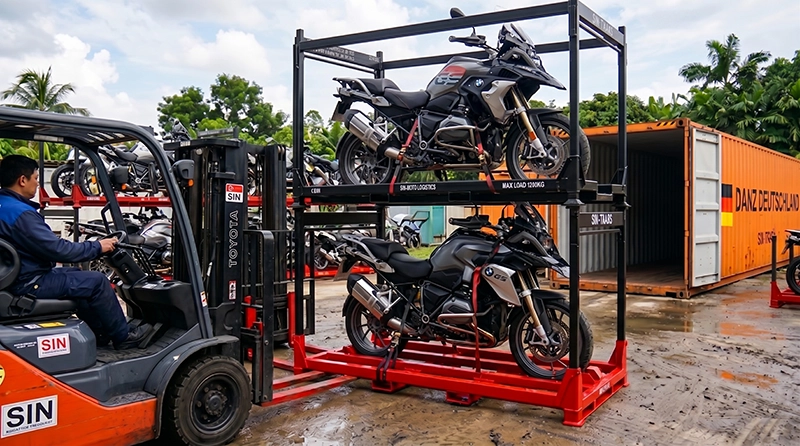
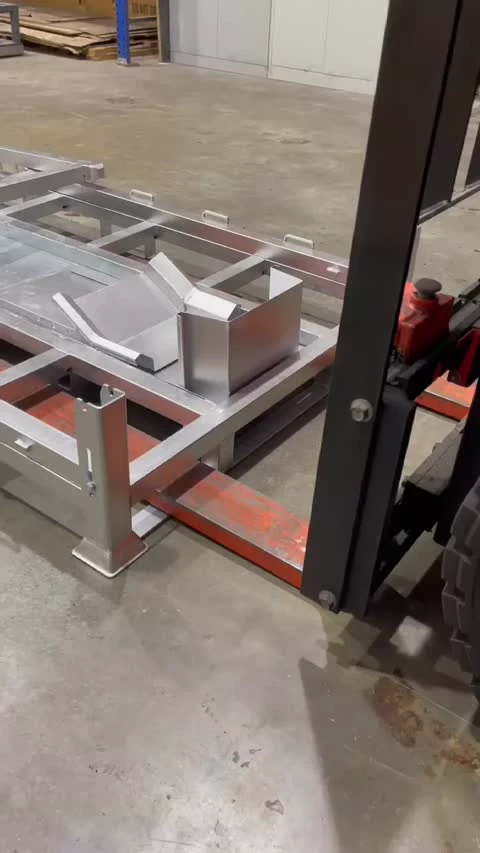
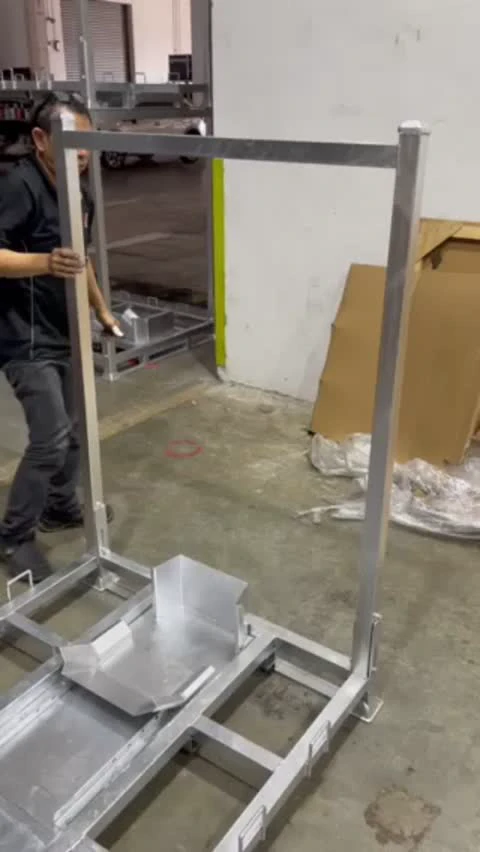
Three ways the bike is held — clamp, straps, or both
Clamp
Handwheel front-wheel clamp
The front wheel is held by a clamp at the locating position. The handwheel on the mechanism controls closing and opening, so the operator tightens it once the wheel is seated and releases it before the bike is rolled off.
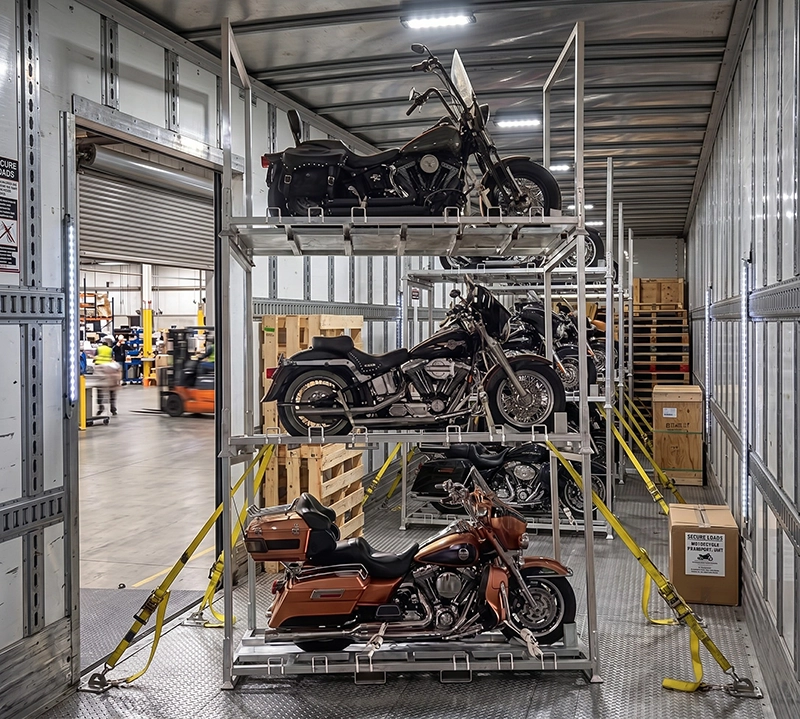
Straps
Two-sided U-shaped strap hooks
U-shaped hooks are set into both sides of the base so straps can be run on the left and right of the motorcycle rather than over a random tube. Hook positions are part of the drawing, not an improvised anchor point.
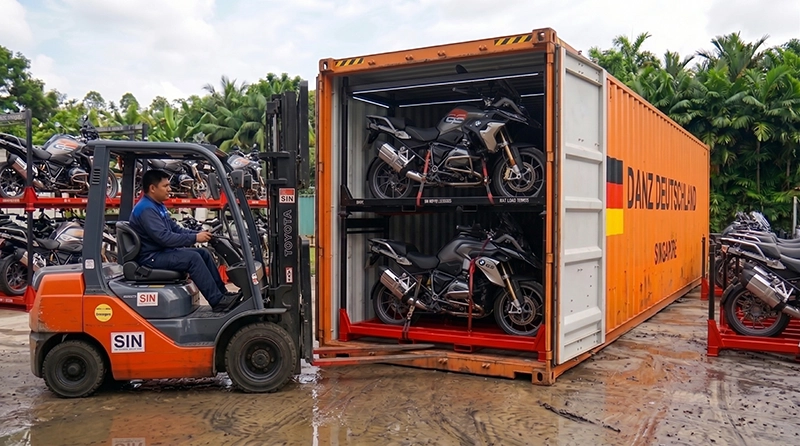
Loading
Ramps, wheel groove and front stop
Ramps on the base let the front wheel be pushed up and into the wheel position, so one person can load the bike without a lift. A wheel groove and a front locating stop hold it in line while the clamp and straps are tightened.
Why clamp and strap, not strap only
Front wheel held by the clamp, not by chance
A flat pallet leaves the front wheel free to turn and walk. The clamp closes on the wheel at the drawn position, and the handwheel gives the operator one clear action to tighten it and one to release it.
Hooks on both sides for a straight pull
U-shaped hooks on both sides let straps pull against the base instead of against a non-load-bearing tube, so the bike is restrained left and right rather than by one diagonal strap that shifts under fork handling.
Roll in, don’t lift
Ramps on the base mean the bike is pushed up into the wheel position. Heavier touring and cruiser models can be loaded by one operator, and the wheel drops into the groove in a repeatable spot each time.
Capacity is a project figure, not a series claim
Recorded per-rack working loads differ by project: 500 kg on projects 14905 and 15052, 350 kg on project 15385, and 250 kg on project 15575. Your rack is calculated from the bike weight, the rack size and the handling method you specify.
Confirming the clamp and strap scheme for your bike
Send the bike data
Model, front tyre and wheel size, wheelbase or overall length, handlebar width, height and single-bike weight. If a fleet is mixed, send the largest and smallest bikes — see the multi-size motorcycle pallet rack entry for how one rack or two sizes are chosen.
Choose the restraint
Front-wheel clamp, two-sided strap hooks, or both. Clamping force, the wheel diameters the clamp will take and the strap specification are confirmed at this point, because they are not fixed across the range.
Check the site and the journey
Fork direction and fork opening, whether the rack goes on an existing shelf, a trailer or into a container, the stacking height you need, and the rack working load you require (project records include 250, 350 and 500 kg).
Drawing, then production
The clamp position, hook layout, wheel groove, ramp and load rating are drawn and approved before production. Operators must confirm the clamp is closed and the straps are seated at the specified hooks before the load is lifted.
Questions buyers ask before specifying a clamp
How does the front-wheel clamp tighten and release?
The clamp is controlled by the handwheel on the mechanism: the operator turns it to close the clamp on the front wheel once the wheel is seated, and turns it back to release before the bike is rolled off. This handwheel-controlled closing and releasing is recorded on project 14476.
What are the U-shaped hooks for?
They are the strap fixing points. U-shaped hooks for the tie-down straps are recorded on project 14476, and hooks on both sides of the rack — so the bike is tied on the left and right — are recorded on projects 14905 and 15052. Hook count, positions and spacing are set on the drawing.
How is the bike loaded onto the rack?
By ramp. The base has ramp areas so the front wheel can be pushed up and into the wheel position instead of being lifted, and a wheel groove with a front locating stop keeps the bike in line while the clamp and straps are tightened. A wheel groove width of about 235 mm appears as a project reference on project 15575 only.
What is the load capacity of this rack?
There is no single series-wide rating. Recorded per-rack working loads are 500 kg on projects 14905 and 15052, 350 kg on project 15385, and 250 kg on project 15575. Your rack’s working load is calculated from the bike weight, the rack size and the handling method, and is stated on the approved drawing.
Which wheel diameters will the clamp accept?
This is not a published range. Project 14476 records a clamp position drawn for a Ø480 mm front wheel, and another project involved a 125-type tyre — those are two project inputs, not a fit table. Send your tyre and wheel size and the clamp position is checked for you.
Can you guarantee no scratches or no movement at all?
No blanket promise is made. The clamp locates the front wheel and the hooks define where straps pull, which is what stops the wheel turning and the bike walking during handling; which contact points take the load — wheel, tyre or frame — is agreed per bike. Clamping force and strap specification are confirmed per project rather than quoted as fixed values.
Will one rack fit every motorcycle in my fleet?
Not automatically. Racks are configured around a single vehicle envelope or around two sizes for a mixed fleet, and vehicles that overhang the base are a project decision, not a default rule. Send the largest and smallest bikes and we will confirm whether one specification covers both or whether two sizes are needed.
B2B Racking Structural Engineering Calculator
Input your structural guidelines below. Our math system calculates material deflection, stress bounds, and recommends optimal profiles.
Click Compute to calculate stress factors and display structural drawing recommendations.